


Database Articles
SQL Window Functions: Practical Examples Every Analyst Needs
Microservices vs Monolith: Making the Right Architectural Choice


Get In Touch For Details! Request More Information
SQL vs NoSQL in 2026: Understand the Differences
Sep 19, 2026 6 Min Read 13147 Views
(Last Updated)
SQL vs NoSQL comes down to structure versus flexibility — one organizes data into strict tables, the other lets data take whatever shape it needs. Neither is “better”; they’re just built for different jobs, and picking the wrong one for your project can cost you more than a few headaches down the line.
This guide breaks down how they differ, where each one works best, and where real Indian companies actually use them — so you get the honest picture, not just another generic comparison.
Table of contents
- TL;DR Summary
- What is SQL?
- What is NoSQL?
- SQL vs NoSQL Comparison Table: Key Differences Explained
- SQL vs NoSQL: Key Differences
- Data Model
- Querying
- Scalability
- Schema Flexibility
- ACID Compliance
- Use Cases
- SQL vs NoSQL: Which Skill Pays More in India?
- Indian Companies Using SQL vs NoSQL
- Conclusion
- FAQs
- Which is used more, SQL or NoSQL?
- Why is SQL better than MongoDB?
- Will SQL be replaced by NoSQL?
- Which is harder, SQL or NoSQL?
- Can SQL and NoSQL be used together?
TL;DR Summary
- SQL vs NoSQL isn’t about which is “better” — SQL is structured and reliable, NoSQL is flexible and built for scale.
- SQL databases (like MySQL) use fixed tables and strict rules, so they’re great for banking, orders, and anything that needs 100% accuracy.
- NoSQL databases (like MongoDB, Cassandra) skip the rigid structure, making them perfect for fast-changing data like product catalogs or real-time tracking.
- In India, most big companies — Flipkart, Paytm, Myntra, Ola — don’t pick just one, they use SQL and NoSQL together depending on the job.
- If you’re learning one for career growth, start with SQL for a strong base, then add NoSQL to boost your skills and salary.
What is SQL?
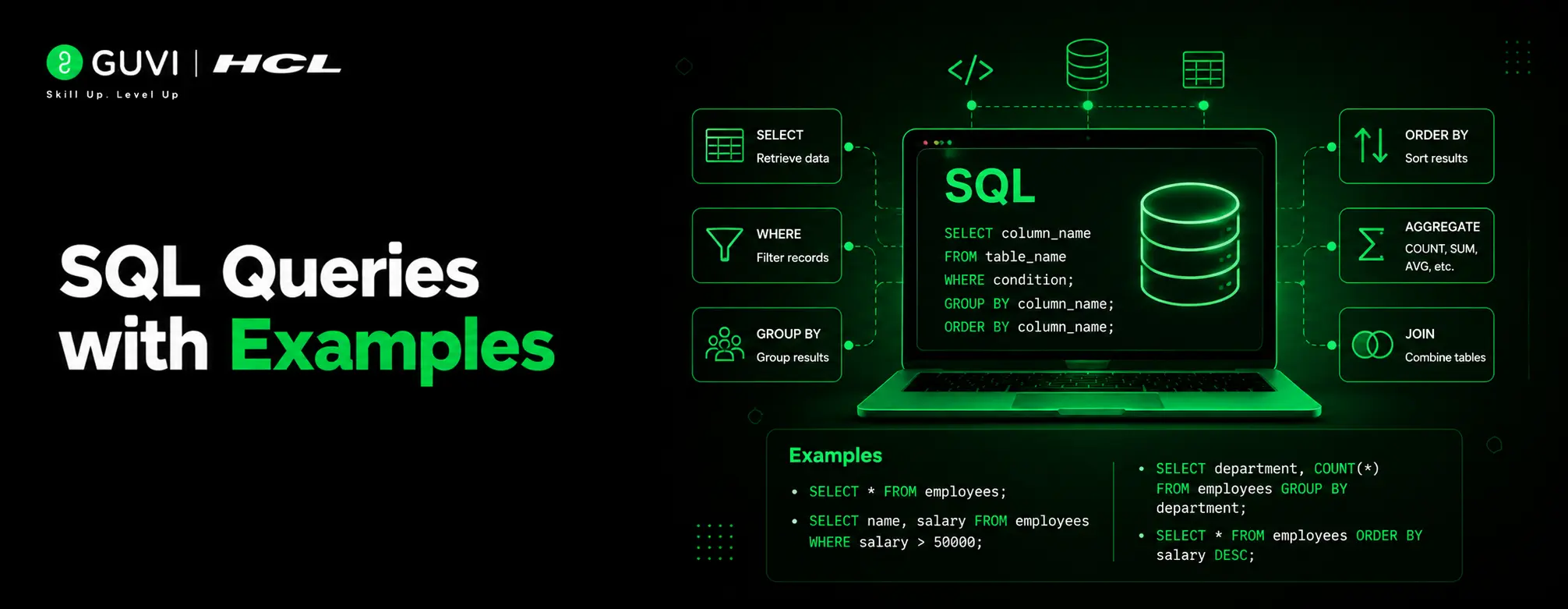
SQL stands for Structured Query Language. It is a programming language used to manage and manipulate relational databases.
Here are some key points about SQL:
- Relational Databases: SQL is designed to work with relational database management systems (RDBMS) like MySQL, PostgreSQL, Oracle, SQL Server, etc. These databases store data in tables with rows and columns, with relationships defined between the tables.
- Data Definition: SQL allows you to create, modify, and delete database objects like tables, indexes, views, etc. using Data Definition Language (DDL) commands like CREATE, ALTER, and DROP.
- Data Manipulation: SQL provides statements to insert, update, delete, and retrieve data from the database tables using Data Manipulation Language (DML) commands like INSERT, UPDATE, DELETE, and SELECT.
- Queries: The core strength of SQL is its ability to query and retrieve specific data from databases using the SELECT statement along with clauses like WHERE, ORDER BY, GROUP BY, JOIN, etc.
- Transactions: SQL supports transactions which are units of work that must be completed entirely or rolled back entirely to maintain data integrity using commands like COMMIT, and ROLLBACK.
- Data Control: SQL has commands to control data access and permissions like GRANT and REVOKE.
- Standardization: SQL adheres to standards defined by ANSI and ISO which makes it portable across different RDBMS platforms with some minor syntax variations.
SQL provides a standardized way to define, manipulate, and query relational databases organized into tables, making it an essential language for managing structured data in applications across various domains.
Want to go beyond theory and actually build with databases? HCL GUVI’s Software and AI Engineer Course covers MongoDB (NoSQL) in depth, plus PostgreSQL (SQL) in the Backend Engineering track — so you learn how both work in real, production-style projects, guided by mentors from top tech companies, with placement support included. Enroll today and transform your career into one that top tech companies actually hire for!
Now that we’ve explored the structured and relational world of SQL, let’s learn about NoSQL.
What is NoSQL?
NoSQL (Non-relational or Not only SQL) refers to database management systems that are an alternative to traditional relational databases.
Here are some key points about NoSQL databases:
- Non-Relational Data Models: Unlike relational databases that store data in tables with rows and columns, NoSQL databases can have different data models like key-value stores, document databases, column-family stores, and graph databases.
- Schema-Less: Most NoSQL databases are schema-less, meaning they don’t have a rigid, pre-defined schema structure. This allows for more flexibility in storing semi-structured and unstructured data.
- Scalability: NoSQL databases are designed to be horizontally scalable, meaning they can handle large volumes of data and high user traffic by scaling out over distributed clusters or cloud infrastructure.
- High Performance: NoSQL databases generally have better performance for simple queries, and read/write operations by avoiding complex relational calculations.
- Flexible Data Models: Different NoSQL databases cater to different data models like key-value (Redis, Voldemort), document (MongoDB, CouchDB), column-family (Cassandra, HBase), and graph (Neo4j).
- Eventually Consistent: Many NoSQL databases sacrifice ACID (Atomicity, Consistency, Isolation, Durability) properties of traditional databases for availability and partition tolerance, following the “Basically Available, Soft-state, Eventual consistency” (BASE) model.
- Cloud Native: Most NoSQL databases were developed in the cloud computing era and are designed to take advantage of cloud infrastructure like auto-sharding, replication, and elasticity.
NoSQL databases are particularly useful for modern applications that need to handle large, rapidly changing data volumes, real-time insights, user profile data, IoT and sensor data, content management, caching, and other use cases where scalability and flexibility are more important than complex transactions.
Having understood NoSQL, let’s now compare and understand the key differences between SQL and NoSQL databases.
Also Read: How Does Database Servers Work? Explained with Illustrations
SQL vs NoSQL Comparison Table: Key Differences Explained
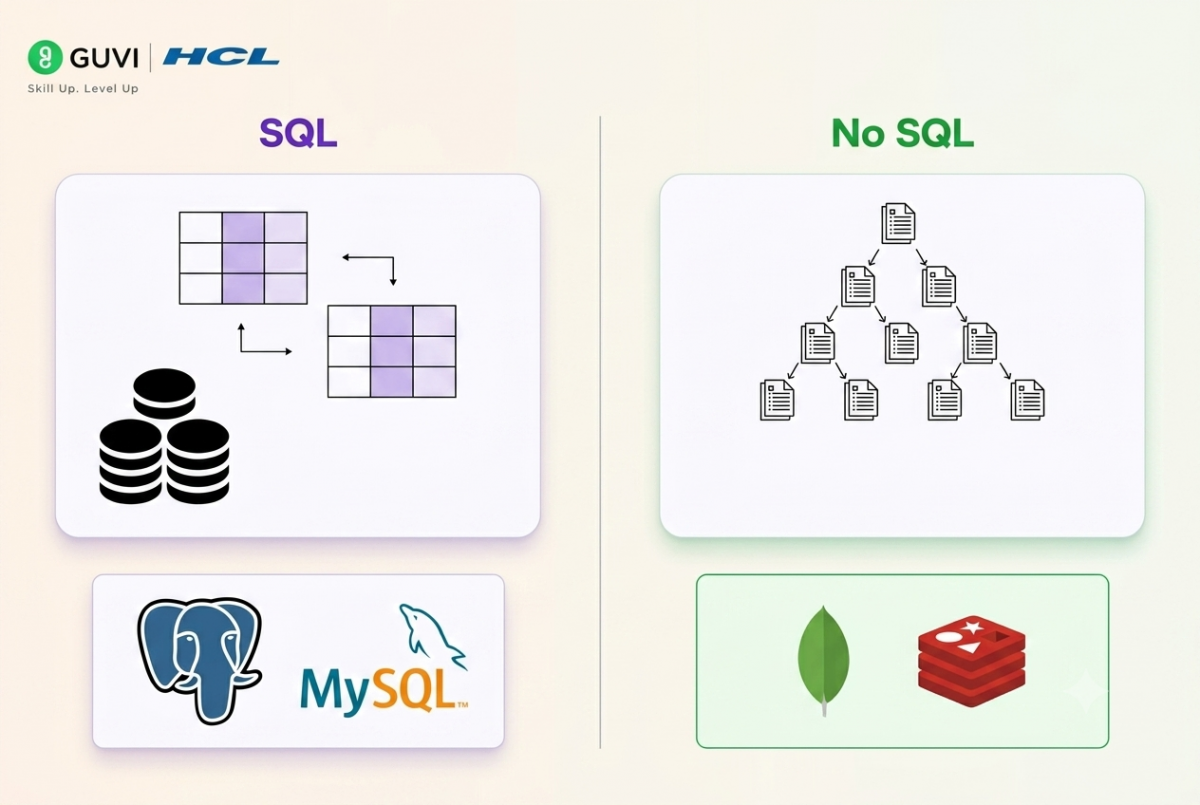
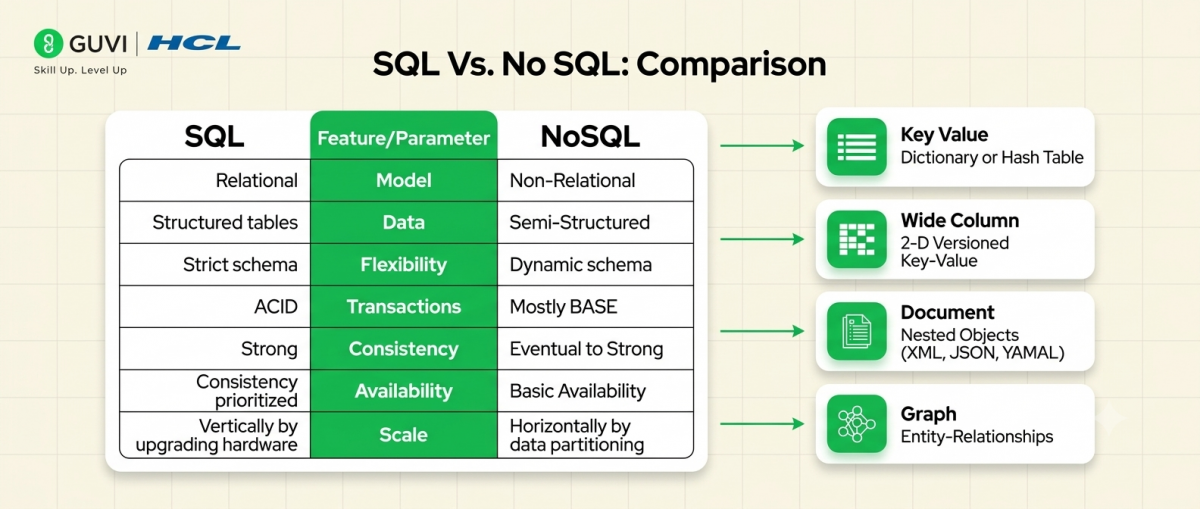
Here’s a quick SQL vs NoSQL comparison to help you understand how these databases differ across key factors:
| Factor | SQL Databases | NoSQL Databases |
|---|---|---|
| Data Model | Relational — data lives in tables with rows/columns, linked via keys. Schema must be defined upfront. | Non-relational — key-value, document, column-family, or graph-based. Schema-less, so structure can vary record to record. |
| Querying | Uses standard SQL — powerful for joins, aggregations, and subqueries. One language works across most SQL databases. | No single standard — each database has its own query style (e.g., MongoDB’s query syntax differs from Cassandra’s). Simpler operations, but less query power than SQL. |
| Scalability | Scales vertically (bigger server) by default. Horizontal scaling is possible but requires sharding/partitioning—real engineering effort. | Built for horizontal scaling from day one — add more nodes, not more power. This is the main reason most people reach for NoSQL at scale. |
| Schema Flexibility | Rigid — changing schema later usually means migrations and possible downtime. Good when your data structure is stable. | Flexible — fields can be added or changed on the fly without touching the whole database. Good when requirements keep shifting. |
| ACID Compliance | Fully ACID-compliant by design — reliable for transactions where accuracy can’t be compromised. | Often trades strict consistency for speed and availability (BASE model instead of ACID). Some databases now offer partial ACID support, so this line is softening over time. |
| Best Use Cases | Financial systems, ERP, CRM — anywhere data relationships and transactional accuracy matter more than raw scale. | Big data, real-time analytics, IoT, content platforms — anywhere volume and flexibility matter more than strict structure. |
| Tool Examples | MySQL, PostgreSQL, Oracle Database, Microsoft SQL Server | MongoDB, Cassandra, Redis, Amazon DynamoDB |
Ready to elevate your database skills? Enroll in HCL GUVI’s SQL Course now and gain the expertise needed to thrive in the rapidly evolving data technology.
SQL vs NoSQL: Key Differences
1. Data Model
The fundamental difference between SQL and NoSQL databases lies in their data models, which dictate how data is organized and structured within the database.
SQL Databases
SQL databases follow a relational data model, where data is organized into tables with rows (records) and columns (fields). These tables are related to each other through keys, enabling complex relationships between different data entities.
SQL databases enforce a strict schema, meaning the data structure must be defined in advance, including data types and constraints.
This rigid structure ensures data integrity and consistency, making SQL databases well-suited for applications that require complex transactions and queries.
NoSQL Databases
In contrast, NoSQL databases employ various non-relational data models, such as key-value stores, document databases, column-family stores, and graph databases.
These models are more flexible and schema-less, allowing for the storage of semi-structured or unstructured data. NoSQL databases prioritize scalability, performance, and flexibility over strict data integrity constraints.
They are particularly well-suited for handling large volumes of rapidly changing data, such as those found in big data and real-time web applications.
Also Read: Top SQL Interview Questions With Answers [2026]
2. Querying
The way data is queried and manipulated differs significantly between SQL and NoSQL databases.
SQL Databases
SQL databases use Structured Query Language (SQL) to query and manipulate data. SQL is a declarative language that allows users to specify what data they want, rather than how to retrieve it. SQL provides powerful querying capabilities, including complex joins, aggregations, and subqueries.
It also supports transactions, ensuring data integrity through ACID (Atomicity, Consistency, Isolation, Durability) properties.

NoSQL Databases
NoSQL databases typically provide their own query languages or APIs that are tailored to their specific data models. For example, key-value stores often use simple get and put operations, while document databases may use a JavaScript-like query language. NoSQL databases prioritize simplicity and performance over the complex querying capabilities of SQL.
They often sacrifice some querying flexibility in favor of scalability and high-throughput read-and-write operations.
Also Read: How to Learn SQL Using Squid Games?
3. Scalability
Scalability is an important factor when choosing a database solution, as applications need to handle increasing amounts of data and user traffic.
SQL Databases
Traditional SQL databases use a monolithic architecture, where data is stored and processed on a single server or a cluster of tightly coupled servers. Scaling SQL databases vertically (adding more resources to a single server) has limitations, and scaling horizontally (adding more servers) can be complex and expensive, often requiring advanced techniques like sharding or partitioning.
NoSQL Databases
NoSQL databases are designed from the ground up with scalability in mind. Many NoSQL databases employ a distributed architecture, where data is spread across multiple servers or commodity hardware clusters.
This architecture allows for seamless horizontal scaling by adding more nodes to the cluster, enabling NoSQL databases to handle large volumes of data and high traffic loads more efficiently than their SQL counterparts.
Also Read: MongoDB vs. MySQL: Which Database Should You Learn?
4. Schema Flexibility
The schema defines the structure of the data stored in a database, specifying the fields and their data types.
SQL Databases
SQL databases have a rigid schema that must be defined upfront before any data can be stored. This schema enforcement ensures data integrity and consistency but can be inflexible when dealing with rapidly evolving data structures or semi-structured data.
Changing the schema in an SQL database can be a complex and potentially disruptive process, often requiring downtime and extensive migration efforts.
NoSQL Databases
NoSQL databases are schema-less or have a flexible schema, meaning that the data structure can be dynamic and evolve over time without the need for explicit schema definitions.
This flexibility allows for easier adaptation to changing data requirements and can be particularly beneficial in agile development environments or when working with unstructured or semi-structured data.
Also Read: 10 Best Database Management Systems For Software Developers
5. ACID Compliance
ACID (Atomicity, Consistency, Isolation, Durability) is a set of properties that guarantee the reliability and integrity of database transactions.
SQL Databases
SQL databases are designed to be ACID-compliant, ensuring that transactions are processed reliably and consistently, even in the face of failures or concurrent operations.
This level of data integrity is important for applications that require complex transactions, such as financial systems or e-commerce platforms, where data accuracy and consistency are important.
NoSQL Databases
Many NoSQL databases sacrifice strict ACID compliance in favor of performance and scalability. While some NoSQL databases offer eventual consistency (data will become consistent eventually after a period of time), others prioritize availability and partition tolerance over strict consistency, adhering to the BASE (Basically Available, Soft-state, Eventual consistency) principles.
This trade-off may be acceptable for certain types of applications, such as real-time analytics or content delivery networks, where data consistency is less critical than high availability and scalability.
6. Use Cases
The choice between SQL and NoSQL databases often depends on the application’s specific requirements and use cases.
SQL Databases
SQL databases are well-suited for applications that require complex transactions, data integrity, and consistent data structures. They are commonly used in traditional business applications, such as enterprise resource planning (ERP) systems, customer relationship management (CRM) software, and financial applications.
SQL databases are also a good choice for applications that involve complex data relationships and require advanced querying capabilities.
NoSQL Databases
NoSQL databases shine in scenarios where scalability, high throughput, and flexibility are important. They are commonly used in big data applications, real-time analytics, content management systems, and Internet of Things (IoT) platforms.
NoSQL databases are particularly beneficial for handling large volumes of rapidly changing, semi-structured, or unstructured data, such as log files, sensor data, or social media data.
SQL vs NoSQL: Which Skill Pays More in India?
Truth is, it’s not really SQL vs NoSQL when it comes to pay. It’s about who else knows it too.
SQL developers in India earn an average of ₹5–5.5 lakh per year, with senior roles (DBAs, architects, cloud specialists) crossing ₹15–20 lakh+. Demand stays strong because SQL runs the backbone of banks, hospitals, and most Indian enterprises.
NoSQL barely exists as a standalone job title in India. Almost nobody gets hired purely as a “NoSQL Developer.” It usually shows up as an add-on skill to roles like backend developer, data engineer, or full-stack developer — and it does bump your salary, but only when paired with the right stack.
So here’s the real picture:
A plain SQL developer earns a solid, stable salary. A developer who knows SQL + NoSQL + cloud (AWS/Azure) earns noticeably more — often 20-30% higher than someone with SQL alone.
The pay gap isn’t SQL vs NoSQL. It’s specialist vs generalist.
If you’re picking one to learn first for salary, SQL gives you a safer, wider base. NoSQL is what tips your salary upward once that base is already there.
Indian Companies Using SQL vs NoSQL
Here are some of the companies and how they actually use SQL and NoSQL:
| Company | Database Used | What It’s Used For | Source |
|---|---|---|---|
| Flipkart | MySQL + MongoDB, Cassandra, Redis | MySQL for orders and logistics; NoSQL for catalog and real-time data | Flipkart’s official engineering blog |
| Paytm | MySQL | Sharded architecture for safe, high-volume transactions | Paytm’s official engineering blog |
| Zomato | TiDB (SQL) → DynamoDB (NoSQL) | Moved billing to DynamoDB for better scale and flexibility | AWS Database Blog, co-authored with Zomato engineers |
| PhonePe | MySQL + HBase | MySQL sharded databases; HBase as source of truth for transactions | PhonePe’s official tech blog |
| Myntra | MySQL + Cassandra | MySQL for orders and catalog; Cassandra for lighter data like profile images | Myntra’s official engineering blog |
| Meesho | MySQL + HBase + Elasticsearch | Used together to handle scale during high-traffic periods | Meesho’s official engineering blog |
| Ola | Cassandra → ScyllaDB | Chosen for eventual consistency use cases over strict ACID needs | ScyllaDB case study, written with Ola’s engineering team |
Conclusion
SQL vs NoSQL really comes down to one thing: what your data needs, not what’s trendy. If your project runs on relationships, transactions, and consistency, SQL still holds up decades later. If it’s scale, speed, and flexibility you’re chasing, NoSQL earns its place. Most real Indian companies don’t pick a side — they use both, exactly where each one fits. That’s the real lesson here, more useful than memorizing definitions.
ALSO READ: Mastering Database Optimization: Advanced Indexing Techniques for Performance
FAQs
1. Which is used more, SQL or NoSQL?
SQL, by a wide margin — it still powers most enterprise and legacy systems.
2. Why is SQL better than MongoDB?
It’s not universally better — SQL wins for complex relationships and strict consistency; MongoDB wins for flexible, fast-scaling data. Depends on your use case.
3. Will SQL be replaced by NoSQL?
No. They solve different problems, so most companies use both instead of one replacing the other.
4. Which is harder, SQL or NoSQL?
SQL is harder to learn upfront; NoSQL is harder to master at scale.
5. Can SQL and NoSQL be used together?
Yes — it’s called polyglot persistence, and it’s common in modern app architecture.
Success Stories









Did you enjoy this article?