


Database Articles
SQL Window Functions: Practical Examples Every Analyst Needs
Database Indexing: How Indexes Work and Improve Speed
DuckDB Tutorial: Learn DuckDB Step-by-Step (2026 Guide)
How to Use MySQL Workbench for Database Design and Querying: Complete and Best Guide


Get In Touch For Details! Request More Information
Microservices vs Monolith: Making the Right Architectural Choice
Aug 06, 2026 4 Min Read 317 Views
(Last Updated)
Table of contents
- TL;DR Summary:
- Introduction
- Direct Answer
- What Is a Monolithic Architecture?
- Typical Monolith Structure
- What Are Microservices?
- Typical Microservices Structure
- How Do Monoliths and Microservices Differ?
- What Are the Advantages of a Monolithic Architecture?
- What Are the Challenges of Monoliths
- What Are the Advantages of Microservices?
- What Are the Challenges of Microservices?
- Monolith vs Microservices: Pros and Cons
- When Should You Choose a Monolith?
- Example
- When Should You Choose Microservices?
- Example
- Can You Start with a Monolith and Migrate Later?
- Architectural Decision Framework
- Common Misconceptions
- Real-World Example
- Best Practices for Choosing an Architecture
- Conclusion
- FAQs
- What is the main difference between microservices and a monolith?
- Which architecture is better for startups?
- Are microservices more scalable than monoliths?
- Can a monolithic application become microservices later?
- Do microservices require separate databases?
- Why do microservices increase operational complexity?
TL;DR Summary:
- Monoliths are simpler to build, deploy, and maintain for many applications.
- Microservices improve scalability and team independence.
- Choose architecture based on business needs, not industry trends.
- Microservices introduce operational complexity alongside flexibility.
- Many successful products begin as monoliths before evolving.
Introduction
Choosing the right software architecture is one of the most important technical decisions you’ll make. A poor architectural choice can slow development, increase operational costs, and make future scaling difficult. Yet many teams adopt microservices simply because they’re popular, even when a well-designed monolith would better suit their needs.
The truth is that neither architecture is universally better. The right choice depends on your application’s complexity, team size, deployment strategy, and long-term business goals. In this article, you’ll learn the differences between monolithic and microservices architectures, their advantages and drawbacks, real-world use cases, and practical guidelines for choosing the right approach.
Direct Answer
Microservices and monolithic architectures represent two different approaches to building software applications. A monolith packages all functionality into a single deployable application, making it easier to develop and deploy initially. Microservices divide an application into smaller, independent services that can be developed, deployed, and scaled separately, making them well suited for large, distributed systems with evolving requirements.
What Is a Monolithic Architecture?
A monolithic architecture combines an application’s user interface, business logic, and data access into a single codebase and deployable unit. All components are tightly integrated and typically share the same database.
When you deploy a monolithic application, the entire application is released together, even if only one feature has changed.
Typical Monolith Structure
Client
│
▼
Monolithic Application
├── Authentication
├── Orders
├── Payments
├── Inventory
└── Database
Monoliths remain a practical choice for many startups, internal tools, and business applications.
What Are Microservices?
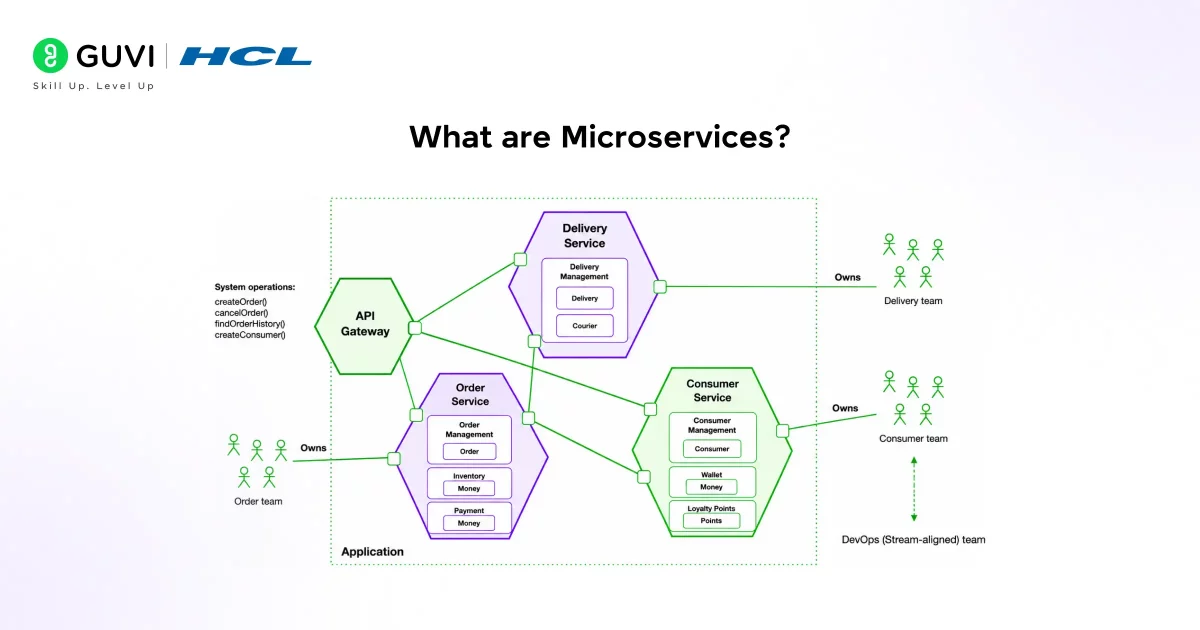
A microservices architecture breaks an application into multiple small, independent services. Each service focuses on a specific business capability and communicates with other services using APIs or messaging systems.
Each service can be:
- Developed independently
- Deployed independently
- Scaled independently
- Updated without affecting unrelated services
Typical Microservices Structure
Client
│
API Gateway
│
├── User Service
├── Order Service
├── Payment Service
├── Inventory Service
└── Notification Service
This modular approach supports large engineering teams and rapidly evolving applications.
How Do Monoliths and Microservices Differ?
The biggest difference lies in deployment and service boundaries.
A monolith packages everything into one application, while microservices split functionality into independently managed services.
| Feature | Monolith | Microservices |
| Deployment | Single application | Independent services |
| Codebase | Unified | Multiple repositories (often) |
| Database | Usually shared | Often separate per service |
| Scaling | Entire application | Individual services |
| Team Ownership | Shared | Service-based ownership |
What Are the Advantages of a Monolithic Architecture?
Monoliths are often the fastest way to build and launch a new application.
- Simpler Development
Developers work within one codebase, making debugging and navigation straightforward.
- Easier Deployment
Only one deployment artifact needs to be built and released.
- Lower Operational Complexity
There’s no need to manage service discovery, distributed tracing, or inter-service communication.
- Better for Smaller Teams
A small engineering team can often move faster with a monolithic architecture.
Pro Tip
A well-structured modular monolith can remain maintainable for years while avoiding much of the operational complexity of distributed systems.
What Are the Challenges of Monoliths
As applications grow, monoliths can become more difficult to maintain.
Common challenges include:
- Large codebases
- Longer build times
- Full application deployments
- Difficult scaling
- Tight coupling between modules
These issues become more noticeable as teams and products expand.
What Are the Advantages of Microservices?
Microservices provide flexibility for large-scale software systems.
- Scaling
Only heavily used services need additional resources.
- Faster Deployments
Teams can release individual services without redeploying the entire application.
- Technology Flexibility
Different services may use different programming languages or databases when appropriate.
- Team Independence
Multiple teams can work on separate services simultaneously.
Data Point
Organizations operating large-scale cloud platforms often adopt microservices to enable independent deployment cycles and reduce release bottlenecks across engineering teams.
What Are the Challenges of Microservices?
Microservices solve some problems but introduce others.
Common challenges include:
- Distributed debugging
- Service discovery
- Network latency
- Data consistency
- Monitoring complexity
- Infrastructure overhead
Warning
Breaking a small application into dozens of services too early often increases complexity without delivering meaningful business value.
Monolith vs Microservices: Pros and Cons
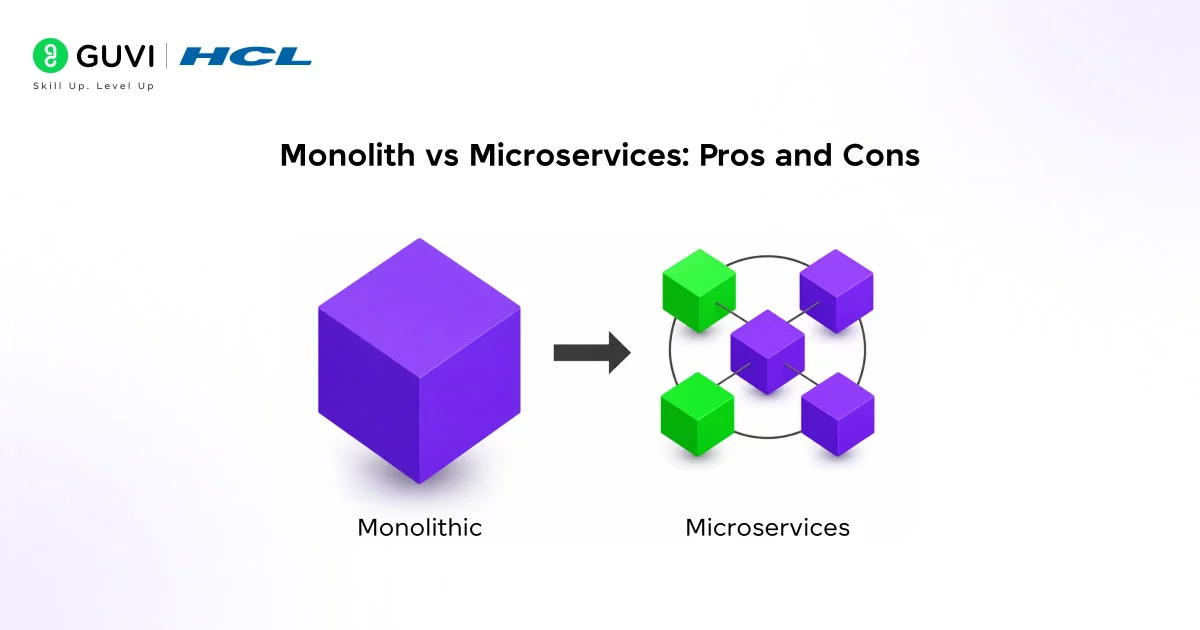
| Architecture | Pros | Cons |
| Monolith | Simple deployment, easier debugging, faster initial development | Harder to scale, larger codebase, coupled releases |
| Microservices | Independent deployment, scalability, team autonomy | Higher operational complexity, distributed failures, increased infrastructure |
When Should You Choose a Monolith?
A monolith is usually the better choice when:
- Building an MVP
- Developing internal business tools
- Working with a small engineering team
- Releasing a new startup product
- Business requirements are still evolving
Example
A startup launching its first SaaS product benefits from shipping features quickly rather than managing distributed infrastructure.
Choose the right architecture with microservices for scale or monoliths for simplicity. Master modern app development with HCL GUVI’s Application Development Using Microservices and Serverless. Start learning here
When Should You Choose Microservices?
Microservices become valuable when an application has grown beyond the practical limits of a single deployable system.

Consider microservices if:
- Multiple engineering teams work independently
- Different components require different scaling characteristics
- Frequent deployments are essential
- High availability is critical
- Business domains are clearly separated
Example
A global e-commerce platform may scale its product catalog independently from payment processing during seasonal shopping events.
Can You Start with a Monolith and Migrate Later?
Yes—and for many organizations, this is the most practical path.
Many successful products begin as well-structured monoliths. As traffic grows and business domains become clearer, specific modules can be extracted into independent services.
This incremental approach reduces unnecessary complexity while preserving flexibility for future growth.
Best Practice
Build a modular monolith first. Clear module boundaries make future migrations significantly easier.
Architectural Decision Framework
| Question | Lean Toward Monolith | Lean Toward Microservices |
| Team size | Small | Large |
| Deployment frequency | Occasional | Frequent |
| Traffic scale | Moderate | High |
| Operational expertise | Limited | Strong |
| Independent scaling needed? | No | Yes |
| Product maturity | Early stage | Mature platform |
Common Misconceptions
- “Microservices Are Always Better”
Modern doesn’t always mean appropriate. Small applications often gain little from distributed architectures.
- “Monoliths Can’t Scale”
Well-designed monoliths can support millions of users with proper optimization, caching, and infrastructure.
- “Migration Is Easy”
Splitting a mature monolith into services requires careful planning around data ownership, APIs, and operational tooling.
Real-World Example
Imagine an online learning platform.
- During its first year, a monolithic application supports authentication, course management, payments, and reporting efficiently.
- As the platform grows internationally, video streaming traffic increases dramatically while reporting workloads remain stable. Rather than scaling the entire application, the engineering team extracts the media processing component into an independent service.
- This targeted migration improves scalability without introducing unnecessary complexity across the rest of the system.
Best Practices for Choosing an Architecture
- Define business goals before selecting an architecture.
- Keep service boundaries aligned with business capabilities.
- Invest in observability and monitoring early.
- Automate deployments regardless of architecture.
- Avoid unnecessary distributed complexity.
- Design for maintainability before scalability.
- Review architectural decisions regularly as the product evolves.
Conclusion
Choosing between a monolithic architecture and microservices isn’t about selecting the most modern option—it’s about selecting the architecture that best supports your application’s current and future needs.
Monoliths offer simplicity, faster development, and lower operational overhead, making them ideal for many startups and business applications. Microservices provide independent scaling, deployment flexibility, and team autonomy, making them well suited for large, evolving platforms.
The most effective architecture is one that evolves alongside your product. By focusing on business goals, maintainability, and gradual evolution, you can build systems that remain reliable, scalable, and easier to maintain over time.
Choosing the right software architecture is one of the most important technical decisions you’ll make. A poor architectural choice can slow development, increase operational costs, and make future scaling difficult. Yet many teams adopt microservices simply because they’re popular, even when a well-designed monolith would better suit their needs.
The truth is that neither architecture is universally better. The right choice depends on your application’s complexity, team size, deployment strategy, and long-term business goals. In this article, you’ll learn the differences between monolithic and microservices architectures, their advantages and drawbacks, real-world use cases, and practical guidelines for choosing the right approach.
Choose the right architecture with microservices for scale or monoliths for simplicity. Master modern app development with HCL GUVI’s Application Development Using Microservices and Serverless. Start learning here
FAQs
What is the main difference between microservices and a monolith?
A monolith packages all application functionality into a single deployable unit, while microservices divide functionality into independently deployable services.
Which architecture is better for startups?
For most startups, a well-designed monolith enables faster development and simpler operations during the early stages.
Are microservices more scalable than monoliths?
Yes, microservices allow individual services to scale independently. However, many monoliths can also scale effectively with proper architecture and infrastructure.
Can a monolithic application become microservices later?
Yes. Many successful organizations begin with a modular monolith and gradually extract services as business and technical needs evolve.
Do microservices require separate databases?
Not always, but a common practice is for each service to own its data to reduce coupling and improve independence.
Why do microservices increase operational complexity?
They introduce challenges such as service discovery, distributed tracing, network communication, monitoring, and data consistency across services.
Success Stories

About the Author
HCL GUVI
This article was selected and published as part of the HCL GUVI AI Blogathon 2026, an initiative designed to encourage students, AI enthusiasts, and aspiring tech writers to simplify complex AI concepts through impactful technical content. The contest recognized high-quality, original, and insightful AI-focused blogs, with selected authors receiving publication opportunities on the HCL GUVI blog platform along with official author credits and recognition.
View all posts by HCL GUVI
Connect with me @















Did you enjoy this article?