


Database Articles
Microservices vs Monolith: Making the Right Architectural Choice
Database Indexing: How Indexes Work and Improve Speed
DuckDB Tutorial: Learn DuckDB Step-by-Step (2026 Guide)
How to Use MySQL Workbench for Database Design and Querying: Complete and Best Guide


Get In Touch For Details! Request More Information
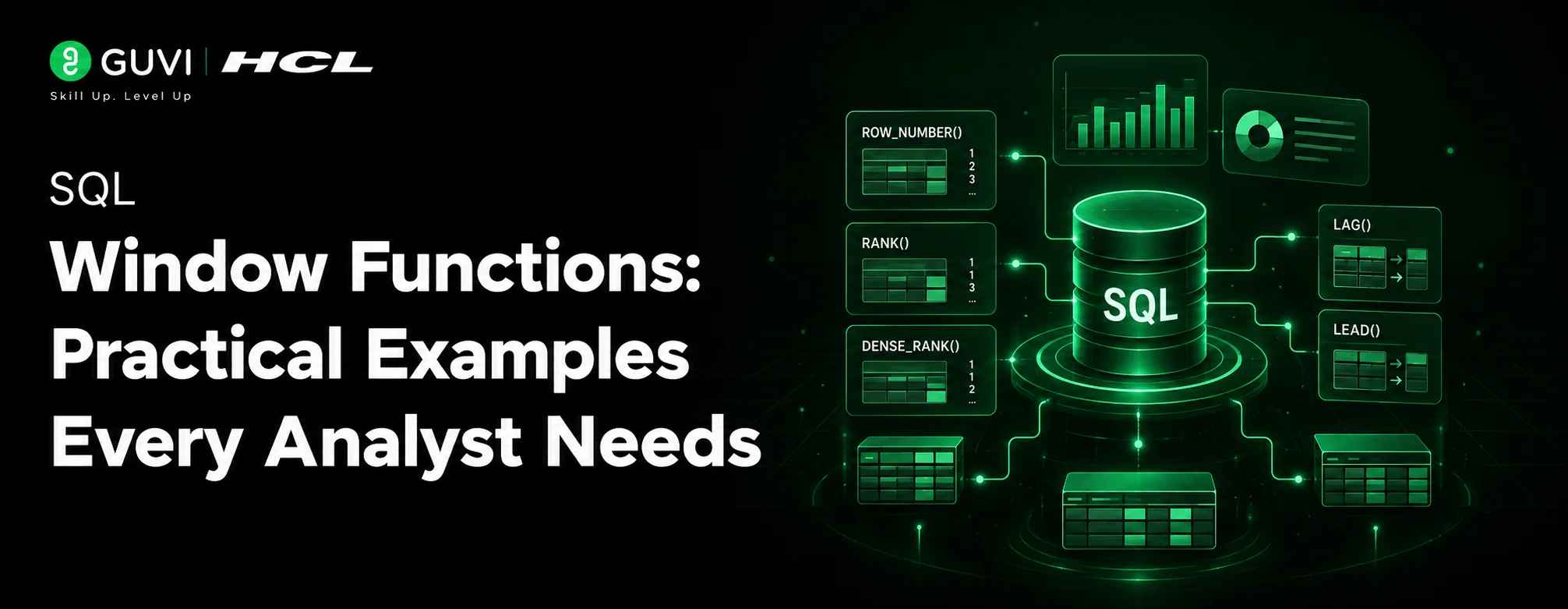
SQL Window Functions: Practical Examples Every Analyst Needs
Aug 07, 2026 3 Min Read 435 Views
(Last Updated)
Businesses collect millions of records every day, from sales transactions to customer interactions. While standard SQL queries retrieve and summarize data, analysts often need advanced techniques to compare rows and generate insights.
TL;DR
- SQL window functions perform calculations across related rows without grouping the data.
- They simplify ranking, running totals, moving averages, and comparisons.
- Window functions preserve individual rows while generating analytical insights.
- They are widely used in reporting, business intelligence, and data analytics.
- Learning SQL window functions helps analysts write cleaner, faster, and more efficient SQL queries.
Data Point
According to the Stack Overflow Developer Survey 2025, SQL remains one of the world’s most widely used programming, scripting, and markup languages, with 58.6% of respondents reporting that they use SQL. This highlights SQL’s continued importance in data analytics, business intelligence, and database management.
Table of contents
- Direct Answer
- What Are SQL Window Functions?
- Key Components of SQL Window Functions
- Why Learn SQL Window Functions?
- Benefits of Learning SQL Window Functions
- SQL Window Functions: Practical Examples Every Analyst Needs
- Example 1: Ranking Employees
- Example 2: Assign Sequential Numbers
- Example 3: Running Total
- Example 4: Compare Previous Values
- Example 5: Compare Next Values
- Example 6: Department-Wise Ranking
- Example 7: Moving Average
- Popular SQL Window Functions
- Real-World Applications of SQL Window Functions
- Sales Analytics
- Financial Reporting
- HR Analytics
- Customer Analytics
- Inventory Management
- Business Intelligence
- Marketing Analytics
- Best Practice
- Key Takeaways
- What To Do Next
- Conclusion
- FAQs
- What are SQL window functions?
- What is the OVER() clause?
- How are window functions different from GROUP BY?
- Which SQL window functions are most commonly used?
- Where are SQL window functions used?
- Can beginners learn SQL window functions?
- Why should data analysts learn SQL window functions?
Direct Answer
SQL window functions are advanced SQL functions that perform calculations across a set of related rows while keeping every row in the result set. They are commonly used for ranking, running totals, moving averages, and comparing values without collapsing data through aggregation, making them essential for modern data analysis and reporting.
Source: https://learn.microsoft.com/sql/t-sql/queries/select-over-clause-transact-sql
What Are SQL Window Functions?
SQL window functions calculate values across a defined “window” of rows using the OVER() clause. Unlike GROUP BY, they do not combine rows into a single result. Instead, each row remains visible while additional analytical values are calculated.
This allows analysts to answer questions such as:
- Which employee has the highest salary in each department?
- What is the running total of monthly sales?
- How does today’s revenue compare with yesterday’s?
- What is the average sales value over the last seven days?
Key Components of SQL Window Functions
- OVER() Clause – Defines the window for calculations.
- PARTITION BY – Divides rows into groups.
- ORDER BY – Specifies the calculation order.
- Window Function – Performs the analytical operation.
- Frame Clause – Controls which rows participate in calculations.
Why Learn SQL Window Functions?
SQL window functions are among the most valuable skills for data analysts because they simplify complex reporting tasks and improve query efficiency.
Benefits of Learning SQL Window Functions
| Benefit | Why It Matters |
| Better Analysis | Compare rows without complex joins |
| Cleaner Queries | Reduce nested queries |
| Faster Reporting | Generate insights efficiently |
| Business Intelligence | Build powerful dashboards |
| Career Growth | Essential for analyst and BI roles |
Curious to build stronger SQL skills? HCL GUVI’s Mastering MySQL Course helps you learn MySQL fundamentals through practical exercises and real-world database examples.
SQL Window Functions: Practical Examples Every Analyst Needs
Let’s explore some commonly used SQL window functions.
Example 1: Ranking Employees
Use RANK() to rank employees by salary.
SELECT employee_name,
salary,
RANK() OVER(ORDER BY salary DESC) AS salary_rank
FROM employees;
Example 2: Assign Sequential Numbers
Use ROW_NUMBER() to generate unique row numbers.
SELECT employee_name,
ROW_NUMBER() OVER(ORDER BY employee_id) AS row_num
FROM employees;
Example 3: Running Total
Calculate cumulative sales.
SELECT sales_date,
sales_amount,
SUM(sales_amount) OVER(ORDER BY sales_date) AS running_total
FROM sales;
Example 4: Compare Previous Values
Use LAG() to compare current and previous sales.
SELECT sales_date,
sales_amount,
LAG(sales_amount) OVER(ORDER BY sales_date) AS previous_sales
FROM sales;
Example 5: Compare Next Values
Use LEAD() to view upcoming values.
SELECT sales_date,
sales_amount,
LEAD(sales_amount) OVER(ORDER BY sales_date) AS next_sales
FROM sales;
Example 6: Department-Wise Ranking
SELECT employee_name,
department,
salary,
DENSE_RANK() OVER(
PARTITION BY department
ORDER BY salary DESC
) AS dept_rank
FROM employees;
Example 7: Moving Average
SELECT sales_date,
AVG(sales_amount)
OVER(ORDER BY sales_date
ROWS BETWEEN 2 PRECEDING AND CURRENT ROW)

AS moving_average
FROM sales;
Warning
Avoid confusing GROUP BY with window functions. GROUP BY combines multiple rows into one result, while window functions retain every row and add analytical calculations.
Popular SQL Window Functions
| Function | Primary Use |
| ROW_NUMBER() | Assign unique row numbers |
| RANK() | Rank rows with gaps |
| DENSE_RANK() | Rank rows without gaps |
| LAG() | Access previous row values |
| LEAD() | Access next row values |
| SUM() OVER() | Running totals |
| AVG() OVER() | Moving averages |
Data Point
The DB-Engines Ranking (June 2026) places MySQL as the second most popular database management system worldwide, highlighting its continued importance for developers, analysts, and businesses working with relational databases.
Did You Know?
Many business intelligence platforms, such as Power BI and Tableau, rely on SQL window functions behind the scenes to generate rankings, cumulative metrics, and trend analyses efficiently.
Real-World Applications of SQL Window Functions
1. Sales Analytics
Track monthly revenue, rankings, and cumulative sales.
2. Financial Reporting
Calculate running balances and compare transactions.
3. HR Analytics
Rank employees based on salaries or performance.
4. Customer Analytics
Identify top customers and purchasing trends.
5. Inventory Management
Monitor stock movement over time.
6. Business Intelligence
Power dashboards with dynamic calculations.
7. Marketing Analytics
Measure campaign performance and customer engagement.
Best Practice
Always use PARTITION BY and ORDER BY thoughtfully. Proper partitioning improves accuracy, while appropriate ordering ensures calculations such as rankings and running totals produce meaningful results.
Key Takeaways
- SQL window functions perform calculations without collapsing rows.
- The OVER() clause defines the calculation window.
- Functions like RANK(), ROW_NUMBER(), and LAG() simplify analysis.
- They improve reporting and business intelligence workflows.
- Mastering SQL window functions is valuable for every data analyst.
What To Do Next
After completing this tutorial, explore:
- SQL joins and subqueries
- Aggregate functions
- Common Table Expressions (CTEs)
- Database indexing
- Query optimization
- Business intelligence dashboards
Before using advanced analytical queries, build a strong understanding of SQL fundamentals such as filtering, joins, and aggregation. These concepts provide the foundation for mastering SQL window functions.
Conclusion
SQL window functions make it easier to perform advanced analytical calculations while preserving every row in a dataset. From rankings and running totals to moving averages and trend analysis, they help analysts generate meaningful insights with concise and efficient queries. As organizations increasingly rely on data-driven decisions, mastering SQL window functions is an essential step toward becoming a skilled data analyst.
FAQs
1. What are SQL window functions?
They perform calculations across related rows while keeping every row in the result set.
2. What is the OVER() clause?
It defines the window of rows on which a window function operates.
3. How are window functions different from GROUP BY?
GROUP BY combines rows, whereas window functions preserve individual rows while adding calculated values.
4. Which SQL window functions are most commonly used?
ROW_NUMBER(), RANK(), DENSE_RANK(), LAG(), LEAD(), SUM(), and AVG().
5. Where are SQL window functions used?
They are widely used in reporting, finance, HR analytics, sales analysis, and business intelligence.
6. Can beginners learn SQL window functions?
Yes. Once you understand basic SQL queries, learning window functions becomes much easier.
7. Why should data analysts learn SQL window functions?
They simplify complex analytical queries, improve reporting efficiency, and are highly valued in data analytics roles.
Success Stories

About the Author
Vishalini Devarajan
An Aerospace Engineer turned content writer, I focus on making complex concepts easy to understand through well-structured, reader-friendly blogs. Whether it’s a technical topic or a non-technical one, I love creating content that is clear, engaging, and impactful.
View all posts by Vishalini Devarajan
Connect with me @














Did you enjoy this article?