


Data Science Articles
How to Write a Data Analyst Resume With BPO Experience That Gets Your Skills Noticed
Which Data Analytics Certifications Help Accountants and Finance Professionals?
Excel SQL Python for BPO Professionals Best Guide to Move Into Data Science
Do Financial Analysts Need Machine Learning to Become Data Scientists?


Get In Touch For Details! Request More Information
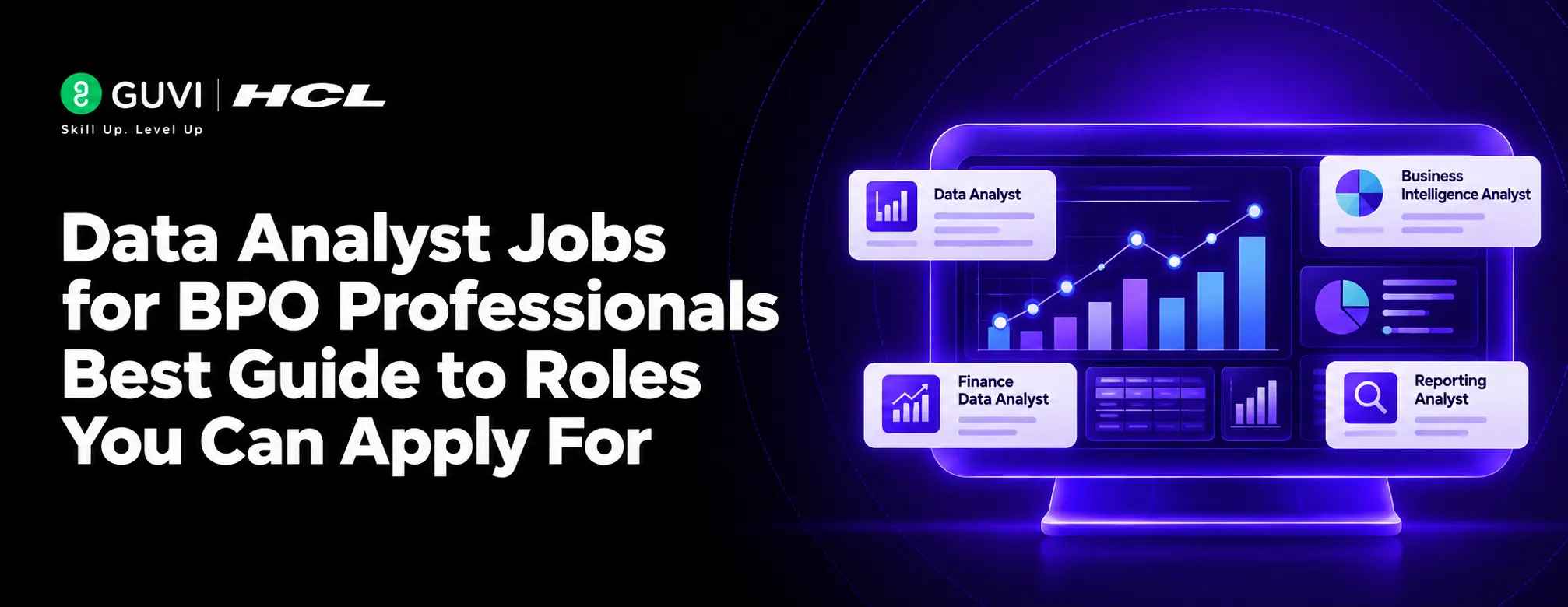
Data Analyst Jobs for BPO Professionals – Best Guide to Roles You Can Apply For
Oct 13, 2026 7 Min Read 24 Views
(Last Updated)
Data analyst jobs for BPO professionals can offer a way to build on existing experience in customer service, reporting, quality assurance, and operations. However, not every analyst role has the same responsibilities or technical requirements.
The best opportunity depends on what you already do at work and which skills you can demonstrate. Instead of applying to every vacancy with “analyst” in the title, identify roles that connect your experience with the type of data work you want to pursue.
Your existing experience with customer records, reports, and performance metrics may already be relevant to analytics roles. Learn more about how BPO experience can support data analyst job applications
Table of contents
- TL;DR
- Which data analyst roles can BPO professionals apply for?
- What Does Each Data Analyst Role Involve for BPO Professionals?
- Which data analyst jobs for BPO professionals suit reporting experience?
- Which roles suit BPO professionals with operations experience?
- Which analyst roles suit quality and customer support experience?
- Can BPO professionals apply for Business Analyst roles?
- BPO Professionals Can Transition into Reporting Analyst Roles
- Which roles suit your BPO experience level?
- Which Data Analyst Jobs Suit BPO Professionals With Under 4 Years of Experience?
- Which Data Analyst Jobs Can more than 4 years Experienced BPO Professionals Apply For?
- What Skills Do BPO Professionals Need to Qualify for Data Analyst Jobs?
- How Can BPO Professionals Find Relevant Data Analyst Job Openings?
- How Can BPO Professionals Use Their Work Experience in a Data Analyst Role?
- What Mistakes Should BPO Professionals Avoid When Applying for Data Analyst Jobs?
- How Can BPO Professionals Prepare for a Data Science and Analytics Career?
- Conclusion
- Frequently Asked Questions
- Which data analyst jobs for BPO professionals are easiest to target first?
- Can BPO professionals apply for data analyst jobs without an IT degree?
- Can four or more years of BPO experience help with a data analyst career?
- Do all data analyst jobs require Python?
- What are the most important data analyst skills for BPO professionals?
- Should BPO professionals apply for Business Analyst or Data Analyst roles?
- How can BPO professionals demonstrate analytics experience without a formal data analyst job?
- Where should BPO professionals search for relevant analyst vacancies?
TL;DR
Data analyst jobs for BPO professionals include Reporting Analyst, MIS Analyst, Operations Analyst, Workforce Management Analyst, Quality Analyst, and entry-level Data Analyst roles. The best option depends on your current responsibilities, technical skills, and experience. If you already prepare reports or track performance metrics, reporting and operations-focused roles may be a practical starting point. If you have experience managing teams or analysing business performance, you can also explore business analysis and workforce analytics. Learn the tools required for your target role, build relevant projects, and use your BPO experience to demonstrate business understanding.
Which data analyst roles can BPO professionals apply for?
BPO professionals can explore several analytics-related roles, including Reporting Analyst, MIS Analyst, Operations Analyst, Workforce Management Analyst, Quality Analyst, and Data Analyst. Some positions focus on reporting and monitoring, while others require more advanced data querying, visualisation, or statistical analysis.
The following roles are useful starting points when researching data analyst jobs for BPO professionals.
| Job role | What you may do | Relevant BPO experience |
| Reporting Analyst | Prepare reports and track performance metrics | Daily reports, KPI tracking |
| MIS Analyst | Maintain management reports and dashboards | Excel reporting, data validation |
| Operations Analyst | Investigate performance issues and process gaps | Operations, process improvement |
| Workforce Management Analyst | Analyse staffing, schedules, and call volumes | Workforce planning, scheduling |
| Quality Analyst | Review quality scores and identify recurring errors | Quality assurance, compliance |
| Junior Data Analyst | Clean, analyse, and visualise datasets | Reporting, problem-solving |
| Business Analyst | Understand business needs and document requirements | Client coordination, process knowledge |
These titles can overlap, and responsibilities vary between employers. Always read the job description rather than assuming that every role with “analyst” in its name involves the same work.
Understanding how your existing BPO skills apply to analytical work can help you identify the roles that best match your experience. Explore these BPO skills for data analytics
What Does Each Data Analyst Role Involve for BPO Professionals?
Which data analyst jobs for BPO professionals suit reporting experience?
1. Reporting Analyst
A Reporting Analyst prepares regular reports, checks data accuracy, and helps teams understand performance. This role may suit you if you already compile daily or weekly reports, track service-level agreements, or share team metrics with managers.
To strengthen your application, practise advanced Excel, PivotTables, data cleaning, and basic dashboard creation. SQL may also be required when reports rely on database information.
2. MIS Analyst
A Management Information Systems (MIS) Analyst maintains reports and information used by managers to monitor business performance. Depending on the company, the role can involve spreadsheet automation, data validation, dashboard maintenance, and consolidating information from multiple sources.
This can be a suitable option if your BPO work involves Excel reports, data entry checks, or performance tracking. Advanced Excel is a useful foundation, while Power BI and SQL can expand the types of work you can handle.
Which roles suit BPO professionals with operations experience?
3. Operations Analyst
An Operations Analyst examines business processes and performance data to identify delays, recurring issues, and improvement opportunities.
For example, if your team experiences repeated ticket backlogs, you might analyse ticket volumes, resolution times, and workload distribution. Excel, SQL, and Power BI can help you investigate the problem and present your findings.
This role may suit professionals who understand operational workflows and want to move beyond reporting into problem-solving.
4. Workforce Management Analyst
A Workforce Management (WFM) Analyst studies workload patterns, staffing requirements, attendance, and schedules. In a contact centre, this can include comparing call volumes with available agents and identifying periods when staffing may be insufficient.
If you already work in workforce management, scheduling, or real-time operations, you may have relevant domain knowledge. Strengthen it with Excel, data visualisation, forecasting fundamentals, and the ability to interpret performance metrics.
Which analyst roles suit quality and customer support experience?
5. Quality Analyst
A Quality Analyst reviews interactions, processes, or records against defined standards. The role may involve identifying recurring errors, tracking quality scores, and preparing reports that help teams improve performance.
If your experience involves call audits, compliance checks, or quality assurance, you can build on that knowledge. Develop stronger data-handling skills so you can analyse trends across multiple records instead of evaluating individual cases alone.
If you have worked in healthcare support or medical operations, explore the skills required for healthcare data analysts
6. Junior Data Analyst
A Junior Data Analyst typically supports data cleaning, analysis, reporting, and visualisation. The role may require Excel, SQL, Power BI, statistics, or Python, depending on the employer.
For data analyst jobs for BPO professionals, this is a direct option to consider once you can demonstrate the technical skills required by the vacancy. A portfolio with relevant projects can help show that you can apply those skills to business problems.
Can BPO professionals apply for Business Analyst roles?
7. Business Analyst
A Business Analyst identifies business needs, gathers requirements, documents processes, and works with stakeholders to improve systems or workflows. Some positions involve substantial data analysis, while others focus more on requirements and communication.
This role may suit experienced BPO professionals who work with clients, coordinate teams, document processes, or recommend operational improvements. Check whether the vacancy expects business analysis methods, technical data skills, or both.
If your BPO role involves gathering requirements and communicating with stakeholders, this guide to switching from business analyst to data analyst may help you compare the two career paths.
If you have experience managing a team, read about the transition from team lead to data analyst to understand the career considerations involved.
BPO Professionals Can Transition into Reporting Analyst Roles
If your BPO role involves preparing daily reports, tracking call volumes, monitoring customer satisfaction, or measuring team performance, you may already have experience relevant to reporting-focused roles. By strengthening your Excel skills, learning SQL, and practising dashboard creation with Power BI, you can build on that experience and demonstrate your ability to analyse operational data.
Which roles suit your BPO experience level?
Your experience level can help you narrow your search, but years of service alone do not determine which roles you qualify for. Employers will also consider your responsibilities, technical skills, education requirements, and evidence of relevant work.
Which Data Analyst Jobs Suit BPO Professionals With Under 4 Years of Experience?
If you are early in your career, consider starting with Reporting Analyst, MIS Analyst, Quality Analyst, or Junior Data Analyst positions, depending on your existing skills.
Prioritise Excel, data cleaning, basic SQL, and dashboard fundamentals. Build one or two projects using sample datasets to demonstrate that you can interpret information and communicate findings.
For data analyst jobs for BPO professionals at this stage, focus on vacancies that match your current abilities while allowing you to develop further. You do not need to apply only to entry-level positions, but avoid roles whose essential requirements you cannot yet demonstrate.
Which Data Analyst Jobs Can more than 4 years Experienced BPO Professionals Apply For?
If you have four or more years of experience, first identify the responsibilities you can transfer to an analytics role. Reporting, quality assurance, workforce planning, process improvement, and stakeholder coordination may all be relevant.
If you already prepare reports, focus on improving the analytical depth of your work. Learn SQL, build dashboards, and practise explaining why a metric changed instead of simply presenting the number.
Experienced professionals can explore Operations Analyst, Workforce Management Analyst, Business Analyst, and Reporting Analyst roles, as well as Data Analyst positions when they meet the technical requirements. Your seniority in BPO does not automatically translate into seniority in analytics, so assess each vacancy carefully.
What Skills Do BPO Professionals Need to Qualify for Data Analyst Jobs?
The required data analyst skills depend on the role. Reporting positions may emphasise Excel, while roles involving database analysis may require SQL. Dashboard-focused positions may ask for Power BI or Tableau, and some data analyst jobs expect Python or statistical knowledge.
| Skill | Why it matters | Roles where it is useful |
| Excel | Clean data, calculate metrics, prepare reports | Reporting, MIS, Quality |
| SQL | Retrieve, filter, group, and combine data | Data Analyst, Operations |
| Power BI or Tableau | Create dashboards and communicate trends | Reporting, Operations, Data Analyst |
| Statistics | Understand variation, trends, and relationships | Data Analyst, Operations |
| Python | Automate tasks and analyse datasets | Data Analyst roles requiring programming |
| Communication | Explain findings and recommendations clearly | All analyst roles |
Start by strengthening your spreadsheet skills, and explore how to use Python in Excel as you progress to more advanced analysis.

If you are new to database queries, use this SQL for Data Science guide to understand the concepts that support everyday analytical tasks.
After building a foundation in Excel and SQL, explore Python for Data Science to learn how Python supports data cleaning and analysis.
For more context on where Python is useful beyond basic scripting, explore these Python applications in the real world
How Can BPO Professionals Find Relevant Data Analyst Job Openings?
Searching only for “Data Analyst” may cause you to miss relevant opportunities. Employers use different job titles for reporting, operations, workforce planning, and business analysis.
Try searching for titles such as:
- Reporting Analyst
- MIS Analyst
- Operations Analyst
- Workforce Management Analyst
- Quality Analyst
- Junior Data Analyst
- Business Analyst
Use job portals such as Naukri, Glassdoor, and Indeed to compare requirements. These are dynamic listings, so the roles and availability can change.
For data analyst jobs for BPO professionals, evaluate each description against three questions:
- What will I actually do? Identify whether the work involves reporting, dashboard creation, data analysis, business requirements, or something else.
- Which skills are essential? Separate must-have skills from preferred skills.
- What experience can I demonstrate? Connect your BPO responsibilities and portfolio projects to the work described in the vacancy.
- Highlight relevant KPIs, reporting tasks, process improvements, and analytical projects using these data analyst resume tips
- Once your resume is ready, prepare for technical and scenario-based questions by reviewing this data analyst interview experience
You can also explore internal opportunities in your current organisation. Reporting, quality, workforce management, and operations teams may provide a route to gain more analytical responsibilities.
How Can BPO Professionals Use Their Work Experience in a Data Analyst Role?
Consider a professional working in a telecom customer-support operation. They track daily call volumes, customer complaints, resolution times, and quality scores.
Initially, their responsibility may be to prepare a report. By learning Excel, they can summarise complaint categories and compare team performance. With SQL, they can retrieve and group records from a database. With Power BI, they can build a dashboard that helps managers see where problems occur.
This experience could support an application for a Reporting Analyst, Operations Analyst, or Junior Data Analyst role, depending on the person’s skills and the vacancy requirements.
The important step is to demonstrate analysis rather than simply listing responsibilities. Explain the business question, the tools used, what the data revealed, and what action the findings could support. Use anonymised or public datasets for portfolio projects, never confidential customer records.
You can demonstrate your dashboard skills by building a sample report using these Power BI project ideas
To practise presenting these findings visually, explore HCL GUVI’s Power BI learning resources
What Mistakes Should BPO Professionals Avoid When Applying for Data Analyst Jobs?
1. Applying only for Data Analyst titles. Relevant opportunities may use titles such as Reporting Analyst, MIS Analyst, or Operations Analyst. Search by responsibilities as well as job title.
2. Assuming BPO experience alone is enough. Domain knowledge is useful, but you must also demonstrate the technical and analytical skills listed in the vacancy. Build projects that show how you work with data.
3. Ignoring the difference between roles. A Quality Analyst may focus on compliance, while a Data Analyst may investigate larger datasets. Read the responsibilities carefully before deciding whether a role matches your goals.
4. Applying for senior analytics roles based only on years of experience. Four or more years in BPO does not necessarily mean you have four years of data analysis experience. Target roles based on your actual skills and responsibilities.
5. Listing tools without practical evidence. Instead of simply mentioning Excel, SQL, or Power BI on your resume, prepare projects that show how you used them to answer a business question.
How Can BPO Professionals Prepare for a Data Science and Analytics Career?
Once you have identified the roles that fit your background, create a focused plan to close your skill gaps. A structured learning programme can help you practise data analysis, develop projects, and build a foundation for your chosen career path.
Explore HCL GUVI’s Data Science and Analytics course for foundational learning, or consider the
HCL GUVI’s Data Science Programme if you prefer a structured programme. Review the curriculum and support offered to decide which option fits your goals.
Conclusion
Data analyst jobs for BPO professionals include reporting, MIS, operations, workforce management, quality assurance, and junior data analysis roles. The right option depends on your current responsibilities, technical skills, and the requirements of each vacancy.
If you are early in your career, build a foundation in Excel, SQL, and visualisation. If you have four or more years of experience, connect your operational knowledge with practical analytical projects and target roles that match your capabilities. A clear understanding of your transferable skills, a focused learning plan, and evidence of hands-on work can help you make a more informed move towards a data analyst career.
Frequently Asked Questions
1. Which data analyst jobs for BPO professionals are easiest to target first?
Reporting Analyst, MIS Analyst, and some Quality Analyst roles may be practical starting points if you already have relevant reporting or quality experience. The easiest role depends on the job requirements and your current skills.
2. Can BPO professionals apply for data analyst jobs without an IT degree?
Some employers accept candidates from non-IT backgrounds if they can demonstrate the required analytical skills and experience. Other vacancies may specify a degree or qualification, so check each job description.
3. Can four or more years of BPO experience help with a data analyst career?
Yes, if your experience includes reporting, quality checks, process knowledge, workforce planning, or performance metrics. You will still need to demonstrate the technical skills required for the target role.
4. Do all data analyst jobs require Python?
No. Requirements vary. Some roles focus on Excel, SQL, and dashboard tools, while others expect Python or additional statistical knowledge.
5. What are the most important data analyst skills for BPO professionals?
Excel, SQL, data visualisation, analytical thinking, and communication are useful foundations. Add Python or deeper statistical skills when they are relevant to your target roles.
6. Should BPO professionals apply for Business Analyst or Data Analyst roles?
Choose based on the work you want to do. Business Analysts often focus on requirements and process improvement, while Data Analysts generally focus more on examining data and communicating findings, although responsibilities can overlap.
7. How can BPO professionals demonstrate analytics experience without a formal data analyst job?
Build portfolio projects using public or simulated datasets. Show the business question, your approach, the tools you used, your findings, and how the results could inform a decision.
8. Where should BPO professionals search for relevant analyst vacancies?
Search job portals and company career pages using titles such as Reporting Analyst, MIS Analyst, Operations Analyst, Workforce Management Analyst, and Junior Data Analyst. Compare the responsibilities and required skills before applying.
Success Stories

About the Author
Reemsha Khan
Always been a storyteller at heart. Now, I turn complex topics into simple, easy-to-understand stories through content. Hope you find it helpful.
View all posts by Reemsha Khan
Connect with me @









Did you enjoy this article?