


Data Science Articles
How to Write a Data Analyst Resume With BPO Experience That Gets Your Skills Noticed
Which Data Analytics Certifications Help Accountants and Finance Professionals?
Data Analyst Jobs for BPO Professionals - Best Guide to Roles You Can Apply For
Do Financial Analysts Need Machine Learning to Become Data Scientists?

Get In Touch For Details! Request More Information
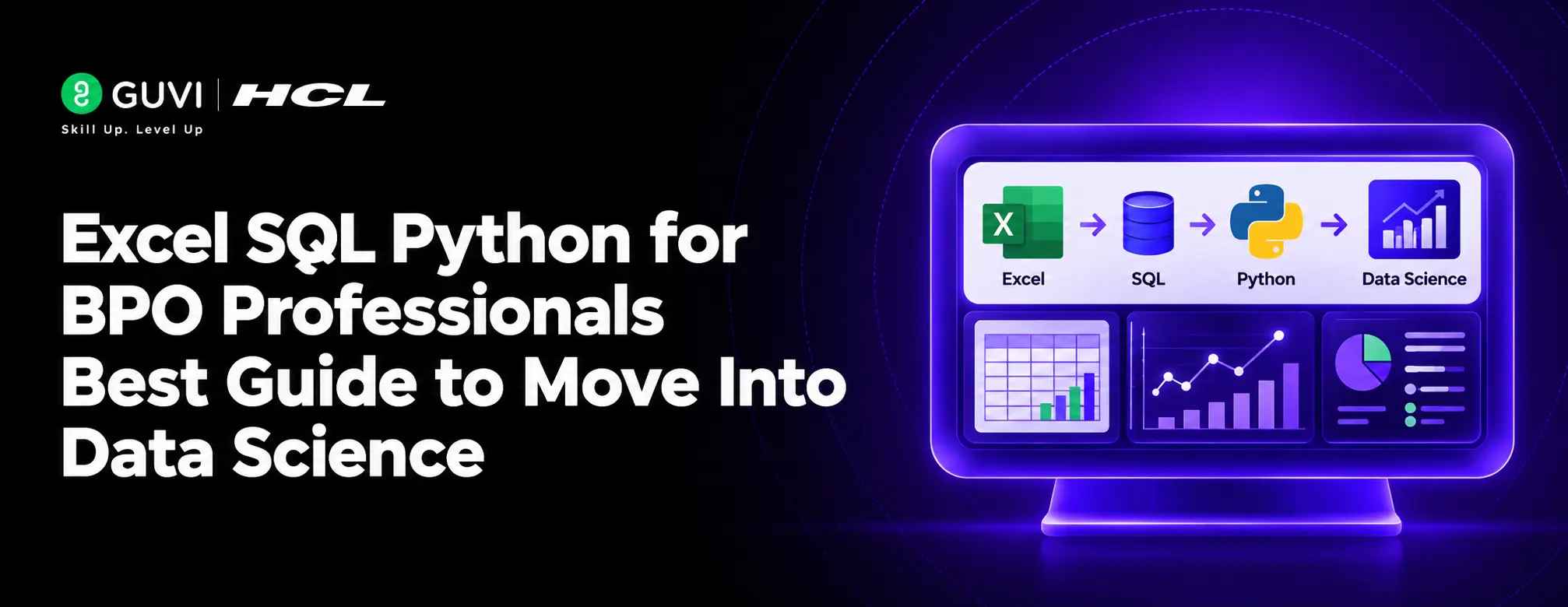
Excel SQL Python for BPO Professionals Best Guide to Move Into Data Science
Oct 13, 2026 8 Min Read 23 Views
(Last Updated)
Table of contents
- TL;DR; Summary
- Why BPO Professionals Should Learn Data Analytics
- Should BPO Professionals Learn Excel, SQL, or Python First?
- Excel: Start With the Basics of Data Analysis
- SQL: Learn to Retrieve and Analyse Data
- Python: Add Automation and Advanced Analysis
- Excel, SQL, and Python Can Work Together in a Real Data Science Project
- Which Data Skill Should BPO Professionals Learn Based on Their Experience?
- If You Have Less Than 4 Years of BPO Experience
- If You Have 4 or More Years of BPO Experience
- Complete Learning Roadmap for How Should BPO Professionals Learn Excel, SQL, and Python?
- Step 1: Build Your Excel Foundation
- Step 2: Practise SQL With Business Questions
- Step 3: Learn Python Through Small Tasks
- How Can BPO Professionals Use Excel, SQL, and Python in Data Analytics?
- What Mistakes Should BPO Professionals Avoid When Learning Data Analytics?
- Trying to Learn All Three Tools at Once
- Watching Tutorials Without Practising
- Ignoring Your Existing BPO Experience
- Focusing Only on Tools and Not Business Questions
- How Can BPO Professionals Use Their Existing Skills to Build a Data Analyst Career?
- Understand Your Data Analytics Career Path
- Prepare for Data Analyst Jobs
- How to Move From a BPO or Non-IT Background to Data Science
- Start With Excel and SQL
- Learn Python and Statistics
- Build Projects Using Real-World Problems
- Progress Towards Data Science
- Prepare for Relevant Entry-Level Opportunities
- How Can BPO Professionals Get Started With Data Analytics Training?
- Conclusion
- Frequently Asked Questions
- Should BPO professionals learn Excel, SQL, or Python first?
- Can I become a data analyst after working in BPO?
- Is SQL more important than Python for a beginner data analyst?
- How long does it take to learn Excel, SQL, and Python?
- Can experienced BPO professionals skip basic Excel?
- What projects can BPO professionals build for a data analyst portfolio?
- Do I need Python to apply for every data analyst job?
- What should I include on my resume when switching from BPO to data analytics?
TL;DR; Summary
If you work in a Business Process Outsourcing (BPO) role and want to move into data analytics, choosing between Excel, SQL, and Python can feel confusing. The right starting point depends on your current skills, experience, and career goals. For many BPO professionals, Excel is a practical starting point, followed by SQL and then Python. However, if you already use Excel confidently, you can move directly to SQL. Understanding excel sql python for bpo can help you build a realistic learning plan instead of trying to master every tool at once. Your existing experience in customer service, operations, reporting, and process management can also help you understand business data.
Why BPO Professionals Should Learn Data Analytics
BPO professionals often work with customer information, service requests, call records, performance reports, quality scores, and operational metrics. These responsibilities provide valuable exposure to business processes and data, even when data analysis is not part of the official job title.
Learning data analytics can help you build on this experience. Instead of only recording information or following an established reporting process, you can learn to identify patterns, measure performance, and explain what the numbers mean. This is one reason excel sql python for bpo is a useful starting point when planning a career transition.
For example, someone working in customer support may already understand average handling time, customer satisfaction, repeat complaints, and service-level agreements. With the right analytical skills, these metrics can become the foundation for investigating performance problems and suggesting improvements.
The goal is not to abandon your existing experience. It is to combine your understanding of BPO operations with technical skills that help you work with data more effectively.
If you’re exploring this career transition, read this guide to the skills BPO professionals can use to move into data analytics to understand how your existing experience can support your next career step.
Should BPO Professionals Learn Excel, SQL, or Python First?
Before deciding which tool to learn, understand what each one does. The best learning order for excel sql python for bpo depends on how comfortable you are with spreadsheets, how much data you work with, and the type of role you want to pursue.
| Factor | Excel | SQL | Python |
| Main purpose | Organising, cleaning, and analysing spreadsheet data | Retrieving and analysing data stored in databases | Automating tasks and performing more advanced analysis |
| Beginner difficulty | Usually easier to start with | Moderate | Can feel more challenging initially |
| Important skills | Formulas, sorting, filtering, PivotTables, charts | SELECT, WHERE, GROUP BY, JOIN | Variables, loops, functions, pandas |
| BPO-related example | Preparing a daily performance report | Retrieving customer or transaction records | Automating repetitive reporting tasks |
| When to learn it | First, if you are new to data tools | After Excel basics or earlier if you already know Excel | After building basic analytical and SQL skills |
1. Excel: Start With the Basics of Data Analysis
Excel is a practical first step if you are new to data analysis. It helps you organise information, clean records, calculate metrics, and present findings through charts and tables.
For BPO professionals, Excel can be particularly useful for analysing call volumes, tracking service-level performance, comparing team productivity, and preparing daily or monthly reports.
Start by learning formulas such as SUM, AVERAGE, IF, COUNTIF, and SUMIF. Then practise sorting, filtering, conditional formatting, PivotTables, and charts. These skills will help you work with real operational data.
A structured approach to excel sql python for bpo should focus on practical spreadsheet tasks rather than memorising every Excel feature. You do not need to learn everything before moving to SQL.
2. SQL: Learn to Retrieve and Analyse Data
SQL, or Structured Query Language, helps you retrieve and analyse data stored in relational databases. While Excel is useful for working with spreadsheets, SQL allows you to work directly with data held in database tables.
Imagine that your BPO team handles thousands of customer interactions every day. Instead of manually reviewing a large spreadsheet, you could use SQL to retrieve records for a particular date, filter complaints by category, or calculate the number of repeat interactions.
Begin with SELECT, WHERE, ORDER BY, GROUP BY, and aggregate functions such as COUNT, SUM, and AVG. Once you are comfortable with these, learn JOIN operations to combine information from different tables.
When exploring excel sql python for bpo, give SQL serious attention because retrieving, filtering, and summarising data are common tasks in many data analyst roles.
You can use HCL GUVI’s SQL for Data Science guide to understand SQL concepts and practise the queries used in data analysis.
3. Python: Add Automation and Advanced Analysis
Python is a programming language used for data cleaning, analysis, automation, and many other technical tasks. It becomes especially useful when you need to process repetitive tasks or work with datasets that are difficult to manage manually.
For example, a BPO professional who prepares the same weekly report could eventually use Python to clean files, combine data, calculate metrics, and generate repeatable outputs.
Start with variables, data types, conditional statements, loops, functions, and basic file handling. Once you understand these concepts, explore libraries such as pandas for data manipulation and Matplotlib for visualisation.
The excel sql python for bpo learning process does not require you to master Python immediately. Build a foundation in spreadsheets and SQL first, then learn Python when you are ready to automate tasks or analyse more complex datasets.
You can also explore how to use Python in Excel to understand how Python and spreadsheets can work together.
Once you understand the basics, explore Python applications in the real world to see how the language is used to solve practical problems.
Excel, SQL, and Python Can Work Together in a Real Data Science Project
Imagine a BPO team wants to understand why customer complaints are increasing. Excel can help summarise complaint trends, SQL can retrieve relevant customer records, and Python can help analyse larger datasets and build predictive models. Together, these tools can support a data science workflow, from preparing data to identifying patterns and predicting potential outcomes.
Sources: Microsoft Excel PivotTables · PostgreSQL SQL Tutorial pandas Documentation
Which Data Skill Should BPO Professionals Learn Based on Their Experience?
There is no single learning order that works for every BPO professional. Your current responsibilities, existing technical knowledge, and target role should determine where you begin.
If You Have Less Than 4 Years of BPO Experience
If you are early in your career and have limited experience with data tools, begin with Excel. Learn how to clean data, use formulas, create PivotTables, and prepare simple reports.
Once you are comfortable, move to SQL and practise retrieving and summarising data. Then introduce Python to automate repetitive work and expand your analytical abilities.
For this experience group, excel sql python for bpo can be approached as a step-by-step learning plan rather than three tools that must be learned simultaneously.
If you already use Excel regularly in your current role, you can shorten the first stage and begin SQL earlier.
If You Have 4 or More Years of BPO Experience
If you have four or more years of experience, start by assessing what you already know. You may have experience preparing reports, tracking team performance, maintaining spreadsheets, or monitoring operational KPIs.
If you are confident with Excel, do not spend months repeating the basics. Refresh any gaps, then prioritise SQL and practical analytical projects. Python can follow when it supports your career goals.
For experienced professionals, excel sql python for bpo should be connected to the problems you already understand. Your familiarity with workflows, escalations, customer behaviour, and performance metrics can help you choose meaningful projects.
For example, if you have worked in quality analysis, you could investigate recurring errors. If you have worked in workforce management, you could analyse staffing patterns and demand. These projects demonstrate how your existing experience connects with data analysis.
Complete Learning Roadmap for How Should BPO Professionals Learn Excel, SQL, and Python?
A focused roadmap makes it easier to learn consistently while managing your current job. The following plan is a starting point; adjust the duration based on your existing skills and available study time.
Step 1: Build Your Excel Foundation
Practise cleaning datasets, using formulas, creating PivotTables, and building charts. Use sample call-centre or customer-support data to calculate daily volumes, average handling time, and customer satisfaction.
The first stage of excel sql python for bpo should help you understand how raw information becomes a useful report.
Step 2: Practise SQL With Business Questions
Learn how to filter records, group results, calculate averages, and join tables. Instead of completing exercises without context, ask questions such as:
- Which complaint categories receive the most cases?
- Which team has the highest number of unresolved tickets?
- How does customer satisfaction change from one month to another?
These questions make SQL practice relevant to your BPO experience.
Step 3: Learn Python Through Small Tasks
Once you understand basic analysis, learn Python fundamentals and practise using pandas to load, clean, and summarise datasets. Start with simple tasks before moving to more advanced automation.
You can also explore HCL GUVI’s guide on using Python in Excel to understand how these tools can work together.
A practical excel sql python for bpo roadmap should end with a project that combines your learning, not just a collection of course completion certificates.
How Can BPO Professionals Use Excel, SQL, and Python in Data Analytics?
Consider a customer-support professional who works with daily call reports. The team has noticed an increase in repeat complaints, but it is unclear which issue categories contribute most to the problem.
Here is how the three tools can help:
Using Excel: Clean the report, remove duplicate records where appropriate, categorise complaints, and create a PivotTable to compare complaint types.
Using SQL: Retrieve records for the relevant period, group complaints by category, and compare repeat interactions across teams or customer segments.
Using Python: Automate parts of the data-cleaning process, analyse larger datasets, and create repeatable summaries.
This example shows how excel sql python for bpo can connect your existing operational knowledge with practical analysis. You already understand the workflow; the tools help you investigate it using data.
You could turn this work into a portfolio project by documenting the business question, the steps you followed, the results, and the limitations of your analysis. Use anonymised or publicly available sample data rather than confidential company or customer information.
After practising these skills, you can explore Power BI project ideas for inspiration when building a portfolio that demonstrates your analytical abilities.

What Mistakes Should BPO Professionals Avoid When Learning Data Analytics?
Learning technical tools while working full-time can be challenging. Avoid these mistakes when planning excel sql python for bpo.
1. Trying to Learn All Three Tools at Once
Switching between Excel, SQL, and Python every day can make it difficult to build confidence in any one tool. Learn one set of fundamentals at a time, then move forward when you can apply them to a practical problem.
2. Watching Tutorials Without Practising
Watching lessons may help you understand concepts, but employers also need evidence that you can apply them. Practise with datasets, write your own queries, and explain what your findings mean.
3. Ignoring Your Existing BPO Experience
Your operational knowledge is an advantage. If you have handled customer escalations, quality checks, reporting, or workforce planning, use that knowledge to choose projects. The excel sql python for bpo approach should build on your experience rather than treat your previous work as irrelevant.
4. Focusing Only on Tools and Not Business Questions
Knowing formulas or writing SQL queries is not enough by itself. You should also learn how to interpret results, explain trends, and connect your analysis to a business problem.
How Can BPO Professionals Use Their Existing Skills to Build a Data Analyst Career?
Your goal should be to build a combination of technical ability, problem-solving, and business understanding. Together, these form important data analyst skills.
Excel can help you prepare and interpret reports. SQL can help you retrieve data efficiently. Python can help you automate repetitive work and perform additional analysis. Visualisation tools such as Power BI can help you communicate findings clearly.
As you learn, document your projects and explain how each one relates to a real business question. You can also improve your applications with HCL GUVI’s data analyst resume tips.
A realistic data analyst career plan should also include communication, critical thinking, and the ability to explain results to people who may not have a technical background.
Understand Your Data Analytics Career Path
Your data analytics career path will depend on your existing experience, the skills you develop, and the roles available to you. Some BPO professionals may target reporting analyst or operations analyst roles first, while others may prepare for junior data analyst positions.
Research job descriptions before deciding what to learn next. Look for recurring requirements, then compare them with your current skills. This helps you focus on relevant tools rather than learning every technology you encounter.
The phrase excel sql python for bpo can guide your initial learning priorities, but your target role should ultimately shape the depth of knowledge you need in each tool.
Prepare for Data Analyst Jobs
When reviewing data analyst jobs, look beyond the job title. Check whether employers ask for Excel, SQL, Python, Power BI, statistics, or specific domain knowledge. Requirements differ across companies and experience levels.
Create two or three projects that demonstrate your ability to clean data, analyse a business problem, and present clear findings. Practise explaining your approach, including the assumptions you made and how you would improve the analysis.
A useful excel sql python for bpo plan is one that helps you show evidence of your skills, not simply list tools on your resume.
You can also read this data analyst interview experience to understand what the interview process may involve.
Your existing experience can give you a useful starting point, but you’ll also need to develop the right technical and analytical skills. Explore the guide to BPO skills for data analytics to understand which transferable skills you can build on and where you may need further learning.
How to Move From a BPO or Non-IT Background to Data Science
Moving from a BPO or other non-IT role to data science is possible, but it requires a structured learning plan. You do not need to learn every tool at once. Start by building your data analysis fundamentals and gradually develop the technical skills required for your target role.
1. Start With Excel and SQL
If you are new to data analysis, learn Excel for data cleaning, formulas, reporting, and basic analysis. Then learn SQL to retrieve, filter, and summarise data from databases. These skills also provide a useful foundation if your first target is a data analyst role.
2. Learn Python and Statistics
Once you understand the basics of data analysis, learn Python for data manipulation and automation. Build your understanding of statistics, including averages, distributions, correlation, and hypothesis testing. These concepts become especially important as you progress towards data science.
3. Build Projects Using Real-World Problems
Use your previous work experience to identify practical project ideas. BPO professionals could analyse customer complaints, repeat interactions, or service-level performance. Professionals from sales, finance, HR, or marketing could explore sales trends, employee data, financial patterns, or campaign performance using appropriate sample datasets.
Build projects that demonstrate your problem-solving skills, analytical thinking, and ability to explain findings.
4. Progress Towards Data Science
Data science typically requires additional skills beyond basic reporting and data analysis. Depending on your target role, learn probability, statistical modelling, data visualisation, machine learning, and model evaluation. Practise applying these concepts to projects instead of relying only on theoretical knowledge.
5. Prepare for Relevant Entry-Level Opportunities
Review job descriptions to understand which skills employers expect. Build a portfolio, update your resume with relevant projects and transferable experience, and prepare to explain your analytical approach during interviews.
A transition does not have to happen in one step. You may choose to pursue a reporting analyst or data analyst role first, strengthen your experience, and then work towards data science opportunities.
How Can BPO Professionals Get Started With Data Analytics Training?
If you want structured guidance while learning data analytics, explore HCL GUVI’s Data Science and Analytics course to learn more about the learning options available.
You can also explore the HCL GUVI’s Data Science Zen Programme for a more structured learning path. Choose a programme based on your current skill level, career goals, curriculum, and the support you need.
Start by identifying your gaps, practise with real-world projects, and use excel sql python for bpo as a framework for deciding which skill to develop next.
Conclusion
BPO professionals do not need to learn Excel, SQL, and Python all at once to begin moving towards data analytics. If you are new to data tools, start with Excel, progress to SQL, and learn Python when you are ready to automate tasks or handle more complex analysis. If you already have strong Excel skills, you can prioritise SQL sooner.
The right excel sql python for bpo plan depends on your experience, current abilities, and target role. Use your understanding of BPO operations to build practical projects, strengthen your analytical thinking, and demonstrate what you can do with data. Consistent practice and a clear learning plan will help you take the next step towards a data analyst career.
Frequently Asked Questions
1. Should BPO professionals learn Excel, SQL, or Python first?
If you are new to data tools, Excel is a practical starting point. Learn SQL next, then Python. If you already use Excel confidently, you can start SQL earlier.
2. Can I become a data analyst after working in BPO?
Yes, a transition may be possible with relevant technical skills, practical projects, and business understanding. Your BPO experience can help you understand operational problems, but you will still need to demonstrate your analytical abilities.
3. Is SQL more important than Python for a beginner data analyst?
SQL is an important skill for many data analyst roles because it helps you retrieve and analyse database information. Python is also valuable, particularly for automation and more advanced analysis. Check the requirements of your target roles.
4. How long does it take to learn Excel, SQL, and Python?
The time varies based on your starting point, study schedule, and practice. Focus on learning the fundamentals and applying them to projects rather than setting a deadline for mastering every feature.
5. Can experienced BPO professionals skip basic Excel?
If you can confidently clean data, use formulas, create PivotTables, and prepare reports, you can review your gaps and move on to SQL. Make sure your Excel skills are strong enough for the tasks expected in your target role.
6. What projects can BPO professionals build for a data analyst portfolio?
You could analyse customer complaints, repeat calls, quality scores, service-level performance, or staffing trends using sample or public datasets. Explain the business problem, your methods, and the insights you found.
7. Do I need Python to apply for every data analyst job?
No. Requirements vary by role and employer. Some roles place more emphasis on Excel, SQL, and visualisation tools, while others expect Python. Review job descriptions to prioritise your learning.
8. What should I include on my resume when switching from BPO to data analytics?
Highlight relevant reporting, quality analysis, operational metrics, and problem-solving experience. Add your technical skills and portfolio projects, and describe your contributions accurately. Avoid claiming professional experience with tools you have only practised during training.
Success Stories

About the Author
Reemsha Khan
Always been a storyteller at heart. Now, I turn complex topics into simple, easy-to-understand stories through content. Hope you find it helpful.
View all posts by Reemsha Khan
Connect with me @








Did you enjoy this article?