


Data Science Articles
Finance Career Growth After 5+ Years: Should You Add Data Skills?
Which Data Roles Suit a BPO Team Lead With People-Management Experience?
BPO Experience for Data Analyst Jobs Does It Count When Applying? - Best Guide
What's Career Growth After 5 Years in BPO? Are You Missing Out on a Data Analyst Career?

Get In Touch For Details! Request More Information
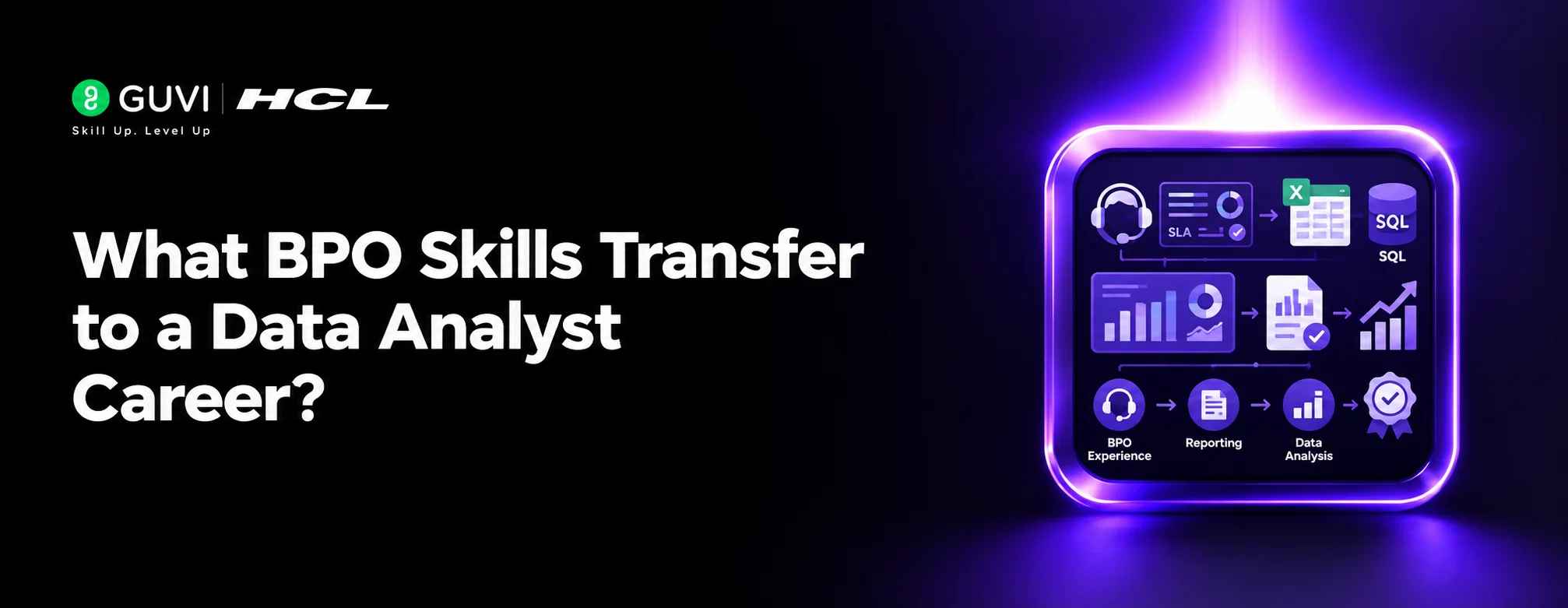
What BPO Skills for Data Analytics Transfer to a Data Analyst Career? – Best Guide
Oct 09, 2026 6 Min Read 17 Views
(Last Updated)
Table of contents
- TL;DR, Summary
- What BPO Skills Transfer to Data Analytics?
- BPO Skills vs Data Analyst Skills
- Which BPO Skills Transfer Best to Data Analytics?
- KPI Tracking
- Reporting
- Customer Understanding
- Problem-Solving
- Quality Monitoring
- SLA and Process Understanding
- Communication
- Process Improvement
- Which BPO Skills Are You Probably Missing?
- How to Turn BPO Experience Into Data Analyst Skills
- Step 1: Start With Excel
- Step 2: Learn SQL
- Step 3:Learn Power BI or Tableau
- Step 4: Build BPO-Based Projects
- Step 5: Rewrite Your Resume Around Transferable Skills
- Real-World Examples
- Customer Support Analytics
- Operations Analytics
- Common Mistakes to Avoid
- Treating BPO Experience as Irrelevant
- Assuming Transferable Skills Are Enough
- Listing Tools Without Projects
- Hiding Your BPO Background
- Learning Every Tool at Once
- Ready to Move From BPO to Data Science?
- Conclusion
- FAQs
- What BPO skills transfer to data analytics?
- Can BPO experience help with a data analyst career?
- Which BPO skills are most useful for Data Analyst jobs?
- Do I need SQL if I already have BPO experience?
- Can customer service experience transfer to data analytics?
- What technical skills should BPO professionals learn for data analytics?
- How can I show BPO skills on a Data Analyst resume?
- Can BPO professionals apply directly for Data Analyst jobs?
- What is the best way to start a data analytics career from BPO?
- Which BPO skills could I be missing for a data analytics career?
TL;DR, Summary
BPO skills for data analytics can give you a useful starting point for a data analyst career, especially if your work involves KPIs, reports, customer data, quality checks, problem-solving, or process improvement. However, transferable experience is only one part of the transition. You still need technical data analyst skills such as Excel, SQL, data visualization, statistics, and basic Python. The strongest approach is to connect what you already do in BPO with analytics projects that prove you can clean data, identify patterns, explain findings, and support business decisions.
What BPO Skills Transfer to Data Analytics?
The strongest BPO skills for data analytics are not limited to technical abilities. They include KPI tracking, reporting, customer understanding, problem-solving, communication, process knowledge, quality monitoring, and working with operational data.
These skills matter because data analysts do not work with numbers in isolation. They use data to understand business problems, find patterns, communicate insights, and support decisions.
Your BPO experience can therefore become useful domain experience. The important part is learning how to connect that experience with technical data analyst skills.
For example, if you monitored Average Handle Time, Customer Satisfaction, Service Level, quality scores, or productivity, you already worked with business performance measures.
The next step is learning how to investigate those numbers rather than simply report them.
BPO Skills vs Data Analyst Skills
| BPO Experience | How It Transfers | What You Need to Add |
| KPI tracking | Understanding business performance | SQL and statistics |
| Reporting | Working with structured information | Data cleaning and analysis |
| Customer handling | Understanding customer behaviour | Customer analytics |
| Quality monitoring | Identifying performance gaps | Root-cause analysis |
| SLA monitoring | Measuring operational performance | Dashboarding |
| Process improvement | Finding inefficiencies | Analytical problem-solving |
| Team performance | Understanding operational metrics | Power BI or Tableau |
| Stakeholder communication | Explaining business issues | Data storytelling |
This is why BPO skills for data analytics should be viewed as a foundation rather than a replacement for technical training.
Which BPO Skills Transfer Best to Data Analytics?
1. KPI Tracking
KPI tracking is one of the most useful BPO skills for data analytics.
If you have monitored AHT, CSAT, FCR, SLA, productivity, quality scores, or resolution rates, you already understand that businesses use metrics to measure performance.
As a data analyst, you take this further. You investigate why a KPI changed, identify patterns, compare segments, and communicate what the numbers mean.
2. Reporting
Regular reporting is another valuable part of BPO skills for data analytics.
You may have created daily, weekly, or monthly reports. That experience teaches you how to organise information, check numbers, meet reporting deadlines, and present results.
The missing piece is usually analysis. You need to move on from “what happened?” to “why did it happen?” and “what should the business do next?”
3. Customer Understanding
Customer-facing experience can become useful BPO skills for data analytics when you learn how to analyse customer behaviour.
You may already understand common complaints, recurring issues, escalation patterns, and customer expectations.
With SQL, Excel, and visualization tools, you can turn that knowledge into customer segmentation, complaint analysis, churn analysis, or service-performance dashboards.
4. Problem-Solving
Problem-solving is one of the most important BPO skills for data analytics because analytics is largely about asking better questions.
Suppose your team’s SLA performance suddenly drops. Instead of accepting the number, an analyst might investigate shift patterns, ticket volumes, issue categories, staffing levels, or resolution times.
Your BPO experience can help you understand the problem. Analytics skills help you prove what is happening in the data.
5. Quality Monitoring
Quality monitoring can also become useful BPO skills for data analytics.
If you have reviewed calls, tickets, interactions, or quality scores, you already understand how performance can be measured against defined standards.
You can build on this by analysing quality trends, identifying recurring issues, comparing teams, and creating dashboards that make quality patterns easier to understand.
6. SLA and Process Understanding
Understanding SLAs and business processes is another strong part of BPO skills for data analytics.
Data analysts often need to understand the process behind a dataset before drawing conclusions from it.
Your BPO experience can help you recognise where delays happen, which process steps create bottlenecks, and which metrics actually matter to operations.
7. Communication
Communication is an underrated part of BPO skills for data analytics.
A technically correct analysis is not very useful if you cannot explain it clearly.
BPO professionals often communicate with customers, team leads, quality teams, operations managers, and other stakeholders. That experience can help when presenting analytical findings to non-technical teams.
8. Process Improvement
Process improvement is another valuable part of BPO skills for data analytics.
If you have identified repetitive issues, reduced unnecessary steps, suggested workflow changes, or helped improve team performance, you already have experience thinking about operational efficiency.
Analytics adds evidence to that thinking.
Which BPO Skills Are You Probably Missing?
This is where many professionals misunderstand BPO skills for data analytics.
Your existing experience may be useful, but it does not automatically mean you have all the skills required for Data Analyst jobs.
The most common gaps are:
- Advanced Excel
- SQL
- Data cleaning
- Data visualization
- Power BI or Tableau
- Basic statistics
- Python fundamentals
- Data storytelling
- Portfolio projects
Technical data analyst skills help you turn your existing business knowledge into measurable analysis.
For example, knowing that a high AHT is a problem is useful. Knowing how to query the data, compare AHT by issue type, visualise the trend, and explain the likely cause is closer to actual analytics work.
Many BPO professionals already work with the building blocks of analytics without calling them “data skills.” Tracking KPIs, reviewing quality scores, preparing reports, identifying recurring customer issues, and spotting process gaps all involve working with business data. The next step is learning how to clean, query, analyze, and visualize that data using tools such as Excel, SQL, and Power BI. Google’s Data Analytics curriculum similarly focuses on preparing, processing, analyzing, and visualizing data before communicating insights to stakeholders.
How to Turn BPO Experience Into Data Analyst Skills
The best way to use BPO skills for data analytics is to connect your existing experience with practical projects.
Step 1: Start With Excel
Use Excel to strengthen your understanding of formulas, PivotTables, lookups, charts, filtering, and data cleaning.
Your first project could analyse customer complaints, SLA performance, or team productivity.
If you already work heavily with spreadsheets, learning Python in Excel can also be a practical way to gradually move from spreadsheet-based reporting toward more advanced analysis.
Step 2: Learn SQL
SQL is an important part of BPO skills for data analytics because it allows you to work with structured datasets and answer business questions.
Start with SELECT, WHERE, GROUP BY, JOINs, CASE statements, subqueries, and window functions.
Then use SQL to answer questions such as:
- Which issue category generates the most escalations?
- Which team has the highest SLA breach rate?
- How does CSAT change by month?
- Which customer segment has the highest repeat-contact rate?
Step 3:Learn Power BI or Tableau
Visualization helps turn BPO skills for data analytics into something you can demonstrate.
Build a dashboard around metrics you already understand, such as AHT, CSAT, SLA, productivity, quality, and escalation rate.
This gives your portfolio a clear business context.

After learning the basics, build a few projects that show how you can turn operational or customer data into useful insights. These Power BI project ideas can help you choose practical projects for your portfolio.
Step 4: Build BPO-Based Projects
Your projects should show that you can combine BPO skills for data analytics with technical tools.
Good project ideas include:
- Customer complaint analysis
- SLA breach dashboard
- Call centre performance dashboard
- Customer churn analysis
- Agent productivity analysis
- Quality score analysis
Each project should show the business problem, data preparation, analysis, visualization, findings, and recommendations.
Step 5: Rewrite Your Resume Around Transferable Skills
Your resume should show the analytical parts of your BPO experience.
Instead of:
“Prepared daily reports and handled customer queries.”
You could write:
“Tracked customer service KPIs and analysed recurring issues to support process improvement.”
Only use claims that accurately reflect your actual work.
If you are ready to build a stronger Data Analyst resume, use relevant data analyst resume tips to present your transferable experience clearly.
Real–World Examples
Customer Support Analytics
Imagine you worked in a customer support process where repeat contacts were increasing.
Your BPO experience helps you understand the customer journey and possible reasons for repeat contacts.
You could use SQL and Power BI to analyse issue categories, resolution times, repeat contacts, and escalations. The final dashboard could identify which issue types create the most repeat interactions.
Operations Analytics
Suppose you worked as a BPO team leader and monitored productivity, attendance, quality, AHT, and SLA.
You could create an operations analytics project examining whether staffing levels, workload, and attendance are associated with SLA performance.
Here, your BPO experience provides the business context while your analytics skills provide the method.
Aman Kumar, a professional in India, moved from Customer Support to Senior Data Analyst after starting his career in aviation. He began learning Excel and advanced reporting, followed by Power BI and practical data projects. He first moved into a Data Specialist role and later progressed to a Senior Data Analyst position, showing how customer-facing experience can be combined with analytics skills to build a career in data.
Common Mistakes to Avoid
1. Treating BPO Experience as Irrelevant
Your BPO background can contain useful business and operational knowledge. Identify the parts that connect to metrics, reporting, customers, quality, and process improvement.
2. Assuming Transferable Skills Are Enough
BPO skills for data analytics give you a foundation, but they do not replace SQL, Excel, visualization, statistics, or project experience.
3. Listing Tools Without Projects
Writing SQL, Power BI, or Python on your resume is not enough. Build projects that show how you used those tools to solve business problems.
4. Hiding Your BPO Background
Do not remove relevant BPO experience just because you are applying for analytics roles. Reframe genuine responsibilities around measurable outcomes and business problems.
5. Learning Every Tool at Once
You do not need to learn every analytics platform immediately. Start with Excel, SQL, one visualization tool, statistics, and then expand into Python based on your target roles.
Ready to Move From BPO to Data Science?
Your BPO experience can give you a strong foundation, but building technical skills in Python, SQL, statistics, machine learning, and data analysis can help you take the next step toward a data career.
Explore HCL GUVI’s Data Science Course and learn through a structured, practical curriculum designed to help you build job-ready data skills.
Conclusion
BPO skills for data analytics can give you a practical foundation for moving toward a data analyst career. KPI tracking, reporting, customer understanding, quality monitoring, process knowledge, problem-solving, communication, and process improvement can all become useful when combined with technical analytics skills. The key is not to present your BPO experience as equivalent to Data Analyst experience. Instead, connect what you already know with Excel, SQL, visualization, statistics, Python, and portfolio projects. With that combination, your BPO background becomes relevant business experience rather than something you need to leave behind.
FAQs
What BPO skills transfer to data analytics?
The most useful BPO skills for data analytics include KPI tracking, reporting, customer understanding, quality monitoring, SLA management, process improvement, problem-solving, and communication.
Can BPO experience help with a data analyst career?
Yes. BPO experience can provide business and operational context, but you still need technical data analyst skills and practical projects to compete for Data Analyst jobs.
Which BPO skills are most useful for Data Analyst jobs?
KPI tracking, reporting, customer data understanding, problem-solving, process improvement, and communication are particularly useful BPO skills for data analytics.
Do I need SQL if I already have BPO experience?
Yes, learning SQL is strongly recommended. BPO experience gives you business context, while SQL helps you retrieve and analyse structured data.
Can customer service experience transfer to data analytics?
Yes. Customer service experience can help you understand customer behaviour, complaints, service metrics, and operational problems. These can become useful BPO skills for data analytics when supported by technical skills.
What technical skills should BPO professionals learn for data analytics?
Start with Excel and SQL, then learn Power BI or Tableau, basic statistics, and Python fundamentals. Build projects that connect those tools with problems you already understand.
How can I show BPO skills on a Data Analyst resume?
Highlight genuine experience with KPIs, reports, customer data, quality metrics, process improvement, and business outcomes. Then add relevant analytics projects that demonstrate your technical skills.
Can BPO professionals apply directly for Data Analyst jobs?
Yes, but your chances depend on your technical skills, projects, resume, and the requirements of the role. You can also consider reporting and operations analytics roles while building your analytics experience.
What is the best way to start a data analytics career from BPO?
Start by identifying your transferable BPO skills for data analytics, then build technical skills in Excel, SQL, visualization, and statistics. Use projects to demonstrate how your previous business knowledge applies to analytics.
Which BPO skills could I be missing for a data analytics career?
You may have strong business and communication skills but lack SQL, data cleaning, statistics, visualization, Python, or portfolio experience. Identifying these gaps is the first step toward building a stronger data analytics career path.
Success Stories

About the Author
Reemsha Khan
Always been a storyteller at heart. Now, I turn complex topics into simple, easy-to-understand stories through content. Hope you find it helpful.
View all posts by Reemsha Khan
Connect with me @










Did you enjoy this article?