


Career Articles
Best Full Stack Development Training Programs for Career Switchers
Best Full Stack Developer Courses for Working Professionals in India
From Manual Operations to Fullstack Development : A Career Transition Guide
How Can a Software Maintenance Engineer Move into Modern Application Development?


Get In Touch For Details! Request More Information

Top High-Paying Data Science Jobs That Don’t Require Heavy Coding in 2026
Nov 18, 2026 15 Min Read 69299 Views
(Last Updated)
Many students and working professionals assume that every Data Science job requires advanced coding, complex algorithms, and a Computer Science degree. But that’s not entirely true. While Data Scientists and Machine Learning Engineers generally need programming expertise, the broader data ecosystem includes careers focused on business analysis, visualization, data governance, communication, project management, and AI evaluation.
For example, a Business Analyst may use data to improve organizational processes. A Data Visualization Designer transforms complex information into interactive dashboards. A Data Journalist uses datasets to uncover stories, while an AI Trainer evaluates the quality of AI-generated responses.
These professionals work with data, but their daily responsibilities don’t necessarily involve building software applications. So, what are the best non-coding jobs in Data Science in 2026? Which roles offer strong salaries in India? Can freshers enter these careers? And what tools should you learn?
In this guide, we’ll explore 13 career opportunities, their responsibilities, coding requirements, skills, indicative salaries, and practical entry paths.
TL;DR
- Non-coding roles: Business Analyst, Data Journalist, Data Privacy Officer, Data Ethicist, and Data Annotator are examples of roles where programming is generally not a core responsibility.
- Low-code roles: Data Analyst, Data Visualization Designer, Prompt Engineer, and Data Product Manager may involve SQL, formulas, visual tools, or limited scripting.
- Technical leadership roles: Data Science Manager and Data Science Consultant may involve less daily coding but require strong technical knowledge and professional experience.
- Coding-intensive roles: Machine Learning Engineer generally requires regular programming and technical development. It is included as a comparison role, not as a non-coding career option.
- Salary in India: Indicative annual salaries vary from approximately ₹2.5 LPA for some annotation positions to ₹30 LPA or more for experienced management and product roles.
- Essential Skills: Excel, Power BI, Tableau, business analysis, data storytelling, communication, critical thinking, and basic statistics.
- Best Roles for Freshers: Data Annotator, Junior Business Analyst, Data Visualization Associate, and entry-level reporting or analytics positions.
- Career Switchers: Professionals from marketing, finance, operations, teaching, journalism, and other non-IT backgrounds can use transferable skills to enter data-focused roles.
- Career Roadmap: Choose a role → Learn relevant tools → Build practical projects → Develop a portfolio → Apply for entry-level opportunities → Upskill for career growth.
Table of contents
- Does Data Science Require Coding in 2026?
- Non-Coding vs Low-Code vs Coding-Intensive Data Science Jobs
- Top Career Paths in Data Science That Require Little to No Coding
- Business Analyst
- Data Scientist Manager
- Data Science Consultant
- Machine Learning Engineer
- Data Product Manager
- Data Privacy Officer
- Data Visualization Designer
- Data Ethicist
- Data Science Educator
- Data Analyst
- Prompt Engineer
- AI Trainer and Data Annotator
- Data Journalist
- Which Non-Coding Data Science Job Is Best for Freshers?
- Which Role Should You Choose?
- How to Transition from a Non-IT Background to a Data Science Career
- Career Transition Opportunities
- Data science non-coding roles at product vs service companies
- How to Get a Non-Coding Data Science Job: 7-Step Roadmap
- Step 1: Choose a Suitable Career Path
- Step 2: Learn Basic Data Concepts
- Step 3: Master Relevant Tools
- Step 4: Build Portfolio Projects
- Step 5: Develop Communication Skills
- Step 6: Prepare Your Resume and Apply Strategically
- Step 7: Continue Upskilling
- Best Tools to Learn for Non-Coding Data Science Jobs
- Microsoft Excel
- Power BI
- Tableau
- SQL
- Google Sheets
- Datawrapper and Flourish
- AI Tools
- How to Improve Your Salary in Non-Coding Data Science Roles
- Develop Strong Tool Proficiency
- Build Domain Expertise
- Learn SQL Where Relevant
- Improve Data Storytelling
- Take Ownership of Business Problems
- Demonstrate Measurable Outcomes
- Progress into Specialized Roles
- Common Mistakes to Avoid When Choosing Non-Coding Data Science Jobs
- Assuming Every Data Job Is Coding-Free
- Learning Too Many Tools at Once
- Relying Only on Certifications
- Ignoring Business Understanding
- Applying Only for High-Salary Positions
- Presenting AI-Generated Work Without Verification
- 💡 Did You Know?
- Future Scope of Non-Coding Data Science Careers in 2026 and Beyond
- AI Evaluation and Quality Assurance
- Business Intelligence and Visualization
- Data Privacy and Governance
- Product Analytics
- Data Storytelling
- Human-AI Collaboration
- Want to Start Your Career in Data Science?
- Conclusion
- FAQs
- What are the top Non-Coding Jobs in Data Science?
- Which industries are actively hiring for non-coding jobs in data science?
- What non-coding jobs in data science are known for providing flexible working arrangements?
- What tools and software should a non-coding data science professional be familiar with?
- Is SQL considered coding?
- Which non-coding Data Science job pays the most?
- Is Prompt Engineering a non-coding career?
- Can a non-IT graduate get a job in the Data Science field without coding?
- Can I get a high-paying data job without prior experience?
- How can I increase my salary in a non-coding data role?
Does Data Science Require Coding in 2026?
Not for every role. While core data scientist positions involve Python or R, many entry-level tech jobs with no experience now fall under non-coding data roles.
Tools like Tableau, Power BI, Alteryx, and Excel-based automation allow you to analyze trends, build dashboards, and deliver insights without touching code. These tools are widely used in marketing, operations, and business teams that rely on data daily.
Companies are hiring for roles like Product Analyst, Power BI Developer, Data Visualisation Specialist, and Marketing Data Associate, regardless of your coding background. What matters more is your ability to think critically, work with data tools, and communicate insights.
If you’re aiming to enter the data science space through a practical, business-oriented route. In that case, these roles offer strong salaries, fast learning curves, and real impact, all without needing to master Python from day one.
Explore More: Is Coding Required For Data Science?
Non-Coding vs Low-Code vs Coding-Intensive Data Science Jobs
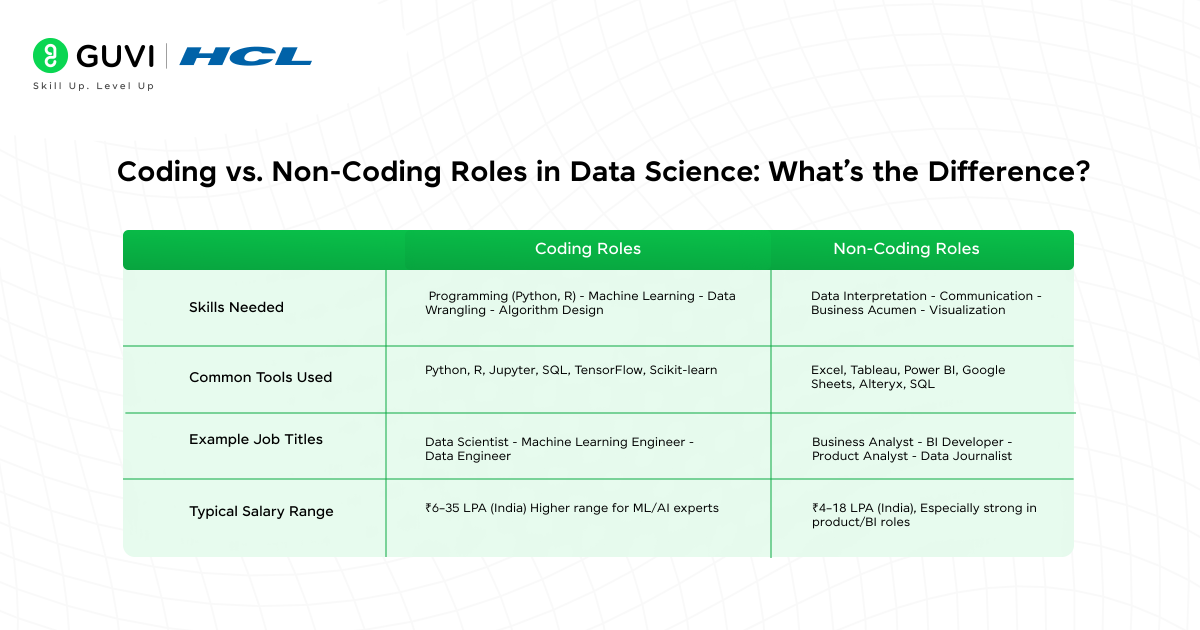
Not every data-related job has the same technical requirements. Understanding the difference between non-coding, low-code and coding-intensive roles can help you choose a career path that matches your current skills.
| Category | What It Means | Example Roles |
|---|---|---|
| Non-Coding | Programming is generally not a core responsibility | Data Annotator, some Business Analyst roles, Data Journalist |
| Low-Code | Uses visual tools, formulas, SQL, or limited scripting | Data Analyst, Data Visualization Designer, some Product Analyst roles |
| Coding-Intensive | Requires regular programming and technical development | Data Scientist, Machine Learning Engineer, ML Platform Engineer |
| Technical Leadership | May involve less daily coding but requires deep technical expertise | Data Science Manager, technical Data Science Consultant |
A role described as non-coding may still require technical knowledge. For example, a Data Analyst may use SQL to retrieve information, while a Data Product Manager may need to understand how data systems and analytics products work.
Top Career Paths in Data Science That Require Little to No Coding
As Data Science continues to evolve, so do the career opportunities within it. Many roles focus on data interpretation, communication, business strategy and analytical thinking, making them relevant to professionals from non-technical backgrounds.
However, not all these positions are entry-level or completely thriving in the field without a coding-heavy skill set. Some require years of industry experience, while others involve technical tools or programming. Here’s a comparison of the 13 career paths.
| Role | Coding Level | Avg Salary (India) | Skills Required | Entry Path |
| Business Analyst | Low or No coding | ₹9.5L – ₹10.5L/yr | Excel, Visio, JIRA, business acumen | CBAP/CCBA certification and process-documentation portfolio |
| Data Science Manager | Limited daily coding; strong technical knowledge | ₹37.1L – ₹41L/yr | Leadership, team management, project management, data science expertise, strategic decision-making and communication | Advanced degree in Data Science or a related field, combined with substantial experience in data science projects and team management |
| Data Science Consultant | Varies by consulting assignment | ₹19L – ₹21L/yr | Analytical thinking, data science knowledge, business acumen, problem-solving, communication and client management | Relevant degree or advanced training in Data Science, supported by experience in analytics projects and business problem-solving |
| Data Science Educator | Depends on subject and teaching role | ₹4L – ₹6L/yr | Data Science expertise, teaching ability, communication, curriculum development and mentoring | Relevant qualification or practical experience in Data Science, along with teaching experience or a portfolio of educational content |
| Data Analyst | Low to Moderate | ₹6.4L – ₹7.1L/yr | Excel, SQL, Tableau/Power BI, statistics | Google/Power BI/IBM certificate and dashboard portfolio |
| Data Visualization Specialist | Low-code or no-code, depending on tools | ₹4 – ₹8L/yr | Tableau, Power BI, design sense | Public dashboard portfolio on Tableau Public |
| Data Journalist | Low-Code or no-code | ₹4L – ₹9L/yr | Excel, Datawrapper, storytelling | Data journalism training and published data stories |
| Prompt Engineer | No coding | ₹6L – ₹6.6L/yr | Prompt writing, LLM behaviour, domain knowledge | GenAI/prompt engineering certificate |
| AI Trainer / Data Annotator | No coding | ₹4.5L – ₹5.3L/yr | Attention to detail, domain knowledge | On-the-job training , no certification required |
| Data Product Manager | Low-code to moderate | ₹24.5L – ₹28L/yr | Product thinking, data storytelling | Product-management training and prior analyst/BA experience |
| Data Privacy Officer | No coding | ₹16.1-17.8L/yr | Data law, compliance, audits | CIPP or CISSP certification |
| Data Ethicist | No coding | ₹13.3L – ₹14.7L/yr | Ethics, governance, critical thinking | Governance/compliance training |
| Machine Learning Engineer (deployment-focused) | Coding-intensive | ₹12.6L – ₹13.9L/yr | Deployment tools, light Python | Google/AWS ML deployment certification |
Salary figures are indicative estimates reproduced from the original article’s detailed role sections. They are not guaranteed offers or verified current market averages. Actual compensation varies by experience, location, employer, job responsibilities and skill level.
1. Business Analyst
Business analysts bridge the gap between data science and business operations. They use data to identify opportunities for improvement, develop strategies, and communicate findings to key stakeholders.

Roles and responsibilities:
- Gather and analyse business requirements.
- Identify process improvements and operational challenges.
- Facilitate communication between business and IT teams.
- Analyse processes and systems to improve efficiency.
Core Skills Required:
- Strong analytical skills
- Business acumen
- Communication
- Problem-solving
- Knowledge of business process modeling.
Tools and Software Knowledge:
- Microsoft Visio
- Microsoft Excel
- JIRA
- Project management software
Relevant Certifications and Training:
CBAP (Certified Business Analysis Professional) or CCBA (Certification of Capability in Business Analysis)
Salary Range: ₹9.5L – ₹10.5L/yr
Career Growth and Progression Paths: Business Analyst → Senior Business Analyst → Product Manager or Project Manager.
Companies Hiring for Business Analysts:
- Amazon
- Microsoft
- Flipkart
Work Flexibility (depending on company policies and job requirements):
- Work in-office
- Remotely
- Hybrid model
A Business Analyst role can suit professionals who understand business processes and enjoy solving operational problems.
If you have experience in finance, operations or project coordination, your existing domain knowledge can be useful when transitioning into this role.
2. Data Scientist Manager
Data science managers oversee the entire data science team, ensuring that projects are on track and aligned with the company’s objectives. They may not code themselves but understand the technical aspects of data science.

Roles and responsibilities:
- Oversee Data Science teams.
- Ensure projects align with organisational objectives.
- Manage project timelines and team performance.
- Make strategic decisions about Data Science initiatives.
Core Skills Required:
- Strong leadership
- Project management
- Data science expertise
- Communication
- Problem-solving skills
Tools and Software Knowledge:
- Python
- R
- Machine learning libraries
- Data analytics tools
Relevant Certifications and Training: Have advanced degrees in data science or related fields and extensive experience in data science.
Salary Range: ₹37.1L/yr-₹41L/yr
Career Growth and Progression Paths: Data Science Manager → Director of Data Science → Chief Data Officer.
Companies Hiring for Data Scientist Manager:
- Amazon
- Microsoft
- Flipkart
Work Flexibility (depending on company policies and job requirements):
- Work in-office
- Remotely
- Hybrid model
This is one of the higher-paying career paths in the list, but it is not generally an entry-level non-coding job.
Professionals usually need substantial experience managing teams, understanding analytical projects and making data-driven business decisions.
3. Data Science Consultant
Consultants provide expert advice to businesses on data science strategies and solutions. They help organisations understand how to use data to solve business problems and improve decision-making.

Roles and Responsibilities:
- Assess a client’s data requirements.
- Develop data strategies.
- Recommend data-driven solutions.
- Help businesses use data for competitive advantage.
Core Skills Required:
- Strong analytical skills
- Data science expertise
- Communication
- Problem-solving
- Business acumen
Tools and Software Knowledge:
- Data science tools
- Analytics platforms
- Know various data analysis
- Visualization software.
Relevant Certifications and Training: Advanced degrees in data science or related fields
Salary Range: ₹19.0L – ₹21L/yr
Career Growth and Progression Paths: Data Science Consultant → Senior Consultant → Specialist Consultant or Independent Consultant.
Companies Hiring for Data Science Consultants:
- Deloitte
- Accenture
- TCS
Work Flexibility (depending on company policies and job requirements):
- Work in-office
- Remotely
- Hybrid model
Consulting can be suitable for professionals who enjoy working with different business problems and communicating recommendations to clients.
Although some consulting assignments involve less hands-on coding, technical Data Science consulting positions may require programming and advanced analytical knowledge.
4. Machine Learning Engineer
Machine Learning Engineers develop, deploy and maintain machine learning models. Their work involves ensuring that models function efficiently in production environments.
While some positions focus more heavily on deployment and optimization than model development, Machine Learning Engineering is generally a coding-intensive career. It should not be considered a typical non-coding Data Science job.

Roles and Responsibilities:
- Develop, deploy and maintain machine learning models.
- Focus on model deployment and optimization.
- Work closely with Data Scientists and software engineers.
- Ensure that machine learning models work efficiently in production.
Do have a look at the roles and responsibilities of a machine learning engineer before getting into it.
Core Skills Required:
- Strong programming skills in languages like Python
- Machine learning expertise
- Knowledge of deep learning frameworks
- Proficiency in model deployment.
Tools and Software Knowledge:
- TensorFlow
- PyTorch
- Docker
- Kubernetes
Relevant Certifications and Training: Google Professional Machine Learning Engineer or AWS Certified Machine Learning
Salary Range: ₹12.6L – ₹13.9L/yr
Career Growth and Progression Paths: Machine Learning Engineer → Senior Machine Learning Engineer.
Companies Hiring for Machine Learning Engineers:
- Amazon
- Microsoft
- Flipkart
Work Flexibility (depending on company policies and job requirements):
- Work in-office
- Remotely
- Hybrid model
If your main objective is to avoid programming, this may not be the right starting point. However, it can be an option for professionals who are willing to develop stronger technical skills over time.
5. Data Product Manager
Data Product Managers collaborate with cross-functional teams to develop data-driven products and services. Their role involves defining product roadmaps and prioritising features based on data insights.

Core Skills Required:
- Strong product management skills
- Data analysis and interpretation
- Communication
- Ability to translate data insights into product features
Tools and Software Knowledge:
- Product management tools
- Data analytics platforms
- Project management software
Relevant Certifications and Training: Training in product management and data analysis can be beneficial
Salary Range: ₹24.5L – ₹28L/yr
Career Growth and Progression Paths: Data Product Manager → Senior Product Manager → Product Leadership roles.
Companies Hiring for Data Product Manager:
- Amazon
- PayPal
Work Flexibility (depending on company policies and job requirements):
- Work in-office
- Remotely
- Hybrid model
Data Product Management can be a high-paying career path, but the role usually requires more than basic data tool knowledge.
Prior experience in product management, business analysis or analytics can help professionals understand user requirements and manage data-driven products.
6. Data Privacy Officer
With increased concern about data privacy, companies need professionals to manage data security and compliance. Data Privacy Officers ensure that data is handled responsibly and following regulations.

Roles and Responsibilities:
- Ensure data is handled responsibly.
- Implement data protection regulations.
- Safeguard an organisation’s data assets and privacy.
- Develop and implement data privacy policies.
- Conduct audits and ensure compliance with data protection laws.
Core Skills Required:
- Strong knowledge of data protection laws
- Legal compliance, risk assessment
- Communication
- Ability to create and enforce data privacy policies.
Tools and Software Knowledge:
- Privacy management and compliance tools
- Data protection software
Relevant Certifications and Training: Certified Information Privacy Professional (CIPP) and Certified Information Systems Security Professional (CISSP)
Salary Range: ₹16.1L – 17.8L/yr
Career Growth and Progression Paths: Data Privacy Officer → Chief Privacy Officer or other senior privacy and security leadership roles.
Companies Hiring for Data Privacy Officer:
- Tech Mahindra
- Infosys
- Amazon
Work Flexibility (depending on company policies and job requirements):
- Work in-office
- Remotely
- Hybrid model
This role can suit professionals with backgrounds in law, compliance, risk management or information security.
It involves understanding how organisations collect, store and use data rather than developing software applications.
7. Data Visualization Designer
Data visualization designers create compelling and easy-to-understand visuals that convey complex data. They help businesses present data in a way that makes it accessible to stakeholders and supports decision-making.

Roles and Responsibilities:
- Create clear and engaging data visualizations.
- Design dashboards.
- Develop infographics and reports.
- Communicate data insights to stakeholders.
Core Skills Required:
- Data visualization tools
- Graphic design
- Creativity
- Communication
- Ability to simplify complex data.
Tools and Software Knowledge:
- Tableau
- Power BI
- Adobe Illustrator
- Data visualization libraries
- D3.js
Relevant Certifications and Training: Training in data visualization and graphic design
Salary Range: ₹4L – ₹8L/yr
Career Growth and Progression Paths: Lead Data Visualization Designer or Data Visualization Manager.
Companies Hiring for Data Visualization Designer:
- McKinsey
- Government departments
Work Flexibility (depending on company policies and job requirements):
- Work in-office
- Remotely
- Hybrid model
This role can be relevant for professionals from graphic design, UI/UX and communication backgrounds.
A portfolio of dashboards, reports and visual storytelling projects can help demonstrate your ability to present information clearly.
8. Data Ethicist
Data Ethicists work on the ethical implications of data usage, ensuring that data-driven decisions align with ethical principles. They help organisations consider fairness, accountability, transparency and responsible data practices.

Roles and Responsibilities:
- Assess the ethical implications of data-related decisions.
- Review practices to ensure ethical compliance.
- Offer guidance to organisations.
- Facilitate discussions around responsible data usage.
Core Skills Required:
- Strong ethics knowledge
- Communication
- Critical thinking
- Ability to apply ethical principles to data practices.
Tools and Software Knowledge:
- Data governance
- Compliance tools.
Relevant Certifications and Training: Training in ethics, data governance, and compliance can be valuable.
Salary Range: ₹13.3L – ₹14.7L/yr
Career Growth and Progression Paths: Progress into senior positions within data ethics, governance and compliance departments.
Companies Hiring for Data Ethicist:
- KPMG
- Kainos
- Accenture
Work Flexibility (depending on company policies and job requirements):
- Work in-office
- Remotely
- Hybrid model
Data ethics can be relevant to professionals with backgrounds in law, public policy, governance, research or compliance.
However, specialised roles may require prior experience and a strong understanding of how data systems operate.
9. Data Science Educator
Data Science Educators teach aspiring professionals the skills and knowledge required for Data Science careers. They may work in academic institutions, training organisations or online education platforms.

Roles and Responsibilities:
- Teach Data Science concepts and practical skills.
- Design and deliver data learning programmes.
- Create educational materials.
- Mentor students and help them develop relevant skills.
Core Skills Required:
- Proficiency in data science
- Strong communication
- Teaching ability
- Deep understanding of data science concepts.
Tools and Software Knowledge:
- Proficient in data science tools
- Python and R
Relevant Certifications and Training: Advanced degrees in data science
Salary Range: ₹4L – ₹6L/yr
Career Growth and Progression Paths: Data Science Educator → Senior Educator → Professor or Educational Leadership roles.
Companies Hiring for Business Analysts:
- Coursera
- Udemy
- edX
Work Flexibility (depending on company policies and job requirements):
- Work in-office
- Remotely
- Hybrid model
This career can suit professionals who enjoy teaching, explaining technical concepts and mentoring learners.
Although the role involves communication, educators teaching technical subjects still need a strong understanding of the relevant tools and concepts.
10. Data Analyst
Data Analysts collect, clean and interpret datasets to help organisations make better decisions. Unlike Data Scientists, Data Analysts focus primarily on describing what has happened and why, rather than building predictive models.
This makes the role relevant to freshers and career switchers who have strong logical thinking and are comfortable working with structured data tools.
Roles and Responsibilities:
- Collect, clean and interpret structured data.
- Build reports and dashboards for business decisions.
- Identify trends and anomalies in data.
- Present findings to non-technical teams in plain language.
Core Skills Required:
- Proficiency in Excel and Google Sheets
- SQL for querying databases
- Data visualisation using Tableau or Power BI
- Basic statistics and logical reasoning
- Strong communication and storytelling with data
Tools and Software Knowledge:
- Microsoft Excel
- Google Sheets
- SQL
- Tableau
- Power BI
- Looker
Relevant Certifications and Training: Google Data Analytics Professional Certificate, Microsoft Power BI Data Analyst Certification, or IBM Data Analyst Professional Certificate
Salary Range: ₹6.4L – ₹7.1L/yr
Career Growth and Progression Paths: Junior Data Analyst to Senior Data Analyst to Analytics Manager or transition into Business Intelligence or Product Analytics roles.
Companies Hiring for Data Analysts:
- Swiggy
- Zomato
- Razorpay
- TCS
- Deloitte
Work Flexibility (depending on company policies and job requirements):
- Work in-office
- Remotely
- Hybrid model
Data Analyst roles are not always completely non-coding. Many employers expect candidates to understand SQL, and some positions may involve Python or other technical tools.
However, you can begin with Excel, basic statistics and visualization tools before developing more advanced technical skills.
11. Prompt Engineer
Prompt engineering involves designing, testing and refining instructions given to large language models such as ChatGPT, Gemini and Claude. The objective is to make AI systems produce accurate, useful and relevant outputs.
Some prompt-focused roles require little programming, especially those involving writing, testing and evaluating prompts. However, technical roles may require Python, APIs and software integration.

Roles and Responsibilities:
- Design and optimise prompts for generative AI systems.
- Act as a bridge between human intent and AI-generated output.
- Write, test and refine prompts for different use cases.
- Document prompt workflows and best practices.
- Evaluate AI-generated outputs for accuracy, safety and relevance.
- Collaborate with product teams to integrate AI into business workflows.
- Exceptional written communication and logical reasoning
- Understanding of how large language models behave and what affects their outputs
- Domain expertise in the industry the AI is being applied to
- Attention to detail and systematic testing mindset
Tools and Software Knowledge:
- ChatGPT, Claude, Gemini (prompt testing interfaces)
- LangChain (basic usage, no coding required for many use cases)
- Notion or Confluence for documentation
- Spreadsheets for prompt tracking and evaluation logs
Relevant Certifications and Training: DeepLearning.AI Prompt Engineering course, Google’s Prompt Design in Vertex AI, or GUVI’s Generative AI courses
Salary Range: ₹6L – ₹6.6L/yr
Career Growth and Progression Paths: Junior Prompt Engineer → Senior Prompt Engineer → AI Product Specialist or Conversational AI Lead.
Companies Hiring for Prompt Engineers:
- Accenture
- Infosys
- Wipro
- AI-focused startups
- Global product companies building LLM-powered features
Work Flexibility (depending on company policies and job requirements):
- Work in-office
- Remotely
- Hybrid model
Prompt engineering can be relevant to professionals with backgrounds in writing, communication, research, education and business.
However, it is important to review job descriptions carefully because some positions combine prompt design with software development and technical integration.
12. AI Trainer and Data Annotator
AI trainers and data annotators make AI systems smarter. Every machine learning model needs labelled training data, and labelling requires human judgement, domain knowledge, and careful attention to quality.
As generative AI and computer vision models become embedded in every product category, the demand for people who can review, label, and provide feedback on AI outputs has surged significantly in 2026.

Roles and Responsibilities:
- Label and annotate text, images, audio and video.
- Review AI outputs for accuracy, safety and alignment with intended behaviour.
- Follow detailed annotation guidelines.
- Provide structured feedback to help AI models improve.
- Maintain consistency and accuracy across datasets.
Core Skills Required:
- Strong attention to detail and ability to follow precise guidelines
- Good language skills (English plus regional languages for Indian market roles)
- Domain expertise is valuable (medical annotators, legal annotators, finance reviewers)
- Logical consistency in applying labelling criteria across varied examples
Tools and Software Knowledge:
- Annotation platforms like Scale AI, Labelbox, or Amazon SageMaker Ground Truth
- Microsoft Excel and Google Sheets for tracking
- Internal proprietary annotation tools used by large tech companies
Relevant Certifications and Training: No formal certification required. Most companies provide on-the-job annotation guidelines and training.
Salary Range: ₹4.5L/yr-₹5.3L/yr
Career Growth and Progression Paths: Data Annotator to Annotation Team Lead to AI Quality Assurance Specialist or AI Training Programme Manager.
Companies Hiring for AI Trainers and Data Annotators:
- Amazon Mechanical Turk (MTurk) and Amazon AI
- Appen
- Outlier AI
- iMerit
Work Flexibility (depending on company policies and job requirements):
- Work in-office
- Remotely (many annotation roles are fully remote and flexible-hours)
- Hybrid model
This can be an accessible starting point for freshers and professionals from language, research or domain-specific backgrounds.
However, pay, work availability and employment arrangements can vary significantly between full-time roles, contract work and project-based assignments.
13. Data Journalist
Data Journalists combine traditional journalism skills with the analytical capabilities of a data professional.
They use publicly available datasets, government records, corporate filings and survey data to uncover stories, verify claims and present complex information in a way that general audiences can understand.

Roles and Responsibilities:
- Source, clean and analyse data to identify stories.
- Present data-driven findings through written, visual or interactive formats.
- Source information from government portals, APIs and public records.
- Create data visualizations, maps and charts.
- Fact-check data claims.
- Collaborate with designers and developers to build interactive data stories.
Core Skills Required:
- Strong writing and narrative skills
- Ability to find, clean, and interpret data from public sources
- Basic data visualisation using Datawrapper, Flourish, or Tableau Public
- Critical thinking and editorial judgement
- Understanding of statistics sufficient to verify claims and avoid misleading readers
Tools and Software Knowledge:
- Microsoft Excel and Google Sheets
- Datawrapper
- Flourish
- Tableau Public
- OpenRefine (for data cleaning)
- SQL (basic, for querying public databases)
Relevant Certifications and Training: Knight Center for Journalism in the Americas online courses, Google News Initiative training, or the European Journalism Centre data journalism programmes
Salary Range: ₹4L – ₹9L/yr
Career Growth and Progression Paths: Junior Data Reporter → Senior Data Journalist → Data Editor or Head of Interactives.
Companies Hiring for Data Journalists:
- The Hindu
- Hindustan Times
- Economic Times
- NDTV Data
- Reuters
- BBC Data Journalism team
Work Flexibility (depending on company policies and job requirements):
- Work in-office
- Remotely
- Hybrid model
This role can suit professionals with backgrounds in journalism, content writing, communication, economics and social sciences.
Research, fact-checking and storytelling skills can provide a useful starting point, while spreadsheet and visualization skills help strengthen your profile.

Which Non-Coding Data Science Job Is Best for Freshers?
Not every position in the list is suitable for someone starting their career.
Data Science Manager and Data Product Manager, for example, generally require relevant professional experience.
Freshers should prioritize roles that offer opportunities to develop analytical skills while working on practical business problems.
| Entry-Level Role | Coding Requirement | Recommended Starting Skills |
|---|---|---|
| Data Annotator | Usually none | Attention to detail, quality review |
| Junior Business Analyst | None to low | Excel, process mapping, documentation |
| Data Visualization Associate | Low | Power BI, Tableau, dashboard design |
| Junior Data Analyst | Low to moderate | Excel, SQL, basic statistics |
| Reporting Analyst | Low | Excel, reporting, Power BI |
| AI Response Evaluator | Usually none | Language skills, AI literacy, evaluation |
| Data Journalism Intern | None to low | Research, spreadsheets, storytelling |
If you’re a fresher, focus on the skills and responsibilities expected in entry-level job descriptions rather than choosing a role based only on its senior-level salary.
Which Role Should You Choose?
The right career depends on your strengths, interests and willingness to learn technical tools.
- If you enjoy solving business problems, consider Business Analysis.
- If you prefer visual communication, explore Data Visualization.
- If you’re comfortable with numbers and reporting, Data Analytics may be suitable.
- If you enjoy writing and research, Data Journalism or AI evaluation could be relevant.
- If you have experience in product development or business strategy, explore Data Product Management.
- If you’re interested in privacy, compliance and responsible data usage, consider Data Privacy or Data Ethics.
Before choosing, compare the job responsibilities, experience requirements, salary expectations and technical skills needed for each role.
How to Transition from a Non-IT Background to a Data Science Career
You don’t necessarily need a Computer Science degree to enter a data-related role.
Many professionals already use data in their daily work without identifying themselves as analytics professionals.
For example, marketing teams analyse campaign performance, finance professionals review budgets, and operations employees monitor productivity.
These activities can provide a useful foundation for transitioning into data-focused careers.
Career Transition Opportunities
| Current Background | Suitable Data Career | Transferable Skills |
|---|---|---|
| Marketing | Marketing Analyst, Data Analyst | Campaign reporting, customer insights |
| Finance and Accounting | Financial Analyst, Business Analyst | Reporting, reconciliation, financial KPIs |
| Operations | Operations Analyst, Business Analyst | Process improvement, performance monitoring |
| Human Resources | HR Analyst, People Analytics Associate | Employee reporting, workforce metrics |
| Content Writing | Data Journalist, AI Evaluator | Research, storytelling, fact-checking |
| Graphic / UX Design | Data Visualization Designer | Visual hierarchy, usability, information design |
| Teaching | Data Science Educator, AI Trainer | Communication, instruction, assessment |
| Customer Support | Customer Experience Analyst | Customer feedback, service metrics |
Your previous experience can help you understand the business context behind the data. The next step is to identify the tools and analytical skills required for the role you want to pursue.
Data science non-coding roles at product vs service companies
The type of organisation you join can influence your responsibilities, work environment and career progression.
At product-based companies (Amazon, Flipkart, Google), non-coding data roles like Business Analyst and Data Product Manager work inside cross-functional teams and are expected to interpret data independently using SQL and BI tools.
At service-based companies (TCS, Infosys, Accenture), similar roles are more client-facing and documentation-heavy, relying on Excel and stakeholder meetings rather than direct data querying.
Product companies:
- Greater ownership of products and business outcomes.
- Direct use of BI and analytics tools.
- Opportunities to work with cross-functional product teams.
- Potentially higher compensation in some roles.
- More competitive entry requirements.
Service companies:
- Client-delivery focus.
- Documentation and stakeholder coordination.
- Structured project environments.
- Opportunities to build experience across different industries.
The right choice depends on your experience and current skills. If you have limited data experience, focus on building practical projects and applying for suitable entry-level openings.
If you already have relevant experience, you can explore specialised roles in product and analytics teams.
How to Get a Non-Coding Data Science Job: 7-Step Roadmap
Step 1: Choose a Suitable Career Path
Start by identifying a role that matches your interests.
For example, Business Analysis may suit someone interested in operations and strategy, while Data Visualization may suit someone with design skills.
What to Do: Review 15–20 relevant job descriptions and identify recurring requirements.
Step 2: Learn Basic Data Concepts
Understand how organizations collect, organize, interpret, and use information.
What to Learn:
- Data types
- Basic statistics
- Data cleaning
- Business KPIs
- Charts and dashboards
- Data quality fundamentals
Why It Matters: These concepts provide a foundation for most data-related roles.
Step 3: Master Relevant Tools
Choose tools based on the role.
For example:
- Business Analyst: Excel, Jira, process mapping
- Data Analyst: Excel, SQL, Power BI
- Data Visualization Designer: Tableau, Power BI, Figma
- AI Trainer: Annotation platforms and spreadsheets
- Data Journalist: Excel, Datawrapper, Flourish
Why It Matters: Employers generally evaluate your ability to use relevant tools in practical situations.
Step 4: Build Portfolio Projects
Create two or three projects demonstrating your abilities.
You can use public datasets or realistic fictional business scenarios.
Examples:
- Sales performance dashboard
- Customer feedback analysis
- Business process improvement case study
- Data visualization report
- AI response evaluation framework
Why It Matters: A portfolio helps demonstrate practical skills beyond course completion.
Step 5: Develop Communication Skills
Data professionals must explain their findings clearly.
Practise presenting insights, documenting requirements, and recommending actions.
Why It Matters: Employers value candidates who can translate information into business decisions.
Step 6: Prepare Your Resume and Apply Strategically
Highlight relevant tools, transferable experience, and practical projects.
Search for specific titles rather than only using broad keywords such as “Data Science jobs.”
Job Titles to Search:
- Junior Business Analyst
- Reporting Analyst
- Data Visualization Associate
- Junior Data Analyst
- AI Data Annotator
- AI Response Evaluator
- Marketing Analyst
Step 7: Continue Upskilling
Once you gain experience, develop more advanced skills.
For example, a Reporting Analyst may learn SQL and progress into Data Analytics.
A Data Visualization Designer may develop business intelligence expertise.
A Business Analyst may move toward Product Management.
Key takeaway: You don’t need to learn every technical skill before applying. Focus on the requirements of your chosen role and demonstrate practical ability.
Best Tools to Learn for Non-Coding Data Science Jobs
Tools are important because they help professionals work with information without necessarily building software from scratch.
1. Microsoft Excel
Excel is widely used for organizing information, calculations, reporting, and basic analysis.
Skills to Learn:
- PivotTables
- XLOOKUP
- Charts
- Conditional formatting
- Data cleaning
- Power Query
Best For: Business Analysts, Reporting Analysts, and entry-level Data Analysts.
2. Power BI
Power BI helps transform datasets into interactive dashboards and reports.
Skills to Learn:
- Data import
- Power Query
- Data modelling
- Dashboard design
- Basic DAX
Best For: Data Analysts, Business Intelligence professionals, and Data Visualization Designers.
3. Tableau
Tableau is a visualization platform used to explore information and build interactive dashboards.
Skills to Learn:
- Connecting datasets
- Creating charts
- Filters and parameters
- Dashboard layouts
- Data storytelling
Best For: Data Visualization Designers and analytics professionals.
4. SQL
SQL is used to retrieve, filter, join, and summarize information stored in relational databases.
Although it involves writing queries, it is often easier to approach than general-purpose programming.
Skills to Learn:
- SELECT
- WHERE
- GROUP BY
- JOIN
- ORDER BY
- Aggregate functions
Best For: Data Analysts, BI Analysts, and analytics-focused Business Analysts.
5. Google Sheets
Google Sheets supports collaborative data organization, reporting, and analysis.
Skills to Learn:
- Formulas
- Pivot tables
- Charts
- Data validation
- Collaboration
Best For: Reporting, operations, marketing, and entry-level analytics.
6. Datawrapper and Flourish
These tools help create charts, maps, and interactive visual stories.
Best For: Data Journalists, content creators, and visualization professionals.
7. AI Tools
AI assistants can help with explaining analytical concepts, drafting documentation, and exploring data questions.
However, AI-generated calculations and conclusions should always be verified.
Best For: Research, learning, documentation, and supporting analytical workflows.
How to Improve Your Salary in Non-Coding Data Science Roles
Entering a data-related career without programming is possible, but salary growth depends on your skills and responsibilities.
1. Develop Strong Tool Proficiency
Learn Excel, Power BI, Tableau, or other tools relevant to your chosen role.
2. Build Domain Expertise
Understanding finance, healthcare, retail, marketing, or operations can make your analytical work more valuable.
3. Learn SQL Where Relevant
SQL can expand opportunities in reporting, business intelligence, and analytics.
4. Improve Data Storytelling
Learn how to explain findings and recommend actions rather than simply presenting numbers.
5. Take Ownership of Business Problems
Look for opportunities to improve processes, reporting quality, or decision-making.
6. Demonstrate Measurable Outcomes
Document improvements you’ve contributed to, such as reduced reporting time or better operational visibility.
Use actual results rather than invented percentages.
7. Progress into Specialized Roles
As you gain experience, consider Business Intelligence, product analytics, governance, consulting, or leadership pathways.
Common Mistakes to Avoid When Choosing Non-Coding Data Science Jobs
1. Assuming Every Data Job Is Coding-Free
Some positions advertised as non-coding still require SQL, DAX, Python, or other technical skills.
Better Approach: Read the job description carefully.
2. Learning Too Many Tools at Once
Trying to master Excel, SQL, Python, Tableau, and Power BI simultaneously can slow your progress.
Better Approach: Focus on tools required for one target role.
3. Relying Only on Certifications
Certifications can demonstrate learning, but they don’t replace practical ability.
Better Approach: Build portfolio projects and explain your work.
4. Ignoring Business Understanding
Technical tools alone aren’t enough to solve organizational problems.
Better Approach: Learn how data supports business decisions.
5. Applying Only for High-Salary Positions
Senior management and product roles generally require professional experience.
Better Approach: Target realistic entry-level positions and build toward senior opportunities.
6. Presenting AI-Generated Work Without Verification
AI-generated dashboards, calculations, and explanations may contain errors.
Better Approach: Verify your work and understand every conclusion you present.
💡 Did You Know?
- India’s data analytics market is projected to grow from USD 4.3 billion in 2023 to over USD 17 billion by 2030, according to NASSCOM, creating demand for both technical and non-technical data professionals at every experience level.
- Prompt Engineering was listed among the Top 10 fastest-growing tech roles in India in LinkedIn’s Emerging Jobs Report 2026, making it one of the newest genuinely accessible non-coding jobs in data science for people from communication, education, and business backgrounds.
Future Scope of Non-Coding Data Science Careers in 2026 and Beyond
The broader data and AI ecosystem continues to create opportunities for professionals with analytical, business, and communication skills.
1. AI Evaluation and Quality Assurance
AI systems require testing, human feedback, and quality assessment. Professionals with strong language and evaluation skills may find relevant opportunities.
2. Business Intelligence and Visualization
Organizations need accessible reports and dashboards to support decisions.This makes data visualization and business reporting useful areas for skill development.
3. Data Privacy and Governance
Data handling responsibilities create a need for privacy, compliance, and governance expertise.
4. Product Analytics
Product teams use data to understand user behaviour, evaluate features, and monitor performance.
5. Data Storytelling
Businesses and media organizations need professionals who can explain complex information clearly.
6. Human-AI Collaboration
Generative AI is changing how professionals research, analyse, document, and communicate information. Learning how to evaluate AI outputs and use AI responsibly can complement existing skills. These trends indicate areas worth exploring, but they do not guarantee job availability or salary growth.
Want to Start Your Career in Data Science?
You don’t need to become an expert programmer overnight to begin exploring the data field.Start by building foundational skills in data analysis, visualization, statistics, and problem-solving.
HCL GUVI’s Data Science Program offers structured learning in areas such as Python, SQL, statistics, machine learning, and data visualization.
While the program includes programming concepts, these foundations can support learners who want to explore analytics careers and eventually move into more technical Data Science roles.
Conclusion
A career in the data ecosystem doesn’t always require advanced programming. From Business Analysis and Data Visualization to Data Journalism, AI evaluation, and privacy governance, there are opportunities for professionals who enjoy working with information, solving problems, and communicating insights.
However, it’s important to distinguish genuinely non-coding roles from low-code and technical positions. Data Analysts may need SQL, Prompt Engineers may need technical integration skills, and Machine Learning Engineers generally require substantial programming expertise.
If you’re a fresher or career switcher, start by identifying a role that matches your strengths. Learn the relevant tools, build practical projects, develop a portfolio, and apply for opportunities that align with your experience. You don’t have to become a programmer to begin working with data. You need to understand how to turn information into meaningful decisions.
FAQs
1. What are the top Non-Coding Jobs in Data Science?
Some top non-coding data science job roles include Data Analyst, Data Visualization Specialist, Business Analyst, and Machine Learning Engineer.
2. Which industries are actively hiring for non-coding jobs in data science?
Industries such as finance, healthcare, e-commerce, and marketing are actively hiring non-coding data science professionals in India to make data-driven decisions.
3. What non-coding jobs in data science are known for providing flexible working arrangements?
Data Analyst and Business Analyst roles in India often offer flexible working arrangements, including remote work options.
4. What tools and software should a non-coding data science professional be familiar with?
Proficiency in tools like Excel, Tableau, Power BI, and data visualization software is essential for non-coding data science professionals in India.
5. Is SQL considered coding?
SQL is a query language used to interact with databases. It involves writing commands, although it differs from general-purpose programming languages such as Python and Java.
6. Which non-coding Data Science job pays the most?
Senior Data Product Manager, Data Science Manager, and specialized consulting positions may offer high compensation, but they generally require substantial experience and may involve technical expertise.
7. Is Prompt Engineering a non-coding career?
Some prompt-focused roles require little programming, especially those involving writing, testing, and evaluation. Technical roles may require Python, APIs, and software integration.
8. Can a non-IT graduate get a job in the Data Science field without coding?
Yes. A non-IT graduate can explore roles such as Business Analyst, Data Visualization Associate, AI Evaluator and certain reporting positions. Learning Excel, basic statistics, visualization tools and relevant domain concepts can help build a foundation. Some roles may also require SQL or programming skills.
9. Can I get a high-paying data job without prior experience?
High-paying roles such as Data Science Manager and Data Product Manager generally require professional experience. Freshers should focus on suitable entry-level positions, build practical projects and develop relevant skills before progressing towards senior roles.
10. How can I increase my salary in a non-coding data role?
Develop proficiency in role-specific tools, build domain expertise, improve data storytelling and take ownership of business problems. Learning SQL where relevant and demonstrating measurable contributions can also help support career progression.
Success Stories

About the Author
Hashmithaa
Hi, I’m Hashmithaa — a content writer with a love for words. Writing isn’t just what I do; it’s how I connect, communicate, and create meaning in a noisy digital world. And if my words help someone make a better decision, learn something new, or feel more confident, then I’ve done my job well.
View all posts by Hashmithaa
Connect with me @















Did you enjoy this article?