Quick Answer
A Data Scientist collects, cleans, analyzes, and models data to solve business problems — turning raw data into insights, predictions, and decision-support systems. Core responsibilities include data collection, EDA, feature engineering, machine learning model building, evaluation, visualization, and ethical data handling. In 2026, the role also expects comfort with AI tools, cloud platforms, and clear business communication.
TL;DR
- Data Scientists don’t just build models — most of the job is data collection, cleaning, and communicating insights.
- Core skills: Python/R, SQL, Statistics, Machine Learning, Visualization, Business Understanding.
- Salary in India ranges ₹4 LPA (fresher) to ₹35 LPA+ (senior), depending on experience.
- Best suited for people comfortable with ambiguity, who like connecting technical work to real business decisions.
- If you want quicker, more defined day-to-day work, Data Analyst is often a better starting point before growing into this role.
Role at a Glance: Data Scientist Roles, India 2026
- Avg Salary: ₹4-35 LPA, Glassdoor, India (2026)
- Time to Learn: 6-12 Months to become job-ready
- Top Hiring Companies: Google, Amazon, Microsoft, IBM, Accenture
- Job Openings: 1,000+ Entry-Level Jobs, LinkedIn (India, 2026)
- GUVI graduates hired at 500+ companies
Every company collects data — from websites, apps, payments, customer support, marketing campaigns, and daily operations. But raw data alone doesn’t help anyone unless someone can clean it, analyze it, and turn it into a decision worth acting on.
The scale of that gap is significant. According to NASSCOM, nearly 2.9 million data related positions across engineering, analytics, and governance functions remain unfilled globally, and the report notes that hiring alone will not close it. What actually closes it is skilled people who can turn raw data into decisions companies can trust and act on, and that’s exactly the role a Data Scientist plays.
Using statistics, programming, machine learning, and business understanding, a Data Scientist solves real problems with data rather than just building models for their own sake. This guide covers the key roles and responsibilities of a Data Scientist, required skills, tools, daily workflow, how much it pays in India, and how to know if it’s the right career for you.
Who is a Data Scientist?
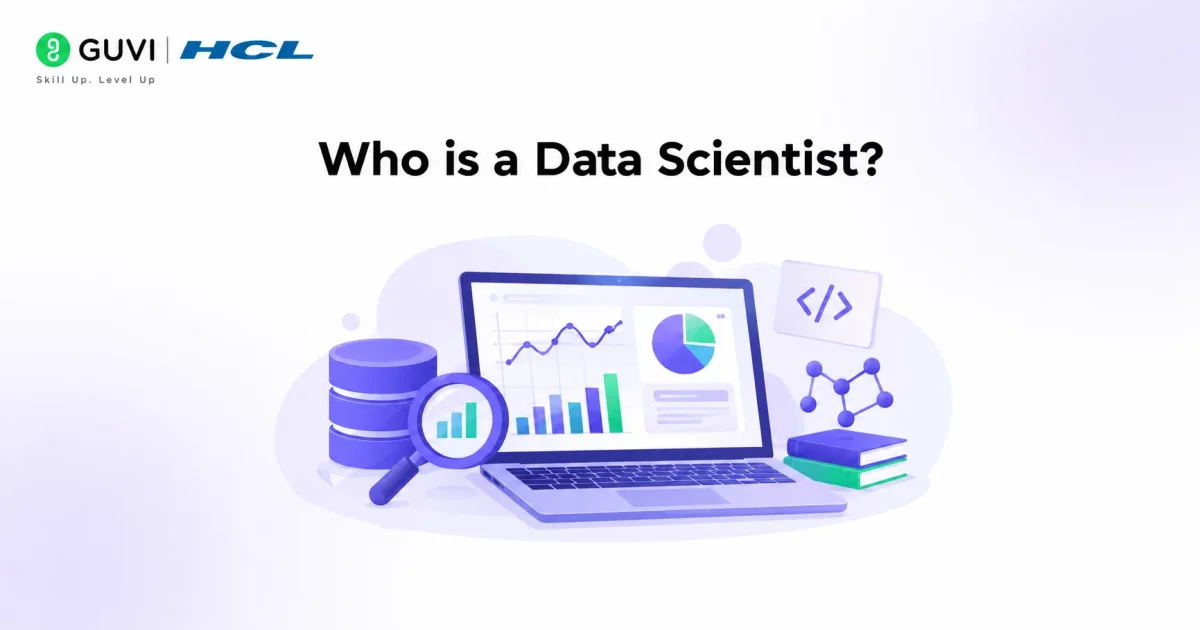
A data scientist is a tech professional who collects, analyzes, and interprets large amounts of data using analytical, statistical, and programming skills. They mine valuable information from various sources and transform it into actionable insights that drive business growth.
In today’s data-driven world, organizations rely on data scientists to uncover patterns, identify trends, and develop solutions to complex business problems, not just build models in isolation, which is what makes data scientist roles so central to modern decision-making.
Before going deeper into data scientist roles, make sure you have a solid grip on data science essentials like Python, SQL, Pandas, NumPy, and basic visualization tools like Tableau and Power BI. GUVI’s Data Science Course covers these fundamentals with real-time projects and placement assistance.
Where a Data Scientist Fits in the Team
A Data Scientist rarely works alone, and understanding who sits around them explains a lot about what data scientist roles actually involve day to day.
Who a Data Scientist typically works with, across most data scientist roles:
- Data Engineers: build and maintain the pipelines and infrastructure that feed clean, reliable data to the Data Scientist. Without this foundation, a Data Scientist spends most of their time firefighting data access issues instead of analysis.
- ML Engineers: take a Data Scientist’s model from a notebook and turn it into a production system that scales, handles real traffic, and gets monitored. The handoff between Data Scientist and ML Engineer is one of the most common team boundaries in larger organizations.
- Data Analysts: often work alongside Data Scientists on the same team, handling more routine reporting and dashboard work while the Data Scientist tackles deeper, more exploratory problems.
- Product Managers: bring the business problem to the table and work with the Data Scientist to translate it into something measurable, like defining what “churn” actually means for an upcoming campaign.
- Business Stakeholders: the people a Data Scientist ultimately reports results to, whether that’s a marketing lead, a finance team, or company leadership.
How team structure shifts with company size across data scientist roles:
- Startups: a single Data Scientist often wears every hat, data engineering, analysis, modeling, and communication all at once, with little specialization.
- Mid-size companies: teams typically split into Data Scientist, Data Analyst, and Data Engineer as distinct roles, though one person may still cover more than one function.
- Large enterprises: highly specialized teams exist, with separate Data Scientists, ML Engineers, Data Engineers, Analytics Engineers, and MLOps specialists each owning a narrow slice of the pipeline, usually organized under a Data Science Manager or Director.
Where a Data Scientist typically reports: most commonly into a Data Science Manager, Head of Analytics, or Director of Data Science, who in turn usually reports into a VP of Data, VP of Engineering, or Chief Data Officer at larger companies.
Data Scientist Roles and Responsibilities: Quick Summary Table
| Responsiblity | What a Data Scientist Does | Common Tools Used | Business Outcome |
| Data Collection | Gathers data from databases, APIs, apps, CRM tools, and cloud platforms | SQL, APIs, Python, BigQuery | Gets the right data for analysis |
| Data Cleaning | Fixes missing values, duplicates, errors, and inconsistent formats | Python, Pandas, NumPy, SQL | Improves data quality |
| Exploratory Data Analysis | Finds patterns, trends, correlations, and unusual behavior | Python, Excel, Jupyter, Matplotlib, Seaborn | Helps understand what is happening |
| Feature Engineering | Creates useful variables from raw data | Python, Scikit-learn, SQL | Improves model performance |
| Machine Learning | Builds models for prediction, classification, clustering, and recommendations | Scikit-learn, XGBoost, TensorFlow, PyTorch | Supports prediction and automation |
| Model Evaluation | Tests model accuracy, reliability, fairness, and business usefulness | Scikit-learn, MLflow, evaluation metrics | Reduces wrong decisions |
| Data Visualization | Converts complex results into charts, dashboards, and reports | Power BI, Tableau, Looker, Plotly | Makes insights easy to understand |
| Business Communication | Explains insights to managers, product teams, and stakeholders | Dashboards, reports, presentations | Supports better decision-making |
| Model Monitoring | Tracks deployed model performance over time | MLflow, cloud tools, monitoring dashboards | Keeps models reliable |
| Data Ethics | Protects privacy, reduces bias, and ensures responsible AI use | Governance tools, privacy checks | Builds trust and compliance |
A Day in the Life of a Data Scientist
A typical day might start with checking an overnight model’s performance dashboard, then pulling fresh transaction data to investigate why a fraud-detection model flagged an unusual spike. By mid-morning, there’s a call with the product team to understand why “churn” needs redefining for an upcoming campaign. The afternoon goes into feature engineering in a Jupyter notebook, testing whether a new variable actually improves the model. The day wraps with a short update to stakeholders — no code, just what the numbers mean for the business and what to do next.
Core Responsibilities: Segmented by Experience Level
A typical day across most data scientist roles might start with checking an overnight model’s performance dashboard, then pulling fresh transaction data to investigate why a fraud-detection model flagged an unusual spike.
By mid-morning, there’s a call with the product team to understand why “churn” needs redefining for an upcoming campaign. The afternoon goes into feature engineering in a Jupyter notebook, testing whether a new variable actually improves the model.
The day wraps with a short update to stakeholders, no code, just what the numbers mean for the business and what to do next.
Data Scientist Roles by Experience Level
Fresher / Entry-level
Entry-level data scientist roles typically include:
- Data collection from multiple sources
- Data cleaning and quality checking
- Exploratory data analysis
- Supporting dashboard and visualization work
Mid-Level (2-4 yrs)
Mid-level data scientist roles expand into:
- Feature engineering for better models
- Machine learning model development
- Model evaluation and performance testing
Senior / Lead
Senior data scientist roles shift toward ownership and strategy:
- Model deployment support and MLOps collaboration
- Model monitoring, drift detection, and retraining strategy
- Data privacy, fairness, and responsible AI ownership
- Mentoring junior data scientists and driving data science strategy
Data Scientists don’t spend all their time building machine learning models. A significant part of the role involves understanding business problems, cleaning data, analysing results, and communicating insights to stakeholders.
Data Scientist Roles and Responsibilities (Detailed)
1. Data Collection from Multiple Sources
In 2026, one of the key data scientist roles is collecting data from different business sources. This may include databases, CRM platforms, websites, mobile apps, APIs, cloud storage, customer feedback tools, transaction systems, and social media platforms.
The data scientist must understand where the data comes from, how reliable it is, and whether it is useful for solving the business problem.
2. Data Cleaning and Quality Checking
A data scientist is responsible for cleaning raw data before using it for analysis or machine learning. Real-world data often has missing values, duplicate records, wrong formats, spelling errors, outliers, and inconsistent entries.
In 2026, companies expect data scientists to check data quality carefully because poor data can lead to wrong predictions, weak dashboards, and poor business decisions.
3. Exploratory Data Analysis
Exploratory Data Analysis, or EDA, is an important responsibility of a data scientist. It helps them understand patterns, trends, relationships, and unusual behavior in the dataset.
Data scientists use charts, graphs, summary statistics, and correlation analysis to find useful insights before building models. This step helps businesses understand what is happening in their data.
4. Feature Engineering for Better Models
Feature engineering is one of the most technical responsibilities of a data scientist. It means creating useful input variables from raw data to improve machine learning model performance.
For example, a data scientist may convert purchase dates into customer recency, transaction history into spending patterns, or website activity into engagement scores. Good features can make predictions more accurate and useful.
5. Machine Learning Model Development
A major responsibility across data scientist roles in 2026 is building machine learning models for prediction, classification, recommendation, forecasting, and automation.
They may use algorithms such as linear regression, logistic regression, decision trees, random forest, XGBoost, clustering, and neural networks. The model depends on the business problem, data type, and expected output.
Modern Data Scientists may also work with LLM-based workflows, recommendation systems, forecasting models, and AI-assisted analytics depending on the company’s use case.
6. Model Evaluation and Performance Testing
A data scientist does not only build models. They also test whether the model is accurate, fair, and reliable. They use metrics like accuracy, precision, recall, F1-score, RMSE, MAE, and AUC-ROC to measure performance.
In 2026, model evaluation is very important because businesses use these models for real decisions in finance, healthcare, retail, marketing, and operations.
7. Data Visualization and Dashboard Creation
Data scientists are responsible for converting complex data into simple visual reports. They create dashboards, charts, graphs, and business reports using tools like Power BI, Tableau, Looker, Matplotlib, Seaborn, and Plotly.
These visuals help managers, product teams, marketing teams, and leadership understand insights without reading complex code or raw datasets.
8. Model Deployment Support
In many companies, these data scientist roles also extend into supporting model deployment. This means helping engineering or MLOps teams move machine learning models from notebooks into real business systems.
A model may be deployed into a website, mobile app, CRM tool, fraud detection system, recommendation engine, or business dashboard.
9. Model Monitoring and Improvement
Across data scientist roles, model monitoring after deployment is non-negotiable. A model that works well today may become less accurate later because customer behavior, market trends, or business conditions change. This is called model drift.
In 2026, data scientists are expected to track model performance, update datasets, retrain models, and improve predictions regularly.
10. Data Privacy and Ethical AI Responsibility
Across data scientist roles, handling customer and business data responsibly is a core expectation. They should protect sensitive data, avoid biased models, and follow privacy rules while working with personal, financial, healthcare, or behavioral data.
In 2026, ethical AI has become a core responsibility because companies want models that are accurate, fair, explainable, and safe.
This responsibility is becoming increasingly important as AI and machine learning models are used in hiring, lending, healthcare, fraud detection, and customer decision-making.
Data Scientist Skills Required in 2026
To succeed as a data scientist in 2026, professionals need a strong mix of technical and analytical skills. Key skills include Python, SQL, statistics, machine learning, data visualization, and AI technologies. Developing these skills can help you build practical solutions and stay competitive in the evolving data science field.
Read More about Data Science Skills
These skills form the foundation of a Data Scientist’s toolkit, but the depth required can vary depending on the role, industry, and level of experience. Looking to build these skills through structured learning? Explore GUVI’s Data Science course to develop the practical skills needed to start your Data Science career.
Types of Data Scientist Roles
Among the most common data scientist roles:
- Applied Data Scientist: focuses on building and shipping models directly into products.
- Research Data Scientist: works on more experimental, cutting-edge modeling problems, often with a research/publication component.
- ML-focused Data Scientist: leans heavily into model architecture and deployment, closer to an ML Engineer.
- Analytics-focused Data Scientist: spends more time on EDA, dashboards, and business insight than deep modeling.
- Product Data Scientist: embedded in a product team, focused on experimentation (A/B testing) and feature-level decisions.
Tools Used in Data Science Roles
The tools below power nearly all data scientist roles, though emphasis shifts by specialization.
| Category | Tools |
|---|---|
| Programming | Python, R |
| Data Handling | Pandas, NumPy, SQL |
| Machine Learning | Scikit-learn, XGBoost, TensorFlow, PyTorch |
| Visualization | Power BI, Tableau, Looker, Matplotlib, Seaborn, Plotly |
| Notebooks | Jupyter Notebook |
| Model Ops | MLflow, cloud monitoring tools |
The specific tools used often shift depending on where a Data Scientist sits within the team, for instance, those closer to ML Engineers lean more on MLflow and cloud monitoring, while those closer to Data Analysts lean more on Power BI and Tableau.
Is This the Right Fit Among Data Scientist Roles for You?
You May Be a Good Fit If
Data scientist roles tend to suit you well if:
- You enjoy connecting technical models to real business decisions, not just optimizing for accuracy.
- You are comfortable working with ambiguity and messy, real-world datasets.
- You can explain model outputs and statistical concepts to non-technical stakeholders.
- You enjoy solving open-ended problems and exploring different approaches to find the best solution.
You May Want to Consider Other Roles If
Data scientist roles may not be the right fit if:
- You prefer writing ML code with minimal stakeholder interaction, ML Engineer may be a better fit.
- You prefer quicker, more clearly defined day-to-day tasks, Data Analyst could be a good starting point before moving into a Data Scientist role.
Data Scientist Salary in India in 2026
Salaries across data scientist roles in India depend on experience, city, company type, skill level, and project exposure. Freshers may start at entry-level packages, while experienced Data Scientists with machine learning, cloud, AI, and business problem-solving skills can earn higher salaries.
Use salary data as a range, not a fixed number, since platforms like Glassdoor, AmbitionBox, Indeed, and PayScale may show different averages for data scientist roles based on reported profiles and job titles.
| Experience Levels | Salary Range (India) |
|---|---|
| Fresher / Entry-level | ₹4-8 LPA |
| 1-3 years | ₹6-12 LPA |
| 3-6 years | ₹10-22 LPA |
| 6+ years | ₹18-35 LPA+ |
Top Companies Hiring Data Scientists in India
In India, data scientist roles are hired across IT services, consulting, product companies, fintech, e-commerce, healthcare, analytics firms, and global capability centres. The following companies are among the prominent employers offering data scientist roles:
| Company | Company Type | Key Industries/Domains | Common Data Science Work |
|---|---|---|---|
| Product & Technology | Technology, Advertising, Cloud | Machine Learning, predictive modelling, recommendation systems | |
| Amazon | E-commerce & Technology | E-commerce, Cloud, Logistics | Forecasting, recommendations, customer analytics |
| Microsoft | Product & Technology | Cloud, Software, AI | AI/ML, predictive analytics, business intelligence |
| IBM | IT & Technology | AI, Cloud, Consulting | AI solutions, predictive modelling, NLP |
| Accenture | IT Services & Consulting | Consulting, Technology, BFSI | Business analytics, AI/ML, predictive modelling |
| Deloitte | Consulting & Professional Services | Consulting, BFSI, Healthcare | Risk analytics, forecasting, business analytics |
| KPMG | Consulting & Professional Services | BFSI, Consulting, Risk | Data analytics, risk modelling, predictive analytics |
| PwC | Consulting & Professional Services | Consulting, Finance, Healthcare | Business analytics, forecasting, risk analytics |
| EY | Consulting & Professional Services | Finance, Consulting, Risk | Data analytics, predictive modelling, AI |
| TCS | IT Services | BFSI, Healthcare, Retail, Technology | Data analytics, ML, AI solutions |
| Infosys | IT Services & Consulting | BFSI, Retail, Healthcare, Technology | AI/ML, predictive analytics, data engineering |
| Wipro | IT Services & Consulting | BFSI, Healthcare, Retail, Technology | Data analytics, ML, AI solutions |
| HCLTech | IT Services & Technology | Technology, Engineering, BFSI | AI/ML, data analytics, automation |
| Cognizant | IT Services & Consulting | Healthcare, BFSI, Retail, Technology | Predictive analytics, ML, business analytics |
| Capgemini | IT Services & Consulting | BFSI, Automotive, Retail, Technology | Data analytics, AI/ML, predictive modelling |
| Fractal Analytics | Analytics & AI | BFSI, Healthcare, Retail, Consumer Goods | Data Science, AI/ML, predictive analytics |
Data Scientist vs Data Analyst vs ML Engineer
Data Scientist vs Data Analyst
| Aspect | Data Analyst | Data Scientist |
|---|---|---|
| Main Focus | Reports on what already happened | Predicts what happens next |
| Core Tools | SQL, Excel, Dashboards | Statistics, Machine Learning, Programming |
| Skill Depth | Descriptive analysis | Predictive modeling |
| Best Fit For | People who enjoy explaining the past clearly | People who want to build predictive systems |
Data Scientist vs ML Engineer
| Aspect | Data Scientist | ML Engineer |
|---|---|---|
| Main Focus | Exploring data, building models, generating insights | Deploying and scaling models in production |
| Core Tools | Python, Statistics, Scikit-learn, Visualization | MLOps tools, Cloud platforms, CI/CD pipelines |
| Skill Depth | Full problem-to-insight process | Systems and engineering at scale |
| Best Fit For | People who enjoy analysis and discovery | People who enjoy engineering and systems work |
Career Path Across Data Scientist Roles
Data science offers a wide range of career opportunities, and the career path for a data scientist is not strictly defined. Professionals from various diverse backgrounds such as mathematics, statistics, computer science, or even economics can end up in data science and do really well.
As you gain experience and expertise, you can progress through various roles and positions. Given below are some of the major career paths in data science:
- Data Analyst: A data analyst collects, cleans, and analyzes data to provide insights and support decision-making. This entry-level role allows you to gain hands-on experience in data analysis and prepares you for more advanced positions.
- Associate Data Scientist: As an associate data scientist, you work on more complex projects, develop machine learning models, and contribute to data-driven initiatives within the organization.
- Data Scientist: This is the core role of data science. Data scientists leverage their skills in statistics, machine learning, and programming to solve complex business problems and provide actionable insights.
- Senior Data Scientist: With experience and expertise, you can progress to a senior data scientist role. In this position, you take on more leadership responsibilities, mentor junior team members, and drive data science strategies within the organization.
- Lead Data Scientist: As a lead data scientist, you oversee data science projects, collaborate with cross-functional teams, and provide guidance on technical and strategic aspects of data science initiatives.
- Director/VP/SVP: In senior leadership roles, you contribute to the overall data strategy of the organization, manage teams, and drive data-driven decision-making at the executive level.
| Career Stage | Typical Role | Main Focus |
| Entry Level | Data Analyst / Junior Data Scientist | Data cleaning, SQL, dashboards, basic analysis |
| Early Career | Associate Data Scientist | EDA, feature engineering, basic ML models |
| Mid-Level | Data Scientist | Model building, experimentation, business insights |
| Senior Level | Senior Data Scientist | Complex models, strategy, mentoring, stakeholder work |
| Leadership | Lead Data Scientist / Data Science Manager | Team leadership, roadmap, business impact |
How to Become a Data Scientist: A Roadmap
Becoming a data scientist requires a structured approach to learning technical, analytical, and problem-solving skills. Start with Python, statistics, SQL, and data analysis, then progress to machine learning and real-world projects. Following a clear data science roadmap can help you build the right skills and prepare for a successful career.
Real-World Applications Across Industries
| Industry | Data Scientist Responsibility | Example use Case | Business impact |
| Banking | Fraud detection and risk modelling | Detecting unusual transactions or fake accounts | Reduces fraud loss |
| E-commerce | Recommendation systems | Suggesting products based on browsing and purchase history | Improves sales and personalization |
| Healthcare | Predictive modelling | Predicting disease risk using patient history and lab reports | Supports early diagnosis |
| Retail | Demand forecasting | Predicting product demand during festivals or sale periods | Reduces stockouts and overstocking |
| EdTech | Learning analytics | Identifying students likely to drop off from a course | Improves student retention |
| Marketing | Customer segmentation | Grouping users based on behavior and purchase patterns | Improves campaign targeting |
| Logistics | Route optimization | Finding faster delivery routes using traffic and order data | Reduces delivery cost and delays |
| Finance | Credit risk scoring | Assessing income, repayment history, and spending behavior | Supports loan eligibility decisions |
Common Mistakes to Avoid While Understanding a Data Scientist Role
- Thinking Data Scientists only build models — a lot of the real work is data cleaning, problem understanding, analysis, visualization, and communication.
- Ignoring business understanding — a technically correct model isn’t useful if it doesn’t solve the actual business problem.
- Skipping data cleaning — raw data usually contains missing values, duplicates, outliers, and incorrect formats; clean data is the foundation of reliable analysis.
- Not explaining insights clearly — findings need to reach non-technical stakeholders through simple charts and clear, business-friendly language.
- Forgetting model monitoring — models can become less accurate over time as behavior and market conditions change; monitoring is part of the job, not an afterthought.
Conclusion
A Data Scientist plays a key role in helping organizations turn raw data into insights, predictions, and better decisions. Responsibilities span data collection, cleaning, analysis, feature engineering, machine learning, visualization, reporting, model monitoring, and ethical data handling. In 2026, the role is increasingly practical, business-focused, and AI-driven. To build a strong career, focus on Python, SQL, statistics, machine learning, visualization, and communication and remember that the best Data Scientists aren’t just good at models, they’re good at solving business problems with data.
FAQs
What are the 4 roles in data science?
Data science typically spans four roles: Data Scientist (analyzes data, builds statistical models and algorithms), Data Engineer (builds and manages data infrastructure), Data Analyst (collects, cleans, and visualizes data for decision support), and Machine Learning Engineer (develops and deploys ML models at scale).
What are the 3 main functions of data science?
Descriptive analytics (examining historical data to understand patterns), predictive analytics (forecasting future outcomes using statistical models and ML), and prescriptive analytics (recommending optimal actions based on the analysis).
What are the 5 levels of data science?
Data collection and preparation, exploratory data analysis, predictive modeling, deployment and implementation, and monitoring and optimization — each level builds on the previous one.
What are the 3 C’s of data science?
Context (understanding the problem and objectives), Cleaning (preprocessing and transforming raw data), and Collaboration (teamwork and communication throughout the process).
What is the primary goal of a data scientist?
To extract actionable insights from data using statistical analysis, machine learning, and visualization — uncovering patterns and correlations that drive data-driven business decisions.
Is Data Scientist a good career in 2026?
Yes, the U.S. Bureau of Labor Statistics projects 34% employment growth for Data Scientists from 2024–2034, with roughly 23,400 openings per year, well above average for all occupations.
Data Scientist vs Data Analyst: Which Role Should You Start With?
If you’re new to the field, Data Analyst is usually the faster entry point and a natural stepping stone toward Data Scientist as you build ML and statistics skills.