Data science has moved far beyond simply analysing datasets and building machine learning models. In 2026, data scientists are expected to work across the entire data lifecycle – from collecting and cleaning data to building models, communicating insights, and deploying solutions in real-world environments.
The demand for these skills continues to grow, with the U.S. Bureau of Labor Statistics projecting 35% employment growth for data scientists between 2025 and 2035. In this guide, we’ll explore the essential data scientist skills for 2026, what employers look for, and how you can build the right skill set to become job-ready.
Quick Answer: What Skills Does a Data Scientist Need?
The most important data scientist skills in 2026 include:
- Python and SQL for programming and data work
- Mathematics and statistics for understanding models
- Machine learning for predictive and classification tasks
- Deep learning and neural network fundamentals
- Data wrangling and feature engineering
- Big data technologies for large-scale datasets
- Cloud computing and model deployment (MLOps)
- GenAI, LLMs, and prompt engineering (2026 addition)
- Data visualization and storytelling
- Domain expertise and business acumen
- Communication, collaboration, and critical thinking
You don’t need to master all of these at the same depth. Beginners should build the foundation first — Python, statistics, and core ML — then specialize based on the kind of data science role they want.
TL;DR Summary
- Python alone isn’t enough anymore — 2026 data scientists are also expected to work with GenAI tools, cloud deployment, and production-ready pipelines, not just notebooks.
- Foundational skills: Python/R, SQL, statistics & probability, and core machine learning.
- In-demand 2026 additions: deep learning, GenAI/LLM familiarity, big data tools (Spark, Hadoop), and cloud-based model deployment.
- Soft skills — communication, storytelling, and business framing — are what separate a “good” data scientist from a hireable one.
- Freshers in India typically start at ₹6–9 LPA; experienced GenAI-capable data scientists can cross ₹30+ LPA.
- You don’t need a PhD, but you do need real projects — a portfolio outweighs certificates in every hiring conversation.
Who Is a Data Scientist?
A data scientist is a professional who uses data, statistics, programming, and machine learning to solve business problems and support better decision-making. They work with large and complex datasets to identify patterns, uncover insights, build predictive models, and communicate findings to both technical and non-technical teams.
A data scientist typically works on:
- Understanding Business Problems — identifying what needs to be solved and defining the right questions to ask from the data
- Collecting & Preparing Data — gathering data from databases, APIs, and other sources and preparing it for analysis
- Analyzing Data — exploring datasets to identify trends, relationships, anomalies, and useful patterns
- Building Predictive Models — applying statistical and machine learning techniques to make predictions or automate decisions
- Communicating Insights — presenting findings through visualizations, reports, and clear explanations that stakeholders can understand
- Driving Data-Backed Decisions — helping organizations use evidence and predictions to improve products, operations, marketing, finance, and other business functions
Data Scientist Skills at a Glance
| Skills | Priority for beginners | Why it Matters | Tools |
|---|---|---|---|
| Python | Essential | Core language for the entire workflow | Pandas, NumPy, Scikit-learn |
| SQL | Essential | Querying and preparing structured data | PostgreSQL, MySQL |
| Statistics & Probability | Essential | Validating findings, hypothesis testing | SciPy, statsmodels |
| Machine Learning | Essential | Predictive and classification systems | Scikit-learn, XGBoost |
| Data Wrangling | Essential | Cleaning messy real-world data | Pandas, OpenRefine |
| Deep Learning | High | Complex tasks — vision, NLP, forecasting | TensorFlow, PyTorch |
| Data Visualization | High | Communicating insights to stakeholders | Matplotlib, Seaborn, Power BI |
| Big Data Technologies | Medium–High | Handling data at scale | Spark, Hadoop |
| Cloud & Deployment (MLOps) | Medium–High | Shipping models into production | AWS SageMaker, Docker |
| GenAI & LLM familiarity | Medium (rising fast) | Modern AI-augmented workflows | LangChain, Hugging Face |
| Domain Expertise | Medium | Framing the right business problem | — |
| Communication & Storytelling | High | Translating models into decisions | — |
Why Data Science Is the Right Career to Explore Right Now
The demand numbers are hard to ignore:
| Stats | Source |
|---|---|
| Data science jobs projected to grow 36% (2023–2033), far above the average occupation | U.S. Bureau of Labor Statistics |
| India expected to need 11 million+ data professionals by 2026 | Industry analyses citing NASSCOM data |
| NASSCOM has flagged a shortfall of 2 lakh+ data analytics professionals in India | NASSCOM |
| AI and big data roles named among the fastest-growing career categories globally | World Economic Forum, Future of Jobs 2025 |
Three forces are driving this: enterprise-wide AI adoption, the explosion of data volume across every industry, and a persistent gap between the number of data science graduates and the number who can actually ship a working model.
Advanced Data Science & Generative AI Program
The Core Data Scientist Skills That Matter in 2026
Foundational Skills (Start Here)
1. Programming: Python, SQL, and R
Python is the industry standard — its ecosystem covers everything from data manipulation (Pandas, NumPy) to machine learning (Scikit-learn, TensorFlow, PyTorch) to visualization (Matplotlib, Seaborn, Plotly). SQL is non-negotiable for querying structured data — SELECT, JOIN, GROUP BY, and window functions come up constantly in real work. R remains relevant for advanced statistical modeling and academic research, particularly with libraries like ggplot2 for visualization.
Beginner tip: Get comfortable writing clean Python before jumping into ML — messy fundamentals compound into bigger problems later.
2. Mathematics & Statistics
You don’t need research-level math, but you do need working intuition for:
- Descriptive statistics — mean, median, variance, distributions
- Inferential statistics — hypothesis testing, p-values, confidence intervals
- Probability — Bayes’ theorem, distributions that model real-world processes
- Linear algebra — vectors, matrices, and the operations behind PCA and neural networks
3. Machine Learning
Core competencies include supervised learning (regression, classification), unsupervised learning (clustering, dimensionality reduction), model evaluation (F1, AUC-ROC, confusion matrix), and hyperparameter tuning. Know when to reach for linear regression versus gradient boosting (XGBoost, LightGBM) versus a simple decision tree — algorithm choice matters as much as implementation.
4. Data Wrangling & Feature Engineering
Real datasets are messy. This skill covers handling missing values, removing inconsistencies, detecting outliers, and encoding categorical variables — then going a step further to create new features (ratios, aggregates, extracted text features) that actually improve model performance.
In-Demand Skills (What Employers Want in 2026)
5. Deep Learning
Needed for complex, unstructured-data problems: CNNs for images, RNNs/LSTMs for sequences, and Transformer architectures (BERT, GPT-family) for language tasks. Even data scientists who don’t build these from scratch need to understand how they work well enough to fine-tune or evaluate them.
Primary tools: TensorFlow, PyTorch, Keras
6. GenAI, LLMs & Prompt Engineering (2026 addition)
This wasn’t on a data scientist’s skill list even two years ago — now it’s close to standard. Data scientists increasingly need to call LLM APIs, evaluate outputs for hallucinations, and build simple retrieval-augmented (RAG) workflows to ground models in company-specific data.
Tools: LangChain, Hugging Face Transformers, OpenAI/Anthropic APIs
7. Big Data Technologies
When datasets outgrow a single machine, you need distributed tools: Apache Hadoop (HDFS + MapReduce) for batch processing, Apache Spark for faster in-memory processing, NoSQL databases (MongoDB, Cassandra) for unstructured or high-volume data, and Kafka for real-time streaming.
8. Cloud Computing & Model Deployment (MLOps)
A model that never leaves a notebook creates zero business value. Know at least one cloud platform in depth — AWS (SageMaker, Lambda), GCP (Vertex AI, BigQuery), or Azure ML — and the deployment basics: packaging models as APIs (Flask/FastAPI), containerizing with Docker, and monitoring for model drift once live.
Supporting Skills (Round Out Your Profile)
9. Data Visualization & Storytelling
Numbers alone don’t move decisions — you need to translate findings into charts, dashboards, and a narrative stakeholders can act on. Tools: Matplotlib, Seaborn, Power BI, Tableau.
10. Domain Expertise & Business Acumen
Understanding the industry you’re working in — finance, healthcare, e-commerce — helps you frame the right problem before you touch a single line of code. A statistically perfect model solving the wrong business question is still a failure.
11. Communication & Collaboration
You’ll work with engineers, product managers, and non-technical stakeholders constantly. Being able to explain a model’s logic and limitations in plain language is often what determines whether your work actually gets used.
12. Critical Thinking & Problem-Solving
Data science rarely hands you a clean, well-defined problem. Breaking down ambiguity, questioning your own assumptions, and finding creative workarounds for messy data are daily requirements, not occasional ones.
Data Scientist Skills for Freshers vs Experienced Professionals
Not every skill needs to be learned at the same depth from day one:
| Skills | Freshers | 1-3 years | 3-6 Years | Seniors |
|---|---|---|---|---|
| Python & SQL | Strong | Strong | Advanced | Expert |
| Statistics & ML fundamentals | Strong | Strong | Advanced | Advanced |
| Deep Learning | Basic | Working knowledge | Strong | Advanced |
| GenAI / LLMs | Basic awareness | Working knowledge | Strong | Advanced |
| Big Data tools | Fundamentals | Working knowledge | Strong | Advanced |
| Cloud & MLOps | Fundamentals | Working knowledge | Strong | Expert |
| Business framing & storytelling | Basic | Intermediate | Strong | Expert |
| Leadership | Basic | Basic | Intermediate | Expert |
Telling a fresher to “master deep learning, MLOps, cloud architecture, and GenAI” on day one sets an unrealistic learning path — sequence matters more than coverage.
Data Scientist Skills in India 2026: What Employers Look For
The Indian market increasingly expects a blended profile: statistics + programming + business framing, with GenAI familiarity as a growing differentiator.
A practical skill-building sequence:
Python + SQL + Statistics → Machine Learning → Deep Learning → Cloud + Deployment → GenAI/LLM familiarity
Job titles vary a lot even within “Data Scientist” postings — some emphasize classical statistics and A/B testing, others lean almost entirely into ML engineering or GenAI application-building. Always read the actual job description rather than assuming one universal skill list applies everywhere.
Is Data Science Hard to Learn?
Data science is more demanding than many entry-level IT skills because it blends programming, statistical reasoning, and a constantly evolving toolset. That said, you don’t need PhD-level math — solid intuition for statistics, probability, and linear algebra is enough to start doing real work.
Difficulty: 4/5 for full end-to-end data science (from raw data to deployed model); 2.5/5 for a beginner doing guided analysis with existing datasets and pre-built libraries.
What Can You Do With Data Science Skills?
- Build predictive models — forecast sales, churn, or demand using historical data
- Detect fraud and anomalies — flag unusual transactions or behavior automatically
- Power recommendation systems — personalize content or product suggestions
- Run A/B tests and experiments — validate whether a product change actually works
- Build customer segmentation models — group users for targeted marketing
- Create dashboards and reports — turn raw data into decisions stakeholders can act on
- Support GenAI applications — evaluate and fine-tune model outputs for domain-specific use cases
Industries That Use Data Science
| Industry | How Data Science is used |
|---|---|
| Banking & Financial Services | Credit scoring, fraud detection, risk modeling |
| Healthcare | Diagnostics support, patient risk prediction |
| E-commerce & Retail | Recommendation engines, demand forecasting |
| IT Services | Building data platforms and analytics for enterprise clients |
| Manufacturing | Predictive maintenance, quality control analytics |
| Media & Edtech | Personalization, content recommendation, learning analytics |
Data Science Learning Roadmap for Beginners
Building a career in data science requires more than learning individual tools or techniques. Start with programming and statistics, then progress through data analysis, machine learning, data visualization, and model deployment. A well-planned learning path helps you develop these skills progressively and apply them to real-world data problems.
Jobs and Career Paths for Data Science Learners
| Job Roles | What the Role Does | Skills needed |
|---|---|---|
| Junior Data Scientist | Builds and tests models under guidance | Python, SQL, statistics basics |
| Data Scientist | Designs and owns models independently | ML, deep learning, visualization |
| Senior Data Scientist | Leads complex modeling and mentors juniors | Advanced ML, MLOps, business framing |
| ML Engineer | Deploys and scales models in production | Software engineering + ML, Docker/Kubernetes |
| Data Science Lead / Manager | Owns strategy across a data team | Leadership, architecture, stakeholder management |
Data Scientist Salary in India 2026
| Levels | Skills | Salary Range (LPA) |
|---|---|---|
| Fresher (0–1 yr) | Python, SQL, ML basics, 1–2 projects | ₹6–9 LPA |
| Junior (1–3 yrs) | ML, visualization, cloud basics | ₹8–14 LPA |
| Mid-level (3–6 yrs) | Deep learning, MLOps, GenAI familiarity | ₹12–22 LPA |
| Senior (6–10 yrs) | Advanced ML, architecture, leadership | ₹20–35 LPA |
| Lead / Principal (10+ yrs) | Full data strategy ownership | ₹30–60+ LPA |
Data Science vs AI Engineering: Which Should You Learn?
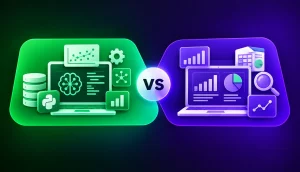
Choosing between Data Science and AI Engineering depends on your interests, career goals, and the type of work you want to pursue. While both fields involve data, machine learning, and AI, Data Science focuses more on analyzing data, uncovering insights, and building predictive models, whereas AI Engineering focuses on developing and deploying AI-powered applications and systems. Understanding the key differences can help you identify which career path aligns better with your skills and aspirations.
Build Data Scientist Skills with HCL GUVI
If you’re ready to move from reading about these skills to actually building them, HCL GUVI’s Data Science Course covers Python, statistics, machine learning, and visualization from scratch — with real-world projects, mentorship, and placement support.
Advanced Data Science & Generative AI Program
Conclusion
Becoming a data scientist in 2026 means more than learning Python and a few ML algorithms — it means building a layered skill set that spans statistics, machine learning, deployment, and increasingly, GenAI. The field’s demand is real and growing, but the gap between “took a course” and “job-ready” comes down to one thing: a portfolio of real, deployed projects. Start with the foundations, build one project at a time, and let your skill depth follow employer demand rather than trying to learn everything at once.
FAQs
What skills are needed in data science?
Key skills include programming (Python, SQL, R), statistics and probability, machine learning, data visualization, data wrangling, big data tools, and increasingly, GenAI and cloud deployment skills — alongside communication and business framing.
Is SQL needed for data science?
Yes. SQL is essential for querying, filtering, and managing structured data stored in relational databases — it’s used constantly, even in ML-heavy roles.
Is coding required for data science?
Yes, coding is necessary for data processing, statistical analysis, and building machine learning models — primarily using Python, with SQL for data querying.
Which language is best for data science?
Python is the most widely used language for data science because of its extensive libraries (Pandas, Scikit-learn, TensorFlow) and strong community support. R remains relevant for advanced statistical and academic work.
How long does it take to become job-ready as a data scientist?
Most beginners need 8–12 months of consistent, structured learning to become job-ready, covering Python, statistics, machine learning, and at least one deployed project. A programming or math background can shorten this timeline.
Do I need a GenAI or LLM skill set to become a data scientist in 2026?
It’s not yet universally required, but it’s rapidly becoming a differentiator. Many 2026 job postings now expect at least basic familiarity with LLM APIs, prompt engineering, and RAG concepts alongside classical data science skills.