


Artificial Intelligence and Machine Learning Articles
Finance Manager to Data Analytics: Career Growth, Salary and Seniority
How to Evaluate LLM Outputs in Production Deployments
AI/ML Skills Gap 2026: Why Companies Can't Find Job-Ready Talent
20 AI/ML Interview Questions Recruiters Can Use Without a Tech Background - Best Guide


Get In Touch For Details! Request More Information

Who is an ML Engineer? A Complete Guide
Jun 19, 2026 5 Min Read 1888 Views
(Last Updated)
Table of contents
- Introduction
- TL;DR
- What Does an ML Engineer Do?
- Core Responsibilities of an ML Engineer
- Core Skills Required to Become an ML Engineer
- Mathematics and Statistics
- Programming Python and Beyond
- Machine Learning Frameworks and Algorithms
- MLOps and Cloud Infrastructure
- How to Become an ML Engineer: A Roadmap
- Step 1: Build Mathematical Foundations (Months 1–3)
- Step 2: Learn Python and Core ML (Months 3–6)
- Step 3: Master Deep Learning Frameworks (Months 6–9)
- Step 4: Build MLOps and Cloud Skills (Months 9–12)
- Step 5: Build a Portfolio and Apply
- Industries Hiring ML Engineers in India and Globally
- Conclusion
- FAQs
- Who is an ML engineer?
- What skills does an ML engineer need?
- What is the difference between an ML engineer and a data scientist?
- What is the salary of an ML engineer in India?
- How long does it take to become an ML engineer?
Introduction
Machine learning is reshaping every industry, from how doctors diagnose disease to how banks detect fraud, how streaming platforms recommend content, and how factories predict equipment failure before it occurs. Behind every one of these intelligent systems is a specialist who builds, trains, and deploys the models that power them.
The ML engineer role sits at the intersection of software engineering and data science. Unlike data scientists, who focus primarily on analysis and experimentation, ML engineers own the full lifecycle of a machine learning model from data pipelines and feature engineering through model training, evaluation, and production deployment at scale.
In 2025 and beyond, the ML engineer has become one of the most in-demand technology roles globally. As organisations shift from AI experimentation to AI production, the ability to build reliable, scalable, and maintainable ML systems has become a critical competitive advantage, and the engineers who can deliver it are among the highest-paid professionals in the industry.
TL;DR
- An ML engineer builds, trains, and deploys machine learning models at production scale.
- The role bridges data science (model development) and software engineering (system reliability).
- Core skills include Python, mathematics, ML frameworks, cloud platforms, and MLOps tools.
- ML engineers earn significantly more than most technology roles — ₹10–50 LPA in India; $120K–$200K+ globally.
- The role is distinct from a data scientist (who experiments) and a data engineer (who builds data infrastructure).
Who Is an ML Engineer?
An ML (Machine Learning) engineer is a technology professional responsible for designing, building, training, and deploying machine learning models into production systems. They combine expertise in data science, mathematics, and software engineering to transform experimental models into scalable, reliable, and efficient applications. ML engineers work closely with data scientists and software developers to ensure that machine learning solutions are not only accurate but also optimized for real-world performance, integration, and deployment at scale.
What Does an ML Engineer Do?
At its core, the ML engineer’s job is to take machine learning from a prototype to production, transforming experimental models built by data scientists into reliable, scalable systems that run in real applications serving real users.
This involves far more than training a model in a Jupyter notebook. It requires engineering discipline: building robust data pipelines, managing model versioning, ensuring low-latency inference, handling distribution shifts, and maintaining model performance over time as real-world data evolves.
Upgrade your AI capabilities with HCL GUVI’s Intel & IITM Pravartak Certified AI & ML course. Gain hands-on experience in machine learning, automation, and real-world AI applications with industry-recognised certification.
Core Responsibilities of an ML Engineer
- Data pipeline development: Designing and maintaining pipelines that collect, clean, transform, and serve training and inference data at scale.
- Feature engineering: Identifying, transforming, and selecting the input variables that give models the best signal for learning patterns in data.
- Model training and evaluation: Selecting appropriate algorithms, tuning hyperparameters, and rigorously evaluating model performance using the right metrics for each business problem.
- Model deployment: Packaging trained models and deploying them to production environments REST APIs, batch scoring systems, embedded devices, or real-time streaming pipelines.
- MLOps and monitoring: Building infrastructure for model versioning, A/B testing, performance monitoring, data drift detection, and automated retraining triggers.
- Collaboration: Working with data scientists, data engineers, product managers, and software engineers to align ML systems with business objectives and technical constraints.
Core Skills Required to Become an ML Engineer
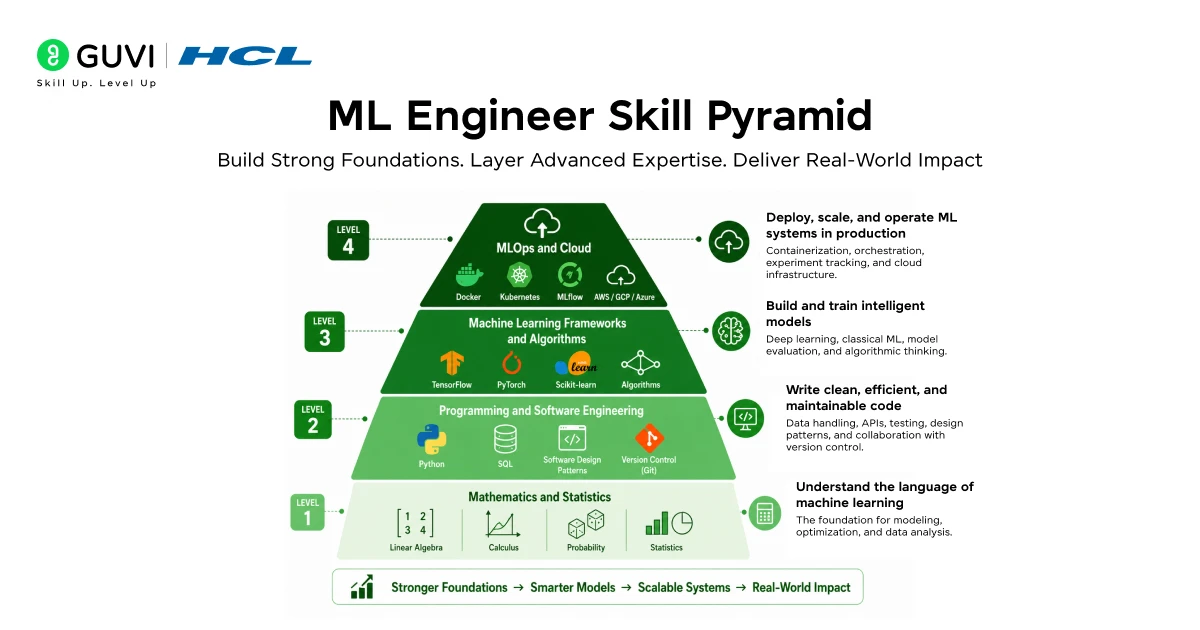
1. Mathematics and Statistics
A solid foundation in linear algebra, calculus, probability theory, and statistics is non-negotiable for an ML engineer. These mathematical concepts underpin how every machine learning algorithm learns from data, from gradient descent optimisation to Bayesian inference to the geometric intuitions behind neural networks.
• Linear algebra: matrix operations, eigenvalues, vector spaces essential for neural networks and dimensionality reduction.
• Calculus: derivatives, gradients, and the chain rule the basis of backpropagation and optimisation.
• Probability and statistics: distributions, hypothesis testing, and Bayesian reasoning essential for model evaluation and uncertainty quantification.
2. Programming Python and Beyond
Python is the primary language of machine learning engineering. ML engineers must write clean, efficient, and well-tested Python code not just for scripting experiments, but for production-quality code that can be reviewed, versioned, and maintained by a team.
- Python proficiency: NumPy, pandas, object-oriented programming, and writing testable, modular code.
- SQL: for querying databases and feature stores to extract training and inference data.
- Software engineering practices: version control (Git), code review, unit testing, CI/CD pipelines.
- Familiarity with Scala or Java: useful for working with distributed data processing frameworks like Apache Spark.
3. Machine Learning Frameworks and Algorithms
ML engineers must be proficient with the major machine learning frameworks and understand when to apply which class of algorithm. This is the technical heart of the role — not just using libraries, but understanding their internals well enough to debug, optimise, and extend them.
- Supervised learning: Linear and logistic regression, decision trees, gradient boosting (XGBoost, LightGBM), and neural networks.
- Unsupervised learning: Clustering (K-means, DBSCAN), dimensionality reduction (PCA, t-SNE), and anomaly detection.
- Deep learning frameworks: TensorFlow, PyTorch, and Keras for building, training, and serving neural network models.
- Classical ML: Scikit-learn for rapid prototyping and traditional ML algorithms.
4. MLOps and Cloud Infrastructure
MLOps Machine Learning Operations) is the discipline of applying DevOps principles to the ML lifecycle. It is what separates an ML engineer who can train a model from one who can run AI systems reliably in production at scale.
- Containerisation: Docker and Kubernetes for packaging models and managing deployment at scale.
- ML pipelines: Apache Airflow, Kubeflow, and MLflow for automating training, evaluation, and deployment workflows.
- Model registries and experiment tracking: MLflow, Weights & Biases, and Neptune for managing model versions and experiment results.
- Cloud platforms: AWS (SageMaker), Google Cloud (Vertex AI), and Azure (Machine Learning) are the dominant platforms for training and serving models at scale in production.
The role of a Machine Learning Engineer began to emerge as a distinct job title in mainstream industry around 2015–2016, as companies started to separate responsibilities within the AI development lifecycle. Organizations such as :contentReference[oaicite:0]{index=0}, :contentReference[oaicite:1]{index=1}, and :contentReference[oaicite:2]{index=2} helped popularize this distinction by differentiating between model experimentation (often associated with data scientists) and model productionization (handled by machine learning engineers). This separation reflects the growing complexity of deploying machine learning systems at scale, where building a model is only one part of the challenge—reliability, scalability, monitoring, and integration into production systems are equally critical.
Explore: How I Switched from Web Developer to ML Engineer

How to Become an ML Engineer: A Roadmap
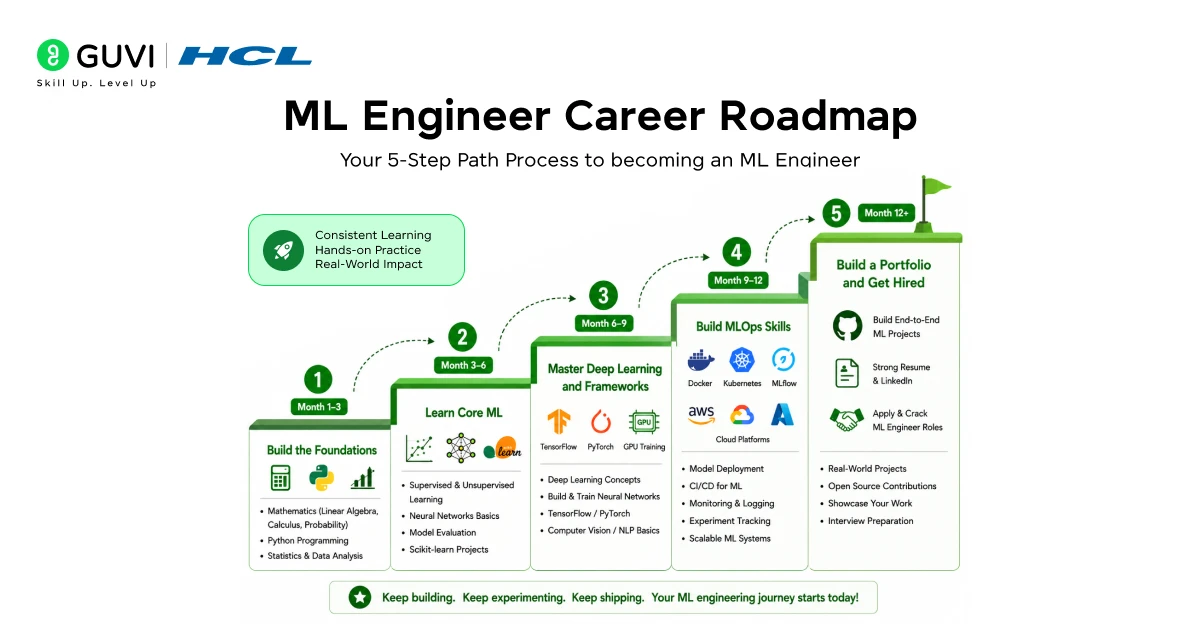
Becoming an ML engineer requires deliberate, structured skill development across mathematics, programming, machine learning, and engineering systems. There is no single path, but the following roadmap reflects the sequence that produces job-ready ML engineers most effectively.
Step 1: Build Mathematical Foundations (Months 1–3)
Before learning ML algorithms, build solid foundations in linear algebra (matrices and vectors), calculus (derivatives and gradients), probability theory, and descriptive and inferential statistics. Resources include MIT OpenCourseWare, Khan Academy, and the book Mathematics for Machine Learning (Deisenroth et al. — free online).
Step 2: Learn Python and Core ML (Months 3–6)
Master Python for data manipulation (NumPy, pandas), visualisation (Matplotlib, Seaborn), and ML (Scikit-learn). Build and evaluate models across supervised learning (regression, classification) and unsupervised learning (clustering, dimensionality reduction). Practice on real datasets from Kaggle and UCI Machine Learning Repository.
Step 3: Master Deep Learning Frameworks (Months 6–9)
Learn neural network fundamentals: feedforward, convolutional, and recurrent networks and become proficient with PyTorch or TensorFlow. Build projects in image classification, natural language processing, and time series forecasting. Understand GPU training, transfer learning, and fine-tuning pre-trained models.
Step 4: Build MLOps and Cloud Skills (Months 9–12)
Learn Docker, Kubernetes, and CI/CD for model deployment. Explore MLflow or Weights & Biases for experiment tracking and model registry. Build end-to-end pipelines using Apache Airflow or Kubeflow. Complete hands-on projects on AWS SageMaker, Google Vertex AI, or Azure Machine Learning.
Step 5: Build a Portfolio and Apply
Assemble three to five end-to-end ML projects on GitHub, each demonstrating a complete pipeline from data to deployed model. Include a real-time inference API, a model monitoring dashboard, and at least one project using a large pre-trained model. Contribute to open-source ML projects to build visibility in the community.
If you want to learn more about building skills for Claude Code and automating your procedural knowledge, do not miss the chance to enrol in HCL GUVI’s Intel & IITM Pravartak Certified Artificial Intelligence & Machine Learning courses. Endorsed with Intel certification, this course adds a globally recognised credential to your resume, a powerful edge that sets you apart in the competitive AI job market.
Industries Hiring ML Engineers in India and Globally
ML engineering is not a niche role confined to a few large technology companies. It is now a mainstream hire across virtually every data-intensive industry, and the range of problems ML engineers solve is broader than most candidates realise.
- Technology and SaaS: Recommendation engines, natural language processing, intelligent search, code completion, and fraud detection.
- Financial services and fintech: Credit scoring, algorithmic trading, real-time fraud detection, risk modelling, and customer churn prediction.
- Healthcare and life sciences: Medical image analysis, drug discovery, patient outcome prediction, genomics, and clinical NLP.
- E-commerce and retail: Personalised recommendations, dynamic pricing, demand forecasting, inventory optimisation, and visual search.
Conclusion
The ML engineer is one of the defining roles of the current decade in technology. As artificial intelligence moves from research papers to production systems serving billions of users, the ability to build, deploy, and maintain machine learning at scale has become one of the most valued and best-compensated capabilities in the industry. The ML engineer is the professional who makes that capability real.
The path to becoming an ML engineer is demanding but well-defined: build mathematical foundations, master Python and core ML, develop deep learning expertise, learn MLOps and cloud infrastructure, and build a portfolio of real end-to-end projects.
Whether you are a software engineer looking to specialise in AI, a data scientist seeking to expand your production engineering skills, or a student choosing a career path in technology, the ML engineer role offers exceptional scope, impact, and reward.
FAQs
1. Who is an ML engineer?
An ML engineer (machine learning engineer) is a technology professional who designs, builds, trains, and deploys machine learning models and systems in production. They bridge data science and software engineering owning the full ML lifecycle from data pipelines through model deployment, monitoring, and maintenance.
2. What skills does an ML engineer need?
Core ML engineer skills include Python programming, linear algebra and statistics, machine learning algorithms, deep learning frameworks (PyTorch or TensorFlow), SQL, cloud platforms (AWS, GCP, or Azure), MLOps tools (Docker, Kubernetes, MLflow), and software engineering best practices such as version control and CI/CD.
3. What is the difference between an ML engineer and a data scientist?
A data scientist focuses on analysis, experimentation, and prototype model development. An ML engineer takes those prototypes and engineers them into scalable, reliable production systems. Data scientists deliver insights and proof-of-concept models; ML engineers deliver deployed, monitored, and maintainable ML applications.
4. What is the salary of an ML engineer in India?
ML engineer salaries in India range from ₹10–18 LPA at entry level to ₹20–40 LPA at mid-level and ₹45–80 LPA+ at senior level. At principal or staff engineer level in top product companies, total compensation can exceed ₹1 crore per annum including stock options.
5. How long does it take to become an ML engineer?
With a structured learning plan, most candidates with a strong programming or mathematics background can become job-ready ML engineers in 12 to 18 months. The roadmap covers mathematical foundations, core ML, deep learning, MLOps, and cloud skills, followed by building a portfolio of end-to-end projects.
Success Stories

About the Author
Vishalini Devarajan
An Aerospace Engineer turned content writer, I focus on making complex concepts easy to understand through well-structured, reader-friendly blogs. Whether it’s a technical topic or a non-technical one, I love creating content that is clear, engaging, and impactful.
View all posts by Vishalini Devarajan
Connect with me @
















Did you enjoy this article?