


Artificial Intelligence and Machine Learning Articles
Finance Manager to Data Analytics: Career Growth, Salary and Seniority
How to Evaluate LLM Outputs in Production Deployments
AI/ML Skills Gap 2026: Why Companies Can't Find Job-Ready Talent
20 AI/ML Interview Questions Recruiters Can Use Without a Tech Background - Best Guide


Get In Touch For Details! Request More Information

Forward Chaining and Backward Chaining in Artificial Intelligence: An In-depth Guide
Jul 27, 2026 4 Min Read 5382 Views
(Last Updated)
Quick Answer:
Forward chaining starts with known facts and applies rules step by step until it reaches a conclusion. It is data-driven.
Backward chaining starts with a goal and works backward through rules to check if the facts support it. It is goal-driven.
Use forward chaining when you have data flowing in and no fixed target. Use backward chaining when you have a specific question to verify with the fewest possible checks.
Table of contents
- TL;DR Summary
- What is Forward Chaining in Artificial Intelligence?
- What is Backward Chaining in Artificial Intelligence?
- Forward Chaining and Backward Chaining: Comparison Table
- Worked Example: Forward and Backward Chaining in a Medical Rule Base
- Forward Chaining Walkthrough
- Backward Chaining Walkthrough
- When to Use Forward Chaining and Backward Chaining?
- Forward and Backward Chaining in Expert Systems: Real Applications
- Common Mistakes to Avoid
- Interview Questions for AI Roles
- Conclusion
- FAQs
- What is the difference between forward and backward chaining?
- Can forward and backward chaining be used together?
- Which search method does backward chaining use?
- Is forward chaining or backward chaining better for medical diagnosis?
- What tools are used for backward chaining?
- Why do interviewers ask about chaining methods?
TL;DR Summary
- Forward chaining moves from facts to conclusions. It is used in monitoring, fraud detection, and diagnosis systems that react to live data.
- Backward chaining moves from a goal to the facts that prove it. It is used in troubleshooting, legal reasoning, and hypothesis testing.
- Both forward chaining and backward chaining rely on production rules (IF-THEN statements) and an inference engine to apply them.
- Forward chaining uses breadth-first search. Backward chaining typically uses depth-first search.
- Real systems often combine both: forward chaining flags something unusual, backward chaining confirms it.
If you are new to AI reasoning, think of these as two different ways of asking the same question. One starts with “what do I know?” The other starts with “what am I trying to prove?”
In the 1980s, nearly two-thirds of Fortune 500 companies were using expert systems in their operations—highlighting the early widespread adoption of rule-based AI.
A recent IoT-based AI study combined forward chaining for real-time diagnostics with backward chaining for failure prediction—vital for maintaining systems expected to include 41.6 billion IoT devices by 2025.
The expert system OPS5, based on forward chaining, implemented the influential Rete algorithm—a key innovation that allowed rapid rule matching by avoiding repeated checks across thousands of rules.
What is Forward Chaining in Artificial Intelligence?
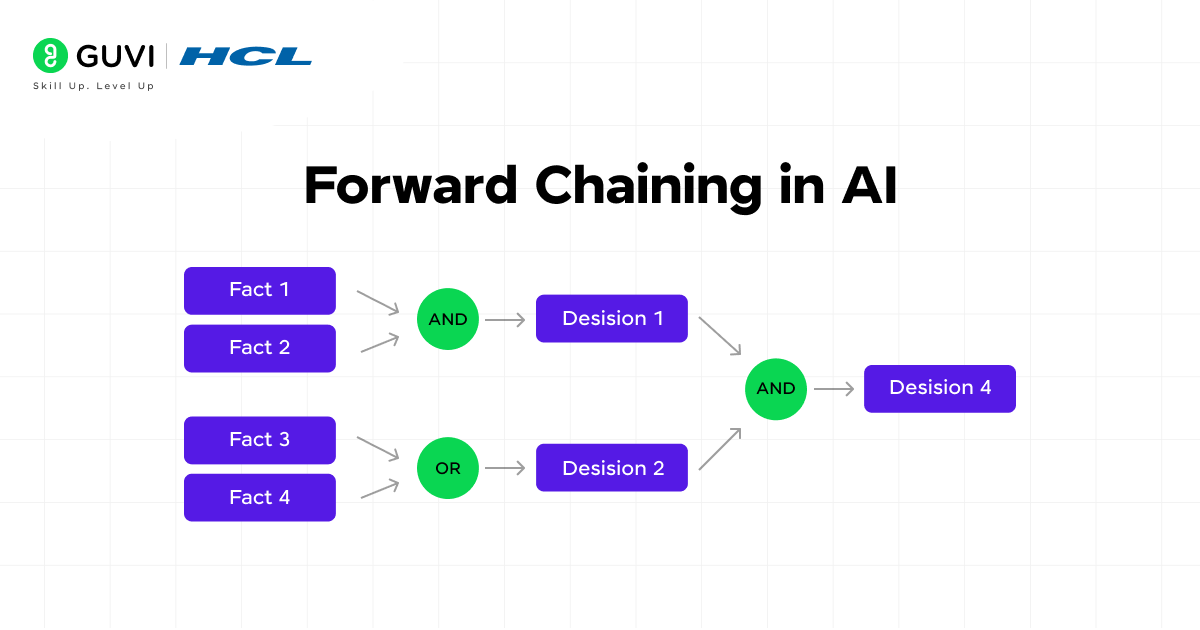
A forward chaining expert system is a reasoning method in artificial intelligence that begins with available facts and applies inference rules to reach new conclusions. The process continues step by step until a specific goal is achieved or no further rules can be applied.
You will find forward chaining in systems where data keeps arriving. Think sensor networks, fraud alerts, or a patient monitor. The system does not know in advance what conclusion it will reach. It just keeps reacting to what comes in.
Also Read: Will AI Replace Programmers? The Future of AI
What is Backward Chaining in Artificial Intelligence?
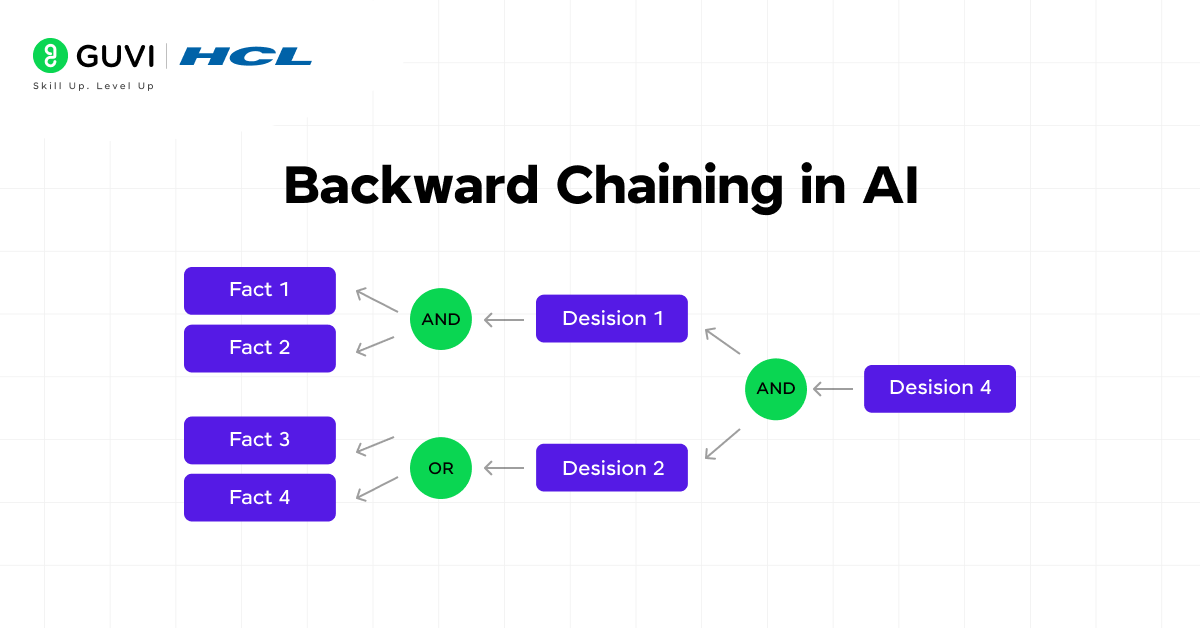
Backward chaining is a reasoning method in artificial intelligence and machine learning that begins with a goal and works backward to determine the facts or conditions needed to support it. The system checks if the goal is directly supported by known facts, and if not, it looks for rules that could lead to the goal, verifying their premises recursively.
This is efficient when you already have a specific hypothesis and just need to confirm or reject it, rather than explore every possible outcome.
Forward Chaining and Backward Chaining: Comparison Table
| Feature | Forward Chaining | Backward Chaining |
|---|---|---|
| Direction | Facts to conclusion | Goal to facts |
| Approach | Data-driven | Goal-driven |
| Search strategy | Breadth-first, checks all applicable rules | Depth-first, follows one path at a time |
| Best suited for | Monitoring, real-time alerts, diagnosis from open-ended data | Diagnosis with a specific hypothesis, troubleshooting, legal checks |
| Number of outcomes | Can generate multiple, sometimes irrelevant, conclusions | Usually verifies a single, targeted outcome |
| Example tools | CLIPS, OPS5, Drools | Prolog, MYCIN |
Worked Example: Forward and Backward Chaining in a Medical Rule Base
To see the difference clearly, let’s use a small rule base and walk through both methods.
Rules
- R1: IF fever AND cough THEN suspect_respiratory_infection
- R2: IF suspect_respiratory_infection AND breathlessness THEN suspect_pneumonia
- R3: IF suspect_pneumonia AND abnormal_chest_xray THEN diagnose_pneumonia
Known facts: fever, cough, breathlessness, abnormal_chest_xray
Forward Chaining Walkthrough
- Start with the known facts: fever, cough, breathlessness, abnormal_chest_xray.
- R1’s conditions (fever, cough) are already satisfied, so it fires. This adds suspect_respiratory_infection to the fact base.
- R2’s conditions (suspect_respiratory_infection, breathlessness) are now both satisfied, so it fires. This adds suspect_pneumonia.
- R3’s conditions (suspect_pneumonia, abnormal_chest_xray) are satisfied, so it fires. This adds diagnose_pneumonia.
- No further rules apply, and a conclusion has been reached: the system diagnoses pneumonia.
Backward Chaining Walkthrough
- Set the goal: prove diagnose_pneumonia.
- Check R3. It needs suspect_pneumonia and abnormal_chest_xray. The second is a known fact. The first is not, so it becomes a new sub-goal.
- Check R2 to prove suspect_pneumonia. It needs suspect_respiratory_infection and breathlessness. Breathlessness is known. suspect_respiratory_infection becomes the next sub-goal.
- Check R1 to prove suspect_respiratory_infection. It needs fever and cough. Both are known facts, so R1 is satisfied.
- Working back up the chain: suspect_respiratory_infection is proven, which proves suspect_pneumonia, which proves diagnose_pneumonia. The goal is confirmed.
Notice both methods reach the same conclusion. Forward chaining explored everything the facts could produce. Backward chaining only checked what was needed to confirm one specific goal.
When to Use Forward Chaining and Backward Chaining?
Ask yourself these questions before picking a method:
- Do you have a specific question to verify, or are you exploring open data? A specific question points to backward chaining. Open data points to forward chaining.
- Is your data arriving continuously? Sensor feeds, transaction logs, and live monitoring favor forward chaining.
- Do you need to justify a decision? Backward chaining naturally shows the chain of sub-goals that led to a conclusion, which is useful for audits and explainability.
- How many possible outcomes exist? If the outcomes are limited and well defined, backward chaining avoids wasted computation. If outcomes are open-ended, forward chaining is more thorough.
In practice, you are not always choosing one over the other. Many systems run forward chaining to catch something unusual, then switch to backward chaining to confirm it.

Forward and Backward Chaining in Expert Systems: Real Applications
- Fraud detection: Forward chaining flags an unusual transaction the moment it happens. Backward chaining then checks whether that transaction actually meets the criteria for fraud before an alert is escalated.
- Healthcare diagnosis: Forward chaining picks up abnormal readings from patient monitors in real time. Backward chaining verifies whether those readings support a specific suspected condition.
- IT and network troubleshooting: Backward chaining is common here. You start with “why is the server down?” and work backward through logs and configurations to find the cause.
- Customer support automation: Forward chaining gathers signals from a user’s actions (repeated errors, failed payments). Backward chaining confirms the root cause before suggesting a fix.
- Legal and compliance checks: Backward chaining starts with a claim like “this contract is valid” and works backward through the required conditions to confirm or reject it.
Common Mistakes to Avoid
- Treating them as interchangeable. Forward chaining and backward chaining solve different problems. Using forward chaining for a narrow diagnostic question wastes processing on irrelevant rules.
- Ignoring conflict resolution. When multiple rules match the same facts in forward chaining, you need a clear priority order, or the system can behave unpredictably.
- Starting backward chaining with a vague goal. A poorly defined hypothesis leads to wasted sub-goal exploration.
- Not updating the knowledge base. Both methods depend on facts and rules staying current. Stale rules produce outdated conclusions.
Interview Questions for AI Roles
- What is the core difference between forward and backward chaining? Forward chaining is data-driven and starts with facts. Backward chaining is goal-driven and starts with a hypothesis.
- Which search strategy does each method typically use? Forward chaining tends to use breadth-first search. Backward chaining tends to use depth-first search.
- Why might a system combine both methods? Forward chaining catches new facts as they arrive, while backward chaining verifies a specific outcome, making hybrid systems both reactive and precise.
- What is conflict resolution in forward chaining? It is the strategy used to decide which rule fires first when multiple rules match the same facts.
- Name one classic tool built for each method. OPS5 or CLIPS for forward chaining, Prolog for backward chaining.
- When would backward chaining be more efficient than forward chaining? When the number of possible goals is small and you only need to verify one of them, rather than generate every possible conclusion.
Elevate your AI expertise with HCL GUVI’s Intel‑certified Artificial Intelligence & Machine Learning course, a six-month, live-online program crafted in collaboration with Intel and IITM Pravartak. Gain hands-on experience through over 20 modules covering Generative AI, Agentic AI, Deep Learning, and MLOps, supported by expert-led bootcamps, hackathons, and lifetime access to mentor‑assisted sessions.
Conclusion
Forward and backward chaining give you two different ways to reason with rules. Forward chaining is useful when data keeps arriving and you want to see everything it can tell you. Backward chaining is useful when you already have a question and want the fastest path to a confirmed answer.
Understanding both, and knowing when to combine them, is a foundational skill for anyone working with expert systems or rule-based AI. If you are preparing for AI interviews, expect at least one question on this comparison, since it tests both theory and practical judgment.
FAQs
What is the difference between forward and backward chaining?
Forward chaining starts from known facts and moves toward a conclusion. Backward chaining starts from a goal and works backward to check if facts support it.
Can forward and backward chaining be used together?
Yes. Many expert systems use forward chaining to react to new data and backward chaining to confirm a specific conclusion.
Which search method does backward chaining use?
It typically uses depth-first search, following one reasoning path before trying another.
Is forward chaining or backward chaining better for medical diagnosis?
It depends on the case. Forward chaining suits open-ended diagnosis from symptoms. Backward chaining suits confirming a specific suspected condition.
What tools are used for backward chaining?
Prolog is the most well-known language built around backward chaining. MYCIN is a classic example system.
Why do interviewers ask about chaining methods?
They test whether a candidate understands rule-based reasoning, which underlies many expert systems and still comes up in AI system design discussions.
Success Stories

About the Author
Vaishali
I'm a seasoned writer with four years of experience across technical, non-technical, and just about every genre or niche you can imagine. Adaptable and curious, I enjoy exploring new topics and making information engaging and easy to understand. Fueled by a steady stream of tea, I approach each project with creativity, reliability, and genuine enthusiasm for storytelling.
View all posts by Vaishali
Connect with me @











Did you enjoy this article?