


Artificial Intelligence and Machine Learning Articles
Finance Manager to Data Analytics: Career Growth, Salary and Seniority
How to Evaluate LLM Outputs in Production Deployments
AI/ML Skills Gap 2026: Why Companies Can't Find Job-Ready Talent
20 AI/ML Interview Questions Recruiters Can Use Without a Tech Background - Best Guide

Get In Touch For Details! Request More Information
Difference Between Strong AI and Weak AI: A Comparison Guide
Jul 30, 2026 8 Min Read 7850 Views
(Last Updated)
Weak AI (also called Narrow AI or ANI) is task-specific intelligence, like Siri or ChatGPT, that excels at one job but cannot generalize beyond it. Strong AI (Artificial General Intelligence, or AGI) is a still-theoretical system with human-level intelligence across every domain, and it does not exist yet.
Understanding Strong AI and Weak AI helps explain why some machines can perform tasks efficiently while others remain only a futuristic idea. The difference between them shapes how artificial intelligence is built, used, and expected to evolve.
This guide covers definitions, examples, major differences between Strong AI and Weak AI, the current state of AGI development, and which companies are actually racing to build it. Knowing this distinction makes it easier to understand what modern AI can actually do and what still remains beyond reach.
Strong AI vs Weak AI at a Glance:
| Feature | Strong AI (AGI) | Weak AI (ANI) | Examples |
|---|---|---|---|
| Existence today | Theoretical, does not exist yet | Exists and is widely deployed | ANI: everywhere; AGI: none |
| Scope | Any intellectual task, like a human | One specific task or domain | ANI: chess, translation, driving |
| Understanding | Would possess genuine understanding/consciousness (debated) | No true understanding, pattern-based only | ChatGPT generates text without comprehension |
| Learning | Learns and adapts autonomously across domains | Learns only within its trained scope | Netflix recommends movies, nothing else |
| Real-world instance | None confirmed | Siri, Alexa, ChatGPT, Google Assistant | These are all Weak AI |
Table of contents
- TL;DR Summary
- Understanding Weak AI (Narrow AI)
- Weak AI Examples You Use Every Day — Siri, ChatGPT, Alexa
- Understanding Strong AI (General AI)
- Does Strong AI Exist in 2026? Current State of AGI Development
- Key Features of Strong AI
- The Three Levels of AI: ANI, AGI, and ASI
- Strong AI vs Superintelligence — Another Level Beyond AGI
- Which AI Companies Are Working on Strong AI?
- Key Differences Between Weak AI and Strong AI
- Conclusion
- FAQs
- Can strong AI exist with today’s technology?
- Why do AI systems struggle outside their training data?
- Is weak AI capable of improving on its own over time?
- What makes human intelligence different from AI behavior?
- Could strong AI replace all types of human jobs?
- Why is AGI considered harder than improving current AI models?
TL;DR Summary
- Strong AI and weak AI define the core divide in AI, where weak AI is task-specific and used in everyday tools, while strong AI is a theoretical system with human-like cognitive abilities.
- Weak AI powers features such as assistants, recommendations, and chatbots, but it operates only within fixed limits and lacks real understanding or awareness.
- Strong AI (AGI) is still theoretical and would be able to learn, adapt, and solve problems across any domain like a human.
- As of mid-2026, no lab has achieved confirmed AGI, though OpenAI, Anthropic, and Google DeepMind all consider it their central mission, with internal timelines ranging from 2-3 years to 2033.
- The main difference is scope, weak AI is specialized, while strong AI would be flexible and transferable across tasks.
💡 Did You Know?
- The terms “strong AI” and “weak AI” were coined by philosopher John Searle in his 1980 paper “Minds, Brains, and Programs,” in which he introduced the Chinese Room Argument to argue that no computational system could genuinely possess understanding the way humans do.
- IBM’s Deep Blue, which defeated world chess champion Garry Kasparov in 1997, is weak AI. Despite its superhuman chess performance, it cannot play checkers, hold a conversation, or perform any task outside chess.
- A 2023 survey of leading AI researchers found that the median estimate for a 50% chance of achieving AGI was around 2059, though estimates ranged widely from less than a decade to never.
Understanding Weak AI (Narrow AI)
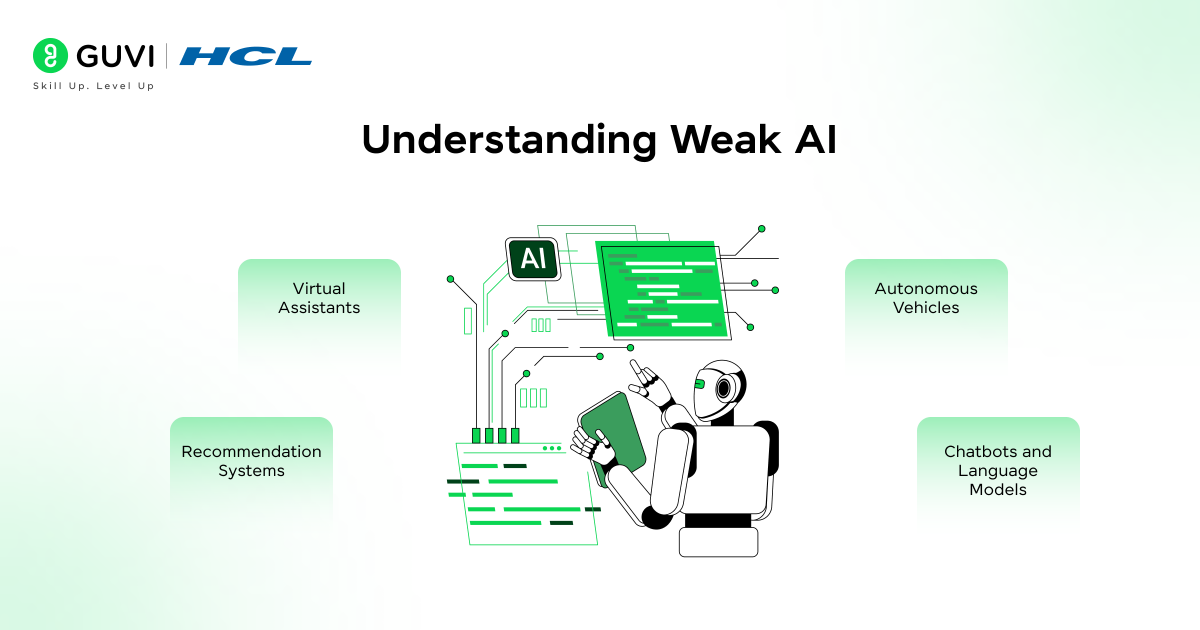
Understanding Strong AI and Weak AI starts with the simpler half of the pair. Weak AI, often called narrow AI, refers to artificial intelligence that is designed to perform a limited, specific task or a set of related tasks.
These systems do not possess genuine understanding or consciousness; they operate within pre-defined parameters and simulate intelligent behavior without true cognition.
This is actually the AI we interact with every day, and despite the name “weak,” these systems can be incredibly powerful and useful in their domain.
Want to understand AI concepts better? Check out HCL GUVI’s free AI & ML Email Course and build a stronger foundation in AI and ML.
These traits define the weak side of Strong AI and Weak AI clearly.
Some key characteristics of weak AI include:
- Single-Task Focus: The system is highly specialized. It can perform one type of task extremely well, but it cannot generalize its knowledge to different tasks.
- No True Understanding or Consciousness: These systems simulate thought but do not truly understand the meaning behind their actions or outputs. They follow algorithms and training data.
- Dependency on Human Input: Weak AI typically requires human-defined parameters and training. Its intelligence is confined to what it has been taught or programmed to do. It relies on humans to provide data and goals, and it can’t learn entirely new tasks on its own beyond its narrow scope.
- Prevalence Today: Virtually all AI in use is weak AI. This includes everything from your smartphone’s virtual assistant to advanced machine learning models.
Weak AI Examples You Use Every Day — Siri, ChatGPT, Alexa
Understanding Strong AI and Weak AI is easier once you see the weak side in action. You don’t have to look far to find examples, they are everywhere in modern technology, often multiple times before breakfast. Here are the ones you’re most likely using without a second thought:
- Siri and Google Assistant: When you ask Siri to set a timer or Google Assistant to check the weather, you’re using weak AI trained specifically for voice commands and simple task execution. Neither can reason about topics outside its programmed scope. This is another everyday illustration of the weak side of Strong AI and Weak AI.
- Alexa: Amazon’s Alexa handles smart home control, music playback, and shopping lists competently, but it has no understanding of what a “home” or “song” actually means, it’s pattern-matching your request to a predefined action.
- ChatGPT and similar language models: Even the most advanced language models like ChatGPT are considered weak AI, despite feeling remarkably conversational. They generate impressively human-like text and answer questions across many topics, but they remain specialized in one domain: predicting and generating language, without genuine self-awareness.
- Netflix and Amazon recommendations: When Netflix suggests a movie or Amazon recommends a product, that’s weak AI analyzing your past behavior through algorithms to predict preferences, nothing more.
- Autonomous vehicle systems: Self-driving car AI processes sensor data and makes driving decisions, but it’s strictly limited to driving tasks. It can’t suddenly use its driving intelligence to translate a document or plan a meal.
It’s worth noting, in the context of Strong AI and Weak AI, that calling these systems “weak” isn’t a knock on their capabilities. The term simply means their intelligence is narrowly focused. A weak AI can outperform humans in its specialty, but it cannot go beyond that domain.
Understanding Strong AI (General AI)

Now let’s talk about the other half of Strong AI and Weak AI. Strong AI, also known as Artificial General Intelligence (AGI), refers to a hypothetical AI system that possesses intelligence comparable to a human being across the board.
A strong AI would not be limited to one task; it would be able to understand, learn, and apply knowledge to any problem in any domain, much like a person can.
In addition, strong AI implies a level of sentience or consciousness; the machine wouldn’t just simulate understanding, it would genuinely understand and be self-aware.
These traits define the strong side of Strong AI and Weak AI, none of which exist reliably yet.
Key features that would define a strong AI include:
- General Problem-Solving Ability: A strong AI could tackle any intellectual task. It would have the ability to generalize knowledge and skills from one context to another.
- Learning and Adaptation: Strong AI would learn from experience just as humans do. It could learn new skills or information without explicit programming for each new task.
- Autonomy and Self-Improvement: Unlike weak AI, which heavily relies on human-provided training data and objectives, a strong AI might set its own goals or at least continue learning and improving autonomously.
- Consciousness and Understanding: This is a debated aspect, but strong AI in the purest sense implies that the AI has a mind of its own, it experiences awareness, understands context, and has intentionality.
This is the single most important fact anyone learning about Strong AI and Weak AI should remember: strong AI does not exist as of today, at least not yet. All the impressive AI systems we have seen so far are still narrow AI. Strong AI remains theoretical.
Does Strong AI Exist in 2026? Current State of AGI Development
Short answer: no, not by any consensus definition, though the industry’s confidence about the timeline has shifted dramatically, a shift worth understanding as part of the broader Strong AI and Weak AI conversation.
Understanding where things actually stand matters more than hype when discussing Strong AI and Weak AI.
Where the major labs actually stand, as of mid-2026:
- OpenAI: Sam Altman has publicly stated the company is “confident we know how to build AGI,” and in some reporting has claimed OpenAI has “basically built AGI, or very close to it.” This claim has been publicly disputed by Microsoft CEO Satya Nadella, who said the industry remains nowhere close.
- Anthropic: CEO Dario Amodei has said he’s “more confident than I’ve ever been” that powerful, near-AGI capabilities are coming within roughly 2-3 years, while emphasizing safety and alignment (Constitutional AI) as prerequisites, not afterthoughts.
- Google DeepMind: CEO Demis Hassabis remains the most cautious of the three, shifting his estimate from “as soon as 10 years” to a “3 to 5 years” window, and has published a formal framework (“Levels of AGI”) that measures progress across tiers (Emerging, Competent, Expert, Virtuoso, Superhuman) rather than treating AGI as a single yes/no milestone.
This is the clearest evidence in the entire Strong AI and Weak AI debate.
What current systems can and can’t do: today’s most advanced models show genuine “sparks” of general intelligence, strong performance on zero-shot reasoning and cross-domain pattern recognition, but they still lack persistent memory across sessions, true causal understanding of the physical world, and the ability to independently set and pursue novel goals. These are exactly the gaps that separate “very impressive narrow AI” from AGI.
The honest takeaway on Strong AI and Weak AI in 2026: no credible, independent, widely-accepted benchmark has confirmed AGI has been achieved. The disagreement between Altman’s optimism and Nadella’s skepticism, in the same industry, in the same year, tells you the term itself still lacks a universally agreed-upon test, which is exactly why “does Strong AI exist” doesn’t have a clean yes or no answer yet.
Key Features of Strong AI
Building on the Strong AI and Weak AI distinction above, here’s what researchers agree a genuine Strong AI system would need to demonstrate, none of which current systems reliably do yet:
None of these appear reliably in any weak AI system, which is exactly the point of the Strong AI and Weak AI divide.
- Transfer learning across unrelated domains without retraining from scratch.
- Persistent memory and continuity of experience across interactions, not just within a single session, another gap in the current Strong AI and Weak AI picture.
- Causal reasoning about the physical world, not just statistical pattern-matching from text, a key missing piece in today’s Strong AI and Weak AI landscape.
- Independent goal formation, rather than only pursuing goals explicitly given by a human operator, the final and hardest gap in the Strong AI and Weak AI divide.
The Three Levels of AI: ANI, AGI, and ASI
Most discussions about AI’s future use a three-level framework that is important to understand alongside the Strong AI and Weak AI distinction.

| Level | Full Name | Status | Description |
|---|---|---|---|
| ANI | Artificial Narrow Intelligence | Exists today | Task-specific AI. All current AI systems fall here. |
| AGI | Artificial General Intelligence | Theoretical | Human-level intelligence across all domains. |
| ASI | Artificial Superintelligence | Theoretical | Intelligence surpassing the best human minds in every field. |
Artificial Superintelligence (ASI) is the level beyond strong AI. An ASI would not just match human intelligence; it would exceed it across every domain simultaneously. This is the scenario that researchers warn requires the most careful preparation, because a system far smarter than any human with misaligned goals could be profoundly dangerous.
Strong AI vs Superintelligence — Another Level Beyond AGI
Once you understand Strong AI and Weak AI, a third term often gets confused with the first: Superintelligence. Strong AI (AGI) and Superintelligence (ASI) are often used loosely as if they’re the same thing, but they describe two genuinely different thresholds.
| Factor | Strong AI (AGI) | Superintelligence (ASI) |
|---|---|---|
| Intelligence level | Roughly equal to human-level, across all domains | Exceeds the best human minds, across all domains simultaneously |
| Analogy | A single, exceptionally capable human generalist | An entire civilization’s worth of the smartest humans combined, and then some |
| Timeline consensus | Debated, ranging from 2-3 years to decades away | Considered further out and more speculative than AGI |
| Primary concern | Whether it can be built at all, and what tasks it displaces | Whether it can be controlled or aligned once it exists |
| Current status | Not yet achieved by any independent benchmark | Purely theoretical, no lab claims to be close |
This distinction is just as important as the core Strong AI and Weak AI split itself.
Why this distinction matters practically: AGI reaching human-level intelligence is already considered a monumental, civilization-altering milestone on its own. ASI represents a further, qualitatively different leap, a system that doesn’t just match the best human experts but surpasses all of them simultaneously across every field at once. This is why AI safety researchers, including teams at Anthropic and DeepMind, treat the AGI-to-ASI transition as the period requiring the most rigorous alignment work, since a superintelligent system’s goals would need to be correctly specified before it becomes powerful enough that mistakes are difficult or impossible to correct.
Which AI Companies Are Working on Strong AI?
A handful of well-funded labs treat building the Strong AI side of the Strong AI and Weak AI divide as their explicit, stated mission rather than a side effect of building better products.
- This is the most-discussed company in any Strong AI and Weak AI conversation. OpenAI: states AGI as its core mission in its founding charter, defining it as “highly autonomous systems that outperform humans at most economically valuable work.” Valued at roughly $300 billion as of 2026, it leads much of the public conversation around AGI timelines.
- Anthropic: approaches the Strong AI and Weak AI gap differently, building toward advanced capabilities with safety and alignment as a first-class design constraint, through its Constitutional AI approach, rather than treating safety as something bolted on afterward. Valued at roughly $183 billion as of 2026.
- Google DeepMind: takes the most measured stance in the Strong AI and Weak AI race, pursuing AGI research with a more cautious public timeline and has published one of the field’s few peer-reviewed frameworks for measuring progress toward it (the “Levels of AGI” paper).
- Meta AI: rounds out the major labs racing to close the Strong AI and Weak AI gap, also pursuing general-purpose AI capabilities as part of its broader AI research efforts, alongside xAI and a number of well-funded startups also racing toward similar goals.
Worth noting in this Strong AI and Weak AI context: these companies disagree publicly, sometimes sharply, on how close AGI actually is, which itself tells you the field still lacks a single, universally accepted test for “has AGI been achieved.” Treat any single company’s timeline claim as one data point in an active, unresolved debate, not a settled fact.
Key Differences Between Weak AI and Strong AI

Now that we’ve defined both halves of Strong AI and Weak AI, let’s summarize the major differences between them. This comparison will highlight why strong AI is such a big leap from what we have today:
| Aspect | Weak AI (Narrow AI) | Strong AI (General AI) |
|---|---|---|
| Scope of Intelligence | This row captures the core Strong AI and Weak AI scope difference. Weak AI is confined to a specific task or a narrow domain. For instance, a recommendation engine can suggest movies but cannot diagnose diseases. | Strong AI would be able to handle any intellectual task across domains, much like humans. It wouldn’t just perform well in one niche; it could transfer learning from one area to another. |
| Existence Today | This existence gap is the most concrete part of the Strong AI and Weak AI comparison. Weak AI is the reality of virtually all deployed AI systems today, used across billions of devices. | Strong AI is still hypothetical. It exists only as a concept in research labs and as characters in science fiction. No machine currently demonstrates the full generality and awareness of human intelligence. |
| Learning and Adaptability | Weak AI typically requires large amounts of training data and can only operate within the boundaries of that training. It struggles with unfamiliar problems because it cannot generalize knowledge across tasks. | Strong AI would be able to learn new skills independently, adapt to unexpected challenges, and apply reasoning in unfamiliar contexts. Much like humans, it could approach problems creatively and improve continuously without needing task-specific programming. |
| Consciousness and Understanding | Consciousness is the most philosophically loaded row in this Strong AI and Weak AI table. Weak AI does not truly “understand” what it processes. It relies on algorithms, pattern recognition, and statistical models to generate outputs. | Strong AI would possess something closer to true understanding or consciousness. It wouldn’t just manipulate symbols or patterns; it would actually grasp meaning, context, and possibly even emotions. This is why philosophers often associate strong AI with the idea of machines having a “mind.” |
| Autonomy | Autonomy is another axis worth comparing in Strong AI and Weak AI. Weak AI often outperforms humans in its narrow domain (a chess AI can beat world champions), but the trade-off is rigidity. The moment you take it outside its comfort zone, it fails. | Strong AI would have a degree of autonomy, potentially setting its own goals or at least reasoning about the best way to achieve a task. |
| Performance vs. Flexibility | Weak AI often outperforms humans in its narrow domain, but the trade-off is rigidity. The moment you take it outside its comfort zone, it fails completely. | Strong AI would prioritize flexibility over narrow perfection. Even if it doesn’t always outperform humans in every niche, its ability to shift across domains and contexts would make it far more versatile. |
| Terminology | Terminology itself is a small but real part of understanding Strong AI and Weak AI. Weak AI is also called narrow AI or Artificial Narrow Intelligence (ANI). Despite the term “weak,” it is the foundation of almost all AI applications today. | Strong AI is often called general AI or Artificial General Intelligence (AGI). Beyond this lies Artificial Superintelligence (ASI), which would surpass human cognition entirely. |
In summary, the Strong AI and Weak AI divide comes down to this: weak AI is like a set of highly skilled specialists, each expert at one thing, whereas strong AI would be like a Renaissance person (or a whole team of experts in one mind) that can do all the things and truly understand them.
The Strong AI and Weak AI distinction covered throughout this guide is exactly the kind of foundational concept worth mastering early.
If you’re serious about building a career in artificial intelligence, enroll in HCL GUVI’s Intel & IITM Pravartak Certified Artificial Intelligence & Machine Learning course and gain real-world skills along with an Intel-backed credential that helps you stand out in the competitive AI job market.
Conclusion
The conversation around Strong AI and Weak AI is really a conversation about limits and possibilities.
While machines continue getting better at specific tasks, and while the industry’s confidence about AGI’s timeline has genuinely shifted in recent years, the gap between doing something intelligently and truly understanding it is what still makes this distinction matter.
As AI continues to evolve, knowing where that line lies helps set more realistic expectations about what comes next.
FAQs
1. Can strong AI exist with today’s technology?
(This FAQ sits at the heart of the whole Strong AI and Weak AI discussion)
Current systems are built on narrow AI models, so strong AI remains a long-term research goal rather than something achievable with existing approaches, even as leading labs claim the timeline is shrinking.
2. Why do AI systems struggle outside their training data?
AI models learn patterns from data they are trained on, so unfamiliar situations fall outside their learned boundaries, limiting performance in new contexts.
3. Is weak AI capable of improving on its own over time?
Most weak AI improves through retraining with new data, but it does not independently evolve or redefine its own capabilities.
4. What makes human intelligence different from AI behavior?
Human thinking combines reasoning, awareness, and context understanding, while AI relies on statistical patterns without lived experience or true intent.
5. Could strong AI replace all types of human jobs?
Strong AI would still face constraints such as real-world integration, ethical oversight, and unpredictable environments, making a total replacement unrealistic.
6. Why is AGI considered harder than improving current AI models?
AGI requires flexible reasoning across all domains, not just scaling performance in a single task, which demands a fundamentally different design approach.
Success Stories

About the Author
Jebasta
I translate the language of data into stories that anyone can understand. As a writer with a data science background, I simplify analytics, AI, and decision-making so beginners and enthusiasts can confidently explore the world of data.
View all posts by Jebasta
Connect with me @













Did you enjoy this article?