


Artificial Intelligence and Machine Learning Articles
Finance Manager to Data Analytics: Career Growth, Salary and Seniority
How to Evaluate LLM Outputs in Production Deployments
AI/ML Skills Gap 2026: Why Companies Can't Find Job-Ready Talent
20 AI/ML Interview Questions Recruiters Can Use Without a Tech Background - Best Guide


Get In Touch For Details! Request More Information
Semantic Networks in Artificial Intelligence: A Complete Guide
Jul 13, 2026 6 Min Read 1105 Views
(Last Updated)
Think about how you know that a dog is an animal.
You don’t store that fact in isolation. You know dogs have fur, they bark, they are pets, they are mammals, and mammals are animals. Your brain stores knowledge as a web of connected concepts, not as a list of disconnected facts.
That is exactly what semantic networks do for AI.
A semantic network is a knowledge representation technique that maps concepts as nodes and relationships as edges, creating a graph structure that lets AI systems understand how different pieces of information connect to each other.
This guide walks through what semantic networks are, how they work, why they matter in AI, where they are used today, and what makes them different from other knowledge representation methods.
Table of contents
- Quick TL;DR Summary
- How Semantic Networks Are Structured
- Why Semantic Networks Matter in AI
- How Semantic Networks Work
- Types of Semantic Networks
- Applications of Semantic Networks in AI
- Final Thoughts
- FAQs
- What is the difference between a semantic network and a knowledge graph?
- Can semantic networks handle real-time updates?
- How do semantic networks support explainable AI?
- What tools are used to build semantic networks?
- Are semantic networks still relevant with modern large language models?
Quick TL;DR Summary
- Semantic networks represent knowledge as graphs where nodes are concepts and edges are relationships, mirroring how humans organize information.
- They enable AI inference by traversing relationships, answering questions the network was never explicitly told by following logical paths through connected concepts.
- Inheritance hierarchies let properties propagate from general to specific concepts, so “mammals breathe air” automatically applies to all mammals without repetition.
- Semantic networks power knowledge graphs, natural language understanding, expert systems, and recommendation engines across search, healthcare, and e-commerce.
- Building effective networks requires balancing expressiveness with efficiency, as overly complex networks become difficult to query and maintain at scale.
What Are Semantic Networks?
Semantic networks are a knowledge representation technique in artificial intelligence that organizes information as a directed graph. In this structure, nodes represent entities, concepts, or objects, while edges represent the relationships and connections between them. This allows AI systems to model and reason about how different pieces of knowledge are related.
Unlike databases that store isolated records or rule-based systems that encode rigid if-then logic, semantic networks capture the semantic meaning of how concepts relate to each other in a flexible, human-readable structure.
How Semantic Networks Are Structured
- The Basic Building Blocks
- Nodes
Nodes are the fundamental units representing individual concepts. A node can represent anything: a physical object like “car,” an abstract idea like “justice,” a category like “animal,” or a specific instance like “Einstein.”
Each node is labeled with the concept it represents. Nodes exist as part of the network, deriving much of their meaning from the connections they have rather than from isolated definitions.
- Edges
Edges are the relationships that connect nodes. Common relationship types include “is-a” for category membership (dog is-a animal), “has-a” for possession or composition (car has-a engine), “part-of” for hierarchical structures (wheel part-of car), and domain-specific relations like “treats” in medical networks (aspirin treats headache).
The direction of edges matters. “Dog is-a animal” means something different from “animal is-a dog.” Edges carry the semantic weight that transforms disconnected concepts into structured knowledge.
- Properties and Attributes
Nodes can have properties attached directly to them. A node representing “car” might have attributes like “has wheels,” “requires fuel,” or “used for transportation.” These properties describe characteristics rather than relationships to other concepts.
- How Semantic Networks Represent Knowledge
A simple semantic network example:
- Node: Dog
- Edge: is-a → Mammal
- Node: Mammal
- Edge: is-a → Animal
- Property on Mammal: breathes air, warm-blooded
From this structure, an AI system can infer that dogs breathe air and are warm-blooded without those facts being explicitly stated on the dog node. This is inheritance through the is-a hierarchy.
The network grows by adding more nodes and edges. Add “Collie is-a Dog” and “Lassie is-a Collie,” and the network can answer “Is Lassie an animal?” by traversing the path: Lassie → Collie → Dog → Mammal → Animal.
Read More: What is Semantic Segmentation? An Exclusive Beginner’s Guide
Why Semantic Networks Matter in AI
- They Enable Inference Beyond Explicit Storage
Semantic networks do not just store facts. They allow reasoning about facts that were never directly encoded. If the network knows “all birds have wings” and “sparrow is-a bird,” it can conclude sparrows have wings without storing that fact separately.
This reduces redundancy and makes knowledge systems scalable. Instead of storing properties for every individual entity, properties are stored at the appropriate level of abstraction and inherited downward.
- They Mirror Human Conceptual Organization
Humans organize knowledge relationally. We understand “apple” through its connections: it is a fruit, it grows on trees, it can be red or green, it is edible. Semantic networks formalize this structure in a way AI systems can process while remaining interpretable to humans.
This alignment with human reasoning makes semantic networks useful for systems that need to explain their conclusions or interact naturally with people.
- They Support Flexible Querying
Unlike rigid database schemas, semantic networks allow traversal-based queries. You can ask “What treats headaches?” and get answers by finding all nodes connected to “headache” via a “treats” relationship. You can ask “What properties do mammals have?” and aggregate attributes across all nodes inheriting from the mammal category.
This flexibility makes semantic networks well-suited for exploratory tasks where the exact structure of the query is not known in advance.
- They Integrate Heterogeneous Knowledge
Semantic networks can represent different types of knowledge in a unified structure. Factual knowledge (Paris is-a city), taxonomic knowledge (city is-a settlement), procedural knowledge (to book a flight, select destination), and relational knowledge (Paris located-in France) all coexist in the same graph.
This integration is why knowledge graphs, the modern evolution of semantic networks, power systems that need to answer diverse questions from a single knowledge base.
One of the earliest semantic networks was developed by Ross Quillian in 1968 as part of his doctoral research on modeling human associative memory. His work represented knowledge as interconnected concepts linked through relationships, creating a structure that could simulate how humans organize and retrieve meaning. These early semantic networks became a major foundation for natural language understanding and later influenced the development of modern knowledge graphs and AI knowledge representation systems.
How Semantic Networks Work
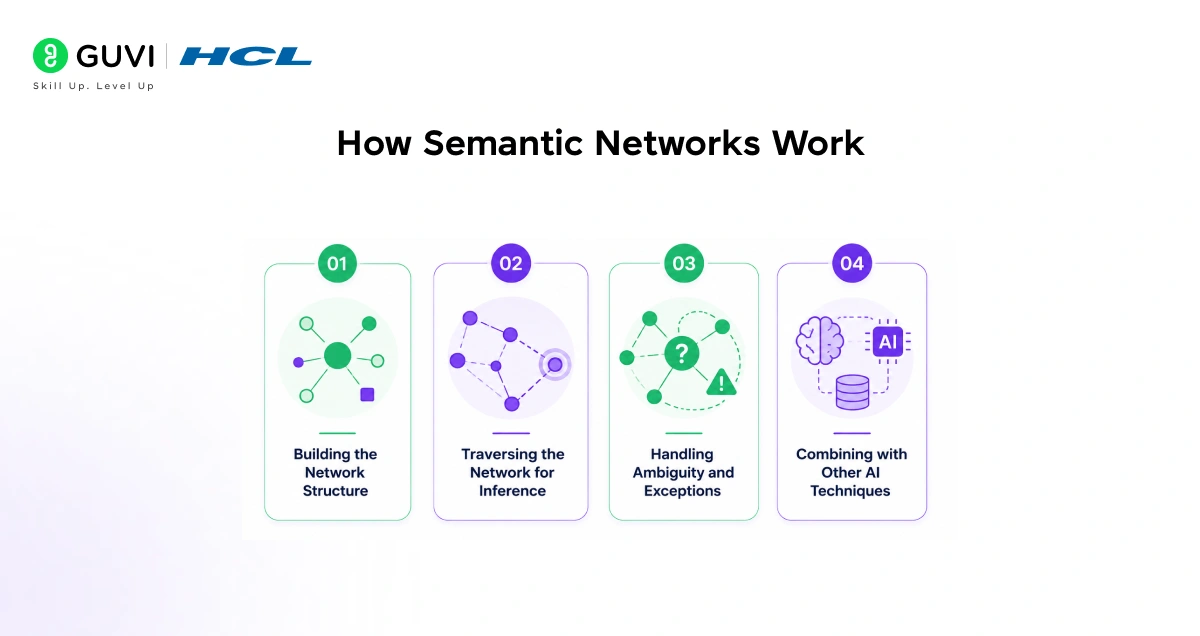
- Building the Network Structure
Construction begins with identifying the domain concepts that need representation. For a medical knowledge system, these might include diseases, symptoms, treatments, and body parts.
Next, relationships between concepts are defined. Diseases “cause” symptoms. Treatments “alleviate” diseases. Symptoms “affect” body parts. Each relationship type becomes an edge label.
Nodes are created for each concept and edges connect them according to the defined relationships. Properties are attached to nodes where needed. The result is a directed graph encoding domain knowledge.
- Traversing the Network for Inference
Inference happens through graph traversal. To answer “What are the symptoms of flu?” the system finds the “flu” node, follows all outgoing “causes” edges, and returns the connected symptom nodes.
Multi-hop reasoning chains multiple traversals. To answer “What treats the symptoms of flu?” the system first finds flu symptoms, then follows “treated-by” edges from those symptom nodes to treatment nodes.
Inheritance traversal follows is-a hierarchies upward to collect inherited properties. When asked about properties of “Collie,” the system traverses Collie → Dog → Mammal → Animal, collecting properties at each level.
- Handling Ambiguity and Exceptions
Real-world knowledge contains exceptions. Penguins are birds but cannot fly. Semantic networks handle this through explicit exception nodes or property overrides. The “penguin” node can have a “cannot fly” property that overrides the “can fly” property inherited from “bird.”
Multiple inheritance creates ambiguity when a concept inherits from multiple parents with conflicting properties. Resolution strategies include prioritizing more specific categories, using explicit conflict rules, or marking ambiguous properties as uncertain.

- Combining with Other AI Techniques
Semantic networks rarely work in isolation. They integrate with:
- Natural language processing to extract entities and relationships from text and populate the network automatically.
- Machine learning to predict missing edges or validate existing relationships based on patterns in data.
- Rule-based reasoning to apply logical inference rules on top of the network structure.
- Search algorithms to find optimal paths through large networks efficiently.
Types of Semantic Networks
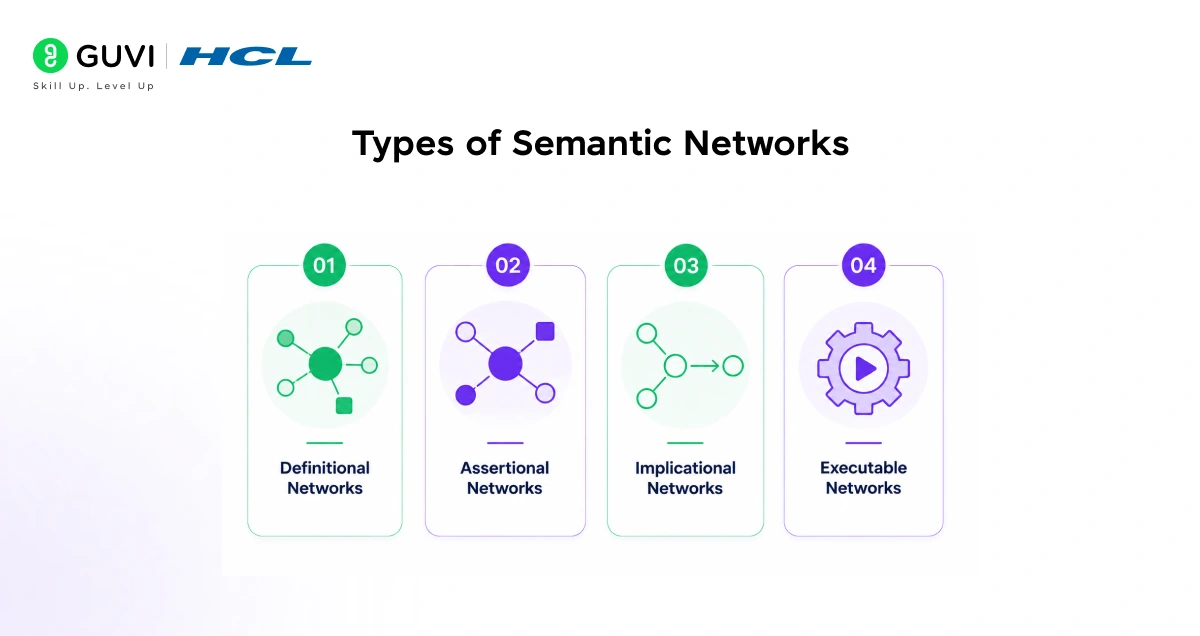
- Definitional Networks
Definitional networks focus on is-a and part-of hierarchies, organizing concepts into taxonomies. They answer questions about categories and composition: what something is and what it contains.
WordNet is the most well-known definitional network, organizing English vocabulary into semantic relationships with over 100,000 concepts. It powers language understanding in search engines, machine translation, and question-answering systems.
- Assertional Networks
Assertional networks represent specific facts and assertions about the world. They focus on instances rather than categories. “Einstein born-in Germany” and “Einstein developed relativity theory” are assertional statements linking a specific individual to properties and events.
Knowledge graphs like Wikidata and Google Knowledge Graph are assertional networks at massive scale, containing billions of factual assertions about real-world entities.
- Implicational Networks
Implicational networks encode cause-and-effect, prerequisite, and conditional relationships. They answer questions about consequences and dependencies. If X then Y. X causes Y. X requires Y.
These networks appear in planning systems, diagnostic tools, and causal reasoning applications where understanding the implications of actions or conditions matters more than static categorization.
- Executable Networks
Executable networks combine knowledge representation with procedural logic. Nodes can represent actions, states, or procedures. Edges represent control flow, preconditions, or triggers.
Workflow automation systems and intelligent agents use executable networks to represent not just what things are but what to do with them in different situations.
Building a knowledge graph that works in development is very different from operating one reliably in production at massive scale. Many organizations discover that challenges such as data consistency, graph updates, query performance, and infrastructure maintenance become increasingly difficult as graphs grow to millions or even billions of interconnected nodes. This is why successful semantic network systems depend not only on strong knowledge modeling, but also on robust engineering and scalable graph infrastructure.
Applications of Semantic Networks in AI
- Natural Language Understanding
Semantic networks help AI systems understand language by mapping words and phrases to concepts and relationships. When you search “who invented the telephone,” the system maps “invented” to an inventor-invention relationship and “telephone” to the telephone concept node, then traverses to find the connected inventor.
This powers question-answering systems, chatbots, and voice assistants that need to understand not just keywords but the semantic meaning of queries.
- Knowledge Graphs and Search Engines
Google’s Knowledge Graph, built on semantic network principles, enhances search results with structured information panels. When you search for “Albert Einstein,” the panel showing his birth date, nationality, and notable works comes from traversing relationships in a massive semantic network.
Enterprise knowledge graphs organize internal company information, connecting documents, people, projects, and expertise through relationship networks that enable discovery and insight generation.
- Expert Systems and Medical Diagnosis
Medical diagnosis systems use semantic networks to represent relationships between symptoms, diseases, tests, and treatments. A doctor inputs symptoms, and the system traverses the network to suggest possible diagnoses and appropriate tests.
Fault diagnosis in engineering follows the same pattern. Symptoms connect to potential failures, which connect to components, which connect to repair procedures.
- Recommendation Systems
Recommendation engines build semantic networks of users, items, and preferences. “User likes item,” “item similar-to item,” and “user similar-to user” relationships enable collaborative filtering and content-based recommendations.
E-commerce platforms use these networks to suggest products. Streaming services use them to recommend content. The network structure captures taste profiles and item relationships that simple attribute matching misses.
- Semantic Web and Linked Data
The Semantic Web vision uses semantic network principles to make web content machine-readable. RDF (Resource Description Framework) and OWL (Web Ontology Language) formalize how to represent knowledge as linked data across the internet.
DBpedia extracts structured information from Wikipedia into a semantic network with over 400 million facts, making encyclopedia knowledge queryable and linkable across applications.
To learn more about Semantic Networks in Artificial Intelligence and how AI systems represent knowledge and relationships between concepts, enroll in this AI and Machine Learning course covering AI fundamentals, Python, deep learning, NLP, and computer vision through hands-on projects and expert guidance with certification.
Final Thoughts
Semantic networks are not a relic of symbolic AI. They remain foundational to how modern AI systems represent, organize, and reason about knowledge. Every knowledge graph, every entity relationship model, every ontology-based system builds on semantic network principles.
The systems that work in production are built by teams that understood their domain deeply, designed relationship vocabularies carefully, planned for scale from the beginning, and integrated semantic networks with other AI techniques rather than treating them as standalone solutions.
Building semantic networks well is less about choosing the right graph database and more about executing the full knowledge engineering process without cutting the corners that look optional until they are not.
FAQs
1. What is the difference between a semantic network and a knowledge graph?
Semantic networks are the foundational concept for representing knowledge as graphs with nodes and relationships. Knowledge graphs are large-scale implementations of semantic networks, often containing millions of entities and relationships, typically with richer metadata and integration with modern graph databases.
2. Can semantic networks handle real-time updates?
Yes, but performance depends on network size and query patterns. Small to medium networks handle updates efficiently. Large-scale knowledge graphs require specialized graph databases with optimized indexing to maintain query performance as the network changes.
3. How do semantic networks support explainable AI?
Semantic networks provide interpretable reasoning paths. When an AI system makes a conclusion, it can trace the exact nodes and edges traversed to reach that conclusion, making the reasoning process transparent and auditable in a way black-box models cannot match.
4. What tools are used to build semantic networks?
Popular tools include RDF and OWL for semantic web applications, Neo4j and Amazon Neptune for graph databases, Protégé for ontology editing, and Python libraries like NetworkX and RDFLib for programmatic network construction and querying.
5. Are semantic networks still relevant with modern large language models?
Absolutely. While language models excel at generating text, they struggle with factual consistency and structured reasoning. Combining LLMs with semantic networks for retrieval-augmented generation improves accuracy, reduces hallucination, and provides explainable grounding for generated content.
Success Stories

About the Author
Vishalini Devarajan
An Aerospace Engineer turned content writer, I focus on making complex concepts easy to understand through well-structured, reader-friendly blogs. Whether it’s a technical topic or a non-technical one, I love creating content that is clear, engaging, and impactful.
View all posts by Vishalini Devarajan
Connect with me @








Did you enjoy this article?