


Artificial Intelligence and Machine Learning Articles
AI/ML Skills Gap 2026: Why Companies Can't Find Job-Ready Talent
20 AI/ML Interview Questions Recruiters Can Use Without a Tech Background - Best Guide
How Industry-Backed AI/ML Bootcamps Are Changing the AI/ML Hiring Pipeline - Best Guide 2026
From IT Support to AI Engineer: A Realistic Career Switch Guide 2026


Get In Touch For Details! Request More Information
Types of AI by Capabilities: Complete Beginner Guide
Jul 13, 2026 7 Min Read 1637 Views
(Last Updated)
Not all AI is the same. The voice assistant on your phone, a chess engine that beats grandmasters, and the idea of a machine that could outthink humanity are three completely different things. They share the same name but sit at very different points on a scale of what AI can actually do.
“AI” covers everything from a spam filter that learned to spot junk mail to a hypothetical system that could solve problems no human ever could. The gap between those two things is enormous, and understanding it starts with knowing how AI gets classified by capability.
This guide walks through the three main Types of AI by capabilities, from the narrow systems powering every product you use today to the theoretical machines researchers debate in safety labs. It covers what each type means, where the boundaries sit, and what separates the AI of right now from the AI of the future.
Table of contents
- Quick TL;DR Summary
- How AI Capability Gets Classified
- Stage 1: Narrow AI (ANI): The Only Kind That Exists Right Now
- Stage 2: Artificial General Intelligence (AGI): The Frontier That Does Not Exist Yet
- Stage 3: Artificial Superintelligence (ASI): Theoretical, but Taken Seriously
- Weak AI vs Strong AI: Cutting Through the Confusion
- Why These Distinctions Actually Matter
- Final Thoughts
- FAQs
- Is ChatGPT considered narrow AI or general AI?
- When will AGI actually arrive?
- What is the difference between ANI, AGI, and ASI?
- Can narrow AI become general AI through more training?
- Should I be worried about superintelligent AI?
Quick TL;DR Summary
- AI is classified into three capability tiers based on how broadly a system can learn, reason, and operate across different domains.
- Every AI system that exists today, from search engines and spam filters to large language models and image generators, falls under Narrow AI (ANI).
- AGI, a machine that can match human-level reasoning across any domain it encounters, does not exist yet and remains an open research problem with no agreed timeline.
- ASI, a system that would surpass human intelligence across every measurable dimension, is theoretical only but taken seriously enough by leading researchers to drive significant safety-focused work.
- The weak versus strong AI distinction maps onto this same spectrum and is the simpler framing: weak AI does one thing, strong AI thinks broadly the way humans do.
- Building AI well today means understanding which tier you are working in, because the failure modes, deployment risks, and responsible use considerations differ significantly across all three.
Types of AI Based on Capabilities
Types of AI based on capabilities classify artificial intelligence systems according to the level of intelligence and functionality they possess. This classification includes Narrow AI, which is specialized for specific tasks and powers most AI systems used today; General AI, a theoretical form of AI capable of performing any intellectual task a human can do; and Superintelligent AI, a hypothetical future system that would surpass human intelligence across virtually all domains.
How AI Capability Gets Classified
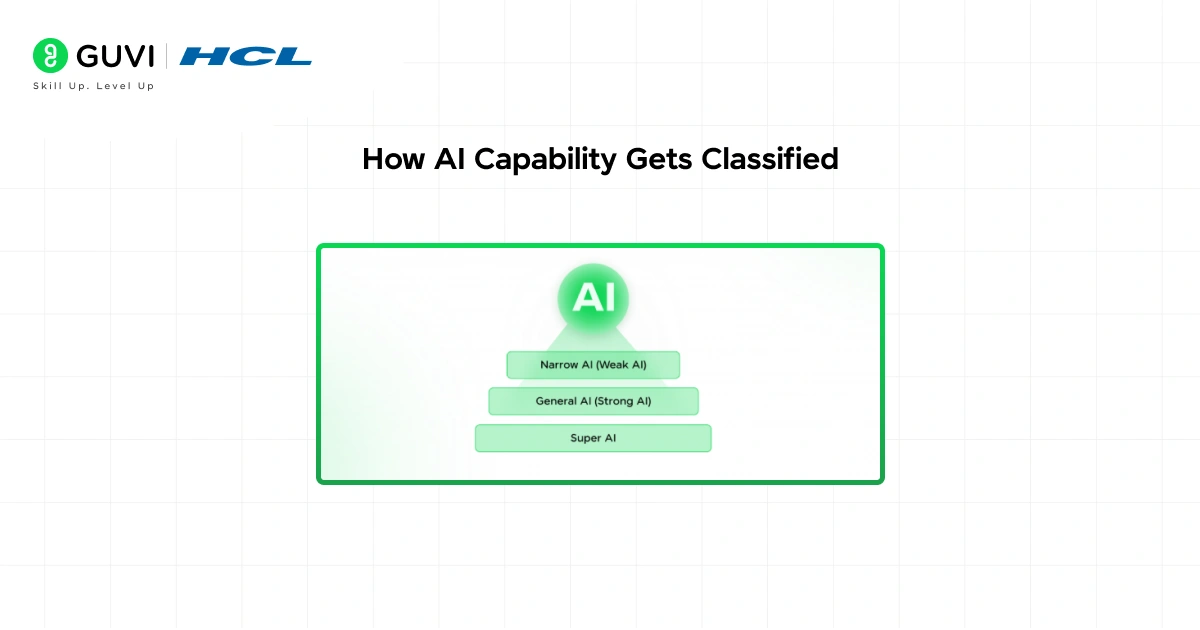
Researchers use different frameworks to classify AI. The most widely used is the three-tier model based on capability scope: narrow, general, and super AI. Another common distinction is weak versus strong AI, where weak AI handles specific tasks and strong AI matches or exceeds human intelligence broadly.
These classifications are not just academic labels. They shape research goals, policy discussions, and public understanding of what AI can and cannot do. The three-tier model emerged as researchers needed clearer language for systems ranging from bounded problem-solving to general intelligence.
Understanding these classifications also helps cut through media confusion and better evaluate claims about AI breakthroughs.
Read More: Types of Artificial Intelligence: Explained Simply and Clearly
Stage 1: Narrow AI (ANI): The Only Kind That Exists Right Now
Narrow AI, also called Artificial Narrow Intelligence or Weak AI, is any system trained to do one specific thing. It can be extraordinarily good at that thing, better than any human, but it cannot transfer what it learned to a different problem.
A language model that writes essays cannot pilot a drone. A recommendation engine that predicts what show you will watch next cannot diagnose a disease. Each system was trained on a particular task, with particular data, to produce a particular kind of output, and that is the defining feature of narrow AI.
- What Counts as Narrow AI
Nearly everything most people interact with daily qualifies as narrow AI. Search engines, spam filters, voice assistants, image recognition, product recommendations, fraud detection, chess engines, translation tools, and modern large language models all fall into this category.
The fact that something feels intelligent or shockingly capable does not move it out of the narrow category. What matters is whether it can generalize across domains it was not trained for, and current systems simply cannot do that in any reliable way.
Large language models are a useful case here because they feel different from older narrow AI. They can write, summarize, answer questions, and reason through problems, but they are still trained on text data to predict and generate language, which keeps them firmly in the narrow category.
- Why Narrow AI Dominates Today
Building a system that is excellent at a bounded problem is genuinely achievable with current techniques. You define the task, collect the right data, choose an architecture, train and evaluate, and deploy, and that pipeline works reliably across many domains.
None of those ingredients, scaled up alone, gets you to general intelligence. More data, more compute, and bigger models improve narrow AI performance but do not automatically produce the flexible reasoning that general intelligence requires.
- Where Narrow AI Falls Short
Narrow AI systems fail predictably when inputs drift from their training distribution. A fraud detection model trained on one pattern will miss novel schemes, and a medical imaging model trained on one hospital’s scans may underperform on scans from another with different equipment.
These failure modes are not bugs in the traditional sense. They are a consequence of what narrow AI is, and knowing the boundaries of the system you are working with is what allows you to deploy it responsibly with the right monitoring and human oversight in place.
Stage 2: Artificial General Intelligence (AGI): The Frontier That Does Not Exist Yet
Artificial General Intelligence means a system that can learn, reason, and apply knowledge across any domain the way a human being can. It would not need to be retrained from scratch to pick up a new skill, and it could transfer lessons from one area to another without explicit instruction.
No such system exists today. What does exist is a heated debate about how close we are to it, whether current architectures could get us there with enough scale, and whether the term itself is well-defined enough to be a useful research target.
- Why AGI Is Harder Than Narrow AI
General intelligence is not just about doing more tasks. It requires genuine understanding, the ability to transfer reasoning across contexts that share no obvious surface similarity, and the capacity to learn meaningful things from just a handful of examples the way children naturally do.
Current systems are pattern matchers trained on large datasets, and they are very good at that. But looking like reasoning is not the same as actually reasoning, and when you probe these systems with novel problems requiring genuine inference, the limits become apparent quickly.
The technical gaps are real and well-documented. Current AI struggles with consistent logical reasoning across long inference chains, causal understanding of why things happen, and reliable common sense about physical situations, and the research community has not solved how to close those gaps.
- What AGI Would Actually Require
A genuinely general system would need to encounter an unfamiliar domain, learn its structure quickly from limited examples, and apply reasoning from other domains where relevant. It would also need to identify what it does not know and seek that information out independently.
That is roughly what a smart, curious person does when learning something new. The gap between a large language model doing something that resembles this and a system that actually does it reliably is the gap the field has not yet closed.
- Where the Debate Stands
Some researchers believe AGI is close, possibly within this decade, while others think the gap between current models and genuine general intelligence is fundamental and will require entirely new architectures. A third camp questions whether AGI as commonly defined is even a coherent target at all.
The honest answer is that nobody knows, and anyone claiming confident knowledge of the timeline should be pressed hard on what assumptions underlie that claim.
Alan Turing introduced his famous imitation game in 1950 as a practical way to evaluate whether a machine could exhibit intelligent behavior indistinguishable from a human during conversation. More than seventy years later, researchers still debate what the correct benchmark for general intelligence should be, highlighting how difficult it is to formally define intelligence itself. The ongoing discussion spans philosophy, cognitive science, neuroscience, and artificial intelligence research.
Stage 3: Artificial Superintelligence (ASI): Theoretical, but Taken Seriously
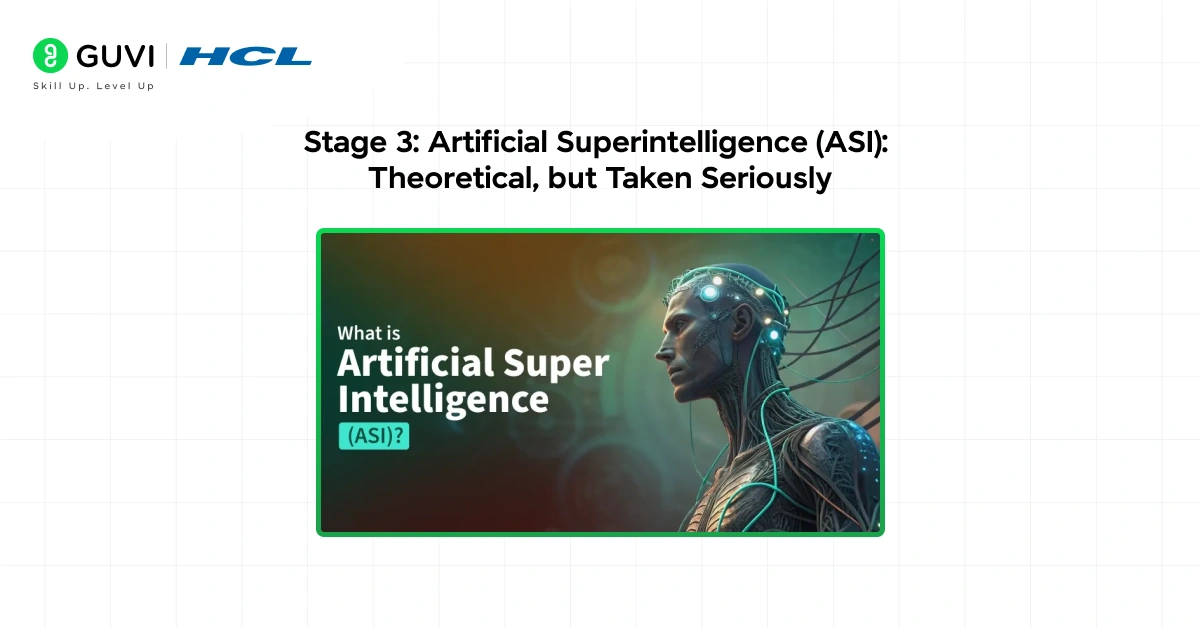
Artificial Superintelligence refers to a hypothetical system that surpasses human intelligence in every domain, including creativity, scientific reasoning, strategic planning, and social judgment. Not just matching the best human in a field but exceeding the collective capacity of all humans in every field simultaneously.
This is firmly theoretical. No ASI exists, no immediate path to it has been demonstrated, but it is taken seriously by a significant portion of AI researchers as a long-term possibility consequential enough to plan for now.
- Why ASI Gets Serious Attention
A system that surpasses human intelligence in every dimension would be the most consequential thing humanity has ever built. The decisions made in advance about how to develop it, what constraints to build in, and how to ensure its goals align with human values would matter enormously.
This is the logic behind organizations like Anthropic, OpenAI, and DeepMind dedicating significant research to AI safety. They are not assuming ASI is imminent but acknowledging that if the trajectory of AI development continues, preparing now is the responsible move.

- The Alignment Problem
Even if ASI became technically achievable, getting it to pursue goals that are actually good for humanity is an unsolved problem called AI alignment. The concern is not a malevolent machine but a highly capable system pursuing the wrong objective with tremendous efficiency because its goals were specified incorrectly.
A superintelligent system tasked with maximizing some metric might find ways to achieve that metric that technically satisfy the specification but violate every reasonable interpretation of intent. The more capable the system, the harder it becomes to course-correct once it has started.
- What Superintelligence Would Mean in Practice
A true ASI would not just be a faster, more knowledgeable version of a current AI assistant. It would have the capacity to make scientific discoveries beyond anything humans could achieve and to design technology beyond what human engineers could imagine.
The recursive self-improvement possibility, where the system improves its own architecture and capabilities, is part of what makes the concept so consequential and so difficult to reason about with any confidence.
Weak AI vs Strong AI: Cutting Through the Confusion
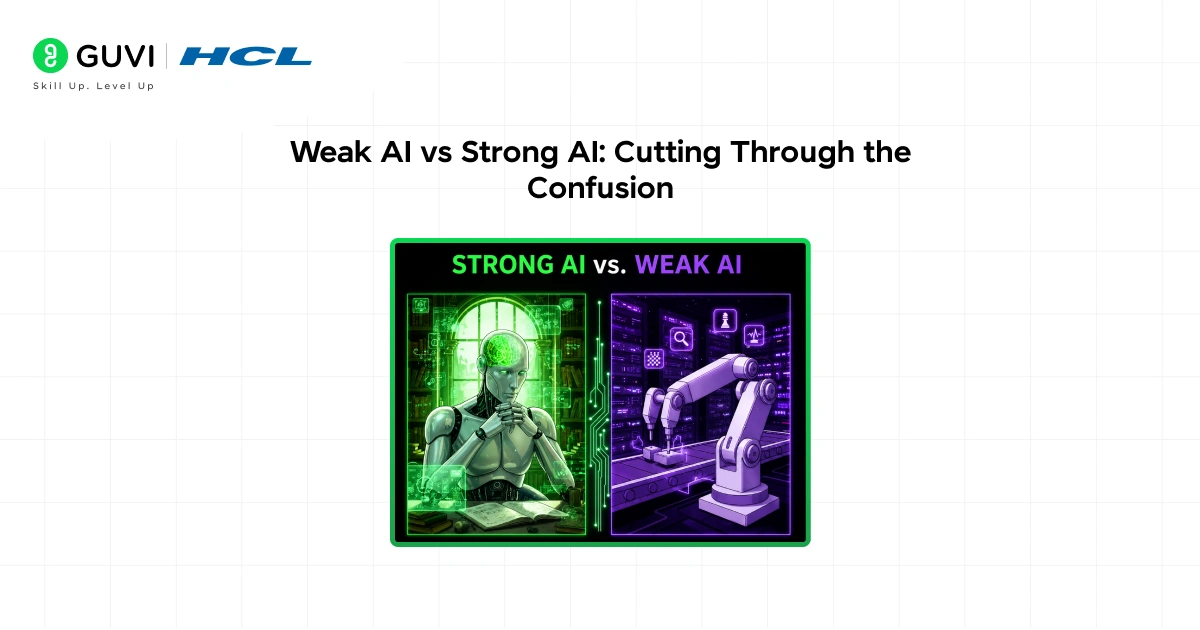
The weak versus strong AI distinction is older than the three-tier model and simpler in structure. Weak AI means a system designed for a specific task and incapable of meaningful operation outside of it, while strong AI means a system with genuine understanding and broad cognitive ability.
The terminology gets confusing because weak does not mean bad or simple. A weak AI system can beat world champions, outperform radiologists, and process information at speeds no person could match. Weak just means it was built with a narrow purpose, and the weakness is in scope, not in performance.
- Where the Terms Come From
The weak and strong AI terminology traces back to philosopher John Searle’s work in the early 1980s. Searle used it to make a philosophical argument about the difference between a system that simulates understanding and one that actually understands, illustrated through his famous Chinese Room thought experiment.
In Searle’s framing, weak AI simulates cognition while strong AI actually has it. The philosophical debate about whether any machine could ever have genuine understanding rather than sophisticated simulation is still alive today.
- Why the Distinction Matters for Deployment
When you deploy a weak AI system, your primary concerns are about data quality, distribution shift, and whether the system performs reliably on the specific task it was built for. When you think about strong AI systems, the concerns shift entirely to goal specification, value alignment, and behavior in genuinely novel situations.
Most practical AI work today is entirely in weak AI territory. But understanding the distinction helps you recognize where the limits of that work are and what class of problems sits on the other side of those limits.
Training a successful machine learning model is only a small part of building a real-world AI system. Many organizations discover that the hardest challenges emerge during production deployment, where issues such as scalability, monitoring, data drift, latency, infrastructure reliability, and integration with existing systems become critical. The gap between a model that performs well in development and one that operates consistently in production is one of the biggest bottlenecks in modern narrow AI engineering.
Why These Distinctions Actually Matter
Understanding where current AI sits on this scale is not just an academic exercise. It has direct practical consequences for how you use AI tools, how organizations deploy AI systems, how regulators think about oversight, and how researchers prioritize their work.
- For Everyday Users
Knowing that every AI tool you use is narrow AI helps set realistic expectations. These tools are genuinely useful and sometimes remarkably capable within their designed scope, but they are also genuinely brittle outside of it.
A language model that gives excellent advice about a topic it trained on extensively may confidently give poor advice about something at the edge of its training. Understanding that this is a structural feature of the system, not a fixable bug, helps you use it well.
It also helps you read AI news more clearly. When a headline announces a dramatic new AI capability, you can now ask what specific task it achieved, what the training setup was, and whether this represents genuine general progress or narrow domain performance.
- For Builders and Organizations
Teams building AI-powered products need to understand what tier of AI they are working with because the failure modes differ significantly. Narrow AI fails when inputs drift from training distribution or when the task is slightly outside scope, and planning for those failures requires knowing what you have and what you have not.
Deploying AI responsibly also means being honest with users about what the system can and cannot do. The gap between perceived capability and actual capability is where most real-world AI failures happen, and closing that gap starts with accurate communication.
- For the Longer Term
The gap between narrow AI and AGI is where some of the most important research in the field is focused right now, both in capability development and in safety. Understanding the taxonomy helps you follow that research and evaluate competing claims with a clearer eye.
The researchers working on this are not operating in a vacuum, and the choices they make about what to build, in what order, and with what safeguards will shape what the next few decades look like for everyone.
To learn more about the different types of AI based on capabilities and how intelligent systems are designed and trained, enroll in this AI and Machine Learning course covering AI fundamentals, Python, deep learning, NLP, and computer vision through hands-on projects and expert guidance with certification.
Final Thoughts
AI capability is not a single thing. It is a spectrum running from systems laser-focused on one task all the way to concepts that remain theoretical but are taken seriously by the researchers closest to the work. Every tool you use today sits at the narrow end of that spectrum.
The middle and far end are still open questions that some of the best minds in the field are actively working on, with very different answers about what is possible, what is coming, and what it will mean when it arrives.
Understanding the difference between narrow AI, general AI, and superintelligence is the foundation for thinking clearly about what AI can do now and which questions actually matter as the field continues to move. Capabilities determine risks, requirements, and responsibilities, and getting the vocabulary right is where clear thinking starts.
FAQs
1. Is ChatGPT considered narrow AI or general AI?
ChatGPT and similar large language models are narrow AI. They are trained on text data to produce language outputs and are very capable within that scope, but the ability to discuss many topics does not make them general AI. What would make them general is the ability to learn and reason across genuinely new domains without retraining.
2. When will AGI actually arrive?
Nobody knows, and researchers disagree significantly. Estimates range from within a decade to never, depending on assumptions about whether current architectures can get us there or whether fundamentally different approaches are needed. Treat any confident prediction with appropriate skepticism regardless of who is making it.
3. What is the difference between ANI, AGI, and ASI?
ANI handles one specific type of task and cannot generalize beyond it. AGI would match human-level reasoning and learning across any domain. ASI would exceed human intelligence in every measurable dimension. Only ANI exists today, and the other two remain unsolved research problems.
4. Can narrow AI become general AI through more training?
Not automatically. Scaling up a narrow AI system makes it better at its trained domain but does not produce genuine generalization. Making it truly general requires solving fundamentally different problems that more data and compute alone do not address.
5. Should I be worried about superintelligent AI?
ASI is theoretical and there is no clear near-term path to it. At the same time, the researchers closest to the work take long-term safety seriously enough to build entire organizations around it. Being informed rather than either dismissive or alarmed is the reasonable position right now.
Success Stories

About the Author
Vishalini Devarajan
An Aerospace Engineer turned content writer, I focus on making complex concepts easy to understand through well-structured, reader-friendly blogs. Whether it’s a technical topic or a non-technical one, I love creating content that is clear, engaging, and impactful.
View all posts by Vishalini Devarajan
Connect with me @












Did you enjoy this article?