


Artificial Intelligence and Machine Learning Articles
AI/ML Skills Gap 2026: Why Companies Can't Find Job-Ready Talent
20 AI/ML Interview Questions Recruiters Can Use Without a Tech Background - Best Guide
How Industry-Backed AI/ML Bootcamps Are Changing the AI/ML Hiring Pipeline - Best Guide 2026
From IT Support to AI Engineer: A Realistic Career Switch Guide 2026


Get In Touch For Details! Request More Information
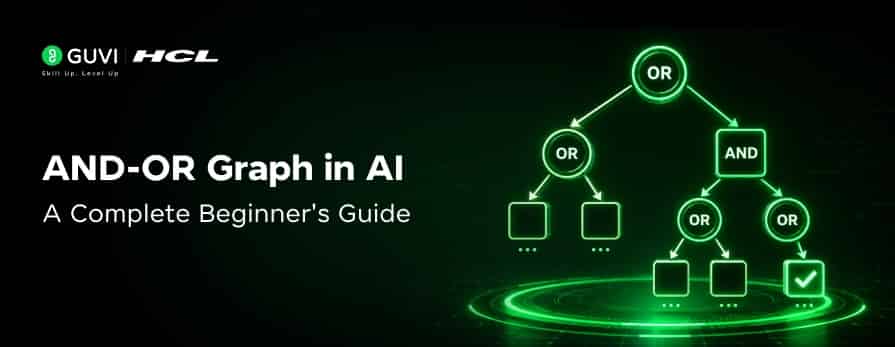
AND-OR Graph in AI: A Complete Beginner’s Guide
Jul 13, 2026 7 Min Read 1749 Views
(Last Updated)
When you think about solving a difficult problem, you naturally break it down into smaller pieces. You might say, “To finish this project, I need to complete Part A AND Part B.” Or you might say, “I can reach my destination by taking Route X OR Route Y.” This kind of thinking, splitting a big problem into smaller ones with clear logical connections, is exactly what AND-OR graphs formalize in artificial intelligence.
Most people learning AI start with standard search algorithms like Breadth-First Search or A*, which work well for problems that have a single path to a solution. But many real-world problems do not look like that. They are complex, layered, and made up of interconnected sub-tasks that all need to be handled in specific combinations.
Standard graph search falls short in these cases. That is where AND-OR graphs come in, offering a structured way to represent and solve problems that can be broken down into smaller, manageable components.
In this article, we will walk through everything you need to know about AND-OR graphs in AI, from what they are and how they work to the AO* algorithm that searches them and the real-world situations where this kind of problem-solving approach is genuinely useful.
TL;DR:
- AND-OR graphs model problems that break into subproblems, with AND nodes (all children needed) and OR nodes (any one child enough).
- Standard OR-graph search (like A*) finds a single path to a goal and works best when only one route/solution is needed.
- AO* is a heuristic, best-first algorithm designed specifically to search AND-OR graphs efficiently and (aim to) find optimal solution subgraphs.
- AO* repeatedly builds a best solution tree, expands promising nodes, propagates updated costs backward, and labels nodes as solved or unsolvable.
- Typical applications include hierarchical planning, robotics, diagnosis, game AI, and any problem with conjunctive subgoals and alternative strategies.
- AO* is powerful but can be computationally expensive and strongly depends on having a well-structured graph and a good heuristic function.
Table of contents
- The Difference Between OR Graphs and AND-OR Graphs
- Understanding AND Nodes and OR Nodes
- The AO* Algorithm
- How AO* Works Step-by-Step
- Step 1: Initialize and Build Best Tree
- Step 2: Select and Expand a Node
- Step 3: Update Local Costs and Best Arc
- Step 4: Backward Propagation and Labeling
- Step 5: Apply FUTILITY, Check Termination, Repeat
- AO* vs. A*: Key Differences
- Real-World Applications
- Advantages and Limitations
- Wrapping Up
- FAQS
- What is an AND-OR graph in simple terms?
- How is AO* different from A*?
- When should AO* be used instead of A*?
- Why can’t standard best-first or A* search handle AND-OR graphs well?
- What are the main limitations of AO*?
What Is an AND-OR Graph in AI?
An AND-OR graph is a specialized problem-solving structure used in artificial intelligence to represent tasks that can be divided into multiple sub-problems. In this graph, AND nodes require all connected sub-problems to be solved for the solution to succeed, while OR nodes require only one of the available alternatives to be solved. By combining mandatory and alternative paths, AND-OR graphs help AI systems model complex decision-making, planning, reasoning, and search problems more effectively.
The Difference Between OR Graphs and AND-OR Graphs
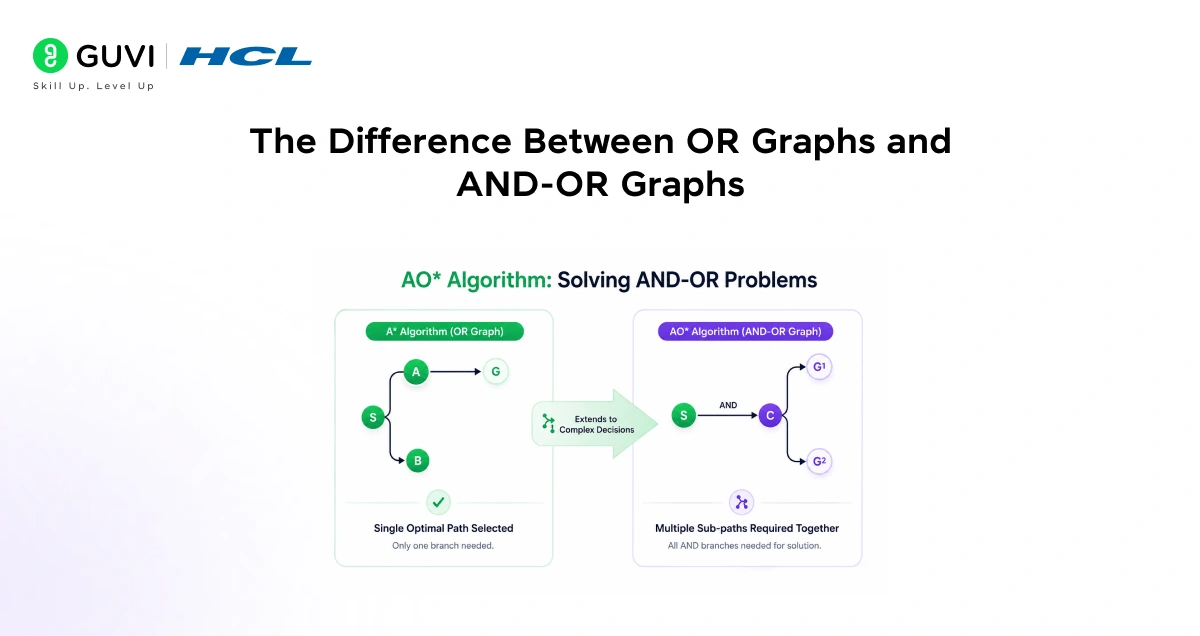
- OR Graphs: One Path Is Enough
In standard search on OR graphs, the goal is to find any single path from a start node to a goal node. Each node represents a state, and each outgoing branch represents an alternative way to continue the search, so reaching the goal along any one branch is sufficient to claim success.
This is similar to navigation: if there are many routes from home to school, you only need one valid route, so the search strategy focuses on finding one successful path, not all of them.
- AND-OR Graphs: Solving All Subproblems
Many AI problems require solving several subproblems together, more like assembling a product than choosing a route. AND-OR graphs represent this by allowing a node to be reduced into multiple subproblems via AND arcs, where all successor nodes of that AND arc must be solved for the original node to count as solved.
At the same time, OR branching can still exist, where solving any one of several alternative decompositions is enough, so a single structure can express both “any one is enough” (OR) and “all are required” (AND) in the same graph.
Understanding AND Nodes and OR Nodes
The two types of nodes are the core of how AND-OR graphs work, and each one represents a fundamentally different logical relationship between a problem and its sub-problems.
- An AND node represents a problem that can only be solved if every one of its subproblems is solved. There is no shortcut.
- Every branch connected to an AND node must lead to a solution for the node itself to be considered solved. A useful everyday analogy is booking a flight and then arranging a taxi to the airport. Both tasks must be completed for the travel plan to work. Finishing one without the other is not enough.
- An OR node, on the other hand, represents a problem that can be solved if any one of its sub-problems leads to a solution.
- The sub-problems connected to an OR node are alternatives. Only one of them needs to succeed. This allows AI to represent both cases where all of a set of sub-goals must be satisfied to achieve some goal and where there are alternative sub-goals, any of which could achieve the goal.
- In the visual representation of an AND-OR graph, AND arcs are typically drawn with a curved line connecting all the branches that emerge from the node, making it clear that every one of those branches must be resolved.
- OR arcs look like regular branches, each representing an independent alternative path. Understanding how to read this notation is important when you start working with textbook examples or algorithm diagrams.
The AO* Algorithm
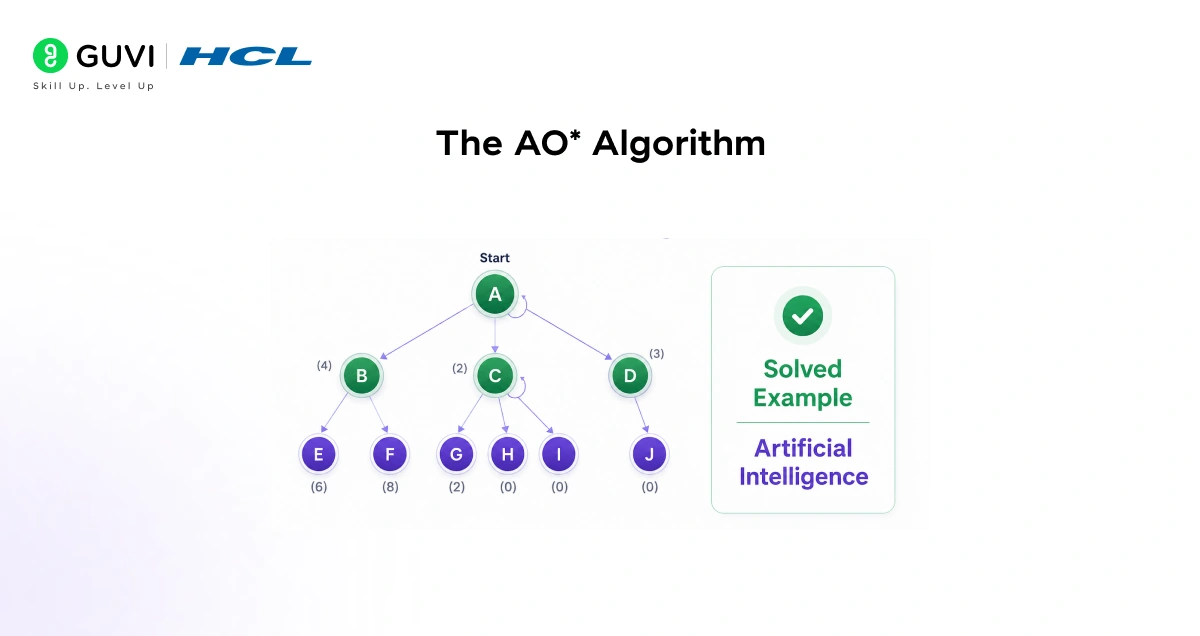
The AO* algorithm is the standard heuristic search technique used to traverse AND-OR graphs.
- It is built specifically to handle the complexity that AND nodes introduce and to find the optimal solution across a graph where some nodes require all subproblems to be solved, while others require only one.
- The AO* algorithm uses knowledge-based search, where both the start and target states are predefined.
- By leveraging heuristics, it identifies the best path, significantly reducing time complexity. Compared to the A* algorithm, AO* is more efficient when solving problems represented as AND-OR graphs, as it evaluates multiple paths at once.
- The AO* algorithm is an example of the best-first search class. Best-first search algorithms are informed, which means they have prior knowledge about distances from heuristics. The AO* algorithm is based on AND-OR graphs to break complex problems into smaller ones and then solve them.
- The AND side of the graph represents those tasks that need to be done together to reach the goal, while the OR side stands alone for a single task.
- Like A*, the AO* algorithm uses two lists to manage its search. AO* uses an OPEN list containing nodes that have been traversed but not yet marked solvable or unsolvable, and a CLOSED list containing nodes that have already been processed.
- The heuristic function h(n) estimates the cost of reaching the goal from any given node, guiding the algorithm toward the most promising paths.
AND-OR graphs power many advanced AI planning systems that go far beyond simple pathfinding. Unlike ordinary search trees, they can represent situations where some tasks require completing multiple subgoals simultaneously (AND relationships) while also supporting alternative strategies or fallback choices (OR relationships). This makes them especially useful for complex decision-making in robotics, game AI, diagnosis systems, web-service composition, and logistics planning, where intelligent systems must balance required steps with flexible ways of achieving a goal.
How AO* Works Step-by-Step
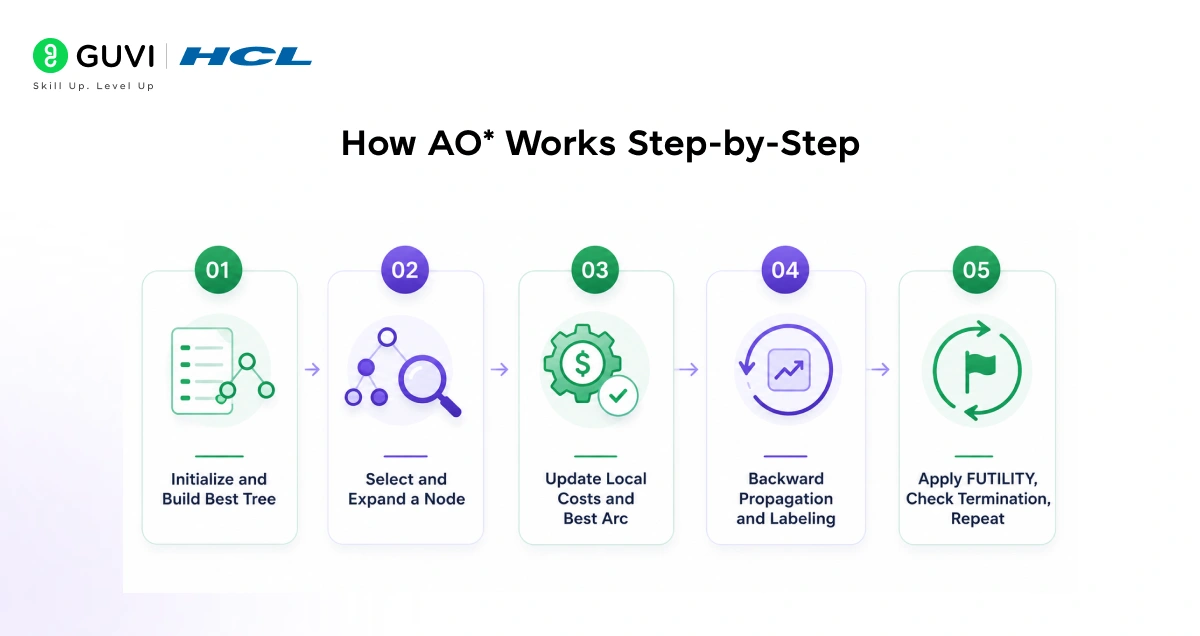
Step 1: Initialize and Build Best Tree
Place the start node into the OPEN list and set all initial heuristic values. From this, compute the current best solution tree by tracing the most promising path (including AND/OR choices) from the start node to leaf nodes, using the present heuristic and cost estimates.
Step 2: Select and Expand a Node
Choose a node that is both in OPEN and lies on the current best solution tree, and make it the current node. Expand this node by generating its successors, adding them to OPEN, and computing heuristic values for each new child according to the problem’s heuristic function.
Step 3: Update Local Costs and Best Arc
For the current node, compute the cost of each outgoing arc (or AND-group of arcs) by combining arc costs with the heuristic values of its successors. Assign the minimum of these as the node’s updated heuristic and mark the corresponding arc (or AND combination) as the best way forward from this node.
Step 4: Backward Propagation and Labeling
Propagate any changed heuristic values and solution status backward from the expanded node to its parents, recomputing their costs and possibly changing their best arcs. Label nodes as solved if they are goal nodes or if, along their best arc, all required successor nodes are solved; label nodes unsolvable if all their options are unsolvable or exceed acceptable cost.

Step 5: Apply FUTILITY, Check Termination, Repeat
Prune branches whose estimated solution cost exceeds a predetermined FUTILITY threshold, since such solutions are not worth pursuing. If the start node becomes solved, the algorithm stops with success; if it becomes unsolvable, it stops with failure; otherwise, recompute the current best solution tree and repeat from Step 2.
AO* vs. A*: Key Differences
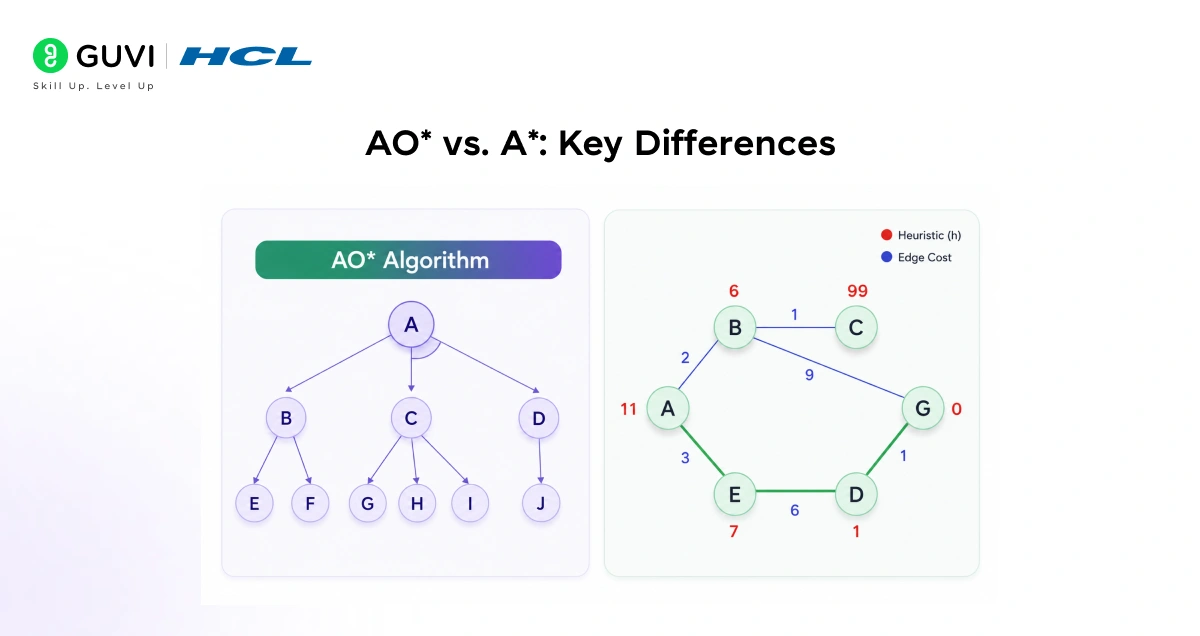
- When to Use A* vs AO*
A* works best for problems that look like “find me the best route from here to there,” such as pathfinding, single-agent planning with deterministic actions, and situations where there is a single clear goal state.
AO* is better for problems that must be decomposed into several subgoals that all need to be satisfied, such as hierarchical planning, conjunctive subgoals, diagnosis, and conditional planning where decisions depend on multiple conditions being resolved.
- How Their Search Behaviors Differ
A* runs a single forward search guided by a heuristic and tries to jump directly to the optimal solution, committing to a single best path as soon as it is justified. AO* instead iteratively refines a solution subgraph: it improves its current best set of paths over time, can update and backtrack as new cost information arrives, and it can evaluate AND and OR choices in parallel branches, which lets it shrink the effective search space for complex decision trees.
If you had a problem like “plan a project with multiple dependent tasks,” how would you argue that AO* is more appropriate than A* in that situation?
Real-World Applications
AND-OR graphs and the AO* algorithm are not purely academic constructs. They show up in several real-world AI applications where complex, multi-step problem-solving is required.
- Robotics is one of the most active application areas. AND-OR graphs are used in task and motion planning for robots, particularly when a robot must handle tools or components around obstacles, requiring dynamic reordering of actions as reachability changes.
When a robot arm in a warehouse needs to clear objects to reach a target item, the sequence of moves it must make forms exactly the kind of AND-OR structure that this framework is built to handle.
- IBM Research uses AND-OR graph search in its DRL-CPLAN system for optimal non-deterministic planning based on memory-limited AND-OR graph search. Planning with AND-OR graphs is also relevant in multi-modal journey planning with contingencies, such as planning for missed connections, and in the composition and adaptation of web services.
- Planning systems that use AND-OR style decomposition also appear across logistics for optimizing routes and schedules, manufacturing for making production processes more efficient, and game AI, where non-player characters need to make intelligent decisions in response to player actions.
Each of these domains involves problems with both mandatory sub-tasks and alternative approaches, making them natural fits for the AND-OR framework.
Advantages and Limitations
- The AO* algorithm’s advantages include efficiency in handling complex decision trees by evaluating multiple paths simultaneously; flexibility because the algorithm’s ability to deal with AND and OR nodes makes it versatile for various problem types, and optimality because by using heuristic functions, AO* aims to find optimal solutions.
- On the limitations side, the algorithm can become computationally expensive, especially in highly complex graphs with many nodes and connections, as it must evaluate numerous possibilities. AO* may also require significant memory resources to store the nodes and paths being evaluated, which can be a limitation in resource-constrained environments.
- The performance of AO* heavily relies on the quality of the heuristic function. A weak heuristic makes the search much less efficient, in the same way it does for A*.
- It is also worth noting that AO* does not work equally well for every problem type. For unsolvable nodes, AO* sometimes cannot find the optimal path. Designing the AND-OR graph structure itself requires a solid understanding of the problem domain, and poorly structured graphs can lead to searches that explore far more nodes than necessary.
If you’re serious about mastering OR/AND graphs in AI understanding problem decomposition, AO* algorithm, OR/AND node traversal, and optimal solution paths, don’t miss the chance to enroll in HCL GUVI’s Artificial Intelligence & Machine Learning Course, co-designed by Intel
Wrapping Up
AND-OR graphs bring a powerful and intuitive idea into formal AI problem solving: not every problem can be solved by finding just one path.
Some problems require all sub-tasks to be completed, others offer alternatives, and most real problems involve a mix of both. By representing these relationships explicitly through AND nodes and OR nodes, AND-OR graphs give AI systems a structured way to reason about complex, decomposable problems.
The AO* algorithm is what makes searching these graphs practical, using heuristic guidance to focus on the most promising solution paths without exhaustively exploring every possibility. From robot task planning and logistics to game AI and automated reasoning, the ideas behind AND-OR graphs remain as relevant as ever in modern AI development.
For anyone building a foundation in AI search techniques, understanding this structure is a genuinely important step toward grasping how intelligent systems tackle problems that go far beyond finding a simple path from A to B.
FAQS
1. What is an AND-OR graph in simple terms?
An AND-OR graph is a way to draw a big problem as smaller subproblems, where some parts are “all must be done” (AND) and others are “choose one option” (OR). AND nodes mean every child must be solved; OR nodes mean any one child is enough to reach the goal.
2. How is AO* different from A*?
A* searches a normal OR graph and looks for a single best path to a goal, assuming you only need to reach one goal state. AO* searches AND-OR graphs, where a solution can be a whole subgraph of tasks, and it must sometimes satisfy several subgoals at once, not just pick one path.
3. When should AO* be used instead of A*?
AO* should be used when the problem naturally breaks into subproblems that must all be solved or where there are conditional branches, such as hierarchical planning, diagnosis, or project plans with dependent tasks. A* is better for pure route-finding or “one-path-to-goal” problems like shortest-path navigation.
4. Why can’t standard best-first or A* search handle AND-OR graphs well?
Standard best-first search and A* choose the next node mostly by looking at that node’s own heuristic value, assuming its cost is independent. In AND-OR graphs, the true cost of an AND node depends on all its children together, so a node that looks cheap alone might be part of an expensive overall combination, which these algorithms are not designed to handle.
5. What are the main limitations of AO*?
AO* can become heavy on time and memory when the AND-OR graph is very large or poorly structured, because many combinations of subproblems must be considered. Its efficiency also depends strongly on having a good heuristic; a weak heuristic can cause AO* to explore much more of the graph than necessary.
Success Stories

About the Author
Vishalini Devarajan
An Aerospace Engineer turned content writer, I focus on making complex concepts easy to understand through well-structured, reader-friendly blogs. Whether it’s a technical topic or a non-technical one, I love creating content that is clear, engaging, and impactful.
View all posts by Vishalini Devarajan
Connect with me @










Did you enjoy this article?