


Artificial Intelligence and Machine Learning Articles
AI/ML Skills Gap 2026: Why Companies Can't Find Job-Ready Talent
20 AI/ML Interview Questions Recruiters Can Use Without a Tech Background - Best Guide
How Industry-Backed AI/ML Bootcamps Are Changing the AI/ML Hiring Pipeline - Best Guide 2026
From IT Support to AI Engineer: A Realistic Career Switch Guide 2026


Get In Touch For Details! Request More Information
AWS AI Practitioner (AIF-C01): Complete Beginner’s Guide
Sep 22, 2026 7 Min Read 1069 Views
(Last Updated)
Ever sat in a meeting where everyone’s throwing around “generative AI” and “foundation models,” and you’re nodding along while quietly Googling what half of it means? That’s exactly the gap the AWS AI Practitioner certification was built to close.
The AWS Certified AI Practitioner (AIF-C01) is a foundational, non-technical certification validating your understanding of AI, ML, and generative AI on AWS, no coding required. Launched in late 2024, it’s become one of AWS’s fastest-growing generative AI credentials.
This guide covers what the AWS AI Practitioner exam actually tests, who it’s really for, the exact domain breakdown, how to prepare, and how it stacks up against Microsoft’s AI-900, useful context if you’re weighing a broader career switch into AI.
Table of contents
- TL;DR Summary
- What Exactly Is the AWS AI Practitioner Certification?
- Who Should Take the AWS AI Practitioner Exam?
- The 5 AWS AI Practitioner Exam Domains
- Fundamentals of AI and ML
- Fundamentals of Generative AI
- Applications of Foundation Models
- Guidelines for Responsible AI
- Security, Compliance, and Governance
- Must-Know AWS Services
- Exam Structure and Format
- AWS AI Practitioner Exam Structure at a Glance
- AWS AI Practitioner Cost, Scheduling, and Validity
- How Long Should You Prepare for the AWS AI Practitioner Exam?
- The Best Study Resources
- How to Actually Prepare for AWS AI Practitioner
- Build a Service Map
- AWS AI Practitioner vs. Microsoft AI-900
- Common Mistakes to Avoid With AWS AI Practitioner
- Sample Exam Question Walkthrough
- What Happens After You Pass?
- Final Thoughts
- FAQs
- Do I need coding experience for AIF-C01?
- How long to prepare?
- What's the passing score and cost?
- Key services to memorize?
- How does it differ from AWS ML Specialty?
TL;DR Summary
- What it is: a non-coding AWS certification proving you understand AI, ML, and generative AI concepts well enough to make informed business decisions
- Who it’s for: business analysts, product/project managers, sales and support teams, and career changers, not hands-on ML engineers
- Exam basics: 65 questions (50 scored), 90 minutes, $100, pass at 700/1,000
- Prep time: 30-40 hours for beginners, 15-20 hours if you already know AWS
- Where it fits: if your org runs on AWS, this beats Microsoft’s AI-900 as your starting point
What Is the AWS Certified AI Practitioner (AIF-C01)?
The AWS Certified AI Practitioner (AIF-C01) is AWS’s foundational AI certification that validates your understanding of artificial intelligence, machine learning, and generative AI concepts. It also assesses your ability to identify the appropriate AWS services to solve business problems. The exam is designed for beginners and does not require coding experience.
What Exactly Is the AWS AI Practitioner Certification?
The AWS AI Practitioner exam, AIF-C01, validates that you can:
- Describe AI, ML, and generative AI concepts, both generally and on AWS
- Identify which AWS AI/ML service actually fits a given business problem
- Use AI and generative AI responsibly
Passing the AWS AI Practitioner exam takes no coding, no math-heavy modeling, just solid conceptual understanding. AWS recommends up to six months of AI/ML exposure beforehand, but that’s a suggestion, not a requirement.
Who Should Take the AWS AI Practitioner Exam?
The AWS AI Practitioner exam is genuinely built for non-technical professionals. It’s a strong fit if you’re a:
- Business analyst, product manager, or project manager who needs to understand how AI actually moves business outcomes
- IT or line-of-business manager making decisions informed by AI capabilities
- Sales, marketing, or customer success professional positioning AI-powered products
- Support specialist working alongside AI systems on AWS
- Student or career changer breaking into AI-adjacent roles, especially given today’s AI/ML skills gap
One important distinction: this is a conceptual exam, not a hands-on one. If you’re a working ML engineer, you want the AWS Certified Machine Learning Specialty (MLS-C01) instead.
And if you already hold an AWS Solutions Architect or any Specialty certification, this content likely won’t teach you much new, you’d get more value jumping straight to the next tier up.
The AWS Certified AI Practitioner (AIF-C01) has rapidly gained popularity, with over 100,000 earners within its first 18 months by 2026, reflecting the surge in demand for generative AI skills across industries. Its growth has been driven not only by developers but also by non-technical professionals seeking to understand tools like Amazon Bedrock, as organizations increasingly prioritize AI literacy and practical GenAI adoption without requiring deep machine learning expertise.
The 5 AWS AI Practitioner Exam Domains
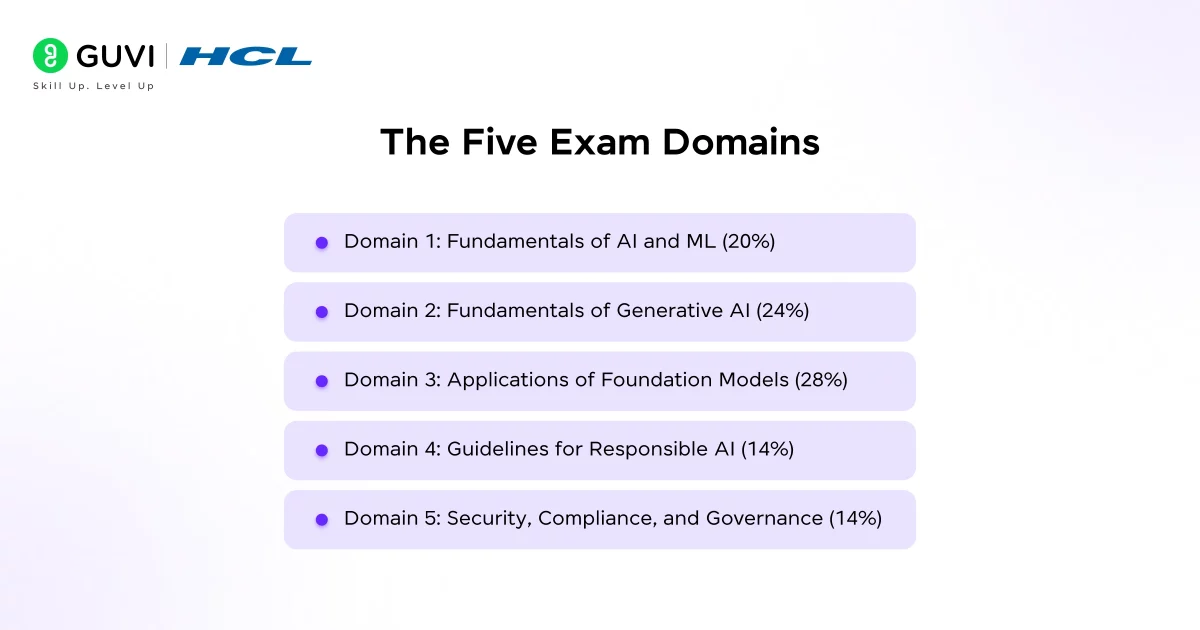
Here’s exactly how the exam is weighted, straight from AWS’s own exam guide.
| Domain | Weight | What It Covers |
|---|---|---|
| 1. Fundamentals of AI and ML | 20% | Core AI/ML/deep learning definitions, supervised vs. unsupervised vs. reinforcement learning, the ML lifecycle |
| 2. Fundamentals of Generative AI | 24% | Foundation models, LLMs, prompt engineering, RAG, guardrails |
| 3. Applications of Foundation Models | 28% | Matching AWS services (Bedrock, SageMaker, Rekognition, etc.) to real use cases |
| 4. Guidelines for Responsible AI | 14% | Bias, fairness, explainability, human oversight |
| 5. Security, Compliance, and Governance | 14% | Shared responsibility model, IAM, encryption, monitoring |
Domain 3 carries the most weight, so knowing which AWS service solves which problem, including newer areas like agentic AI, is worth extra study time.
1. Fundamentals of AI and ML
This AWS AI Practitioner domain checks that you understand the basic vocabulary before anything else builds on it. Artificial intelligence is the broad umbrella, machines performing tasks that normally require human intelligence.
Machine learning is a subset of that: systems that improve at a task by learning from data rather than being explicitly programmed for every rule. Deep learning is a further subset of ML that uses layered neural networks, the technique behind most modern AI breakthroughs.
Within this AWS AI Practitioner domain, you also need to tell apart the three main learning styles:
- Supervised learning: the model learns from labeled examples, like emails tagged “spam” or “not spam”
- Unsupervised learning: the model finds patterns in unlabeled data on its own, like grouping customers by purchase behavior
- Reinforcement learning: an agent learns by trial and error, earning rewards for good decisions, the approach behind game-playing AI
2. Fundamentals of Generative AI
This is where the AWS AI Practitioner exam gets specific to the generative AI wave. A foundation model is a large, general-purpose model pre-trained on massive amounts of data, capable of being adapted to many different tasks without retraining from zero.
A large language model (LLM) is a foundation model specialized in understanding and generating human language.
For AWS AI Practitioner, you’ll also need to know three more building blocks:
- Prompt engineering: crafting inputs carefully to get better, more reliable outputs from a model
- RAG (Retrieval-Augmented Generation): having the model pull in relevant external information before answering, so it’s grounded in real data instead of guessing
- Guardrails: safety controls that filter or block inappropriate model outputs before they reach a user
3. Applications of Foundation Models
This is the AWS AI Practitioner exam’s heaviest domain, worth almost a third of your score, and it’s the most hands-on-feeling one despite being entirely conceptual.
It tests whether you can look at a business problem and pick the AWS service that actually solves it: Amazon Bedrock for building generative AI applications on top of foundation models, Amazon SageMaker for building and training custom ML models end-to-end, Amazon Rekognition for image and video analysis.
Several other specialized services are covered in the table below. Expect the exam to describe a scenario and ask you to identify the right tool, not to define what each service is in isolation.
4. Guidelines for Responsible AI
This AWS AI Practitioner domain covers the ethical and governance side of deploying AI responsibly.
- Bias: a model producing systematically unfair outcomes for certain groups, often inherited from skewed training data
- Fairness: actively designing and testing systems to avoid that bias
- Explainability: being able to describe why a model reached a particular decision, important when AI outputs affect real people
- Human oversight: keeping a person in the loop for consequential decisions rather than letting an AI system act fully autonomously
5. Security, Compliance, and Governance
This AWS AI Practitioner domain applies AWS’s broader shared responsibility model specifically to AI workloads: AWS secures the underlying infrastructure, while you’re responsible for securing your own data, access controls, and applications built on top of it.
Concretely, that means knowing:
- IAM (Identity and Access Management): controlling who can access what
- Encryption: using services like AWS KMS to protect data at rest and in transit
- Monitoring: tools like Amazon CloudWatch for tracking how your AI systems actually behave in production
Must-Know AWS Services
| Service | What It Does |
|---|---|
| Amazon Bedrock | Access and customize foundation models for generative AI apps |
| Amazon SageMaker | End-to-end ML platform, from notebooks to deployment |
| Amazon Rekognition | Detects objects, faces, and text in images and video |
| Amazon Comprehend | Extracts sentiment, entities, and language from text (NLP) |
| Amazon Transcribe | Converts speech to text |
| Amazon Polly | Converts text to natural-sounding speech |
| Amazon Lex | Builds voice and text chatbots |
Exam Structure and Format
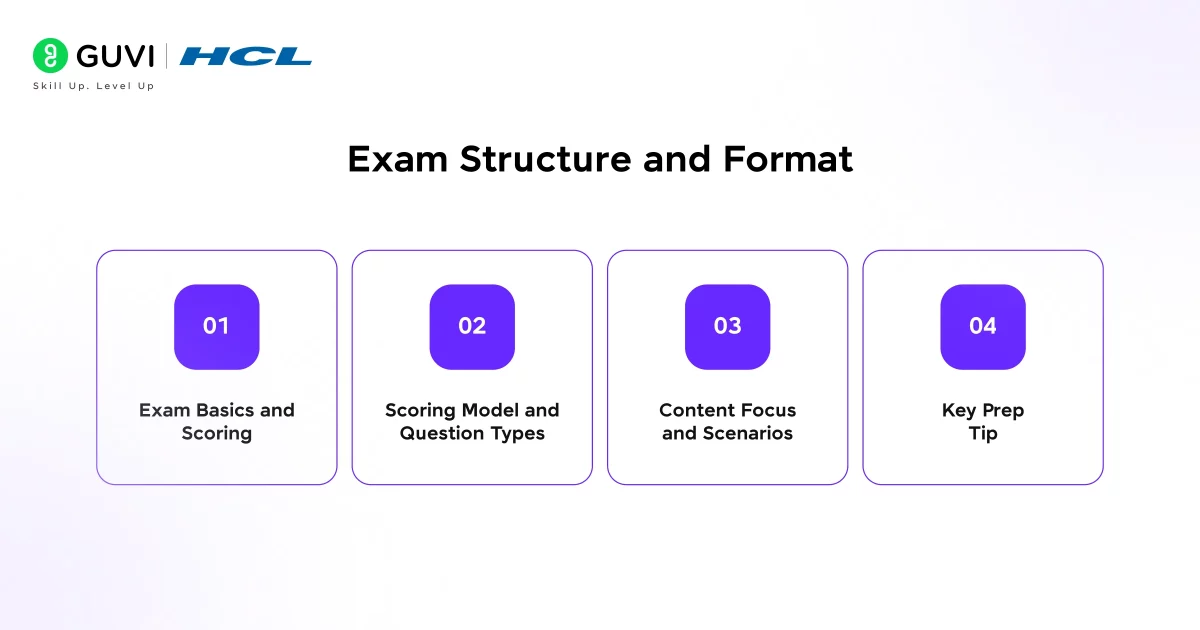
AWS AI Practitioner Exam Structure at a Glance
| Detail | Info |
|---|---|
| Total questions | 65 (50 scored, 15 unscored, you won’t know which is which) |
| Duration | 90 minutes |
| Question types | Multiple choice, multiple response, ordering |
| Scoring | Scaled 100-1,000, pass at 700 |
| Scoring model | Compensatory, you pass overall, not per domain |
| Guessing penalty | None, always answer, unanswered = wrong |
The AWS AI Practitioner exam leans on scenario-based questions: you’re given a business problem and asked to pick the right AWS service, not asked to recall a definition word-for-word.
AWS AI Practitioner Cost, Scheduling, and Validity
- Cost: $100 USD, plus local taxes where applicable
- Languages: Available in English, Arabic, French, German, Italian, Japanese, Korean, Portuguese, Spanish, and both Simplified and Traditional Chinese
- Format: Online with remote proctoring, or in-person at a Pearson VUE center
- Validity: 3 years, renew by retaking the current exam or earning a qualifying Associate/Professional-level AWS credential
- Discounts: AWS occasionally runs 50% discount vouchers through AWS Skill Builder worth checking for before you register
How Long Should You Prepare for the AWS AI Practitioner Exam?
- No AWS background: 30-40 hours total
- Some AWS experience already: 15-20 hours
- Realistic weekly pace: 1-2 hours a day for 2-4 weeks
Most test-takers actually find this easier than the AWS Cloud Practitioner exam, since it stays narrowly focused on AI concepts and a specific set of services instead of the entire AWS ecosystem.

Want structured, mentor-led prep instead of going it alone? HCL GUVI’s AI Software Development Course builds the same foundational AI and ML concepts this exam tests, with hands-on projects alongside the theory.
The Best Study Resources
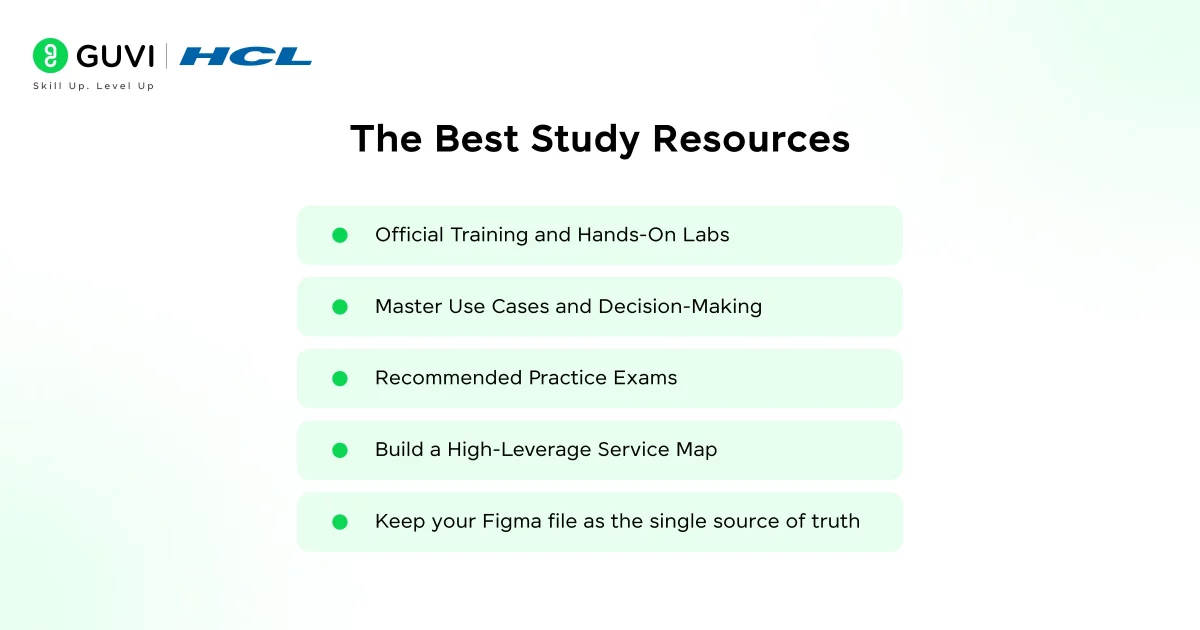
Here’s a structured guide to preparing for the AWS Certified AI Practitioner exam, drawing directly from the key steps you outlined. I’ve organized it into four focused subheadings for clarity.
- Official Training and Hands-On Labs
Start with the free or low-cost AWS ecosystem resources. Take the official AWS training course as step one, then gain hands-on experience with major AI services via the AWS Console. Use AWS Educate for free access to 18+ labs in a simulated console; no credit card needed. This builds practical familiarity without real-world risks.
- Master Use Cases and Decision-Making
Review AWS Decision Guides to grasp service categories, use cases, and trade-offs like cost, scalability, and complexity. Dive into AWS whitepapers on AI/ML and responsible AI for deeper context. Practice scenario-based thinking: for each service, articulate not just why it fits a scenario but why alternatives don’t. This sharpens selection skills.
- Recommended Practice Exams
Test your knowledge rigorously with top resources endorsed by recent candidates. Tutorials Dojo offers 135 questions across multiple full tests; Whizlabs provides Certified AI Practitioner practice tests. Don’t skip the official AWS practice exam on AWS Skill Builder. Focus on true mastery, not mere familiarity, to handle exam pressure.
- Build a High-Leverage Service Map
Tackle the challenge of memorizing numerous services by creating a simple chart or mind map grouped by function:
- Computer Vision: Rekognition (analyzes images/videos for objects, faces, and text).
- NLP: Comprehend (extracts insights like sentiment from text); Lex (builds conversational chatbots); Polly (converts text to lifelike speech).
- Generative AI: Bedrock (manages foundation models for custom generative apps).
- ML Platform: SageMaker (end-to-end platform for building, training, and deploying ML models).
This mental model is your top study tool, as most questions test service-to-scenario matching. Review it daily for reliable recall.
How to Actually Prepare for AWS AI Practitioner
- Start with official AWS training. The free AWS Skill Builder learning path is step one, don’t skip it.
- Get hands-on through AWS Educate. Free access to 18+ simulated labs, no credit card needed.
- Study service-to-use-case mapping. For each AWS AI service, be able to explain why it fits a scenario, and why the alternatives don’t.
- Read the AWS whitepapers on AI/ML and responsible AI for the conceptual depth multiple-choice questions actually test.
- Drill practice exams. Tutorials Dojo and Whizlabs both offer solid AIF-C01-specific tests, plus don’t skip the official practice exam on AWS Skill Builder.
- Aim for 85%+ on practice tests before you book the real thing.
Build a Service Map
For the AWS AI Practitioner exam, group services by function so you’re not memorizing them as a random list:
- Computer Vision: Rekognition
- NLP: Comprehend, Lex, Polly
- Generative AI: Bedrock
- ML Platform: SageMaker
Review this daily. Most exam questions test exactly this kind of service-to-scenario matching.
AWS AI Practitioner vs. Microsoft AI-900
AWS AI Practitioner and AI-900 are both foundational, non-technical AI certifications. The real difference is which cloud ecosystem you’re already in.
| Factor | AWS AI Practitioner (AIF-C01) | Microsoft AI-900 |
|---|---|---|
| Cloud platform | AWS | Azure |
| Key services tested | Bedrock, SageMaker, Rekognition, Comprehend | Azure AI services, Cognitive Services |
| Best fit | Your org runs on AWS | Your org runs on Azure |
| Depth on AI/ML | Goes deeper into AI/ML specifically | Broader coverage across Azure AI in general |
If your workplace is AWS-native, AIF-C01 is the natural pick. If it’s Azure, go with AI-900. Both build genuinely useful AI literacy either way.
Common Mistakes to Avoid With AWS AI Practitioner
- Assuming daily AI use means you’ll pass without studying. Service-mapping and responsible-AI nuances trip up plenty of confident test-takers.
- Skipping the security and governance domain. It’s only 14%, but it’s commonly underestimated and shows up more than people expect.
- Memorizing definitions instead of use cases. The exam tests “which service solves this problem,” not “define generative AI.”
- Ignoring the official AWS exam guide. AWS publishes the full exam guide PDF directly, read it before anything else.
If you’re serious about mastering AI on AWS, covering AI/ML fundamentals, generative AI, foundation models, and responsible AI, HCL GUVI’s Intel & IITM Pravartak Certified Artificial Intelligence & Machine Learning Course, co-designed by Intel, is worth a look.
Sample Exam Question Walkthrough
The AWS AI Practitioner exam tests scenario reasoning, not textbook definitions. Here’s an illustrative example (not an actual exam question) showing the style you’ll face.
Scenario: A retail company wants to build a chatbot that answers customer questions using its own product catalog and return policy documents, without the AI inventing incorrect answers about products it doesn’t recognize. Which approach best fits this need?
Options might include: fine-tuning a foundation model from scratch, using Retrieval-Augmented Generation (RAG) with Amazon Bedrock, using Amazon Rekognition, or training a custom model on Amazon SageMaker from raw text.
How to reason through it:
- The company wants answers grounded in their own documents, not general knowledge, that’s a strong signal for RAG.
- “Without inventing incorrect answers” points directly at reducing hallucination, which is exactly what RAG is designed to address.
- Rekognition is for images and video, not a text chatbot, ruled out immediately.
- Fine-tuning or training from scratch is far more resource-intensive than needed for this use case.
Answer: RAG with Amazon Bedrock.
This is the actual skill the AWS AI Practitioner exam tests: matching the characteristics of the problem to the right AWS approach, not recalling a definition word-for-word.
What Happens After You Pass?
Passing the AWS AI Practitioner exam isn’t really the finish line, it’s usually a starting point. Here’s what typically comes next.
- On your resume and LinkedIn: AWS AI Practitioner signals genuine AI literacy to recruiters and hiring managers, especially valuable in non-engineering roles where AI fluency is increasingly expected but rarely proven.
- As a stepping stone: many AWS AI Practitioner holders use it as a foundation before attempting the AWS Certified Machine Learning Engineer – Associate exam, which goes considerably deeper into hands-on implementation.
- Inside your organization: it’s common for AIF-C01 holders to end up as the informal “AI point person” on their team, the one fielding questions about what’s actually feasible with AWS’s AI services.
- Renewal: remember it’s valid for 3 years. You can either retake the current version of the exam, or let it auto-renew by earning a qualifying Associate or Professional-level AWS credential before it expires.
Final Thoughts
AIF-C01 fills a real gap: proof of AI literacy for people who work with AI, manage AI projects, or make AI adoption decisions, without needing to build models themselves.
Register on AWS Skill Builder, work through the free AWS AI Practitioner learning path, build your service map, and grind practice tests until you’re consistently above 85%. At $100 and roughly 30-40 hours of prep, it’s one of the most accessible, genuinely useful certifications in AI right now.
FAQs
1. Do I need coding experience for AIF-C01?
No, it’s conceptual, focusing on understanding AI concepts and AWS services, not building models.
2. How long to prepare?
30-40 hours for beginners (2-4 weeks at 1-2 hrs/day); less if you know AWS basics.
3. What’s the passing score and cost?
700/1000 minimum; $100 USD (plus taxes), with discounts for existing cert holders.
4. Key services to memorize?
Bedrock, SageMaker, Rekognition, Comprehend, Transcribe, Polly, and Lex: map them to business scenarios.
5. How does it differ from AWS ML Specialty?
AIF-C01 is beginner/conceptual; MLS-C01 is advanced/hands-on for engineers.
Success Stories

About the Author
Jebasta
I translate the language of data into stories that anyone can understand. As a writer with a data science background, I simplify analytics, AI, and decision-making so beginners and enthusiasts can confidently explore the world of data.
View all posts by Jebasta
Connect with me @






Did you enjoy this article?