


Artificial Intelligence and Machine Learning Articles
AI/ML Skills Gap 2026: Why Companies Can't Find Job-Ready Talent
20 AI/ML Interview Questions Recruiters Can Use Without a Tech Background - Best Guide
How Industry-Backed AI/ML Bootcamps Are Changing the AI/ML Hiring Pipeline - Best Guide 2026
From IT Support to AI Engineer: A Realistic Career Switch Guide 2026


Get In Touch For Details! Request More Information

Chain-of-Thought Prompting in Claude
Aug 17, 2026 4 Min Read 574 Views
(Last Updated)
Chain-of-thought prompting in Claude means asking the model to work through a problem step by step before producing its final answer, instead of jumping straight to a conclusion. This can be done through Claude’s built-in thinking capability, or manually by instructing Claude to reason inside structured tags before answering. Anthropic’s own documentation confirms this technique improves accuracy on complex problems by reducing the errors that happen when a model tries to solve everything in one step.
Table of contents
- TL;DR
- What Is Chain-of-Thought Prompting?
- How to Use Chain-of-Thought Prompting with Claude
- Chain-of-Thought Prompting and Claude's Built-In Thinking
- Ask Claude to Self-Check Its Own Reasoning
- When Chain-of-Thought Prompting Is Not Worth It
- Common Mistakes to Avoid
- Key Takeaways
- Conclusion
- FAQs
- What is chain-of-thought prompting in Claude?
- Does Claude still need manual chain-of-thought prompting?
- What tags should I use for structured chain-of-thought prompting?
- When should I avoid chain-of-thought prompting?
- Can I ask Claude to double check its own reasoning?
TL;DR
- Chain-of-thought, or CoT, prompting means asking Claude to reason step by step before giving a final answer.
- It works best on complex tasks like math, multi-step analysis, and decisions with several factors, and adds little value on simple lookups.
- Claude’s newer models offer built-in thinking capabilities, but manual CoT with thinking and answer tags still works as a reliable fallback when thinking is off.
- Structured CoT, where reasoning and the final answer are separated with tags, is easier to debug and easier to extract programmatically than a plain “think step by step” instruction.
- Asking Claude to self-check its own answer against a stated criteria catches errors that a single pass often misses.
Want to actually practice these techniques instead of just reading about them? Explore HCL GUVI’s Generative AI Course, built to help you write prompts that get consistent, reliable output from tools like Claude.
What Is Chain-of-Thought Prompting?
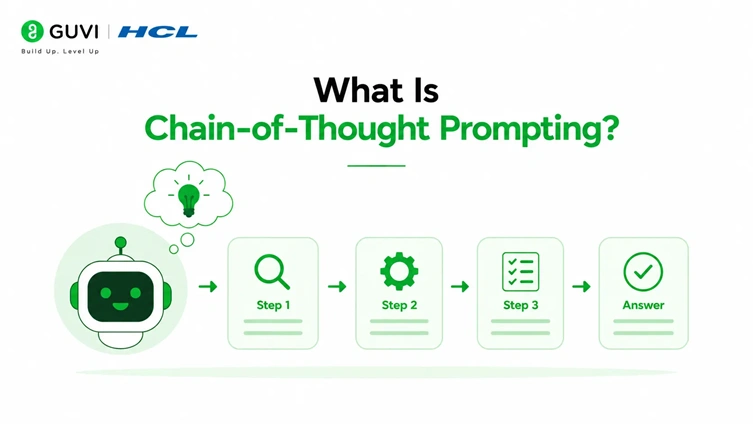
Chain-of-thought prompting asks a model to generate intermediate reasoning steps before it gives a final answer. Instead of producing a result directly, Claude works through the problem in visible stages first.
This makes the reasoning process explicit rather than hidden, which usually leads to more accurate and better organized answers, especially on tasks that a human would also need to think through carefully.
Read More: What Is Chain-of-Thought Prompting?
Why Chain-of-Thought Prompting Improves Claude’s Output
Stepping through a problem instead of answering immediately reduces a specific kind of error, the kind that happens when a model tries to skip ahead and combine several reasoning steps into one guess.
The main benefits are:
- Accuracy, since breaking a problem into steps reduces mistakes in math, logic, and analysis.
- Coherence, since structured thinking tends to produce more organized final responses.
- Debuggability, since seeing the reasoning steps makes it easier to spot exactly where a prompt was unclear.
Anthropic recommends using visible reasoning patterns with thinking tags when manual Chain-of-Thought prompting is needed. This helps Claude produce more accurate, structured responses and generalize the same reasoning process to similar tasks.
How to Use Chain-of-Thought Prompting with Claude
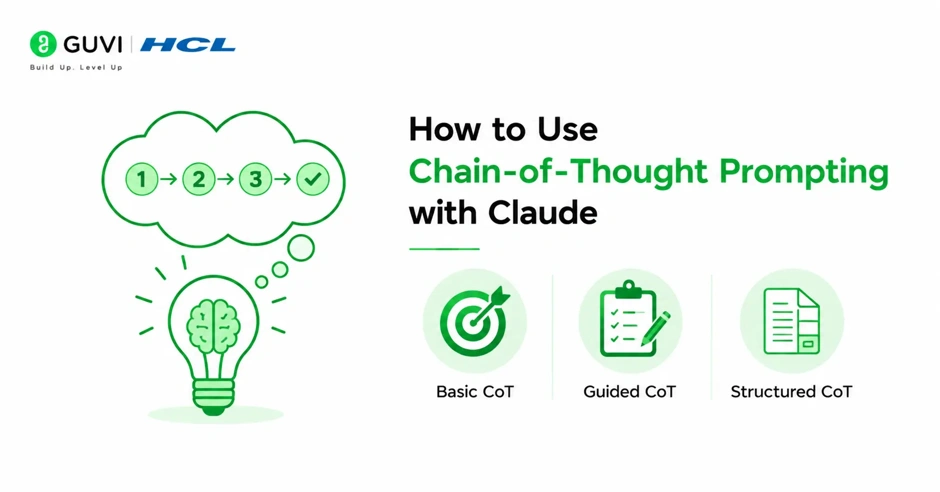
- Basic CoT: Just Ask Claude to Think Step by Step
The simplest version is adding a direct instruction like “think through this step by step before answering.” This works for moderately complex tasks and requires no special formatting.
- Guided CoT: Outline the Reasoning Steps Yourself
For tasks where you already know the reasoning path, you can outline the specific steps Claude should follow, such as “first identify the key variables, then calculate each option, then compare the results.”
This gives Claude more structure than a generic instruction while still keeping the prompt simple.
- Structured CoT: Separate Reasoning from the Final Answer
The most reliable version uses tags to cleanly separate Claude’s reasoning from its final output.
Think step by step in <thinking> tags, then give your final answer in <answer> tags.
This structure has a practical advantage. You can extract just the final answer from the answer tags while still keeping the full reasoning available for review or debugging.
Pro Tip: Structured CoT is especially useful in production systems, since you can programmatically pull only the final answer for the user while logging the full reasoning separately for quality checks.
Chain-of-Thought Prompting and Claude’s Built-In Thinking

Claude’s newer models include built-in thinking capabilities that handle a lot of step by step reasoning internally, without needing explicit CoT instructions in the prompt.
When this built-in thinking is available and active, Anthropic’s guidance recommends starting with general, high-level instructions rather than a rigid step by step script, since the model’s own reasoning process can outperform an overly prescriptive prompt.
Manual chain-of-thought prompting with thinking and answer tags remains a useful fallback for situations where built-in thinking is turned off, or where you specifically need the reasoning steps visible and separated in a particular format.

Data Point: Anthropic’s documentation notes that examples containing a visible reasoning pattern, shown using thinking tags inside few-shot examples, help Claude generalize that same reasoning style into its own responses on new problems.
Ask Claude to Self-Check Its Own Reasoning
One underused technique is asking Claude to verify its own answer before finalizing it. A simple line like “before you finish, verify your answer against the stated requirements” catches errors reliably, particularly on coding and math tasks.
This works because it gives Claude a second pass at its own reasoning instead of treating the first output as final.
When Chain-of-Thought Prompting Is Not Worth It
CoT is not free. Extra reasoning steps add to the length of a response, which adds latency, so it is worth reserving for tasks that actually need it.
Skip CoT for:
- Simple factual lookups.
- Straightforward formatting tasks.
- Quick classification with an obvious answer.
Use CoT for:
- Complex math or multi-step calculations.
- Analysis involving several competing factors.
- Decisions that a human would genuinely need to think through before answering.
Common Mistakes to Avoid
- Asking Claude to think without giving it a way to output that thinking, which defeats the purpose of the technique entirely.
- Using rigid, over-specified reasoning steps with models that already have strong built-in thinking, which can limit rather than help performance.
- Skipping structured tags in production systems, making it harder to separate reasoning from the final answer programmatically.
- Applying CoT to simple tasks where it only adds latency without improving the result.
- Never asking Claude to self-check, missing an easy opportunity to catch avoidable errors.
Warning: Adding chain-of-thought instructions to every prompt regardless of task complexity is a common overcorrection. It slows down simple tasks without meaningfully improving output that was already reliable.
Key Takeaways
- Chain-of-thought prompting asks Claude to reason step by step before answering, which improves accuracy on complex tasks.
- Structured CoT using thinking and answer tags makes reasoning easy to separate from the final output.
- Claude’s built-in thinking capability handles a lot of this reasoning automatically, with manual CoT as a reliable fallback.
- Asking Claude to self-check its own answer catches errors that a single pass often misses.
- CoT is best reserved for genuinely complex tasks, since it adds length and latency without added benefit on simple ones.
Conclusion
Chain-of-thought prompting remains one of the most dependable ways to improve Claude’s output on complex, multi-step problems. Whether you rely on Claude’s built-in thinking or add manual step by step instructions with structured tags, the core idea stays the same: give the model room to reason before it commits to an answer. Used selectively, on tasks that actually need it, this technique turns rushed or shallow answers into responses you can trust.
FAQs
1. What is chain-of-thought prompting in Claude?
Chain-of-thought prompting asks Claude to reason through a problem step by step before giving its final answer, instead of answering immediately.
2. Does Claude still need manual chain-of-thought prompting?
Not always. Newer Claude models handle a lot of reasoning through built-in thinking, though manual CoT with tags still works as a fallback when needed.
3. What tags should I use for structured chain-of-thought prompting?
Use thinking tags for the reasoning process and answer tags for the final output, so both can be separated cleanly.
4. When should I avoid chain-of-thought prompting?
Avoid it for simple lookups, quick classifications, or straightforward formatting tasks, since it adds length without improving results.
5. Can I ask Claude to double check its own reasoning?
Yes, asking Claude to verify its answer against stated criteria before finishing is an effective way to catch errors.
Success Stories

About the Author
Vishalini Devarajan
An Aerospace Engineer turned content writer, I focus on making complex concepts easy to understand through well-structured, reader-friendly blogs. Whether it’s a technical topic or a non-technical one, I love creating content that is clear, engaging, and impactful.
View all posts by Vishalini Devarajan
Connect with me @













Did you enjoy this article?