


Artificial Intelligence and Machine Learning Articles
AI/ML Skills Gap 2026: Why Companies Can't Find Job-Ready Talent
20 AI/ML Interview Questions Recruiters Can Use Without a Tech Background - Best Guide
How Industry-Backed AI/ML Bootcamps Are Changing the AI/ML Hiring Pipeline - Best Guide 2026
From IT Support to AI Engineer: A Realistic Career Switch Guide 2026


Get In Touch For Details! Request More Information

Heuristic Search Techniques in AI Explained
Sep 19, 2026 6 Min Read 1242 Views
(Last Updated)
If you have ever used Google Maps to find the fastest route to a place, you have already seen artificial intelligence at work. Have you ever wondered how the system figures out the best path so quickly, without checking every single road on the map?
Heuristic search techniques are AI strategies that use a heuristic function, an educated estimate of how close a state is to the goal, to guide problem-solving toward the most promising paths instead of blindly exploring every possibility.
It is one of the smartest ideas in AI, and it is what allows machines to solve complex problems without wasting time exploring paths that clearly lead nowhere.
This guide breaks down heuristic search techniques in AI from the ground up, what a heuristic function actually is, how algorithms like A* and Hill Climbing use it, and why these techniques remain central to modern AI and problem-solving.
Table of contents
- TL;DR Summary
- Informed Search vs. Uninformed Search
- Uninformed Search Algorithms
- Informed Search Algorithms
- What Is a Heuristic Function?
- What Makes a Heuristic Admissible?
- Why Admissibility Powers Optimal Algorithms
- Real-World Example: GPS Navigation
- Key Heuristic Search Techniques in AI
- Best-First Search
- A* Algorithm
- Hill Climbing
- Quick Comparison of the Key Techniques
- How to Choose the Right Heuristic Search Technique
- Advantages of Heuristic Search
- Limitations to Keep in Mind
- Common Mistakes When Implementing Heuristic Search
- Real-World Applications
- Wrapping Up
- FAQs
- How does heuristic search differ from blind search like BFS?
- What defines an admissible heuristic, and why care?
- Greedy Best-First vs. A*: When to pick each?
- Why does Hill Climbing fail, and what's the fix?
- Real apps beyond pathfinding?
TL;DR Summary
- What it is: search strategies that use an estimate of goal distance to prioritize the most promising paths, instead of exploring blindly
- The key property: an admissible heuristic never overestimates the true cost, which is what lets A* guarantee an optimal solution
- Greedy Best-First Search: uses only the heuristic estimate, fast but can miss the optimal path
- A* Search: combines actual cost so far with the heuristic estimate, both fast and optimal when the heuristic is admissible
- Hill Climbing: a local, greedy optimizer that can get stuck in local maxima without restarts
What Is Heuristic Search in AI?
Heuristic search is a type of informed search in artificial intelligence that uses a heuristic function to estimate which path is most likely to reach the goal efficiently. Instead of exploring every possible option blindly, it prioritizes the most promising paths, making problem-solving faster and more computationally efficient.
Informed Search vs. Uninformed Search

Before getting into the algorithms, it helps to understand the big picture difference between two types of search strategies in AI.
Uninformed Search Algorithms
Uninformed search is also called blind search, exploring the search space without using any heuristic or additional knowledge, relying only on the structure of the problem to find a solution.
Think of it like trying to find a friend’s house in a new city with zero directions. You would have to check every street until you find it. Algorithms like Breadth-First Search and Depth-First Search fall into this category. They work, but they can be painfully slow when the problem is large.
Informed Search Algorithms
Informed search, by contrast, uses additional knowledge called heuristics to estimate how close a state is to the goal, helping the algorithm choose the most promising path during the search.
Going back to the analogy, this is like having a rough map and a compass. You might not know the exact route, but you have enough information to make educated guesses and move in the right direction. This is what makes informed search far more practical for real-world AI applications.
The key difference comes down to efficiency. Informed search tends to be more optimized, while uninformed search can be slower due to its blind exploration. For problems with large search spaces, such as route planning or game AI, heuristic search techniques are almost always the preferred choice.
What Is a Heuristic Function?
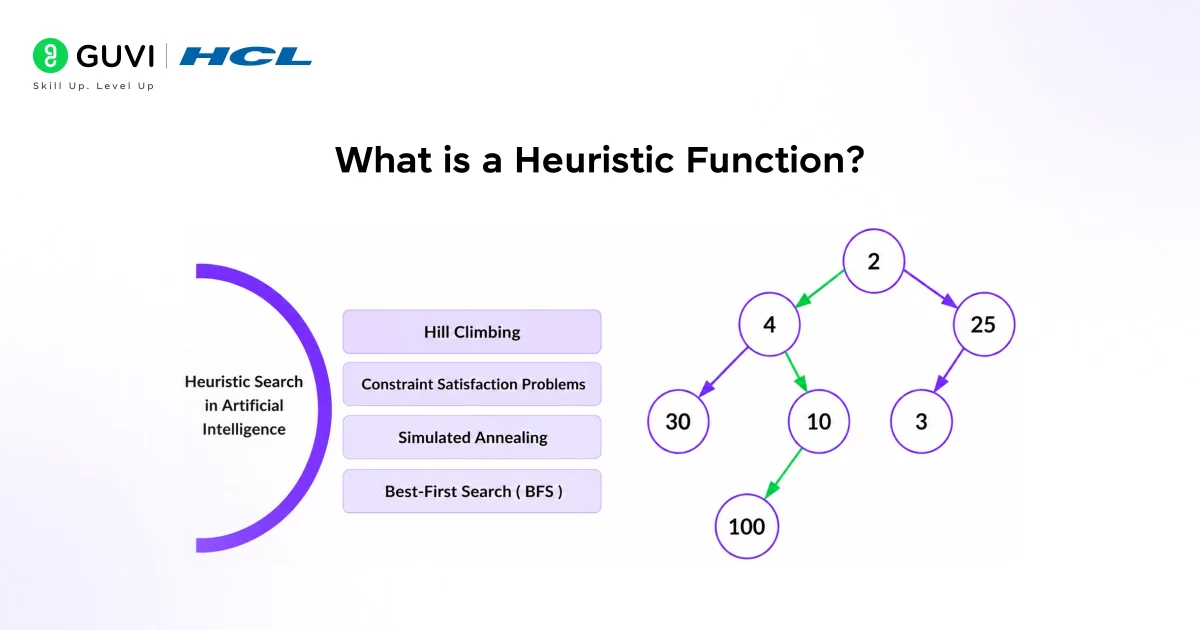
The heuristic function powers heuristic search techniques by estimating the shortest path cost from a node’s state to the goal. A strong heuristic guides algorithms to promising paths, enabling informed searches to outperform uninformed ones like BFS.
What Makes a Heuristic Admissible?
An admissible heuristic never overestimates the true cost to the goal, it’s always optimistic (h(n) ≤ h*(n), where h*(n) is the actual cost). This property ensures algorithms like A* guarantee optimal solutions by prioritizing realistic paths without false overpromises.
Why Admissibility Powers Optimal Algorithms
Admissibility is crucial for A*, as it combines actual path cost g(n) with heuristic estimate h(n) in f(n) = g(n) + h(n), expanding the lowest-f-score node first. Overestimation breaks this guarantee, leading to suboptimal paths.
Real-World Example: GPS Navigation
In GPS routing, an admissible heuristic might estimate 4 hours based on straight-line distance and average speed. If actual travel takes 4 hours or less (accounting for traffic), it guides reliably, never claiming a longer trip than reality.
Key Heuristic Search Techniques in AI
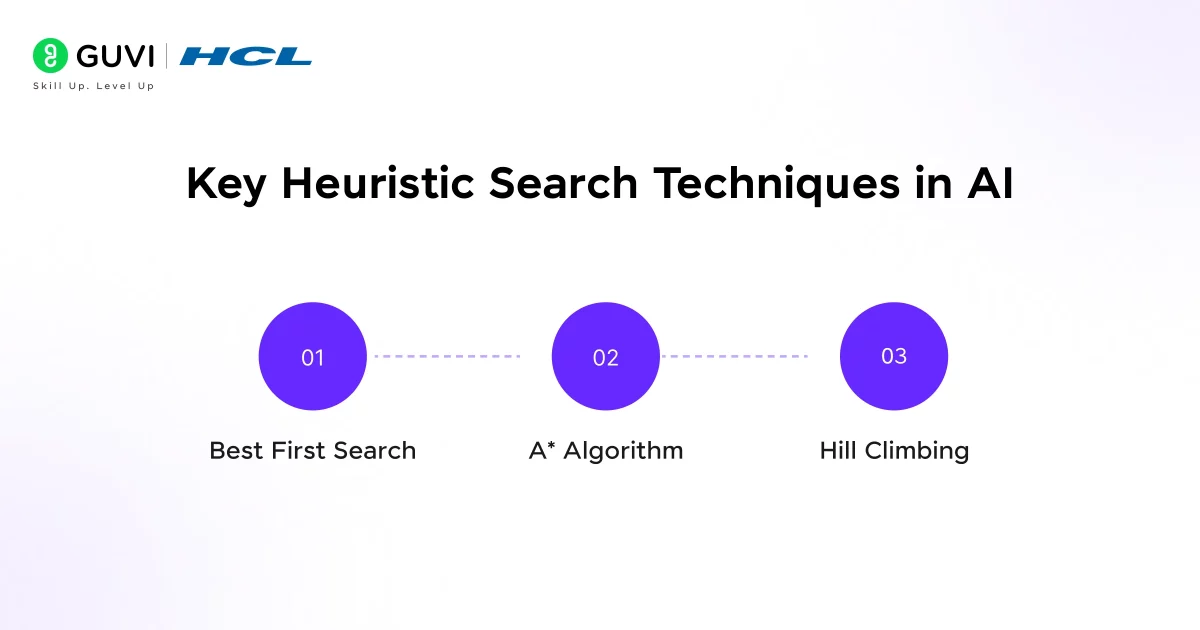
1. Best-First Search
Best-First Search is the foundational idea behind most heuristic search techniques. The core concept is simple: at each step, expand the node that looks the most promising based on the heuristic function, rather than following a strict order like breadth-first or depth-first approaches.
Among heuristic search techniques, Greedy Best-First Search selects the path that appears best at each step using only the heuristic value h.
It prioritizes nodes with the lowest heuristic cost, focusing on reaching the goal as quickly as possible, which makes it one of the fastest search techniques available in AI.
However, speed comes at a price. Because it only looks at how far you seem to be from the goal and ignores how much the journey has already cost, it can sometimes lead you down a path that seems short but turns out to be inefficient.
It’s ideal for situations where a quick, approximate solution is needed, such as real-time robot navigation.
2. A* Algorithm
The A* algorithm is widely considered the gold standard of heuristic search techniques in AI.
It combines the best of both worlds: how far you have already traveled and how far you still need to go, using f(n) = g(n) + h(n), where g(n) is the cost from the start node to n, and h(n) estimates the cost from n to the goal.
Among heuristic search techniques, this simple formula is what makes A* so powerful. By adding the actual cost traveled to the estimated remaining cost, the algorithm avoids getting tricked into chasing paths that look cheap at first glance but turn out to be expensive overall.
This is the single most important property among heuristic search techniques: if A* uses an admissible heuristic, meaning it never overestimates the shortest-path distance to the goal, it always finds an optimal path.
This is what separates A* from greedy approaches, and why it’s used in applications like Google Maps, video game pathfinding, and robotics navigation.
3. Hill Climbing
Hill Climbing takes a very different approach among heuristic search techniques. Instead of exploring a broad search space, it focuses entirely on local improvements, iteratively improving an initial solution.
Imagine hiking up a hill: you take small steps upward until you reach the peak, the optimal solution.
Hill Climbing uses a greedy approach, meaning at each step it moves in the direction that optimizes the objective function. It’s one of the simplest techniques to understand and implement, and it works surprisingly well for a wide range of optimization problems.
The main weakness is that it can get stuck. A local maximum occurs when all neighboring states have values worse than the current state, terminating the process even though a better solution may exist elsewhere.
A plateau is a related problem, where all neighbors have the same value, making it impossible to choose a direction.
To work around these issues, common among heuristic search techniques that rely on local improvement, variations like stochastic Hill Climbing and random restarts were developed.
Stochastic Hill Climbing introduces randomness into the process, while random restarts simply start over from a new random position when the algorithm gets stuck.
Quick Comparison of the Key Techniques
Here’s how the three main heuristic search techniques stack up against each other.
| Technique | Speed | Optimal? | Memory Use | Best For |
|---|---|---|---|---|
| Greedy Best-First Search | Fast | No | Moderate | Quick, approximate solutions, real-time systems |
| A* Search | Moderate | Yes (with admissible h) | High | Pathfinding where correctness matters |
| Hill Climbing | Very fast | No (local optimum only) | Low | Optimization problems, not shortest-path search |
Best-First Search is fast but can miss the optimal path because it ignores the cost already paid.
A* is both fast and optimal when paired with an admissible heuristic, making it the most reliable choice for most pathfinding problems. Hill Climbing is easy to implement and works well for optimization, but it risks getting stuck at local optima and needs strategies like restarts to overcome that weakness.
A* search powers real-world systems ranging from Google Maps routing to strategy game AI, often using heuristics like Manhattan distance for efficient grid navigation. Earlier systems such as Deep Blue relied heavily on search and handcrafted evaluation strategies, while newer systems like AlphaZero combine search with deep neural networks for far stronger decision-making. Even space robotics uses related ideas—NASA rovers apply forms of heuristic optimization and local search when navigating terrain or selecting sampling targets. In large combinatorial problems like the 15-puzzle, which contains trillions of possible states, advanced heuristics such as pattern databases dramatically outperform weaker heuristic approaches, showing how the quality of a heuristic often determines whether a search problem is practically solvable.

How to Choose the Right Heuristic Search Technique
With three genuinely different heuristic search techniques covered in this guide, picking the right one comes down to a few honest questions about what your problem actually needs.
- Need the fastest possible answer and can accept an imperfect one? Greedy Best-First Search fits real-time systems like live robot navigation, where a quick, reasonable path beats a slow, perfect one.
- Need the actual shortest or cheapest path, guaranteed? A* is the right call whenever correctness matters, GPS routing, game pathfinding, and anywhere a wrong answer has real consequences.
- Optimizing a value rather than finding a path? Hill Climbing suits problems like parameter tuning or scheduling, where you’re improving a solution rather than navigating between states.
- Working with a massive search space and limited memory, a common constraint across heuristic search techniques? Lean toward Hill Climbing or a memory-bounded variant of A*, since standard A* can consume significant memory on very large problems.
- Unsure whether your heuristic is admissible, a common uncertainty across heuristic search techniques? Default to Greedy Best-First Search or Hill Climbing for exploration first, then verify admissibility before relying on A*’s optimality guarantee.
Advantages of Heuristic Search
By focusing on the most promising paths, heuristic search techniques significantly reduce the number of possibilities explored, saving both time and computational resources.
When using admissible heuristics, algorithms like A* can guarantee an optimal solution. Heuristic methods are also adaptable and can be applied to a wide range of problems, from pathfinding and optimization to game AI and robotics.
These qualities make heuristic search an essential tool in modern AI systems, whether it’s a navigation app calculating the fastest route or an AI agent learning to play a game.
Limitations to Keep in Mind
Despite their strengths, heuristic search techniques are not perfect. Their effectiveness depends entirely on the accuracy of the heuristic function.
Poorly designed heuristics can undermine heuristic search techniques, leading to suboptimal results or inefficient searches. Some techniques, like Hill Climbing, are prone to getting stuck in local maxima or minima, where the algorithm cannot progress to a better solution even though a global optimum exists.
This is one of the more practical limits of heuristic search techniques: memory. A* search can be memory-intensive when dealing with massive datasets or environments, and when the search space grows very large, even the best heuristic search algorithms can struggle with resource constraints.
The quality of the heuristic function essentially determines the quality of any heuristic search techniques you apply.
A weak heuristic turns A* into something not much better than a blind search, while a strong heuristic makes even simple algorithms perform remarkably well. Designing good heuristics remains both an art and an active area of research in AI.
Common Mistakes When Implementing Heuristic Search
A handful of recurring mistakes trip up developers when they first start applying heuristic search techniques.
- Using a non-admissible heuristic with A and expecting optimal results.* If your heuristic overestimates even once, A*’s optimality guarantee is gone, silently and without any error message.
- Reaching for A on problems where memory is the real constraint, a real risk with these heuristic search techniques.* A* stores every generated node, on huge search spaces this can exhaust memory before it exhausts time.
- Assuming Hill Climbing will find the global optimum. Without restarts or a stochastic variant, it’s guaranteed only to find a local one.
- Picking Greedy Best-First Search when correctness actually matters. It’s fast precisely because it ignores path cost, which makes it the wrong choice whenever a wrong answer is costly.
- Never testing the heuristic against edge cases. A heuristic that works well on typical inputs can behave badly on unusual ones, always validate it against boundary conditions.
Real-World Applications
Heuristic search techniques show up everywhere in the technology used daily.
Navigation and gaming. One of the most visible real-world uses of heuristic search techniques: GPS navigation systems use algorithms similar to A* to calculate the fastest route between two points, factoring in real-time traffic data.
Video game characters use heuristic pathfinding to navigate around obstacles and find the player.
Robotics. Heuristic search techniques also power warehouse robotics: a robot navigating a warehouse needs to plan paths quickly and adapt when obstacles appear. Heuristic search gives it the ability to make fast, informed decisions without recalculating from scratch every time something changes.
Scheduling and logistics. Optimization problems that would take forever to solve with brute force become manageable once heuristic search techniques are applied with a well-designed heuristic.
If you’re serious about mastering heuristic search techniques in AI, like A, Greedy Best-First, admissible heuristics, and optimal pathfinding, don’t miss the chance to enroll in HCL GUVI’s* Intel & IITM Pravartak Certified Artificial Intelligence & Machine Learning Course, co-designed by Intel.
Wrapping Up
Heuristic search techniques are one of those ideas in AI that are simple to grasp but incredibly powerful in practice. By giving a search algorithm a rough sense of direction, it goes from blindly checking every possibility to intelligently zeroing in on the best solution.
A*, Greedy Best-First Search, and Hill Climbing, the three heuristic search techniques covered here, are all built on this same idea, each with its own trade-offs between speed, memory, and optimality.
Almost every advanced concept in AI, from reinforcement learning to automated planning, builds on the same core principle that heuristic search techniques introduced: use what you know to make smarter decisions.
FAQs
1. How does heuristic search differ from blind search like BFS?
Blind (uninformed) exhausts all paths systematically; heuristic (informed) uses estimates to prioritize likely winners, exploding efficiency in huge spaces like Maps routing.
2. What defines an admissible heuristic, and why care?
h(n)≤h∗(n)h(n) \leq h^*(n)h(n)≤h∗(n) (optimistic, never overestimates) powers A*’s optimality guarantee; bad ones yield suboptimal paths.
3. Greedy Best-First vs. A*: When to pick each?
Greedy (h-only) for speed/approximations (e.g., games); A* (g+hg + hg+h) for optimal paths when precision matters.
4. Why does Hill Climbing fail, and what’s the fix?
Gets trapped in local maxima/plateaus, stochastic variants or random restarts add escape routes.
5. Real apps beyond pathfinding?
Yes: game AI (path to player), robotics (warehouse nav), logistics (scheduling), ML (hyperparam tuning).
Success Stories

About the Author
Jebasta
I translate the language of data into stories that anyone can understand. As a writer with a data science background, I simplify analytics, AI, and decision-making so beginners and enthusiasts can confidently explore the world of data.
View all posts by Jebasta
Connect with me @













Did you enjoy this article?