


Artificial Intelligence and Machine Learning Articles
Finance Manager to Data Analytics: Career Growth, Salary and Seniority
How to Evaluate LLM Outputs in Production Deployments
AI/ML Skills Gap 2026: Why Companies Can't Find Job-Ready Talent
20 AI/ML Interview Questions Recruiters Can Use Without a Tech Background - Best Guide


Get In Touch For Details! Request More Information
Self-Supervised Learning: How AI Learns Without Labels
Jul 10, 2026 6 Min Read 937 Views
(Last Updated)
You hand a child a thousand jigsaw puzzles with no picture on the box. No instructions. No answer key. Just pieces and the act of figuring it out.
By the time that child finishes, they understand shapes, patterns, and spatial relationships better than any child who only watched someone else solve them. The struggle was the lesson.
This is self-supervised learning. The AI teaches itself by solving puzzles it creates from its own data, with no human labels required.
This guide covers how it works, why BERT and GPT are built on it, where it outperforms traditional approaches, and how to apply it practically in real AI systems.
Table of contents
- Quick TL;DR Summary
- What Self-Supervised Learning Actually Does
- How Self-Supervised Learning Works
- Step 1: Select a Pretext Task
- Step 2: Generate Labels Automatically
- Step 3: Train the Model on the Pretext Task
- Step 4: Transfer the Learned Representations
- Sample Practice Problems to Try:
- The Three Core Approaches to Self-Supervised Learning
- Common Mistakes That Undermine Self-Supervised Learning
- Self-Supervised Learning vs. Related Approaches
- Real-World Applications of Self-Supervised Learning
- Final Thoughts
- FAQs
- Is self-supervised learning the same as unsupervised learning?
- Do I need to pre-train my own model or can I use existing ones?
- How much labeled data do I need for fine-tuning?
- What is the difference between BERT and GPT in self-supervised training?
- Can self-supervised learning work on tabular data?
Quick TL;DR Summary
- Self-supervised learning generates its own training labels from raw unlabeled data using pretext tasks, removing the need for expensive human annotation.
- It produces powerful, transferable representations that dramatically reduce the labeled data needed for downstream tasks.
- This guide covers how pretext tasks work, how contrastive learning builds representation quality, and why models like BERT and GPT rely on self-supervised foundations.
- You will learn how self-supervised learning differs from supervised, unsupervised, and semi-supervised approaches and when each is appropriate.
- The article includes real-world applications across NLP, vision, and audio, along with practical guidance on when to apply these methods.
What is Self-Supervised Learning?
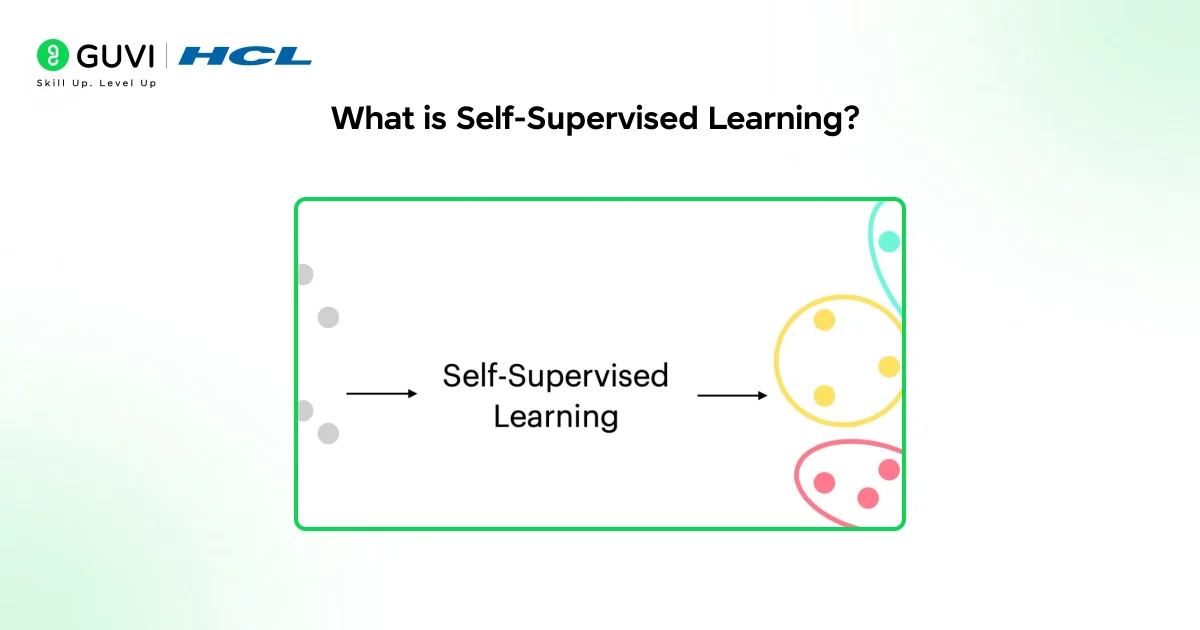
Self-supervised learning is a machine learning approach where models create their own training labels from raw unlabeled data by solving internally generated prediction tasks. Instead of relying on human-annotated datasets, the model extracts supervisory signals directly from the structure and patterns present in the data itself.
What Self-Supervised Learning Actually Does
- It Turns Unlabeled Data Into Its Own Teacher
The fundamental bottleneck in supervised machine learning has always been labels. Collecting and annotating data at scale is expensive, slow, and often requires domain expertise that is hard to source.
Self-supervised learning dissolves this bottleneck by extracting supervisory signal directly from the structure of the data itself. A sentence can be used to predict its own missing words. An image can be split and used to predict its own missing patches. A video frame can be used to predict the frame that follows it.
The data supervises itself. Labels emerge from structure, not from human effort.
- It Learns Representations, Not Just Predictions
The prediction task in self-supervised learning is not the real goal. It is a vehicle.
When a model learns to predict masked words in a sentence, it is not being trained to become a word-guessing machine. It is being forced to develop internal representations that capture grammar, semantics, context, and world knowledge, because those representations are what make accurate prediction possible.
This distinction matters enormously. The representation is what gets transferred to downstream tasks. The pretext task is just the mechanism that forces the model to build it.
- It Pre-Trains Models That Fine-Tune Cheaply
Self-supervised pre-training produces a model that has already learned the deep structure of its data domain. When you then fine-tune this model on a specific labeled task, you need far fewer labeled examples to reach high performance.
BERT pre-trained on unlabeled text can be fine-tuned on a sentiment classification task with a few hundred labeled examples and outperform a model trained from scratch on tens of thousands. The pre-training did the heavy lifting. The fine-tuning just steers the already-capable representations toward the specific task.
- It Scales With Data in Ways Supervised Learning Cannot
Supervised learning is constrained by how much labeled data you can collect. Self-supervised learning is constrained by how much raw data exists, which is effectively unlimited.
Every webpage, every book, every image, every video, every audio recording becomes a training signal. This is why the largest and most capable models in existence today are built on self-supervised foundations.
Read More: Types of Learning in Machine Learning: A Complete Beginner’s Guide
How Self-Supervised Learning Works
Step 1: Select a Pretext Task
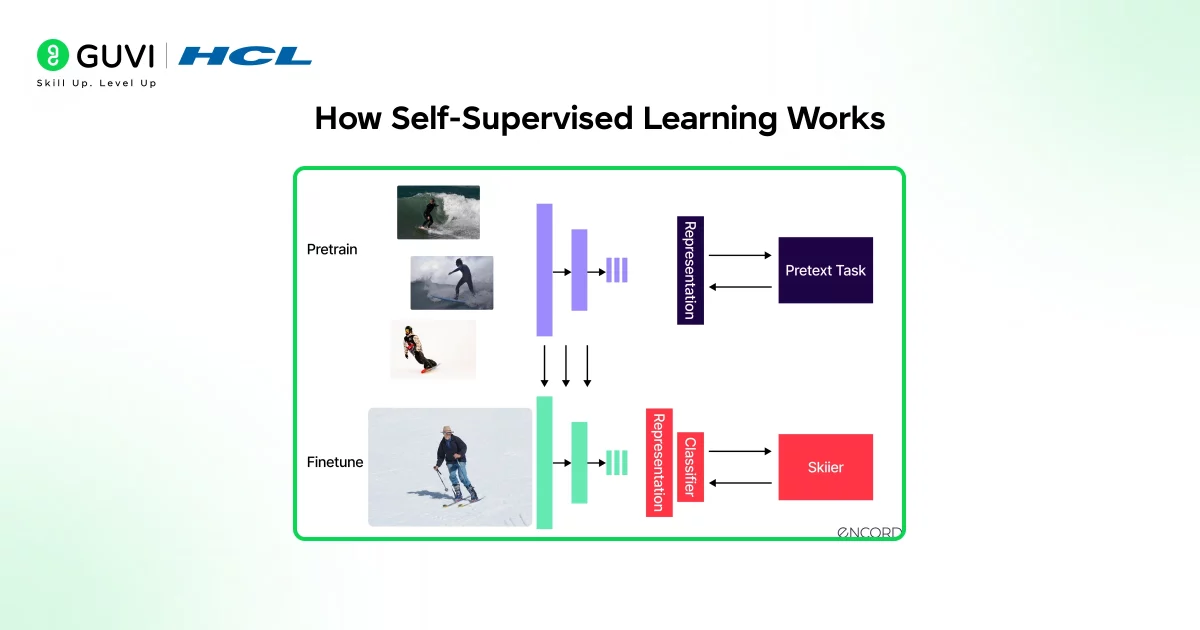
A pretext task is a prediction problem constructed automatically from the raw data. It has no inherent value of its own but forces the model to learn representations that do.
The pretext task must be designed so that solving it well requires understanding the deep structure of the data. A task that can be solved by surface-level pattern matching will produce shallow representations. A task that requires genuine understanding of context, structure, or relationships will produce rich, transferable ones.
Step 2: Generate Labels Automatically
Given the pretext task, labels are generated programmatically from the data itself.
For masked language modeling, randomly select 15 percent of tokens in a sentence and replace them with a mask token. The original tokens become the labels. No human ever labeled anything. The corruption process created the supervision automatically.
For image rotation prediction, rotate an image by 0, 90, 180, or 270 degrees. The rotation angle becomes the label. Again, fully automatic.
Step 3: Train the Model on the Pretext Task
The model trains on these automatically generated tasks using standard gradient descent. It receives corrupted or transformed input, predicts what was hidden or transformed, receives a loss signal based on how wrong it was, and updates its weights accordingly.
This happens across millions or billions of examples, driving the model to develop increasingly powerful internal representations.
Step 4: Transfer the Learned Representations
Once pre-training is complete, the model’s learned representations are transferred to downstream tasks.
The pre-trained model is either used as a feature extractor, with its weights frozen while a small task-specific head is trained on top, or fine-tuned end-to-end on labeled downstream data with a small learning rate to preserve the pre-trained representations while adapting to the specific task.
Sample Practice Problems to Try:
- Design a pretext task for self-supervised pre-training on a dataset of medical X-ray images.
- Explain why masked language modeling forces a model to learn bidirectional context while next-token prediction does not.
- Describe how you would adapt a self-supervised vision model pre-trained on natural images to a satellite imagery classification task.
The Three Core Approaches to Self-Supervised Learning
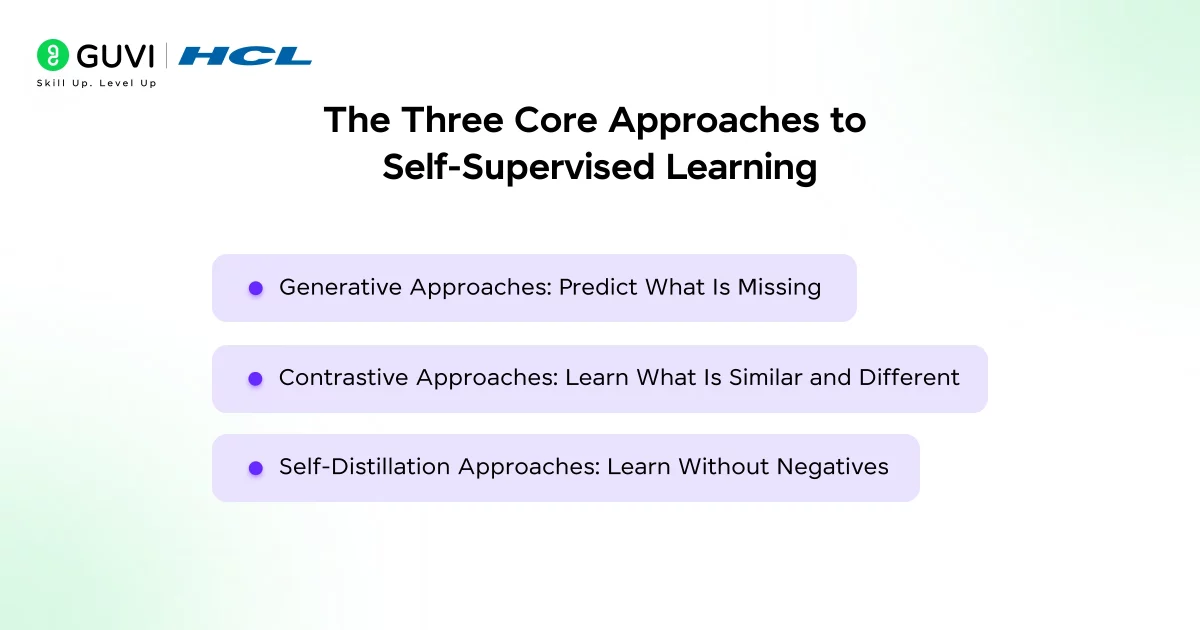
- Generative Approaches: Predict What Is Missing
Generative self-supervised methods train a model to reconstruct hidden or corrupted parts of the input.
- Masked Language Modeling, used in BERT, randomly masks tokens in a sentence and trains the model to predict the original tokens from context. This forces the model to develop a deep understanding of bidirectional language structure.
- Causal Language Modeling, used in GPT, trains the model to predict the next token given all previous tokens. This forces left-to-right sequential understanding and naturally trains models that can generate coherent text.
- Masked Autoencoders, used in vision transformers, randomly mask large patches of an image and train the model to reconstruct the missing pixel content. This forces understanding of global image structure and semantic coherence across regions.
- Contrastive Approaches: Learn What Is Similar and Different
Contrastive learning trains representations by pulling similar examples together in embedding space and pushing dissimilar examples apart.
- SimCLR takes a single image, applies two different random augmentations to create two views, and trains the model to produce similar representations for both views while producing different representations for views from different images. No labels required. The augmentation process defines what counts as similar.
- MoCo (Momentum Contrast) maintains a queue of negative examples from previous batches, allowing contrastive training with large numbers of negatives without requiring enormous batch sizes.
The core insight of contrastive learning is that invariances encoded by the choice of augmentations teach the model what properties of the data are semantically meaningful and what properties are irrelevant noise.
- Self-Distillation Approaches: Learn Without Negatives
More recent methods like BYOL and DINO eliminate the need for negative examples entirely.
A student network receives one augmented view of an image. A teacher network, updated as a slow moving average of the student, receives a different augmented view. The student is trained to match the teacher’s representation. The slow teacher update prevents collapse where the model learns to output the same representation for everything.

These methods often produce representations competitive with contrastive methods while being simpler to implement and less sensitive to batch size and negative sample quality.
BERT, introduced by Google in 2018, showed that a language model pre-trained on massive amounts of unlabeled text using masked language modeling could then be fine-tuned for many downstream tasks with exceptional performance. BERT achieved state-of-the-art results across 11 major NLP benchmarks simultaneously, fundamentally changing the field’s approach to language model training and helping establish the modern pretraining-plus-finetuning paradigm used throughout today’s AI systems.
Common Mistakes That Undermine Self-Supervised Learning
- Choosing Pretext Tasks That Can Be Solved Too Easily
- Using Augmentations That Are Too Weak or Too Strong
- Treating Pre-Training as a Black Box
- Fine-Tuning With Too Much Labeled Data Too Aggressively
Self-Supervised Learning vs. Related Approaches
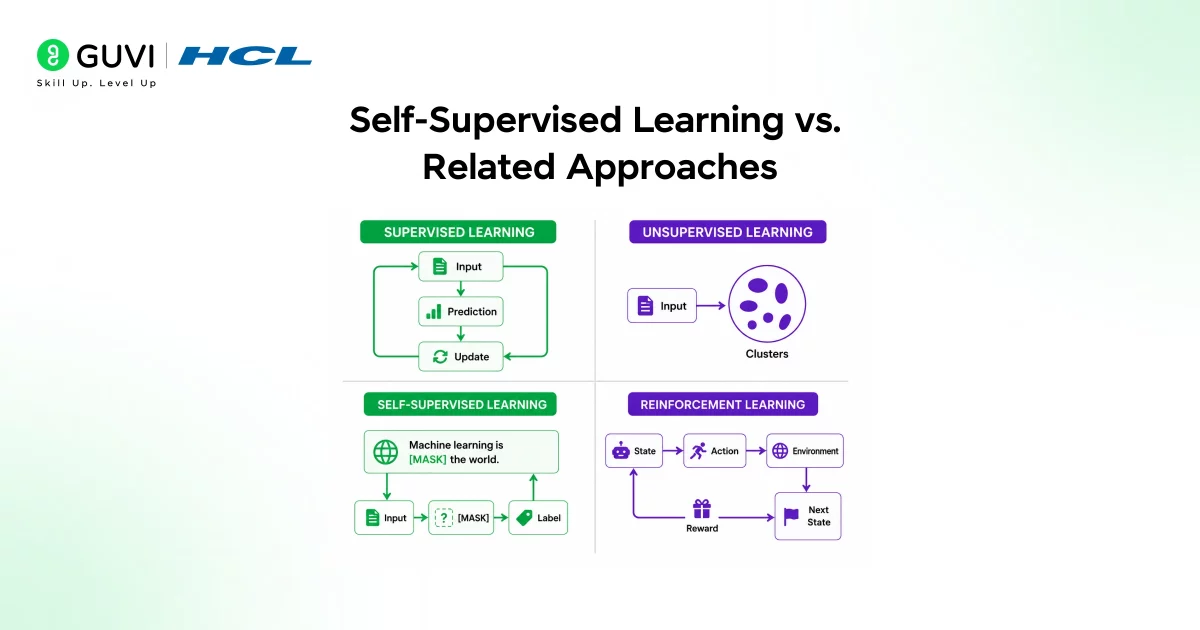
- vs. Supervised Learning
Supervised learning requires human-labeled examples for every training instance. It performs extremely well when abundant labeled data is available for the specific target task.
Self-supervised learning generates its own labels from raw data and produces representations that transfer to many tasks. It shines when labeled data is scarce but raw data is abundant, which describes most real-world domains.
In practice, the most powerful modern systems use self-supervised pre-training followed by supervised fine-tuning, combining the scalability of the former with the precision of the latter.
- vs. Unsupervised Learning
Unsupervised learning discovers patterns, clusters, and structure in data without any explicit objective signal. Methods like k-means clustering or principal component analysis find statistical regularities but provide limited guarantees about what those regularities correspond to semantically.
Self-supervised learning is more structured. It defines an explicit prediction objective that guides representation learning toward semantically meaningful structure rather than purely statistical patterns. This is why self-supervised representations typically outperform traditional unsupervised representations on downstream tasks.
- vs. Semi-Supervised Learning
Semi-supervised learning explicitly combines a small amount of labeled data with a large amount of unlabeled data during training.
Self-supervised learning typically separates the pre-training phase, which uses only unlabeled data, from the fine-tuning phase, which uses labeled data. The distinction is primarily about when and how labeled information enters the training process rather than whether it enters at all.
- vs. Transfer Learning
Transfer learning is the broader concept of reusing a model trained on one task or domain for a different task or domain.
Self-supervised learning is one of the most powerful methods for producing models worth transferring. It creates pre-trained representations that transfer well precisely because they were forced to capture general structure rather than narrow task-specific features.
Self-supervised learning produces the model. Transfer learning describes what you do with it.
GPT-3, released with 175 billion parameters, was trained entirely using self-supervised causal language modeling on large-scale unlabeled internet text. One of its most surprising discoveries was that simply scaling model size and training data led to emergent capabilities that were never explicitly programmed or directly trained for, including arithmetic reasoning, code generation, and few-shot learning, where the model could adapt to new tasks from only a handful of examples provided in the prompt.
Real-World Applications of Self-Supervised Learning
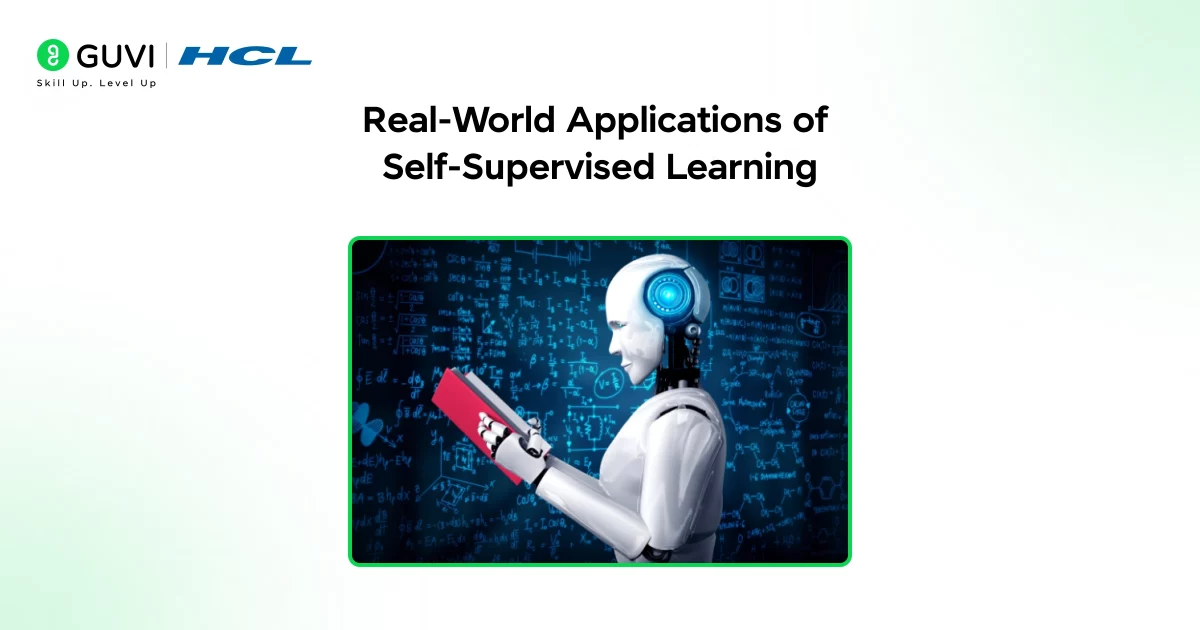
- Natural Language Processing
BERT, RoBERTa, GPT, T5, and virtually every high-performing language model of the past several years is built on self-supervised pre-training.
These NLP models learn language structure, world knowledge, reasoning patterns, and semantic relationships from unlabeled text at scale. They then power search engines, virtual assistants, document summarization tools, code completion systems, and conversational AI with fine-tuning on task-specific labeled data that would be completely insufficient to train these capabilities from scratch.
- Computer Vision
Self-supervised vision models pre-trained with contrastive learning or masked autoencoders have approached or matched supervised baselines on major benchmarks while requiring no image labels during pre-training.
Applications include medical image analysis where labeled data is scarce and expensive to produce, satellite imagery interpretation, autonomous driving perception systems, and content moderation at scale.
- Speech and Audio Processing
Models like wav2vec 2.0 from Meta AI use self-supervised learning on raw audio waveforms to learn speech representations without transcription labels. These representations are then fine-tuned for automatic speech recognition with dramatically less labeled audio than traditional supervised approaches require.
This is particularly impactful for low-resource languages where transcribed speech data is nearly impossible to collect at scale.
To learn more about Self-Supervised Learning and how AI systems learn patterns without labeled data, do not miss the chance to enroll in HCL GUVI’s Intel & IITM Pravartak Certified Artificial Intelligence & Machine Learning course. Endorsed with Intel certification, this course adds a globally recognized credential to your resume, a powerful edge that sets you apart in the competitive AI job market.
Final Thoughts
Self-supervised learning is not a trick for avoiding the cost of labeling. It is a fundamentally different theory of how machine learning systems should acquire knowledge.
Data contains its own structure, and that structure used cleverly as supervisory signal is sufficient to teach models representations that rival supervised learning on labeled datasets. BERT understood language not because someone labeled sentences, but because it was forced to reconstruct what it could not see across billions of words.
The practitioners who get the most value are those who choose the right pretext task, design the right augmentations, and fine-tune without destroying what pre-training built. You do not need labels to teach a model to see the world. You need structure.
FAQs
1. Is self-supervised learning the same as unsupervised learning?
No. Unsupervised learning finds patterns without any explicit objective. Self-supervised learning defines a specific prediction task from the data’s own structure, producing more meaningful and transferable representations.
2. Do I need to pre-train my own model or can I use existing ones?
For most use cases, fine-tuning an existing pre-trained model like BERT or a vision transformer is far more practical. Pre-training from scratch only makes sense when your domain is highly specialized and no relevant checkpoint exists.
3. How much labeled data do I need for fine-tuning?
With strong domain alignment, a few hundred to a few thousand labeled examples can be sufficient. Self-supervised pre-training dramatically reduces labeled data requirements compared to training from scratch.
4. What is the difference between BERT and GPT in self-supervised training?
BERT masks random tokens and predicts them using both left and right context, producing bidirectional representations suited for understanding tasks. GPT predicts the next token using only previous tokens, producing representations suited for generation tasks.
5. Can self-supervised learning work on tabular data?
Yes, though it is less mature than in NLP and vision. Common approaches include masking feature values, corrupting rows for detection tasks, and contrastive methods treating augmented row versions as positive pairs.
Success Stories

About the Author
Vishalini Devarajan
An Aerospace Engineer turned content writer, I focus on making complex concepts easy to understand through well-structured, reader-friendly blogs. Whether it’s a technical topic or a non-technical one, I love creating content that is clear, engaging, and impactful.
View all posts by Vishalini Devarajan
Connect with me @












Did you enjoy this article?