


Artificial Intelligence and Machine Learning Articles
What is Replit’s New Database Editor? A Beginner-Friendly Guide
LLM Engineer Skills: What You Need to Know in 2026


Get In Touch For Details! Request More Information
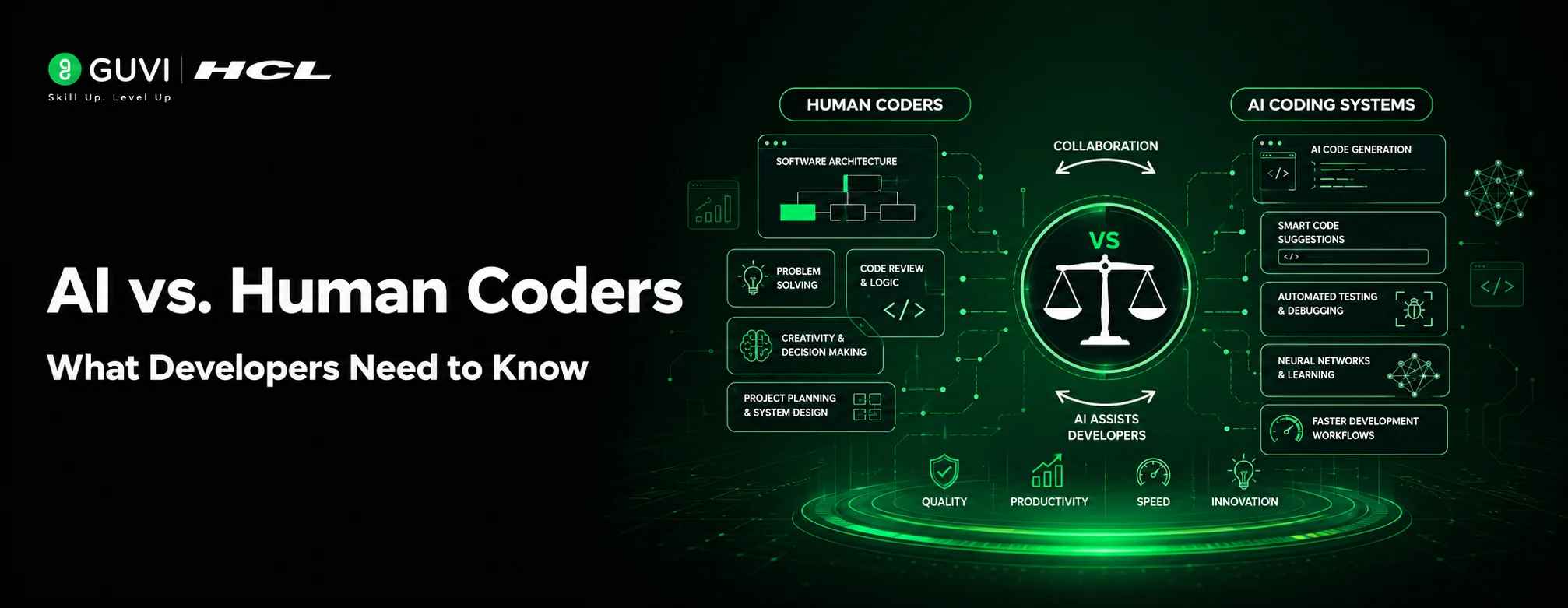
AI vs. Human Coders in 2026: What Developers Need to Know
Jun 16, 2026 7 Min Read 690 Views
(Last Updated)
In 2026, the landscape of software development is undergoing a seismic shift, driven by the rapid advancement and integration of Artificial Intelligence (AI). While the idea of AI writing code might sound like science fiction, it’s rapidly becoming a reality, raising critical questions for human developers: Is AI a threat to their careers, or a powerful new tool? This article delves into the evolving relationship between AI and human coders, exploring the capabilities of AI in software development, the unique strengths of human developers, and what the future likely holds for the industry. Understanding this dynamic is crucial for every developer aiming to stay relevant and thrive in the coming years.
Table of contents
- The Rise of AI in Code Generation
- How AI Generates Code
- Current Capabilities of AI Coding Assistants
- The Enduring Strength of Human Developers
- Creativity and Innovation
- Critical Thinking and Problem-Solving
- Understanding Context and Nuance
- Ethical Considerations and Judgment
- Collaboration and Communication
- The Synergistic Future: AI as a Co-Pilot
- Augmenting Developer Productivity
- Accelerating Learning and Onboarding
- Enhancing Code Quality and Security
- Streamlining Debugging and Maintenance
- What Developers Need to Know and Do in 2026
- Embrace AI Tools
- Deepen Understanding of Core Concepts
- Specialize and Develop Niche Skills
- Focus on Soft Skills
- Cultivate a Growth Mindset
- Challenges and Considerations
- Bias in AI-Generated Code
- Intellectual Property and Licensing
- Over-Reliance and Skill Erosion
- Security Risks
- The Future of the Developer Role
- Conclusion
- Frequently Asked Questions
- What are the main advantages of using AI in coding?
- Can AI completely replace human coders in the near future?
- How can developers best prepare for the integration of AI in their workflow?
- What are the potential risks or downsides of AI in software development?
- Will AI change the demand for certain programming languages or skills?
- How does AI handle complex problem-solving and debugging compared to humans?
The Rise of AI in Code Generation
AI’s foray into code generation is not a sudden development but rather a culmination of years of research in natural language processing (NLP), machine learning (ML), and sophisticated algorithms. Tools like GitHub Copilot, powered by large language models (LLMs) trained on vast repositories of public code, have already demonstrated remarkable abilities. These AI assistants can suggest code snippets, complete lines of code, and even generate entire functions based on natural language prompts.
How AI Generates Code
The process by which AI generates code is complex, but at its core, it involves pattern recognition and prediction. LLMs are trained on billions of lines of code from open-source projects, documentation, and other textual data. Through this training, they learn the syntax, structure, and common patterns of various programming languages. When a developer provides a prompt, whether it’s a comment describing the desired functionality or a partial code snippet, the AI analyzes this input and uses its learned patterns to predict the most probable and relevant code completion or generation.
For example, a developer might write a comment like // function to sort an array of numbers in ascending order. An AI model, having seen countless sorting algorithms during its training, can then suggest a complete function, often with high accuracy. This capability extends beyond simple snippets; more advanced AI can assist in writing tests, refactoring code, and even debugging.
Current Capabilities of AI Coding Assistants
As of 2026, AI coding assistants offer a diverse range of functionalities:
- Code Completion and Suggestion: This is the most prevalent use case. AI can predict and suggest the next lines of code, saving developers significant typing time and reducing syntax errors.
- Function Generation: Developers can describe a desired function in natural language, and AI can generate a working implementation.
- Boilerplate Code Generation: AI excels at creating repetitive or standard code structures, such as class definitions, API endpoints, or configuration files.
- Code Translation: Some AI tools can translate code from one programming language to another, facilitating migration projects.
- Test Case Generation: AI can analyze code and suggest relevant test cases to ensure functionality and identify potential bugs.
- Bug Detection and Fixing: While still an evolving area, AI is increasingly capable of identifying common coding errors and suggesting fixes.
The efficiency gains are undeniable. A study by GitHub indicated that developers using Copilot experienced a significant reduction in the time spent on certain coding tasks. This suggests that AI is not just a novelty but a practical tool that can augment developer productivity.
The Enduring Strength of Human Developers
Despite the impressive advancements in AI, human developers possess unique qualities and skills that AI currently cannot replicate. These strengths are not only valuable but essential for complex problem-solving, innovation, and the overall success of software projects.
Creativity and Innovation
At its heart, software development is a creative process. Human developers bring original ideas, innovative solutions, and a deep understanding of user needs to the table. They can conceptualize entirely new applications, design intuitive user interfaces, and devise novel algorithms to solve complex problems. While AI can generate code based on existing patterns, it lacks the spark of true human creativity and the ability to think outside the box. Innovation often stems from intuition, empathy, and a holistic understanding of the problem domain, qualities that are inherently human.

Critical Thinking and Problem-Solving
Complex software projects often involve ambiguous requirements, unforeseen challenges, and the need for intricate debugging. Human developers excel at critical thinking – analyzing problems from multiple angles, evaluating trade-offs, and making strategic decisions. They can understand the nuances of a business problem, translate it into technical requirements, and design robust solutions that consider long-term maintainability, scalability, and security. AI, while capable of identifying patterns and suggesting solutions based on its training data, struggles with true contextual understanding and abstract reasoning required for novel problem-solving.
Understanding Context and Nuance
Software development is rarely just about writing code; it’s about understanding the broader context of the project. This includes the business goals, the target audience, the existing system architecture, and the team dynamics. Human developers can interpret vague requirements, ask clarifying questions, and adapt their approach based on evolving project needs. They can also understand the why behind a piece of code, not just the how. AI models, trained on code, often lack this deep contextual awareness and can produce code that is syntactically correct but functionally or strategically flawed within the larger system.
Ethical Considerations and Judgment
As AI becomes more integrated into development, ethical considerations become paramount. Human developers are responsible for ensuring that the software they build is fair, unbiased, secure, and respects user privacy. They make judgment calls about data handling, algorithmic fairness, and the potential societal impact of their creations. AI, currently, does not possess this ethical reasoning capacity. Developers must be the guardians of responsible AI development and deployment.
Collaboration and Communication
Software development is a team sport. Human developers collaborate with designers, product managers, testers, and other developers. They communicate complex technical ideas clearly, provide constructive feedback, and work together to achieve common goals. Effective communication, empathy, and team cohesion are vital for project success, and these are skills that AI, in its current form, cannot replicate.
The Synergistic Future: AI as a Co-Pilot
The most probable and beneficial future for software development in 2026 and beyond is not one of AI replacing human coders, but rather one of collaboration. AI is poised to become an indispensable co-pilot, augmenting human capabilities and transforming the developer workflow.
Augmenting Developer Productivity
AI tools will continue to automate repetitive and time-consuming tasks, freeing up developers to focus on higher-level, more strategic work. Imagine AI handling the generation of CRUD (Create, Read, Update, Delete) operations for a database, or automatically writing unit tests for well-defined functions. This allows developers to dedicate more time to system design, complex algorithm development, and innovative feature creation.
Accelerating Learning and Onboarding
For junior developers, AI can serve as a powerful learning tool. It can provide instant feedback, explain code snippets, and offer alternative solutions, accelerating the learning curve. New team members can become productive more quickly, and experienced developers can explore new languages or frameworks with AI assistance.
Enhancing Code Quality and Security
AI can analyze code for potential vulnerabilities, security flaws, and performance bottlenecks with a speed and breadth that humans might miss. By integrating AI-powered static analysis and security scanning tools into the development pipeline, teams can proactively identify and address issues, leading to more robust and secure software.
Streamlining Debugging and Maintenance
Debugging can be one of the most frustrating aspects of development. AI can assist by analyzing error logs, suggesting potential causes for bugs, and even proposing fixes. This can significantly reduce the time spent on troubleshooting and maintenance, improving overall software reliability.
What Developers Need to Know and Do in 2026
To thrive in this evolving landscape, human developers need to adapt and evolve their skill sets. The focus will shift from rote coding to higher-order thinking and specialized expertise.
Embrace AI Tools
The first and most crucial step is to embrace AI-powered development tools. Developers should actively learn to use tools like GitHub Copilot, ChatGPT for coding assistance, and other emerging AI platforms. Understanding how to prompt these tools effectively, interpret their outputs, and integrate them into existing workflows will be a key differentiator.
Deepen Understanding of Core Concepts
While AI can generate code, a deep understanding of fundamental computer science principles, algorithms, data structures, and software architecture remains paramount. Developers need to be able to evaluate the code generated by AI, understand its implications, and guide its implementation. Without this foundational knowledge, developers risk becoming mere operators of AI tools rather than architects of software.
Specialize and Develop Niche Skills
As AI handles more of the general coding tasks, specialization will become increasingly valuable. Developers who possess deep expertise in areas like AI/ML development itself, cybersecurity, cloud architecture, data engineering, or specific domain knowledge (e.g., FinTech, HealthTech) will be in high demand. These specialized skills require human intuition, creativity, and complex problem-solving abilities that AI cannot easily replicate.
Focus on Soft Skills
Communication, collaboration, critical thinking, and problem-solving are becoming even more important. Developers will need to effectively communicate with AI tools, interpret their outputs, and collaborate with human team members and stakeholders. The ability to understand business needs, translate them into technical solutions, and manage complex projects will set developers apart.
Cultivate a Growth Mindset
The pace of technological change is accelerating. Developers must adopt a continuous learning mindset, staying abreast of new AI advancements, programming languages, and development methodologies. A willingness to experiment, adapt, and acquire new skills will be essential for long-term career success.
Challenges and Considerations
While the outlook is largely positive, there are challenges and ethical considerations that need to be addressed as AI becomes more integrated into software development.
Bias in AI-Generated Code
AI models are trained on existing data, which can contain biases. If not carefully managed, AI-generated code could perpetuate or even amplify these biases, leading to unfair or discriminatory outcomes in applications. Developers must be vigilant in identifying and mitigating such biases.
Intellectual Property and Licensing
The use of AI to generate code raises complex questions about intellectual property ownership and licensing. If an AI is trained on publicly available code, who owns the copyright of the generated code? These legal and ethical questions are still being debated and will require clear frameworks and guidelines. The U.S. Copyright Office has begun issuing guidance on AI-generated works, indicating the growing importance of this issue.
Over-Reliance and Skill Erosion
There is a risk that over-reliance on AI tools could lead to an erosion of fundamental coding skills among developers. If developers stop practicing certain types of coding, their proficiency in those areas might decline. This underscores the importance of continued learning and hands-on practice.
Security Risks
While AI can help identify security vulnerabilities, it can also be used to generate malicious code or exploit existing weaknesses. Ensuring the security of AI development tools themselves and understanding how AI can be misused are critical concerns.
The Future of the Developer Role
The role of the developer in 2026 is not one of obsolescence but of evolution. Developers will transition from being primarily code writers to becoming code architects, problem solvers, and AI collaborators. They will leverage AI to automate the mundane, allowing them to focus on the challenging, creative, and strategic aspects of software engineering.
The demand for skilled developers is expected to remain high, but the nature of the skills required will change. There will be a greater emphasis on:
- AI Integration Specialists: Developers who can effectively integrate AI models and services into applications.
- Prompt Engineers: Individuals skilled in crafting effective prompts to elicit desired outputs from AI models.
- AI Ethicists and Auditors: Professionals who ensure AI systems are fair, unbiased, and secure.
- System Architects and Designers: Those who can design complex, scalable, and robust software systems, leveraging AI as a tool.
- Domain Experts: Developers with deep knowledge in specific industries who can apply technology to solve real-world problems.
The ability to understand, guide, and validate AI-generated code will be a core competency. Developers will act as the critical human oversight, ensuring that the code produced by AI aligns with project requirements, ethical standards, and business objectives.
Conclusion
The narrative of AI versus human coders is not a zero-sum game. In 2026, AI is emerging as a powerful amplifier of human potential in software development. By automating repetitive tasks, accelerating development cycles, and providing intelligent assistance, AI empowers developers to achieve more. However, the core human strengths of creativity, critical thinking, ethical judgment, and complex problem-solving remain indispensable.
The future belongs to those developers who embrace AI as a collaborator, continuously refine their core technical skills, specialize in high-demand areas, and hone their soft skills. Rather than fearing replacement, developers should view AI as an opportunity to elevate their roles, tackle more challenging problems, and drive innovation in ways previously unimaginable. The key to success in 2026 and beyond lies not in competing with AI, but in learning to work alongside it, harnessing its power to build better software, faster and more effectively. The journey of software development is evolving, and those who adapt will lead the way.
To deepen your understanding of AI vs Human Coders in 2026: What Developers Need to Know, explore these valuable guides:
- 👉 Artificial Intelligence in Frontend Development
Learn how AI is transforming UI/UX and frontend workflows:
https://www.guvi.in/blog/artificial-intelligence-in-frontend-development/ - 👉 Artificial Intelligence vs Human Intelligence
A deeper comparison of machine intelligence and human thinking:
https://www.guvi.in/blog/artificial-intelligence-vs-human-intelligence/ - 👉 Artificial Intelligence Project Ideas
Explore practical projects to sharpen your AI development skills:
https://www.guvi.in/blog/artificial-intelligence-project-ideas/ - 👉 The Rise of Artificial Intelligence
Understand the growth and future impact of AI across industries:
https://www.guvi.in/blog/the-rise-raise-of-artificial-intelligence/
Frequently Asked Questions
What are the main advantages of using AI in coding?
AI offers several key advantages in coding, including significantly boosting developer productivity by automating repetitive tasks like boilerplate code generation and code completion. It can also help accelerate the learning process for new developers by providing instant suggestions and explanations. Furthermore, AI can aid in identifying potential bugs and security vulnerabilities with greater speed and breadth than manual methods, ultimately contributing to higher code quality and faster development cycles.
Can AI completely replace human coders in the near future?
Based on current trends and capabilities, it is highly unlikely that AI will completely replace human coders in the near future, especially by 2026. While AI excels at generating code based on existing patterns and can automate many tasks, it lacks the human capacity for true creativity, abstract reasoning, ethical judgment, and nuanced understanding of complex business contexts. Human developers are crucial for innovation, strategic problem-solving, and ensuring software aligns with human values and objectives.
How can developers best prepare for the integration of AI in their workflow?
Developers can best prepare by embracing AI tools and learning to use them effectively as collaborators. This involves understanding prompt engineering, critically evaluating AI-generated code, and focusing on deepening their understanding of core computer science principles. Specializing in niche areas like AI/ML development, cybersecurity, or specific domain expertise, and honing soft skills such as communication and critical thinking, will also be vital. A continuous learning mindset is essential to stay current with AI advancements.
What are the potential risks or downsides of AI in software development?
Potential risks include the perpetuation of biases present in training data, leading to unfair or discriminatory code. There are also complex questions surrounding intellectual property rights and licensing for AI-generated code. Over-reliance on AI could lead to an erosion of fundamental coding skills among developers. Additionally, AI tools themselves could present security risks if not properly managed, and malicious actors could leverage AI to generate harmful code.
Will AI change the demand for certain programming languages or skills?
Yes, AI is likely to influence the demand for programming languages and skills. While foundational languages will remain important, there may be an increased demand for languages and frameworks that are well-suited for AI development, machine learning, and data science (e.g., Python). Skills related to AI integration, prompt engineering, data analysis, and understanding AI ethics will become more valuable. The ability to work with and manage AI tools will likely become a standard requirement across many programming roles.
How does AI handle complex problem-solving and debugging compared to humans?
AI can assist in debugging by analyzing error logs and suggesting potential causes or fixes based on patterns it has learned. However, complex, novel problem-solving and deep debugging often require human intuition, abstract reasoning, and a holistic understanding of the system’s context and intended behavior, which AI currently struggles to replicate. Humans can often identify root causes that are not directly evident in the code patterns AI analyzes.
Success Stories

About the Author
Lavish Jain
A Professional Developer Mentor and Corporate Trainer with over 10 years of experience, I have contributed to technological advancements through comprehensive training and mentorship. My journey includes pivotal roles at Cluebix, Focus-4D,ThoughtWorks, and currently with Guvi -HCL Group, where I shape the careers of aspiring developers. I specialize in simplifying complex concepts, making them accessible to learners at all levels, and have successfully trained lakhs of budding developer through corporate and boot camp courses focused on full-stack development.
View all posts by Lavish Jain
Connect with me @







Did you enjoy this article?