


Artificial Intelligence and Machine Learning Articles
Finance Manager to Data Analytics: Career Growth, Salary and Seniority
How to Evaluate LLM Outputs in Production Deployments
AI/ML Skills Gap 2026: Why Companies Can't Find Job-Ready Talent
20 AI/ML Interview Questions Recruiters Can Use Without a Tech Background - Best Guide


Get In Touch For Details! Request More Information
What is Reinforcement Learning? Top 3 Techniques for Beginners
Apr 30, 2026 9 Min Read 3655 Views
(Last Updated)
Reinforcement Learning (RL) is one of the most exciting frontiers in machine learning, teaching agents to learn from trial and error, just like humans. Unlike supervised or unsupervised learning, where labeled or unlabeled data guide the process, RL trains models through experience, rewards, and feedback.
Let’s take an example of a self-driving car. With object detection techniques, we can identify a signal with a red sign. Now that the signal and the color red are detected and identified, what action should we perform?! How does the car make its own decision of whether it should stop or not? That’s where Reinforcement learning comes into play.
In this beginner-friendly guide, you’ll discover the core RL techniques like Q‑Learning, Markov Decision Processes (MDP), and policy gradient methods, and see how they power real-world systems like robots, drones, game AI, and recommendation engines. Let’s get started!
Table of contents
- Quick Answer
- What is Reinforcement Learning?
- The Core Building Blocks of Reinforcement Learning
- The Agent
- The Environment
- State
- Action
- Reward
- How Reinforcement Learning Actually Works: The Learning Loop
- Three Core Approaches to Reinforcement Learning
- Key Decision Process Methods
- 1) Markov Decision Process
- 2) Q- Learning
- 3) Policy Gradient Methods
- Applications of Reinforcement Learning
- 1) Robotics
- 2) Drones
- Reinforcement Learning vs Other Types of Machine Learning
- 💡 Did You Know?
- Concluding Thoughts…
- FAQs
- What is Reinforcement Learning in simple terms?
- How is Reinforcement Learning different from supervised learning?
- Is Reinforcement Learning used in ChatGPT?
- What are the biggest challenges in Reinforcement Learning?
- Where can a beginner start learning Reinforcement Learning?
Quick Answer
Reinforcement Learning is a type of machine learning where a computer program called an agent learns to make decisions by trying actions in an environment, receiving rewards or penalties based on the results, and gradually improving its strategy over time. It is the technology behind ChatGPT learning to give helpful answers and robots learning to walk without being programmed to do so step by step.
What is Reinforcement Learning?
RL is a distinct type of machine learning where an agent explores an environment, takes actions, receives rewards, and transitions between states—all to learn which behaviors yield the highest cumulative rewards.
Let me put it simply, when people say “Machine Learning,” many of us are aware of the two primary types, Supervised and Unsupervised. Reinforcement Learning is also a type of Machine Learning.
When we already have labeled data and we use that data to train an algorithm, it is called the Supervised Learning technique. On the other hand, it is called Unsupervised Learning when we train an algorithm using unlabeled data.
But, what if there is no data? That’s when we let the machine learn on its own by allowing it to make its own mistakes and correct itself by learning from the mistakes.
Instead of a human, reinforcement learning has an agent! This agent explores the environment and learns to perform the desired tasks by taking action. Now this action can give a good outcome or a bad outcome. Avoiding outcomes with bad actions is the task, and this is where a reward is introduced for every good outcome.
The Core Building Blocks of Reinforcement Learning
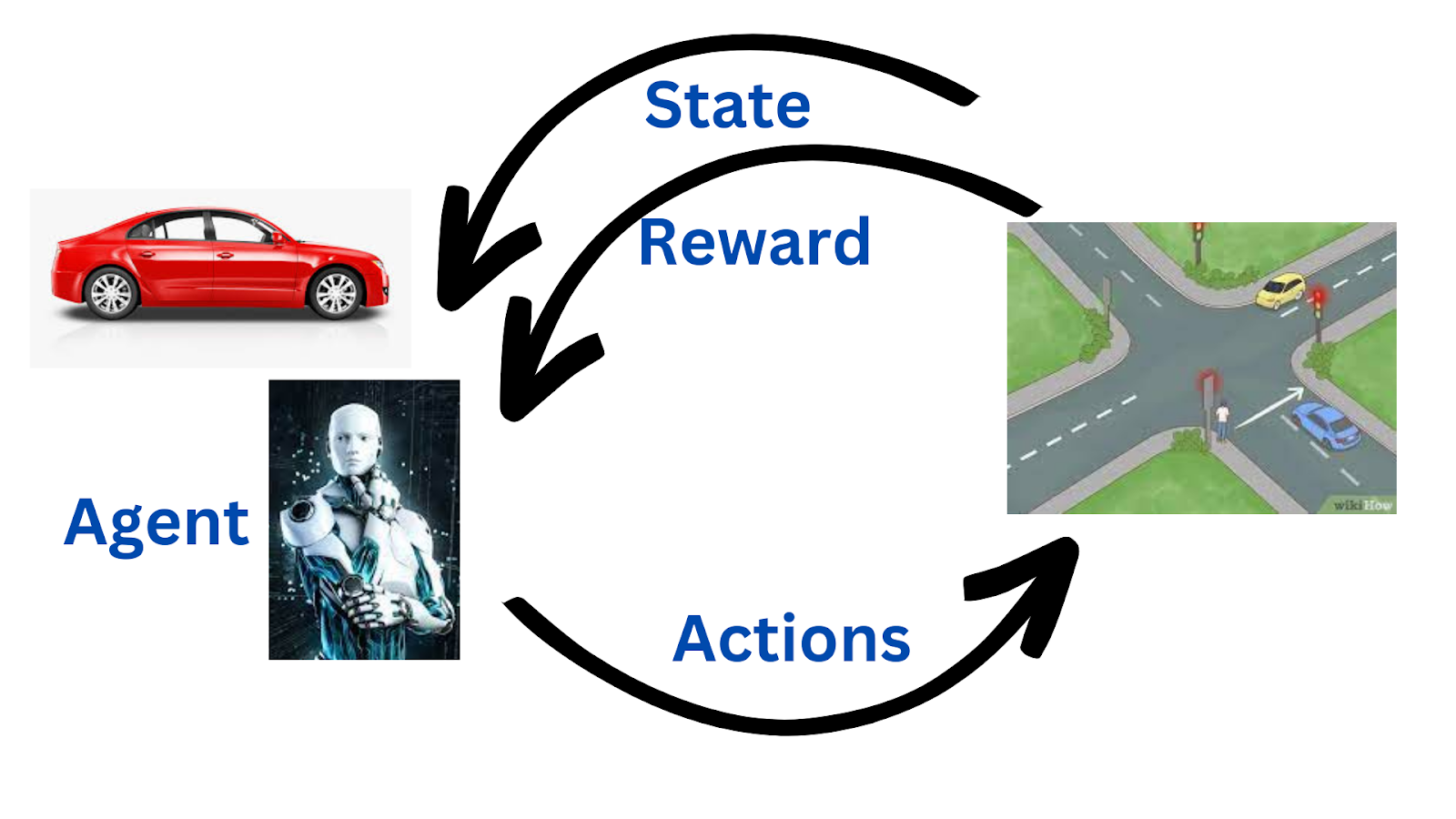
Every system built with this approach, whether it is a chess AI or a robot sorting packages in a warehouse, is built from the same five fundamental components. Understanding these makes everything else in the field much easier to grasp.
1. The Agent
The agent is the learner. It is the program that observes the environment, makes decisions, and receives rewards. The agent is what you are training. In a chess game, the agent is the AI playing the game. In a self-driving car simulation, the agent is the virtual car. The agent has no built-in knowledge of what to do. It only knows how to observe, act, and learn from the feedback it receives.
- What it does: Chooses an action at each step based on its current knowledge and the current state of the environment.
- What it learns: A policy, which is a mapping from situations to actions. A good policy means taking the action most likely to lead to reward in any given situation.
- How it improves: By repeatedly experiencing the consequences of its actions and adjusting its policy to favour actions that led to higher rewards in the past.
2. The Environment
The environment is everything the agent interacts with. It is the world the agent lives in. The environment changes in response to the agent’s actions, and it provides the agent with both observations about its current state and rewards for its behaviour.
The environment could be a real physical space, a video game, a financial market simulation, a conversation with a human, or any other system where actions have consequences that can be observed and measured.
- Real environment: A robot arm in a factory, a self-driving car on a road, or a drone navigating a building.
- Simulated environment: A chess board, an Atari game, a physics simulation, or a virtual factory floor.
- The environment’s job: Receive actions from the agent, update its own state in response, and return the new state plus a reward signal back to the agent.
3. State
The state is the current snapshot of the environment that the agent can observe. It is the information the agent uses to decide what to do next. In a chess game, the state is the current arrangement of pieces on the board. In a self-driving car, the state includes the car’s speed, its position, the positions of other vehicles, traffic light colours, and road conditions.
Riddle: An agent is playing a game of Pac-Man. At this moment, it sees Pac-Man’s position, the positions of all ghosts, which dots have been eaten, and the current score. What is the state, and why does it matter so much for what the agent decides to do next?
Answer: All of that information together forms the state. It matters because the same action (move left, say) might be brilliant in one state (moving away from a ghost) and disastrous in another (moving into a wall). The agent learns not just which actions are good in general, but which actions are good in each specific state. A Reinforcement Learning agent that cannot distinguish between states cannot make good decisions.
4. Action
The action is what the agent does at each step. The set of all possible actions an agent can take is called the action space. Some environments have discrete action spaces where only specific choices are possible, like moving up, down, left, or right. Others have continuous action spaces where actions can take any value within a range, like the exact angle to steer a car or the exact force to apply to a robotic arm joint.
- Discrete actions: Turn left, turn right, jump, shoot, buy, sell, or hold.
- Continuous actions: Steering angle, throttle position, robot joint torque, or volume level.
- Why it matters: The complexity of the action space directly affects how hard the learning problem is. More possible actions mean more to explore and more to learn.
5. Reward
The reward is the feedback signal that tells the agent how well it is doing. It is a number, positive or negative, that the environment returns after the agent takes each action. A positive reward means the action was good. A negative reward (a penalty) means it was bad. The goal of the agent is to maximise its total accumulated reward over time, not just the immediate reward from the next action.
This is one of the most important and tricky aspects of RL. The reward function must be designed carefully. If you reward a robot for picking up boxes quickly without penalising it for dropping them, it learns to pick up and immediately drop boxes to maximise the count. The reward function shapes everything the agent learns.
Brain teaser: A video game AI is trained with a reward of plus one for every enemy destroyed and zero for everything else, including dying. The AI discovers it can stand in a corner and lure enemies to come to it one by one, collecting rewards without exploring the map. Is this good Reinforcement Learning? What does it reveal about reward design?
Answer: The AI is doing exactly what its reward function asks. It found a clever strategy to maximise accumulated reward. But the designer wanted it to play the whole game, not exploit one corner. This illustrates reward hacking, one of the most common and important challenges in Reinforcement Learning. Designing a reward function that captures what you truly want the agent to do, not just a proxy for it, is one of the hardest problems in the field.
Also Read: Machine Learning Must-Knows: Reliable Models and Techniques
How Reinforcement Learning Actually Works: The Learning Loop
Reinforcement Learning works through a continuous cycle of observation, action, reward, and update. Here is what that cycle looks like in plain language.
The agent begins knowing almost nothing. It observes the initial state of the environment and takes an action, often randomly at first. The environment transitions to a new state and returns a reward. The agent stores this experience and uses it to update its estimate of which actions are valuable in which states. Then it observes the new state and takes another action, this time with a slightly better sense of what to do.
Over thousands or millions of these cycles, the agent builds up a detailed understanding of the consequences of actions across many different situations. The result is a policy, the agent’s learned strategy, that consistently produces high rewards.
The balance between exploration (trying new actions to discover their consequences) and exploitation (sticking to actions known to produce rewards) is one of the central challenges of Reinforcement Learning. An agent that only exploits never discovers better strategies. An agent that only explores never actually performs well. Good RL algorithms manage this balance intelligently throughout training.
Three Core Approaches to Reinforcement Learning
Now that we’ve understood what reinforcement learning is, let me explain to you the approaches you can take to solve a Reinforcement Learning problem. There are three approaches:
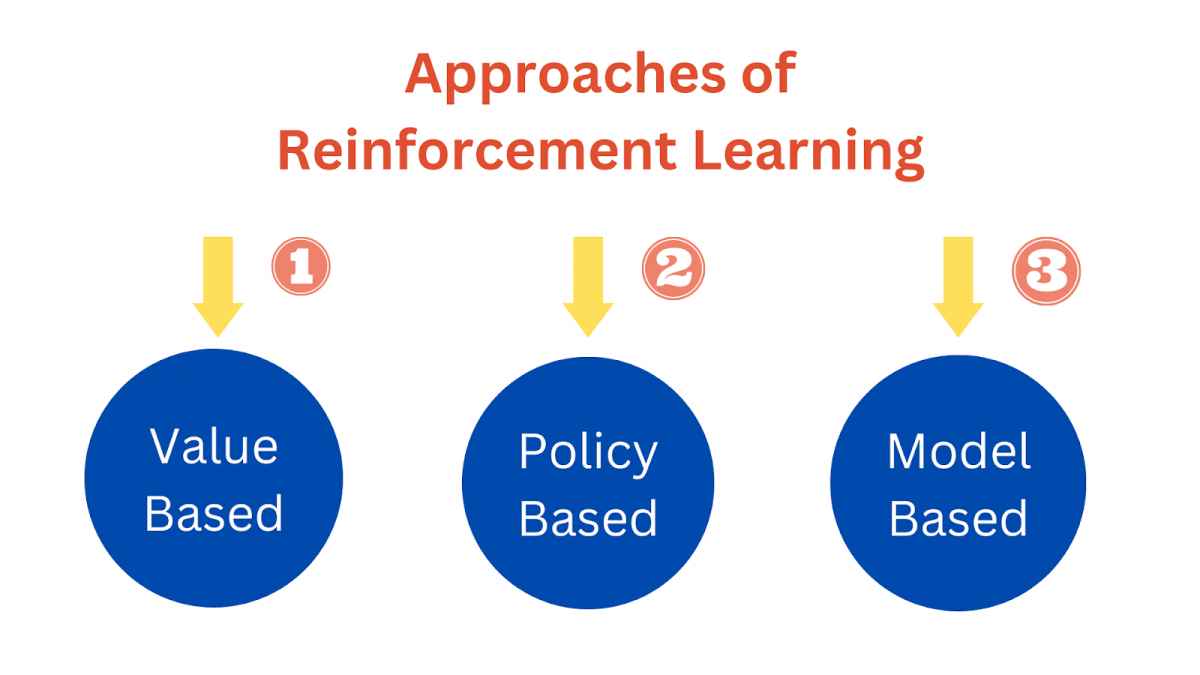
- Value-Based (Q‑Learning): Learns a Q‑value table or function predicting the best action’s long-term reward. The agent chooses the highest Q‑value action.
- Policy-Based (Policy Gradient): Learns a policy directly (e.g., a probability distribution over actions) and optimizes it to maximize expected reward.
- Model-Based: Builds an internal model of the environment to simulate future states and rewards, and planning.
Key Decision Process Methods
There are many concepts in Reinforcement Learning. As I told you earlier, it requires a complex understanding of math and derivations. I’m not going to go in-depth into the derivatives. Here in this article, I’m going to cover three concepts to understand how the agent works in the environment.
- Markov Decision Processes – How the agent decides to transition from one state to another
- Q-Learning – The reward calculation technique to choose the moves
- Policy Gradient- An action-based method to get high rewards
1) Markov Decision Process
In the previous image, you can see there is a component called ‘State’. This refers to the state in which the agent is.
Let’s take a simple example.
I want a robot that is sitting on a chair to stand up and pick up an object.
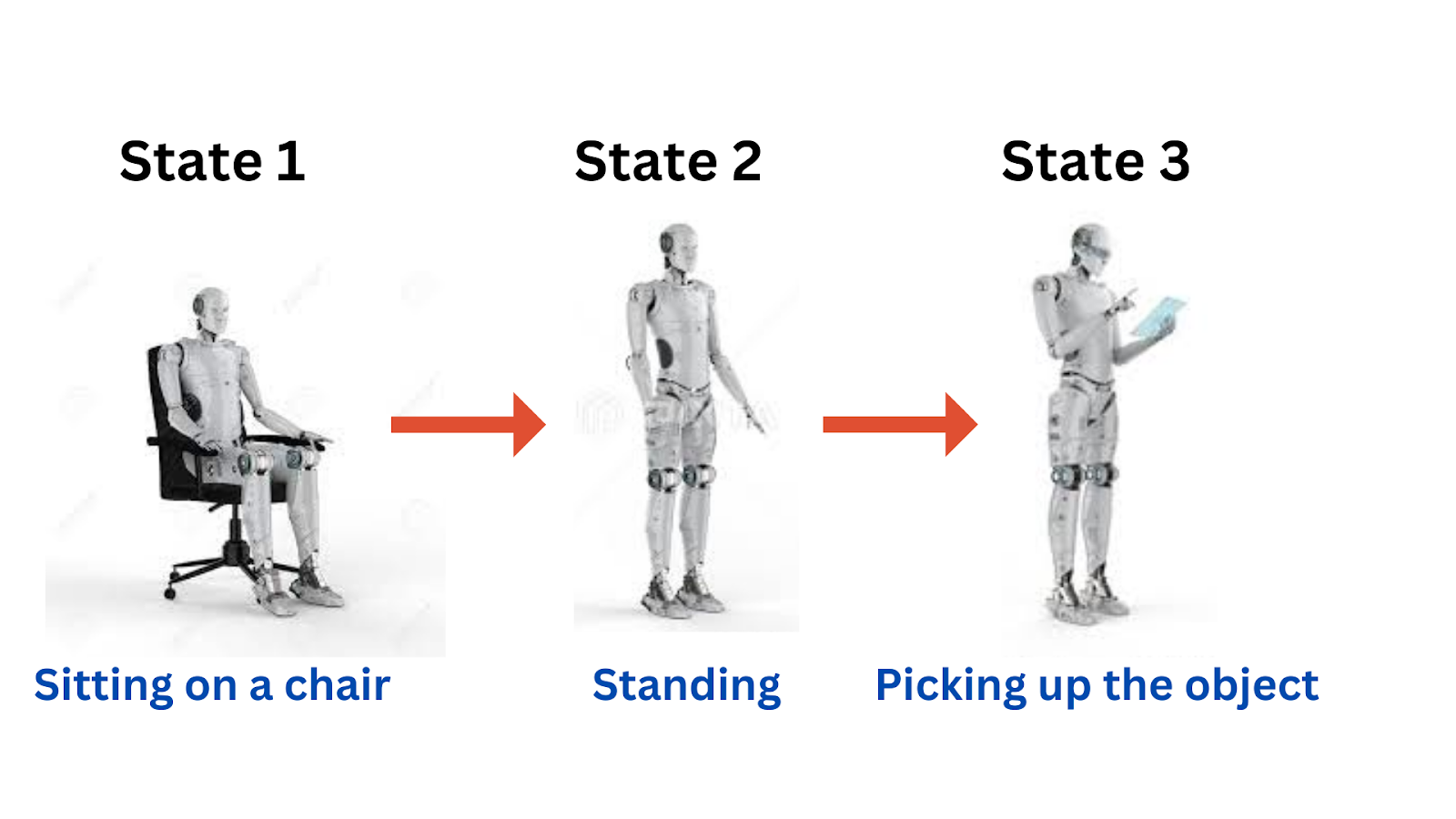
Here, as you can see, the agent has three states, and the transition happens from one state to another. This is based on the probability of the current state and not on the previous states. In simple terms, State 3 depends on State 2 and not on State 1. This is called the Markov Process.
It is defined by (S, P) where S represents the states and P is the state transition probability.

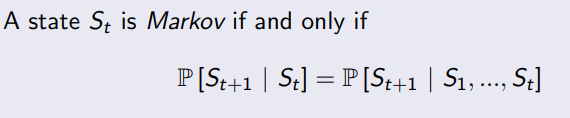
The future is independent of the past, given the present!
A Markov Process is a memoryless random process with a sequence of random states. When this process of transitioning the state is combined with the reward, then this gives us the Markov Decision Process. This reward process is like a chain with values that help the agent to take the right decision.
This process is also combined with the discount factor, which tells how important is the current state to achieve future rewards. It is a value that varies between 0 to 1.
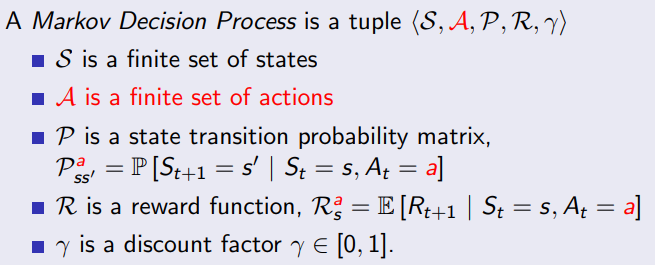
Do you not like the math factors behind this concept?! Just know this…
Markov Decision Process(MDP) is a rewarding process with decisions based on the parameters such as the states, actions, state transition probability, reward function, and discount factor.
Suggested Read: Real-World Machine Learning Applications
2) Q- Learning
When the agent directly derives an optimal policy from its interactions with the environment without needing to create a model beforehand is called Model-free learning.
Q-learning is a value-based model-free learning technique that can be used to find the optimal action-selection policy using a Q function.
Q here stands for Quality. Now that we know there is a reward for an agent when the right decision is made. With the Q-learning, the agent will choose a path where the reward is high.
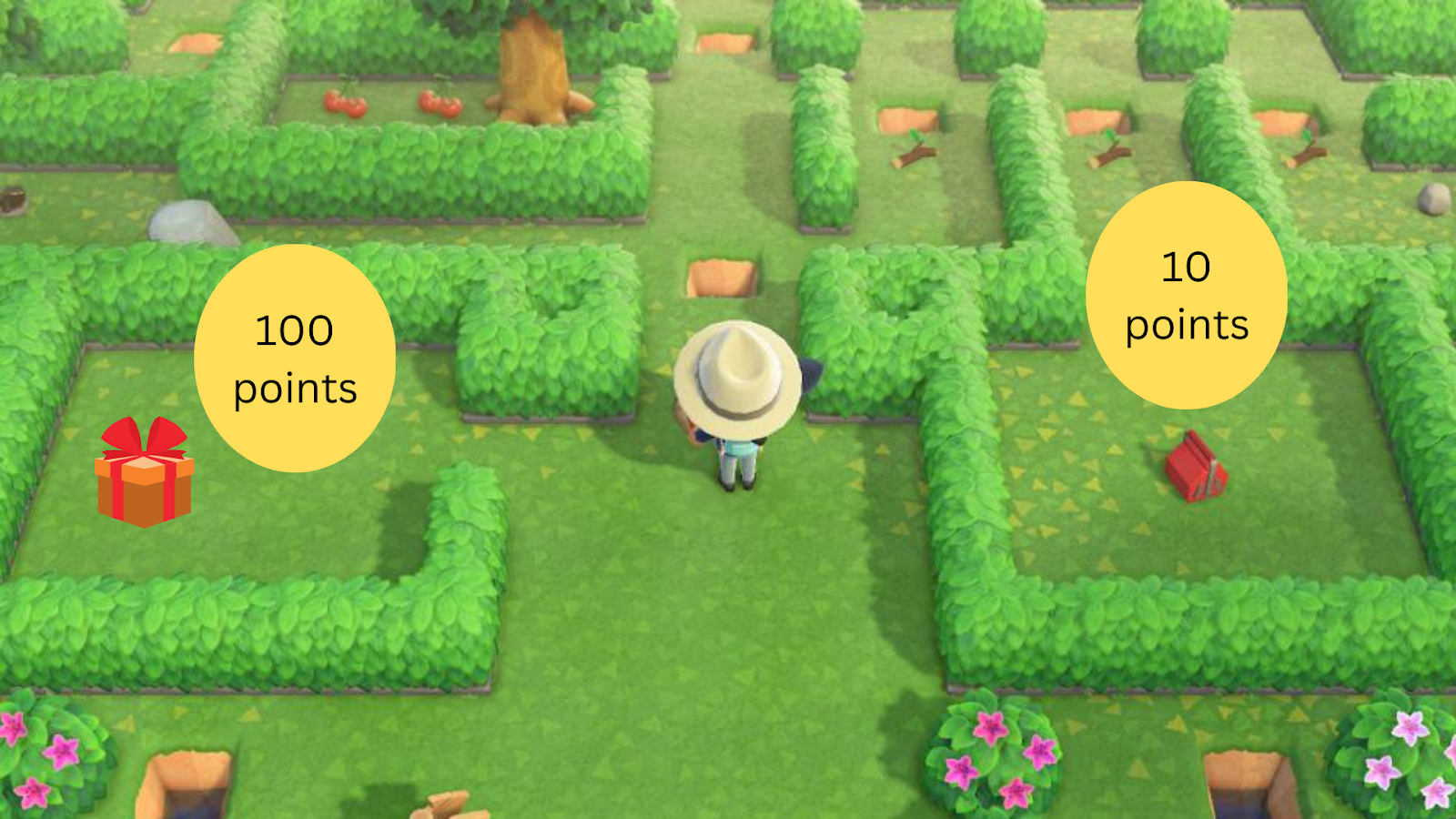
Let’s look at the image above. Now, according to you, where should the agent go? To get 10 points or 100 points? The answer is 100 points. This can be done by making a Q table with the values of rewards the agent will get. The best possible rewards are based on the table, the agent can decide whether to take right, left, up, or down.
This is an example of a Q table based on the action the agent should take.
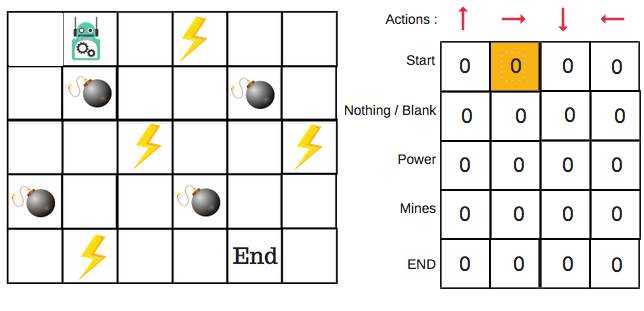
The agent’s work is to take the right action to reach the end without getting into mines, and also to try to get the powers. This is possible by Q Learning, and the table shows how the value can be calculated to let the agent know which way is more rewarding.
3) Policy Gradient Methods
There is also another method, like Q-Learning, on makes the agent take its decisions based on certain parameters. While Q Learning aims at predicting the reward of certain actions taken in a certain state, Policy Gradients directly predict the action itself
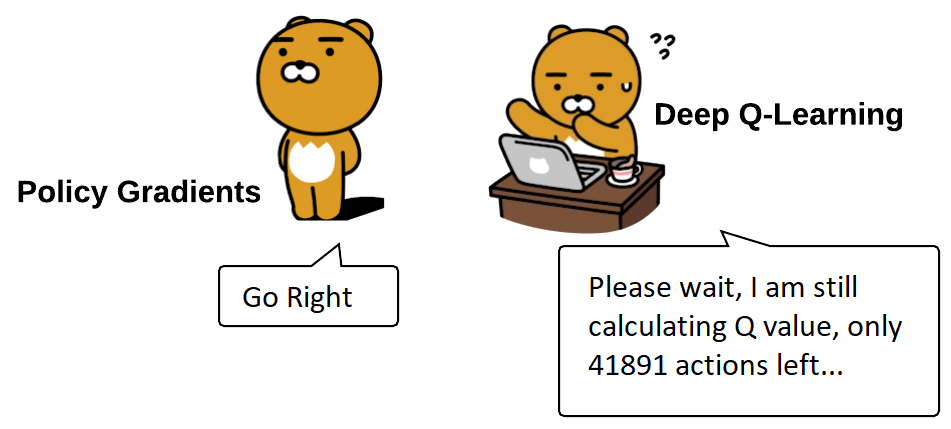
The term ‘Gradient’ means a change in the value of the quantity with a change in the given variable. I’m sure you now know the work of the agent, is to try to maximize the reward. Now if this maximizing happens when following a policy, it is following a policy gradient method. This policy is derived by defining a set of parameters where the change is found and acting accordingly.
Applications of Reinforcement Learning
Let’s now understand some of the applications of Reinforcement Learning in the real world and the simulated world.
1) Robotics
Reinforcement Learning(RL) is widely used in the field of Robotics. In Robotics, the environment can be a simulation or a real-world scenario. Let’s see some of the areas where it is applied.
- Autonomous Navigation: Reinforcement algorithms can be used to train robots to navigate from one location to a target location while avoiding obstacles in the environment
- Manipulation Tasks: We can train robots to perform tasks such as grasping objects, putting them in specific locations, or stacking blocks.
- Aerial Robots: RL algorithms have been used to control the flight of quadrotors, allowing them to perform aerial acrobatics, fly autonomously, or perform tasks such as search and rescue.
- Robotics in Manufacturing: RL can be used to optimize production processes by controlling the movement of robots in a factory.
- Human-robot Interaction: RL can be used to learn a policy for a robot that maximizes human-robot interaction by making decisions such as whether to move closer or further from a person or how to respond to different gestures.
2) Drones
Reinforcement learning (RL) is widely used in the control of drones, both for research purposes and for practical applications.
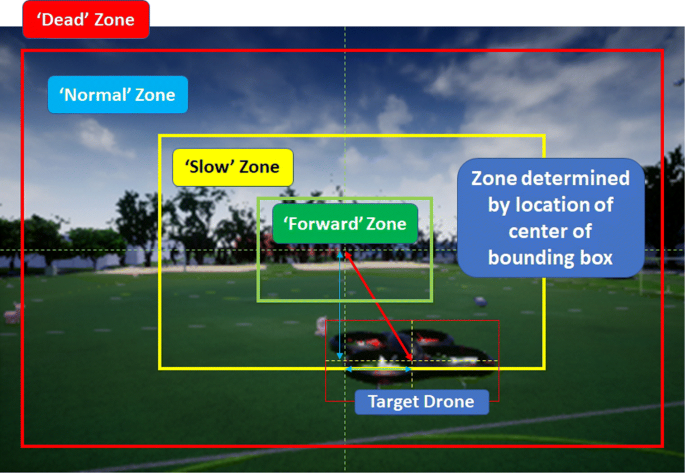
Some common ways RL is used in drones include:
- Autonomous flight: RL algorithms can be used to train drones to fly autonomously, navigate to specific locations, avoid obstacles, and perform tasks such as search and rescue.
- Flight control: RL can be used to learn control policies for the stabilization of the flight of drones, improving their stability and robustness to external disturbances.
- Trajectory optimization: RL algorithms can be used to optimize the trajectory of drones, allowing them to fly more efficiently and conserve energy.
- Motion planning: RL can be used to plan the motion of drones in real time, taking into account obstacles and other constraints in the environment.
- Task allocation: RL can be used to divide tasks among multiple drones, allowing them to work together efficiently to complete a common goal.
In these examples, the drone’s environment could be a simulated or real-world scenario, and the state could include information such as the drone’s position, orientation, velocity, and so on. The actions taken by the drone could include commands to control its motors and other actuators, and the reward signal could be designed to reflect the goals of the task the drone is performing.
As with other applications of RL in robotics, the use of RL in drones is challenging and requires careful consideration of the design of the reward signal, the simulation or real-world scenario, and the algorithm used to learn the policy.
If you’re looking to master Reinforcement Learning along with the core concepts of AI and ML, GUVI’s Artificial Intelligence and Machine Learning Course is a perfect start. Designed by industry experts and powered by IIT-M certification, this course offers hands-on projects and placement support to launch your AI career with confidence.
Reinforcement Learning vs Other Types of Machine Learning
Understanding where RL fits alongside other machine learning approaches helps put everything into context.
| Type | How It Learns | Example |
| Supervised Learning | From labelled examples (right answer given) | Spam email detection |
| Unsupervised Learning | From patterns in unlabelled data | Customer segmentation |
| Reinforcement Learning | From rewards and penalties through experience | AlphaGo, ChatGPT RLHF |
RL is the right choice when the problem involves sequential decisions, when good training data is hard to collect, and when the optimal strategy can only be discovered through experience rather than being specified in advance.
Do check out HCL GUVI’s AI & ML Email Course, a beginner-friendly 5-day learning series that delivers step-by-step lessons on AI and machine learning basics, real-world use cases, career insights, and a clear roadmap to help you understand how AI technologies work and how to start building practical skills in this fast-growing field.
💡 Did You Know?
- Richard Sutton and Andrew Barto, the two researchers who wrote the foundational textbook on Reinforcement Learning, received the Turing Award in 2024, often called the Nobel Prize of computing, for their work that laid the theoretical foundations of the field.
- Reinforcement Learning was used by DeepMind to reduce energy consumption at Google’s data centres by around 40% by learning to control cooling systems more efficiently. This single application demonstrated that Reinforcement Learning had real, immediate economic value beyond games and research.
- The global Reinforcement Learning market was valued at over $122 billion in 2025 and is projected to grow at more than 65% per year through 2037, driven by applications in robotics, autonomous vehicles, healthcare, and AI training.
Concluding Thoughts…
Reinforcement learning (RL) is a promising area of artificial intelligence and machine learning that has the potential to revolutionize many fields and industries. RL algorithms enable agents to learn from experience, optimizing their behavior over time to achieve a desired goal. Applications of RL are wide-ranging, from controlling robots and drones to optimizing resource allocation, game playing, and human-computer interaction.
In conclusion, RL is a field with great potential, and it will be exciting to see how it continues to evolve and what new applications emerge in the future. But no matter what, I will always be here to explain all advancements as simply as possible just for you. Good Luck!
FAQs
1. What is Reinforcement Learning in simple terms?
Reinforcement Learning is a way for computers to learn by trial and error. An agent tries actions, receives rewards or penalties based on the results, and gradually learns which actions lead to the best outcomes. It is similar to how people and animals learn from experience in the real world.
2. How is Reinforcement Learning different from supervised learning?
Supervised learning trains a model using labelled examples where the correct answer is already known. Reinforcement Learning has no labelled data. Instead, the agent learns purely from the rewards it receives by taking actions in an environment. The agent must discover what works through exploration rather than being told directly.
3. Is Reinforcement Learning used in ChatGPT?
Yes. ChatGPT is trained using a technique called Reinforcement Learning from Human Feedback (RLHF). Human reviewers rate different responses, and Reinforcement Learning is used to optimize the model to produce responses that humans consistently find more helpful and appropriate.
4. What are the biggest challenges in Reinforcement Learning?
The main challenges are that Reinforcement Learning can require enormous amounts of training time and computational resources, reward functions are difficult to design correctly, and agents can find unintended shortcuts that satisfy the reward function without actually solving the intended problem.
5. Where can a beginner start learning Reinforcement Learning?
A good starting point is the free Gymnasium Python library for hands-on experimentation. The textbook “Reinforcement Learning: An Introduction” by Sutton and Barto is available free online and is the standard reference. Starting with the Cart-Pole balancing task gives you a practical feel for the core loop before tackling more complex problems.
Success Stories

About the Author
Jebasta
I translate the language of data into stories that anyone can understand. As a writer with a data science background, I simplify analytics, AI, and decision-making so beginners and enthusiasts can confidently explore the world of data.
View all posts by Jebasta
Connect with me @











Did you enjoy this article?