


Artificial Intelligence and Machine Learning Articles
AI/ML Skills Gap 2026: Why Companies Can't Find Job-Ready Talent
20 AI/ML Interview Questions Recruiters Can Use Without a Tech Background - Best Guide
How Industry-Backed AI/ML Bootcamps Are Changing the AI/ML Hiring Pipeline - Best Guide 2026
From IT Support to AI Engineer: A Realistic Career Switch Guide 2026


Get In Touch For Details! Request More Information
How to Reduce Claude Hallucinations with Better Prompts
Jul 23, 2026 4 Min Read 589 Views
(Last Updated)
Even the most advanced AI assistants can occasionally produce answers that sound convincing but are factually incorrect. This phenomenon, commonly known as AI hallucination, can lead to inaccurate code, fabricated citations, incorrect business insights, or misleading explanations if left unchecked.
The good news is that hallucinations are often reduced—not by changing the model—but by improving how you write prompts. Clear instructions, sufficient context, and well-designed workflows help reduce Claude Hallucinations and produce more accurate, grounded, and reliable responses. In this article, you’ll learn why Claude hallucinates, common causes, practical prompt engineering techniques, and best practices to minimize hallucinations in real-world applications.
Table of contents
- TL;DR Summary Box
- What is a Claude hallucination?
- Can hallucinations be completely eliminated?
- How do better prompts reduce hallucinations?
- Is RAG better than prompt engineering?
- Should I ask Claude to cite its sources?
- Does Tool Use help reduce hallucinations?
- Are hallucinations more common in technical tasks?
TL;DR Summary Box
- Hallucinations are incorrect or unsupported AI-generated outputs.
- Better prompts improve accuracy by reducing ambiguity.
- Give Claude enough context instead of expecting it to guess.
- Use RAG for company documents and frequently changing information.
- Encourage Claude to acknowledge uncertainty instead of inventing answers.
- Always verify important technical, legal, medical, or financial information.
Reduce Claude hallucinations by letting it say “I don’t know,” grounding answers in sources, and requiring citations for every claim. Learn AI & ML with HCL GUVI’s Artificial Intelligence and Machine Learning course.
What Are Claude Hallucinations?
A hallucination occurs when Claude generates information that appears plausible but is inaccurate, fabricated, or unsupported by reliable evidence.
Examples include:
- Inventing API parameters
- Misquoting documentation
- Fabricating research citations
- Incorrect code examples
- Wrong product specifications
- False historical details
Hallucinations are a limitation of probabilistic language generation and can occur in any large language model.
Why Do Hallucinations Happen?
Claude predicts the most likely next tokens based on patterns learned during training. When a prompt lacks sufficient information or requests unavailable knowledge, the model may generate its best estimate instead of providing a definitive answer.
Common causes include:
- Ambiguous prompts
- Missing context
- Outdated knowledge
- Overly broad questions
- Requests for unavailable information
- Pressure to answer every question
📊 Data Point
Research across the AI industry shows that retrieval-based systems and well-structured prompts generally produce more reliable factual responses than relying solely on a model’s internal knowledge.
How Do Better Prompts Reduce Hallucinations?
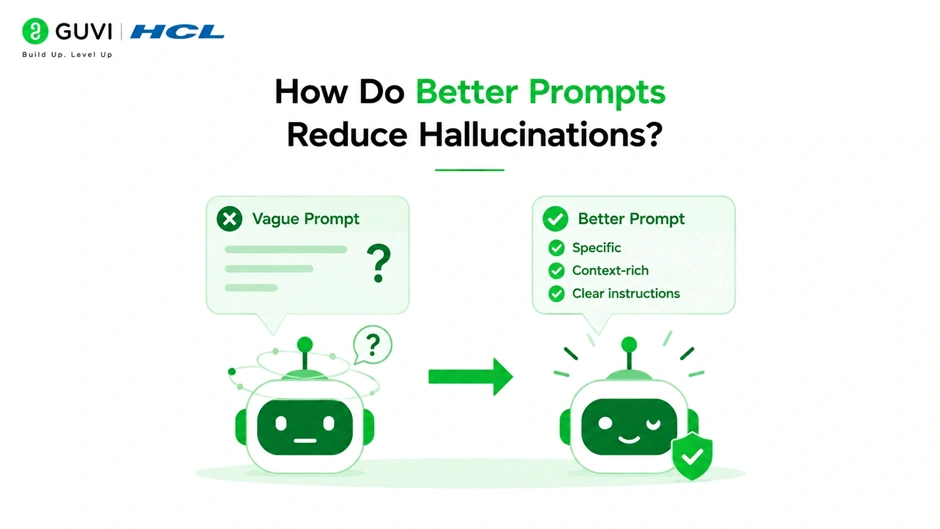
Good prompts reduce uncertainty by giving Claude clear instructions, relevant context, and defined expectations.
Instead of:
“Explain this API.”
Try:
“Based only on the API documentation below, explain how the authentication flow works. If the documentation doesn’t specify something, explicitly say it’s not documented.”
This approach encourages grounded responses rather than educated guesses.
1.Provide Sufficient Context
The less Claude has to infer, the more reliable its responses are.
Include:
- Relevant documentation
- Business rules
- User requirements
- Code snippets
- Error messages
- Desired output format
Providing context is often more effective than asking Claude to “be more accurate.”
💡 Pro Tip
Treat your prompt like a project brief. The clearer your instructions, the less room there is for incorrect assumptions.
2. Ask Claude to Admit Uncertainty
One effective prompting technique is explicitly allowing Claude to say when it doesn’t know something.
For example:
- “If the answer isn’t supported by the provided information, say you don’t have enough information.”
- “Don’t make assumptions.”
- “Distinguish facts from estimates.”
These instructions encourage transparency over speculation.
3. Use Retrieval-Augmented Generation (RAG)
When answers depend on current or proprietary information, Retrieval-Augmented Generation (RAG) is often the most reliable approach.
RAG allows Claude to retrieve relevant information from trusted sources before generating a response.
Ideal use cases include:
- Company documentation
- Product manuals
- Knowledge bases
- Internal policies
- Technical specifications
Rather than relying on memory alone, Claude grounds its answers in retrieved content.
4. Break Complex Tasks into Smaller Steps
Long, multi-part prompts can increase the likelihood of mistakes.
Instead of asking:
“Design, implement, optimize, document, and test this application.”
Break the work into stages:
- Design the architecture.
- Review the design.
- Generate code.
- Review the implementation.
- Optimize performance.
- Produce documentation.
Smaller tasks are generally easier for the model to execute accurately.
5. Ask for Sources or Supporting Reasoning
When factual accuracy is important, request supporting references.
For example:
- “Cite the official documentation when possible.”
- “Separate confirmed facts from assumptions.”
- “Identify any uncertainty.”
This helps you evaluate the reliability of the response more effectively.

⚠️ Warning
Requesting citations does not guarantee they are genuine. Always verify important references using authoritative sources.
Prompt Patterns That Improve Accuracy
| Weak Prompt | Better Prompt |
| Explain Kubernetes | Explain Kubernetes for backend developers with one deployment example |
| What’s the best database? | Compare PostgreSQL and MongoDB for an analytics platform |
| Write API code | Generate Python code using the API documentation below |
| Summarize this | Summarize the following document in five bullet points without adding new information |
| Answer this question | Answer only using the supplied reference material |
Prompt engineering often has a greater impact on reducing AI hallucinations than simply switching to a larger language model. Providing Claude with clear instructions, relevant context, and trusted reference material helps generate more accurate, grounded, and reliable responses while reducing unsupported assumptions.
Common Prompting Mistakes
| Mistake | Better Practice |
| Vague questions | Ask specific questions |
| Missing documentation | Provide reference material |
| Asking for unsupported facts | Request uncertainty when appropriate |
| Overloading a single prompt | Divide work into smaller steps |
| Assuming AI always knows | Verify important outputs |
Real-World Example
Imagine a software team using Claude to generate API integration code.
Initially, developers ask:
“Write the integration.”
Claude generates code based on assumptions, including endpoints and parameters that don’t exist.
The team then changes its prompt:
“Use only the OpenAPI specification below. If any required endpoint or parameter is missing, state that the specification doesn’t provide enough information.”
With the documentation included, Claude produces code that aligns with the API definition and explicitly identifies any gaps instead of inventing implementation details.
Reduce Claude hallucinations by letting it say “I don’t know,” grounding answers in sources, and requiring citations for every claim. Learn AI & ML with HCL GUVI’s Artificial Intelligence and Machine Learning course.
Hallucination Reduction Techniques Compared
| Technique | Reduces Hallucinations? | Best Use Case |
| Better prompts | ✅ Yes | General tasks |
| RAG | ✅ Excellent | Company knowledge and current information |
| Tool Use | ✅ Yes | Live APIs and business systems |
| Human review | ✅ Essential | High-risk decisions |
| Prompt chaining | ✅ Yes | Complex workflows |
| Verification against official sources | ✅ Critical | Technical and compliance-sensitive tasks |
Conclusion
Hallucinations are an inherent challenge of working with large language models, but they are not something you have to accept as unavoidable. In many cases, the quality of Claude’s responses depends as much on the information you provide as on the model itself. Clear prompts, relevant context, Retrieval-Augmented Generation, Tool Use, and thoughtful workflow design all contribute to more reliable outputs.
Rather than trying to force certainty from incomplete information, build AI applications that encourage transparency, provide trusted context, and include human oversight where accuracy matters most. By focusing on grounded prompting instead of guesswork, you can significantly improve the quality and trustworthiness of Claude’s responses.
FAQs
1. What is a Claude hallucination?
A Claude hallucination is a response that contains incorrect, fabricated, or unsupported information while appearing confident and plausible.
2. Can hallucinations be completely eliminated?
No. Like other large language models, Claude can still produce inaccurate information. However, clear prompts, relevant context, RAG, and human verification can significantly reduce the likelihood of hallucinations.
3. How do better prompts reduce hallucinations?
Better prompts reduce ambiguity by providing clear instructions, sufficient context, and defined expectations, making it less likely that Claude will rely on assumptions.
4. Is RAG better than prompt engineering?
They serve different purposes. Prompt engineering improves how instructions are communicated, while RAG provides access to current or proprietary information. Many production systems use both together.
5. Should I ask Claude to cite its sources?
Yes, when appropriate. Requesting references or indicating uncertainty can improve transparency, but you should still verify citations using authoritative sources.
6. Does Tool Use help reduce hallucinations?
Yes. Tool Use allows Claude to retrieve live information or interact with external systems, reducing the need to generate answers based solely on internal knowledge.
7. Are hallucinations more common in technical tasks?
They can occur in any domain, but technical tasks involving undocumented APIs, changing specifications, or proprietary information often benefit most from additional context and retrieval mechanisms.
Success Stories

About the Author
Vishalini Devarajan
An Aerospace Engineer turned content writer, I focus on making complex concepts easy to understand through well-structured, reader-friendly blogs. Whether it’s a technical topic or a non-technical one, I love creating content that is clear, engaging, and impactful.
View all posts by Vishalini Devarajan
Connect with me @












Did you enjoy this article?