


Artificial Intelligence and Machine Learning Articles
Finance Manager to Data Analytics: Career Growth, Salary and Seniority
How to Evaluate LLM Outputs in Production Deployments
AI/ML Skills Gap 2026: Why Companies Can't Find Job-Ready Talent
20 AI/ML Interview Questions Recruiters Can Use Without a Tech Background - Best Guide


Get In Touch For Details! Request More Information

Types of Supervised Learning: Classification vs. Regression
Jun 05, 2026 4 Min Read 1257 Views
(Last Updated)
Machine learning is only as powerful as the foundations it is built on. And one of the most fundamental foundations is supervised learning, the approach behind spam filters, medical diagnosis tools, price prediction engines, and dozens of other systems you interact with every day.
But supervised learning is not a single technique. It splits into two distinct types based on one simple question: what are you trying to predict? A category, or a number? That question leads you to either classification or regression. Understanding the difference between them is the first real step toward building models that actually work.
This guide covers both the types of supervised learning, from the core concepts to the algorithms to real-world examples you can relate to.
TL;DR Summary
- Supervised learning splits into two types based on what you’re predicting, a category or a number.
- Classification predicts discrete outcomes like “spam or not spam” and uses algorithms like Logistic Regression, SVM, and Random Forest.
- Regression predicts continuous numerical values like price or duration, using algorithms like Linear Regression and Gradient Boosting.
- Choosing the right type depends on your output, if it’s a label, use classification; if it’s a number, use regression.
- Always start simple, test Linear or Logistic Regression before jumping to complex models like Neural Networks.
Table of contents
- Types of Supervised Learning
- Classification: What It Is and How It Works
- Key Classification Algorithms
- Logistic Regression
- Support Vector Machines (SVM)
- Random Forest (Classifier)
- Real-World Classification Examples
- Regression: What It Is and How It Works
- Key Regression Algorithms
- Linear Regression
- Random Forest Regressor
- Gradient Boosting
- Real-World Regression Examples
- Key Differences: Classification vs. Regression
- Which Algorithm Should You Use?
- Conclusion
- FAQs
- What is supervised learning?
- What is the difference between classification and regression?
- When should I use Logistic Regression vs. Linear Regression?
- What is Random Forest and when should I use it?
- What metrics are used to evaluate classification models?
Types of Supervised Learning
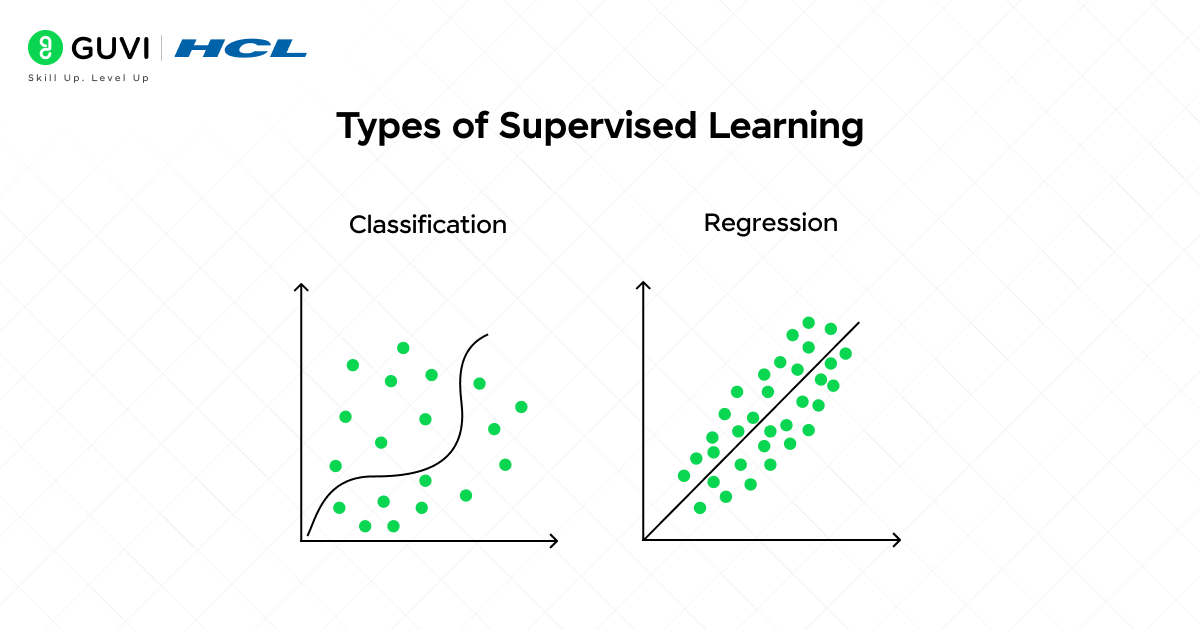
All supervised learning models learn from labeled data. But they differ in what they predict.
Every problem falls into one of two categories:
- Classification: Used when the output is a category (e.g., “Yes” or “No,” “Spam” or “Not Spam”)
- Regression: Used when the output is a continuous number (e.g., a price, a duration, a score)
The moment you define your output, you know which path to take.
Also Read: Supervised and Unsupervised Learning: Detailed Comparison
The term “regression” in machine learning was introduced by statistician Francis Galton in the 19th century. He used it to describe how extreme traits in parents tend to “regress” toward the average in their children. Today, the term has a much broader meaning — but the mathematical roots remain the same.
Classification: What It Is and How It Works
Classification is the process of recognizing, understanding, and grouping data points into distinct categories.
Instead of predicting a number, a classification model predicts which group or label an input belongs to. The output is always one of a fixed set of options — sometimes two (binary classification), sometimes several (multi-class classification).
A spam filter deciding whether an email is “Spam” or “Not Spam” is classification. A model identifying whether a tumor is “Benign” or “Malignant” is classification. A sentiment analyzer labeling a review as “Positive,” “Neutral,” or “Negative” is classification.
The defining characteristic is simple: the output is a label, not a measurement.
Key Classification Algorithms
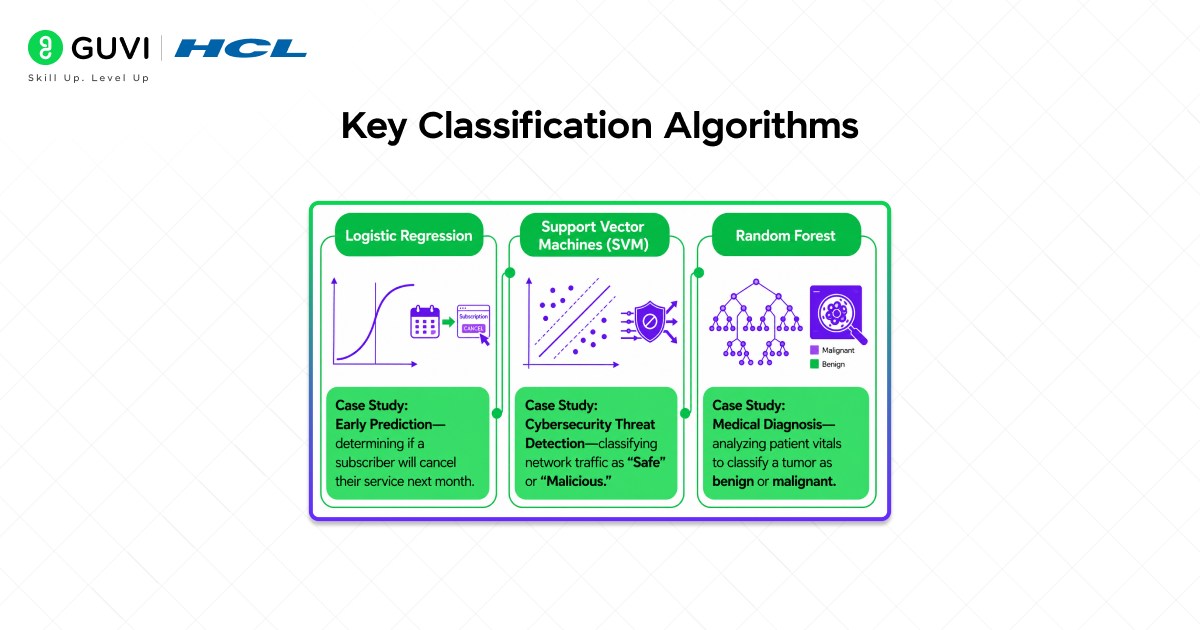
Logistic Regression
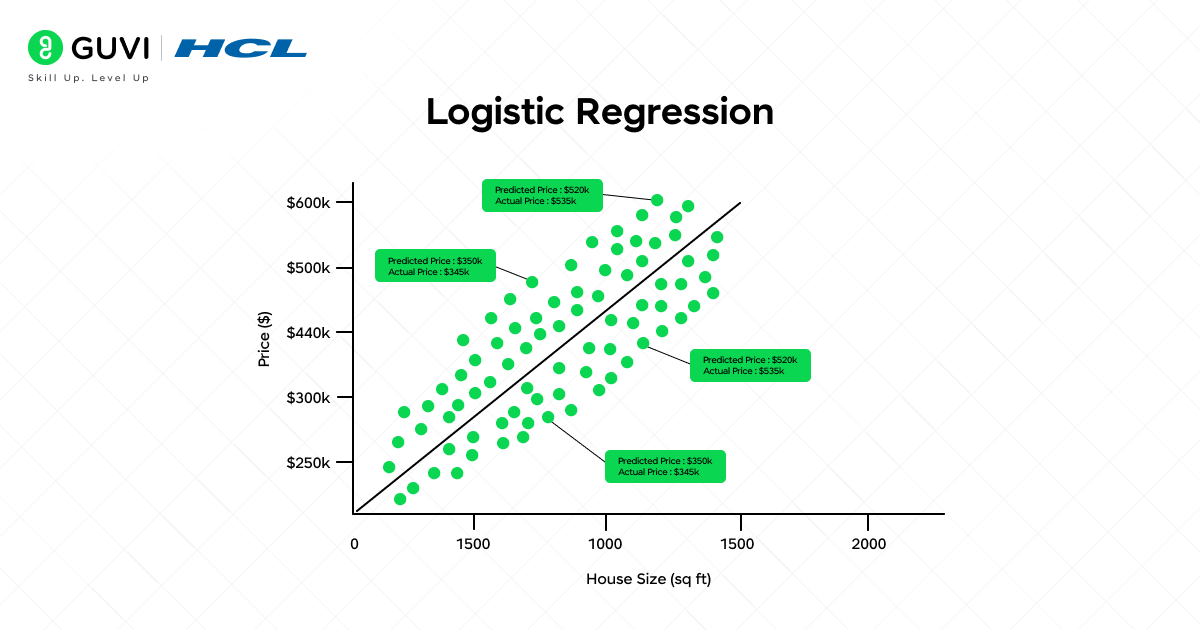
Despite the name, Logistic Regression is a classification algorithm. It predicts the probability of a binary outcome and assigns the input to whichever class is more likely.
Real-world case: Churn prediction, determining whether a subscriber will cancel their service next month. The model outputs a probability, and if it crosses a threshold (say, 70%), the customer is flagged as a churn risk.
Support Vector Machines (SVM)
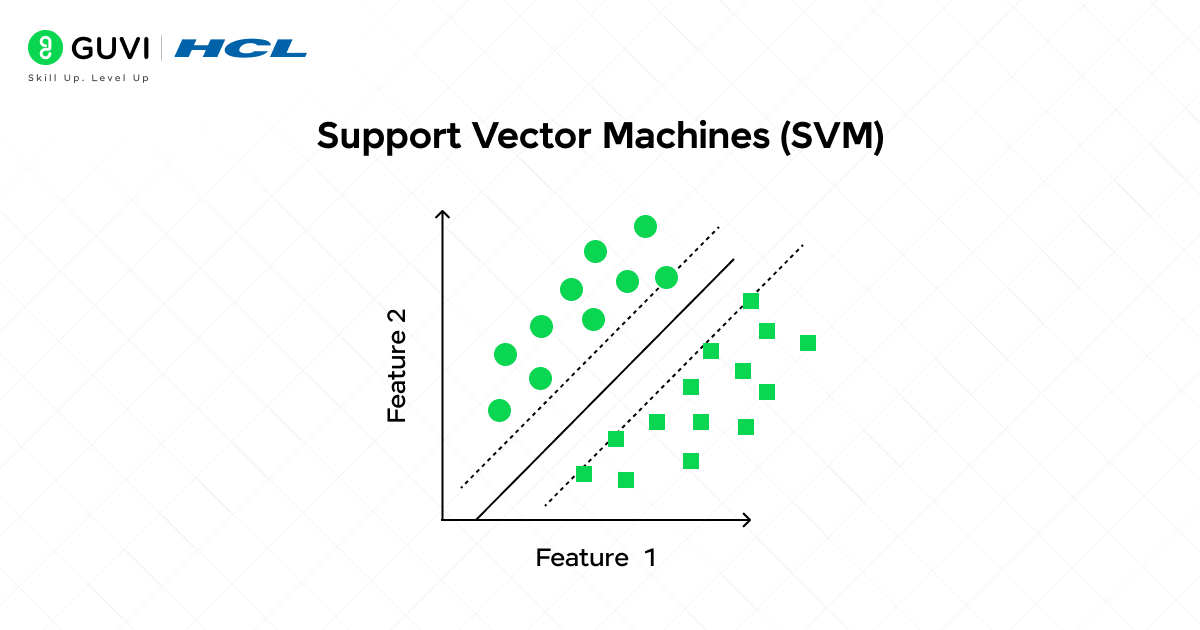
SVM finds the optimal boundary, called a hyperplane, that best separates two classes in the data. It maximizes the margin between the classes, making it robust even with limited training data.
Real-world case: Cybersecurity threat detection, classifying network traffic as “Safe” or “Malicious” based on patterns in the data.
Random Forest (Classifier)
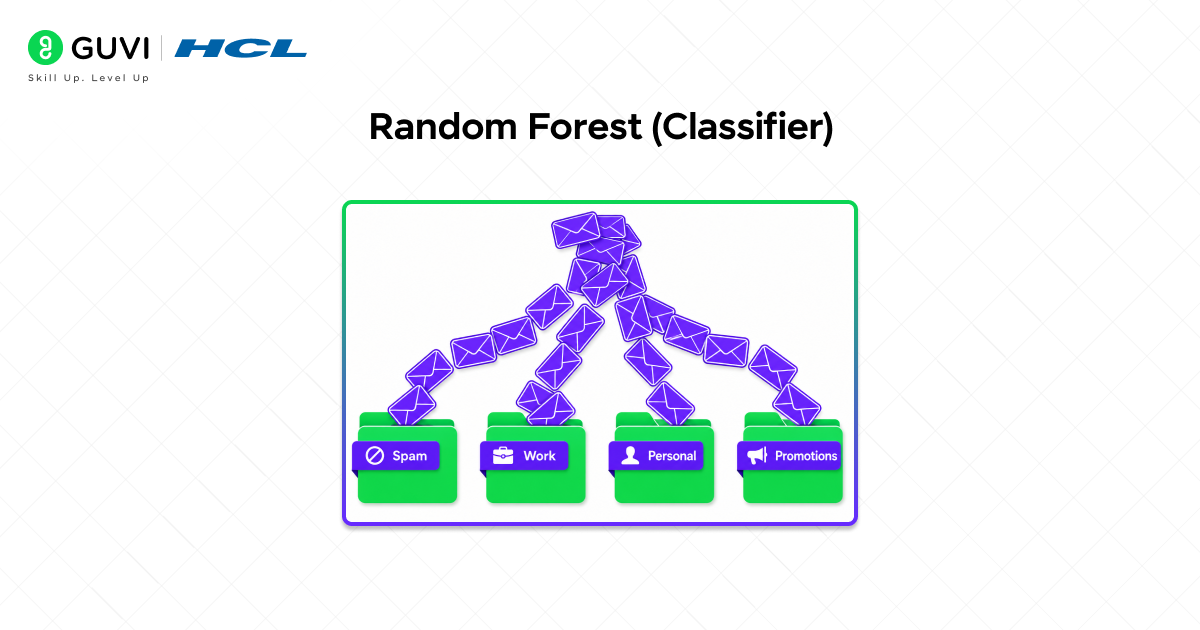
Random Forest builds a large collection of decision trees and combines their outputs to produce a final prediction. Because it averages across many trees, it handles noisy data well and rarely overfits.
Real-world case: Medical diagnosis, analyzing patient vitals and test results to classify a tumor as benign or malignant.
Real-World Classification Examples
Classification shows up constantly in products and services you already use:
- Detecting whether an incoming email is spam or legitimate
- Diagnosing whether a medical scan shows signs of a condition
- Identifying customer review sentiment as positive, neutral, or negative
- Recognizing handwritten digits from 0 to 9 in postal code readers
In every case, the model is choosing between predefined categories, not calculating a value.
Gmail’s spam filter, one of the most widely used classification systems in the world, processes over 15 billion emails every day. It uses a combination of machine learning classifiers trained on billions of labeled examples to make its decisions in milliseconds
Regression: What It Is and How It Works
Regression is the supervised learning approach used when the output you are trying to predict is a continuous numerical value rather than a fixed category.
Instead of asking “which group does this belong to?”, regression asks “what number should this be?”
A model predicting the sale price of a house is doing regression. A system forecasting a company’s quarterly revenue is doing regression. A tool estimating how many days a patient will stay in hospital is doing regression.
The defining characteristic: the output can be any value along a continuous scale, not a label from a fixed list.
Key Regression Algorithms
Linear Regression
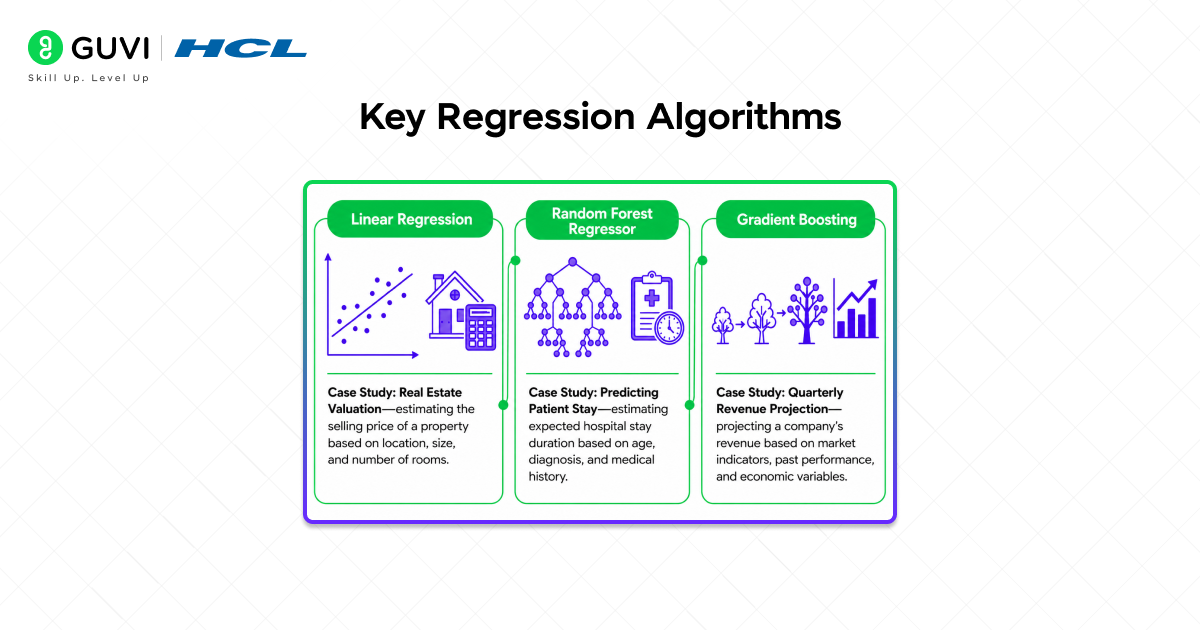
Linear Regression finds the best-fit straight line through your data, describing the relationship between input variables and a numerical target.
It’s the simplest regression algorithm and often the best starting point.
Real-world case: Real estate valuation, estimating the selling price of a property based on location, size, and number of rooms.

Random Forest Regressor
The regression version of Random Forest builds multiple decision trees and averages their predictions. This reduces variance and produces stable, accurate results on complex datasets.
Real-world case: Healthcare planning, predicting a patient’s expected hospital stay duration based on age, diagnosis, and medical history.
Gradient Boosting
Gradient Boosting builds trees sequentially. Each new tree corrects the errors made by the previous one, gradually improving accuracy. It’s one of the most powerful algorithms available for structured data.
Real-world case: Financial forecasting, projecting a company’s quarterly revenue based on market indicators, past performance, and economic variables.
Real-World Regression Examples
Regression drives many of the numerical predictions you encounter in daily life:
- Predicting the sale price of a product based on demand and seasonality
- Forecasting monthly revenue for a business using historical trends
- Estimating the number of hospital days a patient will need after surgery
- Predicting a student’s exam score based on study hours and past performance
In each case, the model isn’t assigning a label. It’s calculating a specific value.
Key Differences: Classification vs. Regression
| Feature | Classification | Regression |
| Output type | Category / Label | Continuous number |
| Example output | “Spam” or “Not Spam” | Rs. 4,50,000 |
| Goal | Assign to a class | Predict a value |
| Common algorithms | Logistic Regression, SVM, Random Forest | Linear Regression, Gradient Boosting, Random Forest |
| Evaluation metrics | Accuracy, Precision, Recall, F1 Score | MAE, MSE, RMSE, R² Score |
| Real-world example | Tumor diagnosis | House price prediction |
The core question to ask yourself: Is my target a label or a number? That single answer determines everything.
Which Algorithm Should You Use?
Choosing the right algorithm doesn’t have to be complicated. Use this as a starting guide:
- Is the output a number? → Start with Linear Regression
- Is the output a category? → Start with Logistic Regression
- Is the data complex or non-linear? → Upgrade to Random Forest or SVM
- Are you working with images or audio? → Use Neural Networks
One important principle to keep in mind: always test simpler models first. Linear and Logistic Regression are fast, interpretable, and often more accurate than you’d expect.
A complex model that overfits your training data is far less useful than a simple model that generalizes well.
If you’re serious about learning types of supervised learning more and want to apply them in real-world scenarios, don’t miss the chance to enroll in HCL GUVI’s Intel & IITM Pravartak Certified Artificial Intelligence & Machine Learning Course, co-designed by Intel. It covers Python, Machine Learning, Deep Learning, Generative AI, Agentic AI, and MLOps through live online classes, 20+ industry-grade projects, and 1:1 doubt sessions, with placement support from 1000+ hiring partners.
I’m Kaviya R, a third-year ECE student at Velammal College of Engineering and Technology, Madurai passionate about emerging technologies, innovation, and using coding as a tool for creative problem-solving.
Conclusion
Supervised learning is behind some of the most impactful AI systems in use today, and it all starts with understanding what you’re trying to predict.
If you’re predicting a category, you’re doing classification. If you’re predicting a number, you’re doing regression. Get that distinction right, choose your algorithm accordingly, and always validate on data your model hasn’t seen before.
Your AI is only as good as the labeled data you provide, and the clarity of the question you’re asking it to answer.
“Algorithms learn from the past, but they are built for the future.”
FAQs
What is supervised learning?
Supervised learning is a type of machine learning where a model is trained on labeled data, meaning every input comes with a known correct output. The model learns the relationship between inputs and outputs and uses it to make predictions on new data.
What is the difference between classification and regression?
Classification predicts which category an input belongs to, while regression predicts a continuous numerical value. If the answer is a label, use classification. If the answer is a number, use regression.
When should I use Logistic Regression vs. Linear Regression?
Use Logistic Regression when your output is a category (e.g., yes/no, spam/not spam). Use Linear Regression when your output is a continuous number (e.g., price, duration, score).
What is Random Forest and when should I use it?
Random Forest is an ensemble algorithm that builds multiple decision trees and combines their outputs. Use it when your data is complex, noisy, or non-linear, it works for both classification and regression tasks.
What metrics are used to evaluate classification models?
Common metrics include Accuracy, Precision, Recall, and F1 Score. The right metric depends on whether false positives or false negatives are more costly in your specific use case.
Success Stories

About the Author
HCL GUVI
This article was selected and published as part of the HCL GUVI AI Blogathon 2026, an initiative designed to encourage students, AI enthusiasts, and aspiring tech writers to simplify complex AI concepts through impactful technical content. The contest recognized high-quality, original, and insightful AI-focused blogs, with selected authors receiving publication opportunities on the HCL GUVI blog platform along with official author credits and recognition.
View all posts by HCL GUVI
Connect with me @













Did you enjoy this article?