


VLSI Design Articles
Why Chips Fail: A Basic Guide to Chip Defects and IC Failure Analysis
Fun Facts About the Semiconductor Industry
Why Are Semiconductor Chips Expensive? Manufacturing Cost Explained
Instruction Set Architecture: How ISA Shapes Modern Chip Design


Get In Touch For Details! Request More Information
What Does a 6-Month VLSI Program Curriculum from IIT Delhi Actually Teach You? We Break It Down
Sep 28, 2026 7 Min Read 2538 Views
(Last Updated)
The semiconductor industry is booming. India alone is projected to grow its share of global semiconductor sales from 6.5% to 11.5% by 2030, and nearly 20% of the world’s chip design engineers are already based here.
Yet the talent gap is enormous, the sector is expected to need 1 million professionals by 2026. The engineers who possess real, hands-on expertise in VLSI design are not just employable, they are in high demand.
That’s precisely why the VLSI Program Curriculum behind the Certificate Programme in Digital VLSI Design, offered by IIT Delhi’s Continuing Education Programme (CEP), an institute consistently ranked 2nd in Engineering by NIRF 2025, is built the way it is.
Table of contents
- TL;DR Summary
- What Is a VLSI Program Curriculum?
- Why This VLSI Program Curriculum's Structure Matters
- VLSI Program Curriculum: Module-by-Module Summary
- Skills You Gain from a VLSI Programme
- Career Opportunities After a VLSI Course
- Module 1: Digital IC Design: Where It All Starts
- Module 2: Scripting for VLSI Professionals: The Language of EDA
- Module 3: Logic Synthesis & Static Timing Analysis (STA)
- Module 4: Design for Testability (DFT) & Reliability
- Module 5: Physical Design: The Backend Story
- Module 6: Low Power & Advanced Design Techniques
- Module 7: Mixed-Signal & AMS Design
- Module 8: Packaging in VLSI
- The Projects: Where This VLSI Program Curriculum Becomes Expertise
- Is This VLSI Program Curriculum Right for You?
- Who Should Enrol in This VLSI Program Curriculum?
- Final Thoughts
- Frequently Asked Questions
- What is this programme, and who offers it?
- Is this an IIT Delhi certificate? Will it say "IIT Delhi" on it?
- What does the curriculum cover?
- Is this a frontend or backend VLSI course?
- Who is eligible to apply?
- Do I need prior VLSI experience to join?
- How does the admission process work?
- How many seats are available?
- Is this programme fully online? Do I need to attend in person?
- What if I miss a live session?
- What kinds of jobs can I get after this programme?
- Who teaches this programme?
- How do I apply?
- What certificate will I receive?
TL;DR Summary
- What it is: a 6-month Certificate Programme in Digital VLSI Design from IIT Delhi’s Continuing Education Programme, delivered with support from HCL GUVI
- What it covers: the complete RTL-to-GDSII flow across 8 modules, digital design, scripting, synthesis, STA, DFT, physical design, low power, mixed-signal, and packaging
- Hands-on component: 5 industry-style projects, from transistor-level circuit design to DFT and ATPG
- Who it’s for: ECE/EEE/CS graduates, final-year students, and diploma holders moving into semiconductor careers
- Career outcomes: roles like RTL Design, Verification, Physical Design, DFT, and STA Engineer, often at 30-40% higher pay than comparable software roles
It doesn’t cover surface-level theory. It takes you all the way from understanding a MOSFET to taping out a full chip design. In this blog, we break down the curriculum module by module so you know exactly what you’re signing up for.
What Is a VLSI Program Curriculum?
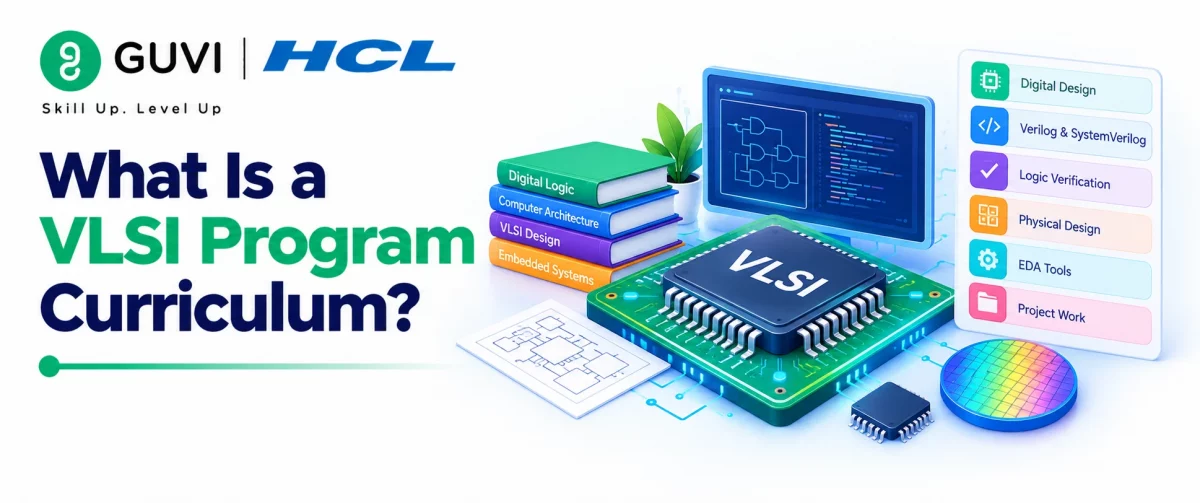
A VLSI Program Curriculum, like the one covered here, is a structured course that teaches you how to design, verify, and implement integrated circuits, from RTL code to final chip layout. It is offered as university electives, postgraduate tracks, or industry-focused certifications.
It is ideal for ECE/EEE students, engineering graduates, or professionals moving into semiconductor roles. Basic knowledge of digital electronics or programming helps, but is not always required.
After completion, you can pursue roles like RTL Design Engineer, Verification Engineer, Physical Design Engineer, DFT Engineer, or STA Engineer. These are high-demand roles with salaries often 30 to 40% higher than comparable software jobs.
This kind of VLSI Program Curriculum is one path in, but not the only one. Explore: How to learn a VLSI Course from Scratch?
Why This VLSI Program Curriculum’s Structure Matters
Before diving into the content, it helps to understand the philosophy behind this programme. VLSI design in industry has two broad domains: frontend (RTL design, synthesis, verification, timing) and backend (physical design, layout, DRC/LVS). Most courses cover one or the other.
This 6-month programme covers both, along with mixed-signal design, low-power techniques, packaging, and real hands-on projects. The result is a complete RTL-to-GDSII design engineer, exactly the profile that chipmakers at companies like Intel, Qualcomm, and Texas Instruments actively recruit for.
Read: How to Start a Career in VLSI in 2026: The Complete Roadmap
VLSI Program Curriculum: Module-by-Module Summary
Before the detailed breakdown, here’s a quick-reference view of what each module covers.
| Module | Core Focus |
|---|---|
| 1. Digital IC Design | MOSFET physics, CMOS inverter, combinational and sequential logic |
| 2. Scripting for VLSI | Linux, TCL, Perl, Python, RTL coding and design styles |
| 3. Logic Synthesis & STA | Gate-level netlists, power-aware synthesis, timing closure |
| 4. DFT & Reliability | Fault models, scan chains, ATPG, BIST, nano-scale reliability |
| 5. Physical Design | Floorplanning, placement, CTS, power planning, routing |
| 6. Low Power & Advanced Techniques | Clock gating, multi-Vt, DVFS, UPF/CPF |
| 7. Mixed-Signal & AMS Design | Analog IC basics, PLLs, clock generation |
| 8. Packaging | Wire bonding, flip-chip, system-in-package |
Core Components of a VLSI Program Curriculum
1. Basics of Electronics & Semiconductor Physics. Learn how semiconductors work, including PN junctions and MOSFETs, the foundation of all chip design.
2. Digital Design Fundamentals. Understand logic gates, combinational and sequential circuits, and FSMs to design digital systems.
3. HDL Programming. Write and simulate hardware using Verilog/VHDL and learn RTL coding for synthesis-ready designs.
4. RTL Design & Verification. Build efficient RTL and verify functionality using testbenches, simulation, and debugging techniques.
5. CMOS & Analog Basics. Explore CMOS logic, inverter design, and basic analog concepts for mixed-signal understanding.
6. Physical Design (Backend). Convert designs into chip layouts through floorplanning, placement, routing, and verification.
7. VLSI Design Flow. Understand the complete RTL-to-GDSII flow from specification to chip tape-out.
8. EDA Tools & Hands-on Training. Gain practical experience with industry tools from Cadence Design Systems, Synopsys, and Siemens EDA.
9. Low Power & Advanced Topics. Learn power optimization, STA, DFT, and advanced techniques used in modern chip design.
Skills You Gain from a VLSI Programme
- RTL Coding: a core focus of this VLSI Program Curriculum, write synthesisable Verilog/VHDL for hardware design
- Design Thinking: balance timing, power, and area trade-offs
- Debugging & Verification: identify and fix design issues efficiently
- EDA Tool Proficiency: hands-on with tools from Cadence Design Systems, Synopsys, and Siemens EDA
The skills this VLSI Program Curriculum builds map directly onto what employers look for. Explore: VLSI Engineer Skills in 2026: What companies actually want
Career Opportunities After a VLSI Course
- VLSI Design Engineer: RTL design and implementation
- Verification Engineer: simulation and functional validation
- Physical Design Engineer: backend design and chip layout
- FPGA Engineer: prototype and optimize hardware systems
- DFT Engineer: ensure chip testability and fault coverage, a common outcome for graduates of this VLSI Program Curriculum
Explore: Top Companies Hiring for VLSI Professionals in 2026
Module 1: Digital IC Design: Where It All Starts
This VLSI Program Curriculum starts with the basics: every VLSI engineer needs a solid grounding in how CMOS circuits actually work. You’ll study MOS device physics, the CMOS inverter, and combinational and sequential logic, including gates, flip-flops, and latches, all at the transistor level.
Critically, this module also introduces the CMOS ASIC design flow, giving you a bird’s-eye view of the entire chip design journey before you zoom into the details, the contextual awareness that separates trained professionals from self-taught practitioners.
Ready to design chips, not just study them? Apply now to the Certificate Programme in Digital VLSI Design by IIT Delhi, delivered with support from HCL GUVI, and start building real, industry-ready skills before applications close.
Module 2: Scripting for VLSI Professionals: The Language of EDA
The second module in this VLSI Program Curriculum shifts gears: modern VLSI design runs on scripts. Every major step, synthesis, place and route, timing analysis, simulation, is controlled through Linux, TCL, Perl, and Python.
- Building a proper Linux environment as the foundation
- Automating RTL coding, design flows, and verification tasks
- Writing efficient, synthesisable HDL code that EDA tools can process reliably
Scripting proficiency might seem like a “soft” skill, but it directly determines how fast and effectively an engineer can work.
Module 3: Logic Synthesis & Static Timing Analysis (STA)
This part of the VLSI Program Curriculum gets into synthesis: logic synthesis translates your RTL code into an actual gate-level netlist using real logic gates from a technology library. This module covers synthesis concepts and optimisation strategies, including power-aware synthesis.
The second half focuses on Static Timing Analysis (STA), how you verify your chip will work at the target clock frequency: setup time, hold time, slack, timing paths, and achieving timing closure.
Module 4: Design for Testability (DFT) & Reliability
This VLSI Program Curriculum module addresses testability directly: a chip that can’t be tested can’t be manufactured at scale. This module covers:
- Fault models and fault coverage metrics
- Scan chain insertion and ATPG (Automatic Test Pattern Generation)
- BIST (Built-In Self-Test) techniques
- Reliability in nano-scale VLSI, soft errors, noise margins, and resilience challenges as transistors shrink
As devices get smaller, reliability becomes harder to guarantee, and engineers who understand these challenges are increasingly sought after.
Module 5: Physical Design: The Backend Story
The physical design module in this VLSI Program Curriculum translates your gate-level netlist into a real, manufacturable chip layout, covering the complete physical design flow:
- Floorplanning: deciding where functional blocks live on the chip
- Placement: positioning individual cells within those blocks
- Clock Tree Synthesis (CTS): building the clock distribution network
- Power Planning and Routing: delivering power and connecting everything with metal wires
It also covers advanced node challenges like FinFET architectures, EUV lithography, and double patterning, the technologies behind chips at 7nm, 5nm, and below.
Module 6: Low Power & Advanced Design Techniques
This part of the VLSI Program Curriculum solves a real commercial problem: a chip that runs too hot or drains a battery too fast is unviable, no matter how functionally correct it is. This module tackles that problem directly.
You’ll learn the sources of power dissipation (dynamic, static leakage, short-circuit), then master clock gating, multi-threshold voltage (multi-Vt) design, DVFS, and power gating.
You’ll also work with UPF/CPF, the industry-standard specification languages for power-aware design used by every major semiconductor company today.
Module 7: Mixed-Signal & AMS Design
This VLSI Program Curriculum module reflects a simple truth: the real world isn’t purely digital. Any chip that communicates with sensors, displays, or wireless networks has analog components, and this module covers Analog-Mixed Signal (AMS) design.
You’ll cover analog IC design basics (amplifiers, reference circuits), then the challenges of mixed-signal integration: noise coupling, signal integrity, and layout constraints. Phase-Locked Loops (PLLs) and clock generation circuits, ubiquitous in communication and high-speed chips, round out the module.

Module 8: Packaging in VLSI
The final module in this VLSI Program Curriculum covers packaging: a chip without a package is a chip that can’t be used.
This module covers IC packaging technologies, from traditional wire bonding to advanced flip-chip and system-in-package (SiP) techniques, plus the electrical, thermal, and mechanical considerations that affect chip performance after it leaves the fab.
With the global push toward chiplets and heterogeneous integration, packaging knowledge has become a distinct competitive advantage for VLSI engineers.
The Projects: Where This VLSI Program Curriculum Becomes Expertise
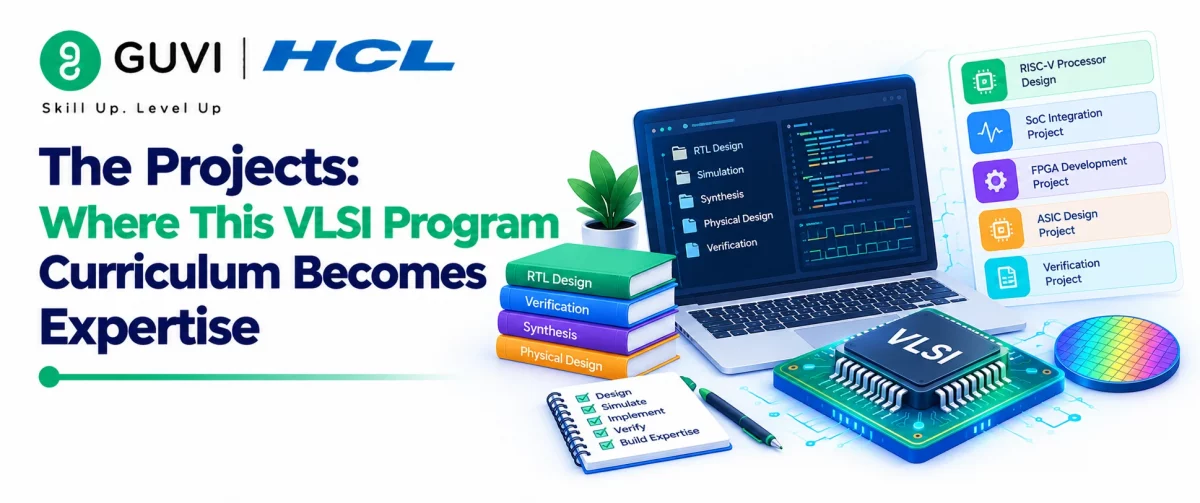
This VLSI Program Curriculum’s philosophy is simple: theory alone doesn’t build engineers. The programme includes five hands-on projects that put every module to work:
- Combinational and Sequential CMOS Circuit Design: transistor-level design with functional verification
- Low Power I/O Circuit Design: designing input buffers, output drivers, and level shifters
- Power Management IC (PMIC) Design: voltage regulators and power delivery circuits
- Clock Tree Synthesis and STA: end-to-end timing analysis and closure
- DFT and ATPG: scan insertion and test pattern generation for high fault coverage
These aren’t toy exercises, they’re the applied backbone of this VLSI Program Curriculum, structured to mirror real industry workflows and build the EDA tool proficiency and problem-solving confidence that employers look for.
Looking for the most practical way to break into chip design through a genuine VLSI Program Curriculum? HCL GUVI’s VLSI training brings you the Certificate Programme in Digital VLSI Design by IIT Delhi, a complete RTL to GDSII learning experience built for real industry roles.
With expert-led sessions, hands-on projects, and end-to-end curriculum delivery powered by HCL GUVI, this is where your VLSI career starts.
Is This VLSI Program Curriculum Right for You?
With a 6-month time commitment and a selective admission process for this VLSI Program Curriculum, it’s worth checking whether this specific programme actually fits your situation before applying.
- You’re an ECE/EEE/CS graduate wanting a structured entry into chip design. This is exactly who the programme is built for, no prior VLSI experience required.
- You’re a final-year student. You’re eligible to apply now, with preference given to candidates who also bring some relevant work experience.
- You want only frontend or only backend skills. This programme covers both, if you specifically want a narrower, shorter course focused on just one side, look at other VLSI certification options first.
- You’re hoping for a fully self-paced, no-deadline experience. This won’t fit, sessions are live online with a genuine attendance requirement (50% minimum) for certification.
- You want in-person campus exposure. An optional 3-day campus immersion at IIT Delhi is available, though travel and accommodation costs are on you.
Who Should Enrol in This VLSI Program Curriculum?
The programme is open to graduates in Electronics, Electrical Engineering, Physics, or Computer Science, as well as diploma holders and final-year students. Admission considers academic background, work experience, and an interview.
With VLSI design engineers commanding up to 40% higher starting pay than typical software roles, and career trajectories moving from Design Engineer to Chip Architect within 7 to 8 years, the return on this investment is substantial.
Final Thoughts
This VLSI Program Curriculum at CEP, IIT Delhi, isn’t designed to give you a certificate to display on your wall. It’s designed to make you someone the semiconductor industry actually needs, a professional who understands both the physics of transistors and the practicalities of taping out a chip.
In a sector growing at 9.2% CAGR globally and adding millions of jobs in India alone, that expertise is one of the most valuable things you can invest in.
If you are serious about building a career in chip design, the right VLSI Program Curriculum matters. HCL GUVI VLSI Training offers the Certificate Programme in Digital VLSI Design by IIT Delhi, giving you a complete RTL to GDSII learning experience aligned with real industry workflows.
With expert-led sessions, practical projects, and structured guidance across this VLSI Program Curriculum delivered by HCL GUVI, you are not just learning concepts, you are building the skills companies hire for.
Frequently Asked Questions
1. What is this programme, and who offers it?
This is a 6-month Certificate Programme in Digital VLSI Design offered by the Continuing Education Programme (CEP) at IIT Delhi. India’s #1-ranked institution in QS World University Rankings: India 2026 and #2 in NIRF 2025 under the Engineering category. It is a live online programme designed to train electronics and CS graduates in end-to-end chip design, from RTL coding all the way to physical layout and verification.
2. Is this an IIT Delhi certificate? Will it say “IIT Delhi” on it?
Yes. Certificates are issued directly by the Continuing Education Programme (CEP), IIT Delhi. Candidates who meet the completion criteria receive a Certificate of Completion from CEP, IIT Delhi. Certificates are issued as e-certificates only.
3. What does the curriculum cover?
Digital IC Design (CMOS fundamentals, MOS device physics)
Scripting for VLSI Professionals (Linux, TCL, Perl, Python)
Logic Synthesis & Static Timing Analysis (STA)
Design for Testability (DFT) & Reliability
Physical Design (Floorplanning, Placement, CTS, Routing)
Low Power & Advanced Design Techniques
Mixed-Signal & AMS Design
IC Packaging
Plus 5 hands-on projects and an optional 3-day campus immersion at IIT Delhi.
4. Is this a frontend or backend VLSI course?
Both. The programme covers the complete RTL-to-GDSII design flow , frontend (RTL design, synthesis, timing analysis, DFT) as well as backend (physical design, clock tree synthesis, routing, power planning). This makes it one of the most comprehensive VLSI programmes available in an online format.
5. Who is eligible to apply?
The programme is open to:
Graduates in Electronics, Electrical Engineering, Physics, or Computer Science
Candidates currently pursuing a graduation degree (preference given to those with work experience)
Diploma holders (10+2+3 or 10+3 format) are also eligible
To Know More: Everything You need to about VLSI Course Eligibility
6. Do I need prior VLSI experience to join?
Prior VLSI experience is not mandatory, but a background in electronics or computer science is expected. The curriculum begins with device-level fundamentals before advancing to industry workflows. Candidates with some work experience are given preference during admission.
7. How does the admission process work?
Admission is based on three factors:
Academic background
Professional background/work experience
Performance in the interview process
The Programme Coordinator(s) at IIT Delhi shortlist and select candidates. Screening and final selection are conducted by the IIT Delhi Programme Coordinator.
8. How many seats are available?
The brochure does not specify a fixed seat count, but as admission is selective and based on an interview process, early application is strongly recommended.
9. Is this programme fully online? Do I need to attend in person?
The programme is delivered as Live Online sessions.
There is an optional 3-day campus immersion at IIT Delhi, which, while not mandatory, is highly recommended for in-person faculty interaction, peer networking, and hands-on reinforcement of concepts. Travel and accommodation for the campus visit are at the participant’s expense.
10. What if I miss a live session?
A minimum of 50% attendance is required to be eligible for the certificate. It is advisable to attend live sessions as much as possible and clarify the recording policy directly with the programme team before enrolling.
11. What kinds of jobs can I get after this programme?
The programme prepares you for roles such as:
VLSI Design Engineer
RTL Design Engineer
Physical Design Engineer
DFT Engineer
Static Timing Analysis (STA) Engineer
Low Power Design Engineer
Mixed-Signal Design Engineer
Chip Architect (with experience)
VLSI design engineers typically earn up to 40% more than equivalent software roles at the same career stage.
12. Who teaches this programme?
The programme is coordinated and taught by faculty from IIT Delhi’s Centre for Applied Research in Electronics (CARE):
13. How do I apply?
Applications are submitted online. Visit the official CEP QIP portal at IIT Delhi for the application link and further details.
14. What certificate will I receive?
You can earn either a Certificate of Participation (50% attendance) or a Certificate of Completion (50% attendance + 60% marks), both issued as e-certificates by IIT Delhi Continuing Education Programme.
Success Stories

About the Author
Jebasta
I translate the language of data into stories that anyone can understand. As a writer with a data science background, I simplify analytics, AI, and decision-making so beginners and enthusiasts can confidently explore the world of data.
View all posts by Jebasta
Connect with me @







Did you enjoy this article?