


VLSI Design Articles
Why Chips Fail: A Basic Guide to Chip Defects and IC Failure Analysis
Fun Facts About the Semiconductor Industry
Why Are Semiconductor Chips Expensive? Manufacturing Cost Explained
Instruction Set Architecture: How ISA Shapes Modern Chip Design

Get In Touch For Details! Request More Information
How to Learn VLSI course From Scratch in 2026: Step-by-Step Roadmap
Sep 02, 2026 9 Min Read 15685 Views
(Last Updated)
Table of contents
- TL;DR Summary
- What is VLSI Design?
- Key Aspects of VLSI Design:
- VLSI Learning Prerequisites — What to Know Before Starting
- Basic Electronics
- Digital Logic Design
- Programming and Scripting Basics
- Hardware Description Languages
- Maths and Problem-Solving
- How to Learn VLSI From Scratch in 2026: Step-by-Step Roadmap
- Build a Strong Foundation in Electronics
- Master Digital Logic Design
- Learn Hardware Description Languages (HDLs)
- Understand the VLSI Design Flow
- Get Familiar with EDA Tools
- Work on Projects
- Enroll in Online Courses
- Participate in Workshops and Webinars
- Join VLSI Communities and Forums
- Pursue Certifications
- Stay Updated with Industry Trends
- Gain Real-World Experience
- VLSI for ECE Students vs CSE Students — Different Entry Points
- VLSI Roadmap for ECE Students
- VLSI Roadmap for CSE Students
- ECE vs CSE Entry Path Comparison
- VLSI Course Duration
- Estimated VLSI Learning Timeline
- Best Tools and Resources to Learn VLSI
- Beginner-Friendly VLSI Tools
- Beginner-Friendly VLSI Resources
- Common Mistakes to Avoid While Learning VLSI
- Skipping Digital Electronics
- Learning Tools Without Understanding Concepts
- Jumping Directly Into UVM or Physical Design
- Not Building Projects
- Not Documenting Your Work
- Benefits of Learning a VLSI Design Course
- Learn VLSI With a Structured Monthly Plan
- Conclusion
- FAQs
- How can I learn VLSI course from scratch in 2026?
- What are the prerequisites to learn VLSI?
- How long does it take to learn VLSI from scratch?
- Can CSE students learn VLSI?
- Is Verilog enough to get a VLSI job?
- Which VLSI domain is best for beginners?
- What tools should beginners use to learn VLSI?
- What projects should I build while learning VLSI?
- Is VLSI a good career in India in 2026?
- Should I join a VLSI course or learn by myself?
TL;DR Summary
To Learn VLSI Course from scratch, start with electronics fundamentals, digital logic, number systems, CMOS basics, and Boolean algebra. Then move to Verilog or SystemVerilog, RTL design, simulation, verification, synthesis, timing analysis, and physical design basics. Beginners can use tools like Logisim, EDA Playground, Icarus Verilog, GTKWave, Vivado, ModelSim, and OpenROAD for practice. ECE students can enter through electronics, RTL, verification, or physical design, while CSE students can focus on verification, scripting, automation, and EDA tool workflows. With consistent study and projects, most beginners can become job-ready in 6–12 months.
VLSI (Very Large Scale Integration), is the technology behind the chips used in smartphones, laptops, electric vehicles, AI systems, telecom devices, and modern consumer electronics. If you want to Learn VLSI Course from scratch in 2026, you need more than theory. You need a clear roadmap that covers electronics basics, digital logic, Verilog, RTL design, verification, EDA tools, projects, and interview preparation.
The demand for semiconductor skills is growing strongly in India. India’s semiconductor market is projected to reach around $100–110 billion by 2030, supported by the India Semiconductor Mission and rising demand from electronics, automobiles, telecom, aerospace, and AI-driven systems.
If India’s semiconductor market is growing, companies will need more people who understand chip design, RTL design, verification, physical design, EDA tools, and semiconductor workflows — all of which are part of a VLSI roadmap.
This guide explains how to Learn VLSI Course from scratch step by step, what prerequisites you need, which tools to practise with, how long it takes to become job-ready, and how ECE and CSE students can enter the VLSI field through different learning paths.
What is VLSI Design?
VLSI (Very Large Scale Integration) design is the process of creating integrated circuits (ICs) by combining millions (or even billions) of transistors onto a single chip. These ICs are the building blocks of modern electronic devices such as smartphones, laptops, and microprocessors.
The term “VLSI” emerged during the 1970s as a result of advancements in semiconductor technology that made it possible to integrate thousands of transistors into a single chip. Today, VLSI design plays a critical role in creating compact, high-performance, and energy-efficient devices.
Key Aspects of VLSI Design:
- Design Flow:
The VLSI design process involves several stages, including specification, architectural design, logic design, physical design, verification, and testing. These steps ensure that the chip functions correctly and meets performance requirements. - Hardware Description Languages (HDLs):
Designers use HDLs like Verilog and VHDL to describe and simulate digital circuits before physical implementation. - EDA Tools:
Electronic Design Automation (EDA) tools assist in creating, verifying, and optimizing chip designs, streamlining the complex design process. - Applications:
VLSI technology is used in a variety of fields, including microprocessors, memory chips, signal processing, artificial intelligence, and communication devices.
VLSI design is the backbone of modern electronics, enabling the development of powerful and compact devices that drive today’s technological advancements.
VLSI Learning Prerequisites — What to Know Before Starting
You do not need to be an expert before you Learn VLSI Course from scratch, but you should build a few basics first. These prerequisites help you understand how digital circuits are designed, simulated, verified, and converted into chip-level implementations.
If you are from ECE, EEE, or a related electronics background, you may already know some of these topics. If you are from CSE or IT, you can still enter VLSI, but you may need extra time for electronics and circuit fundamentals.
Basic Electronics
Start with voltage, current, resistance, power, Ohm’s Law, Kirchhoff’s Laws, diodes, transistors, MOSFETs, and CMOS basics. These concepts help you understand how electronic components behave inside integrated circuits when you Learn VLSI Course from scratch.
Digital Logic Design
Digital logic is the foundation of VLSI and an essential starting point when you Learn VLSI Course from scratch. Learn logic gates, Boolean algebra, K-maps, multiplexers, decoders, flip-flops, counters, registers, and finite state machines.
Programming and Scripting Basics
Basic coding knowledge helps you Learn VLSI Course from scratch because it supports testbench writing, tool-flow automation, and design-file debugging. Python, C, Linux commands, Shell scripting, TCL, or Perl can be useful depending on the VLSI role you choose.
Hardware Description Languages
Verilog is one of the best starting points for beginners who want to Learn VLSI Course from scratch. Once you understand Verilog, you can move to SystemVerilog for verification-focused roles.
Maths and Problem-Solving
You do not need advanced mathematics for every beginner-level VLSI role, but you should be comfortable with logical reasoning, binary arithmetic, number systems, timing calculations, and structured problem-solving when you Learn VLSI Course from scratch.
As you progress, build the key VLSI engineer skills required for RTL design, verification, debugging, scripting, timing analysis, and EDA tool workflows.
How to Learn VLSI From Scratch in 2026: Step-by-Step Roadmap
Before choosing a specialization, understanding the different VLSI design levels can help you see how behavioural design, RTL, gate-level design, circuit design, and physical layout connect within the chip-design flow.
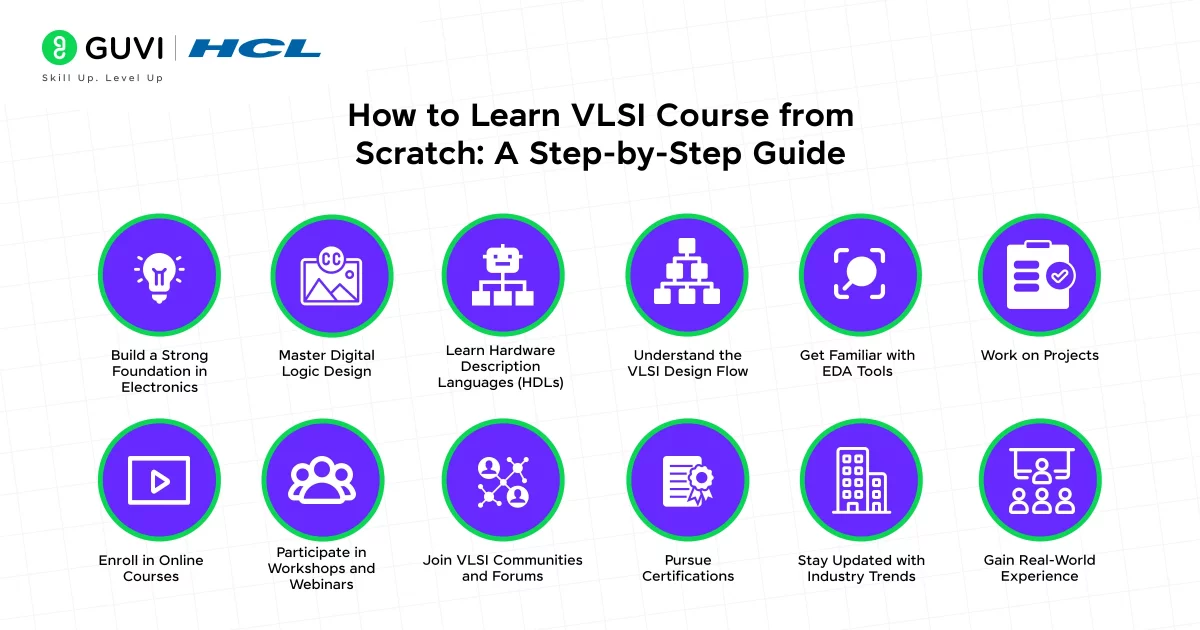
The best way to learn VLSI Course from scratch is to follow a structured VLSI roadmap: learn electronics basics, master digital logic, practise Verilog, understand RTL design, simulate circuits, learn verification, explore synthesis and timing, use EDA tools, build projects, and prepare for interviews. Do not jump directly into advanced topics like UVM, STA, or physical design before understanding digital electronics and HDL coding.
1. Build a Strong Foundation in Electronics
VLSI design is built on the fundamentals of electronics. Start by understanding basic concepts like:
- Voltage, current, resistance, and power.
- Ohm’s Law, Kirchhoff’s Laws, and basic circuit analysis.
- Passive components like resistors, capacitors, and inductors.
- Semiconductor basics (diodes, transistors, and MOSFETs).
Recommended Resources:
- Books: Electronic Devices and Circuit Theory by Boylestad and Nashelsky.
- Online platforms: Khan Academy, Coursera, and YouTube.
2. Master Digital Logic Design
Digital logic design is at the heart of VLSI. It deals with the principles of digital circuits and their behavior. Focus on:
- Boolean algebra and logic simplifications.
- Logic gates (AND, OR, NOT, XOR, etc.).
- Combinational circuits (multiplexers, decoders, adders, etc.).
- Sequential circuits (flip-flops, latches, counters, and registers).
Practical Tip: Use simulation tools like Logisim to practice designing circuits.
3. Learn Hardware Description Languages (HDLs)
For beginners who want to Learn VLSI Course from scratch, Verilog is usually the best starting point because it helps you understand how hardware is described at the RTL level. Once you are comfortable writing modules, testbenches, combinational logic, sequential logic, and finite state machines, you can move to SystemVerilog.
SystemVerilog becomes especially important if you want to enter design verification, because it supports object-oriented programming, assertions, constrained random testing, functional coverage, and UVM-based testbench development.
HDLs like Verilog and VHDL are essential for designing, simulating, and implementing digital circuits. They allow you to describe hardware behavior programmatically.
- Start with the syntax and basics of Verilog or VHDL.
- Practice designing simple modules (e.g., an adder or a multiplexer).
- Gradually move to more complex designs like finite state machines.
Recommended Tools:
- Xilinx Vivado or ModelSim for writing and simulating HDL code.
4. Understand the VLSI Design Flow
The VLSI design flow is the process that transforms an idea into a fully functional integrated circuit. Learn about its stages:
- Specification: Define functionality and requirements.
- Design: Create the architecture and logic using HDLs.
- Verification: Test the design for errors using simulation.
- Synthesis: Convert high-level HDL code into gate-level designs.
- Physical Design: Map the design onto silicon (placement and routing).
- Fabrication: Manufacture the chip.
- Testing: Validate the final product’s functionality.
5. Get Familiar with EDA Tools
Electronic Design Automation (EDA) tools are software applications used for designing and verifying circuits. Industry-standard tools include:
- Cadence: For physical design and layout.
- Synopsys: For logic synthesis and verification.
- Mentor Graphics: For design-for-testability and verification.
Tip: Start with educational versions or open-source tools like KiCAD or Magic VLSI to practice.
For beginner practice, you can start with free or accessible tools before moving to advanced industry tools.
| Tool | Best For | Beginner Use |
| Logisim | Digital logic practice | Build gates, counters, registers, and simple circuits |
| EDA Playground | Online HDL simulation | Practise Verilog/SystemVerilog without installation |
| Icarus Verilog | Verilog simulation | Run simple RTL designs and testbenches |
| GTKWave | Waveform viewing | Debug simulation outputs visually |
| Vivado | FPGA and RTL design | Practise synthesis and FPGA-based implementation |
| ModelSim/QuestaSim | Simulation and verification | Learn simulation flow and testbench debugging |
| OpenROAD | RTL-to-GDS flow exposure | Understand open-source physical design flow |
6. Work on Projects
Hands-on experience is crucial in VLSI learning. Start with small projects like:
- Designing basic logic gates and circuits.
- Creating a 4-bit counter or a simple ALU (Arithmetic Logic Unit).
- Simulating a processor or memory block.
As you gain confidence, tackle advanced projects like a microcontroller design or an FPGA implementation.
Recommended Platforms:
- FPGA development boards like Xilinx or Altera.
- Online project repositories like GitHub.
7. Enroll in Online Courses
Many online courses provide structured content for VLSI learning. These courses often combine theory with practical exercises. Consider these:
- VLSI Design and Verification by HCL GUVI
- VLSI Design Basics by Maven Silicon.
- Digital VLSI Design on Coursera (University of Illinois).
- VLSI System Design (VSD) on Udemy.
8. Participate in Workshops and Webinars
Workshops and webinars conducted by industry professionals can provide insights into real-world VLSI design. They often cover:
- Current trends and challenges in VLSI.
- Hands-on sessions with industry-grade tools.
- Networking opportunities with experts.
9. Join VLSI Communities and Forums
Engaging with online communities allows you to learn from others, seek guidance, and stay motivated. Popular forums and platforms include:
- Stack Overflow: For coding and debugging questions.
- Reddit (r/electronics): For discussing electronics and VLSI.
- Design & Verification Club: A specialized community for VLSI enthusiasts.
10. Pursue Certifications
Certifications validate your skills and increase your employability. Some reputable certifications include:
- Cadence Certified VLSI Designer.
- Synopsys Certified Professional.
- Mentor Graphics Certified Engineer.
11. Stay Updated with Industry Trends
The VLSI field evolves rapidly with advancements like AI accelerators, RISC-V processors, and 3D ICs. Stay informed by:
- Reading industry blogs (e.g., Semiconductor Engineering).
- Following conferences like DAC (Design Automation Conference).
- Subscribing to journals like IEEE Transactions on VLSI.
12. Gain Real-World Experience
Internships and research projects provide hands-on exposure to real-world challenges in VLSI. Look for opportunities at semiconductor companies or universities.
Learning VLSI design from scratch requires patience, dedication, and a systematic approach. Start by building your knowledge base, practice using tools and HDLs, and work on real-world projects.
Explore: No Job After ECE? Try VLSI
A monthly roadmap helps you Learn VLSI Course from scratch in the right order instead of jumping between random topics. The timeline below is suitable for beginners who can study consistently every week and build projects along the way.
Pro Tip:
If you want to Learn VLSI Course from scratch and are from ECE, your existing knowledge of digital electronics may help you complete the beginner roadmap faster. If you are from CSE or IT, spend extra time on electronics, CMOS, and timing concepts before moving into RTL or verification.
| VLSI Topic | Month to Learn | Tools | Resources |
| Electronics Basics and CMOS Fundamentals | Month 1 | Circuit simulators, notes, NPTEL | NPTEL, standard electronics textbooks, YouTube lectures |
| Digital Logic Design | Month 1–2 | Logisim, Digital simulators | Morris Mano, NPTEL Digital Design, practice problems |
| Number Systems and Boolean Algebra | Month 2 | Logisim, worksheets | Digital electronics notes, K-map exercises |
| Verilog HDL Basics | Month 2–3 | EDA Playground, Icarus Verilog, GTKWave | Verilog tutorials, HDLBits, EDA Playground examples |
| RTL Design | Month 3–4 | Vivado, ModelSim, EDA Playground | Build ALU, counter, FSM, FIFO, UART projects |
| Functional Simulation and Debugging | Month 4 | ModelSim, QuestaSim, GTKWave | Testbench practice, waveform debugging |
| SystemVerilog Basics | Month 4–5 | EDA Playground, QuestaSim | SystemVerilog tutorials, verification examples |
| Verification and UVM Introduction | Month 5–6 | QuestaSim, VCS, EDA Playground | Testbench projects, assertions, functional coverage basics |
| Synthesis and Timing Basics | Month 6–7 | Vivado, Yosys, OpenROAD | Synthesis reports, setup/hold timing examples |
| Physical Design Basics | Month 7–8 | OpenROAD, Magic, commercial EDA exposure | Floorplanning, placement, routing, DRC/LVS basics |
| Portfolio Projects | Month 8–9 | GitHub, Vivado, ModelSim | UART, FIFO, SPI/I2C, ALU, RISC-V mini project |
| Interview Preparation | Month 9–10 | Notes, mock interviews, GitHub portfolio | Digital logic, Verilog, timing, project explanation |

VLSI for ECE Students vs CSE Students — Different Entry Points
ECE and CSE students can both Learn VLSI Course from scratch, but their starting points are different. ECE students usually have an advantage in electronics, circuits, semiconductor devices, and digital logic. CSE students often have an advantage in programming, scripting, automation, debugging, and verification workflows.
VLSI Roadmap for ECE Students
ECE students who want to Learn VLSI Course from scratch can start with their existing knowledge of digital electronics, semiconductor devices, signals, microprocessors, and basic circuit theory. From there, they should move to Verilog, RTL design, simulation, synthesis, timing analysis, and physical design basics.
ECE students can explore roles such as:
- RTL Design Engineer
- VLSI Verification Engineer
- Physical Design Engineer
- DFT Engineer
- FPGA Engineer
- Analog Layout Engineer
VLSI Roadmap for CSE Students
Learners who are concerned about programming requirements can also understand how to enter VLSI with no coding background by starting with digital logic, Verilog basics, and role-specific skills.
CSE students can Learn VLSI Course from scratch through programming-heavy areas like design verification, EDA automation, CAD flows, scripting, and tool development. However, they must first learn digital logic, CMOS basics, timing concepts, and Verilog/SystemVerilog.
CSE students can explore roles such as:
- Design Verification Engineer
- SystemVerilog/UVM Verification Engineer
- EDA Tool Engineer
- CAD Automation Engineer
- FPGA Validation Engineer
- Hardware-Software Co-Design Engineer
ECE vs CSE Entry Path Comparison
| Factor | ECE Students | CSE Students |
| Strong Starting Point | Electronics, circuits, digital logic | Programming, debugging, automation |
| Extra Topics Needed | Advanced scripting, verification methodology | Electronics, CMOS, timing, hardware basics |
| Best Entry Domains | RTL, physical design, DFT, verification | Verification, EDA automation, CAD, scripting |
| Suggested First Language | Verilog | Verilog + SystemVerilog |
| Best Project Type | ALU, FIFO, UART, RTL blocks | Testbench, UVM basics, automation scripts |
| Learning Curve | Moderate if fundamentals are clear | Higher initially, but manageable with consistency |
Before selecting a specialization, compare the main VLSI design job roles and understand the skills, tools, and responsibilities associated with each path.
The key point is simple: ECE students should strengthen implementation and tools, while CSE students should strengthen hardware fundamentals. Both can become job-ready with the right project-based roadmap.
VLSI Course Duration
The time required to Learn VLSI Course from scratch depends on your background, weekly study hours, tool access, and project practice. In general, beginners can expect a 6–12 month learning journey to become job-ready for entry-level VLSI roles.
Competitor research also shows similar timelines: ECE graduates with strong fundamentals may need around 4–6 months of focused study, while learners starting without an electronics background may need 8–12 months.
Estimated VLSI Learning Timeline
| Learner Type | Estimated Duration | What to Focus On |
| ECE student with strong basics | 4–6 months | Verilog, RTL, simulation, projects, verification basics |
| ECE student with weak basics | 6–8 months | Digital electronics, CMOS, Verilog, EDA tools |
| CSE/IT student | 8–12 months | Electronics basics, Verilog, SystemVerilog, verification, scripting |
| Working professional | 6–12 months | Flexible roadmap, projects, tool exposure, interview preparation |
| M.Tech/VLSI specialization learner | 1–2 years | Deep specialization, research, advanced tools, chip design flow |
Best Tools and Resources to Learn VLSI
Choosing the right resources can save months of confusion when you Learn VLSI Course from scratch. As a beginner, start with free and accessible tools first, then move to advanced tools when you understand the flow.
Beginner-Friendly VLSI Tools
- Logisim: Best for practising digital logic circuits
- EDA Playground: Best for online Verilog and SystemVerilog simulation
- Icarus Verilog: Best for open-source Verilog simulation
- GTKWave: Best for waveform analysis
- Vivado: Best for FPGA and RTL implementation practice
- ModelSim/QuestaSim: Best for simulation and verification practice
- OpenROAD: Best for understanding open-source RTL-to-GDS flow
Once you understand the beginner workflow, explore the commonly used VLSI design tools for simulation, synthesis, verification, timing analysis, physical design, and chip implementation.
Beginner-Friendly VLSI Resources
- NPTEL Digital VLSI Design courses
- NPTEL RTL-to-GDS design flow course
- Verilog practice platforms
- HDLBits for HDL problem-solving
- GitHub VLSI project repositories
- EDA Playground examples
- OpenROAD documentation
- GUVI’s structured VLSI training resources
Common Mistakes to Avoid While Learning VLSI
Many beginners try to Learn VLSI Course from scratch but still struggle to become job-ready because they follow an unstructured path. Avoid these common mistakes.
1. Skipping Digital Electronics
Digital electronics is the foundation of VLSI. If you skip logic gates, flip-flops, counters, registers, and FSMs, Verilog and RTL design will feel confusing.
2. Learning Tools Without Understanding Concepts
EDA tools are important, but tools alone will not make you job-ready. First understand what the tool is doing, then practise simulation, synthesis, timing, or layout workflows.
3. Jumping Directly Into UVM or Physical Design
Advanced topics like UVM, STA, and physical design require strong basics. Learn Verilog, RTL, simulation, and timing fundamentals before moving into specialization.
4. Not Building Projects
VLSI interviews often include project-based questions. Build simple but clear projects like ALU, FIFO, UART, SPI controller, traffic light controller, or FSM-based designs.
5. Not Documenting Your Work
A GitHub portfolio with clean code, README files, waveform screenshots, and project explanations helps you stand out, especially as a fresher.
Once you complete the roadmap and build two or three strong projects, the next step is to understand how to start a career in VLSI through role selection, portfolio preparation, applications, and interview practice.
Benefits of Learning a VLSI Design Course
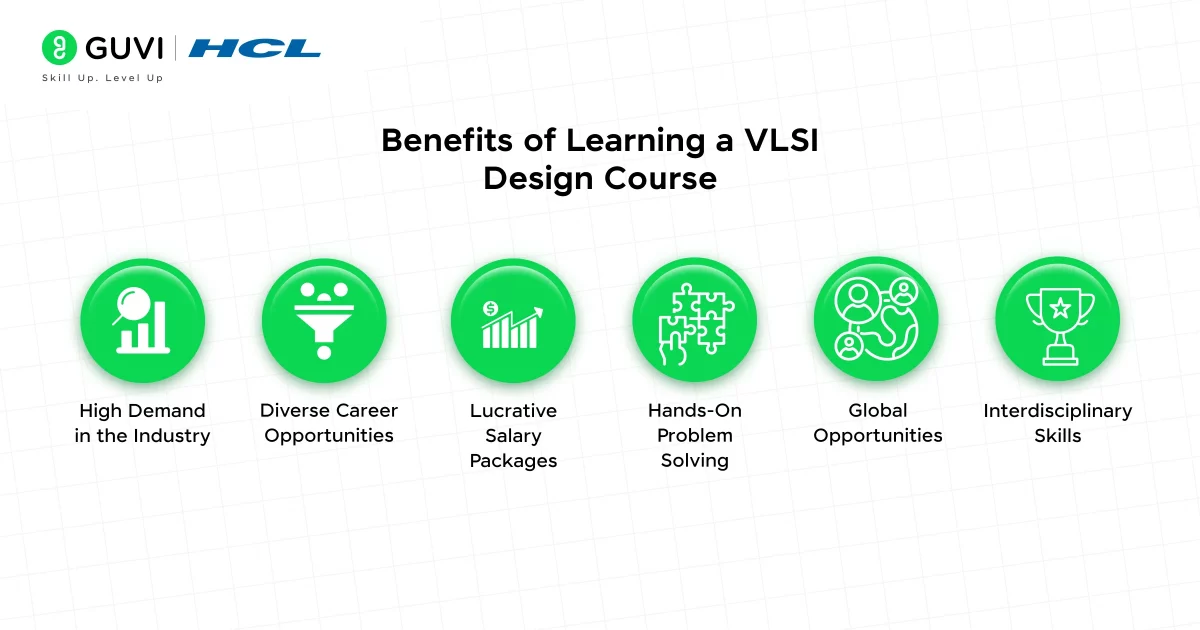
- High Demand in the Industry:
The semiconductor industry is rapidly growing, with increasing demand for skilled VLSI designers to create advanced integrated circuits for devices like smartphones, AI systems, and IoT devices. - Diverse Career Opportunities:
VLSI expertise opens up various career paths, including roles such as ASIC/FPGA designer, verification engineer, physical design engineer, and design automation engineer. - Lucrative Salary Packages:
Salaries for VLSI designers in India vary based on factors like experience, location, and the specific employer. Here’s an overview:
- Entry-Level Positions: Fresh graduates can expect starting salaries ranging from ₹1.8 lakh to ₹5 lakh per annum.
Collegedunia - Mid-Level Positions (2–5 years of experience): Professionals in this bracket typically earn between ₹5 lakh and ₹13 lakh per annum.
Collegedunia - Senior Positions (5+ years of experience): Experienced VLSI designers can command salaries upwards of ₹20 lakh per annum, with some earning as high as ₹37 lakh per annum. AmbitionBox
- Hands-On Problem Solving:
Learning VLSI equips you with practical skills to design, simulate, and optimize real-world systems, enhancing your engineering and analytical capabilities. - Global Opportunities:
Semiconductor companies worldwide seek VLSI experts, offering the chance to work with leading firms like Intel, Qualcomm, AMD, and TSMC. - Interdisciplinary Skills:
VLSI combines knowledge of electronics, programming, and hardware design, making it a versatile field that integrates multiple technical domains.
A VLSI design course not only enhances your technical expertise but also opens doors to exciting and rewarding career opportunities in one of the most dynamic fields of technology.
If you want to learn VLSI design through a step-by-step process guided by a professional mentor that includes Digital Electronics, UNIX and even Shell Scripting, consider enrolling in HCL GUVI’s Certified VLSI Design Course which not only teaches you everything about the subject but also provides you with an industry-grade certificate!
Learn VLSI With a Structured Monthly Plan
If you want to learn VLSI course from scratch without jumping between random resources, HCL GUVI’s VLSI Design and Verification Program can help you follow a structured learning path covering digital electronics, CMOS basics, Verilog, RTL design, verification, scripting, EDA tools, and practical projects.
Learners who want deeper exposure to the complete chip-design flow can also explore the IIT Delhi CEP Certified Program in Digital VLSI Design, delivered with HCL GUVI, which covers the RTL-to-GDSII process, synthesis, verification, physical design, and low-power methodologies.
Conclusion
You can Learn VLSI Course from scratch in 2026 if you follow the right sequence. Start with electronics and digital logic, then move to Verilog, RTL design, simulation, verification, synthesis, timing, and physical design basics. If you are from ECE, use your electronics foundation to move faster. If you are from CSE, use your programming strength for verification, scripting, and EDA automation while building hardware basics. With a structured roadmap, consistent practice, and 2–3 strong projects, you can move closer to job-ready VLSI roles in 6–12 months.
FAQs
1. How can I learn VLSI course from scratch in 2026?
Start with electronics basics, digital logic, Boolean algebra, and CMOS fundamentals. Then learn Verilog, RTL design, simulation, verification, synthesis, timing analysis, and physical design basics through projects.
2. What are the prerequisites to learn VLSI?
The main prerequisites are basic electronics, digital logic design, number systems, Boolean algebra, MOSFET/CMOS basics, and basic programming or scripting knowledge.
3. How long does it take to learn VLSI from scratch?
Most beginners need 6–12 months to become job-ready, depending on their background and practice time. ECE students with strong fundamentals may progress faster, while CSE students may need extra time for electronics and timing basics.
4. Can CSE students learn VLSI?
Yes, CSE students can learn VLSI, especially for roles in design verification, SystemVerilog/UVM, EDA automation, CAD tools, and scripting. They should first learn digital logic, Verilog, CMOS basics, and timing concepts.
5. Is Verilog enough to get a VLSI job?
Verilog is important, but it is not enough alone. You should also understand RTL design, testbenches, simulation, waveform debugging, timing basics, projects, and at least one VLSI specialization.
6. Which VLSI domain is best for beginners?
RTL design and design verification are good starting points for most beginners. ECE students can also explore physical design and DFT, while CSE students may find verification and EDA automation easier to enter.
7. What tools should beginners use to learn VLSI?
Beginners can start with Logisim, EDA Playground, Icarus Verilog, GTKWave, Vivado, ModelSim, and OpenROAD. These tools help practise digital logic, Verilog, simulation, waveform debugging, and RTL-to-GDS flow basics.
8. What projects should I build while learning VLSI?
Good beginner projects include ALU, FIFO, UART, SPI controller, I2C controller, traffic light controller, sequence detector, FSM-based designs, and simple RISC-V or processor blocks.
9. Is VLSI a good career in India in 2026?
Yes, VLSI is becoming a strong career option in India because of semiconductor ecosystem growth, government support, chip design demand, and rising applications in EVs, AI, telecom, defence, and consumer electronics. India’s semiconductor market is projected to reach around $100–110 billion by 2030.
10. Should I join a VLSI course or learn by myself?
You can start by yourself using free resources, but a structured VLSI course can save time by giving you a monthly roadmap, mentor guidance, tool practice, projects, and interview-focused learning.
Success Stories

About the Author
Reemsha Khan
Always been a storyteller at heart. Now, I turn complex topics into simple, easy-to-understand stories through content. Hope you find it helpful.
View all posts by Reemsha Khan
Connect with me @


Did you enjoy this article?
Comments












how to learn vlsi from online