


VLSI Design Articles
Why Chips Fail: A Basic Guide to Chip Defects and IC Failure Analysis
Fun Facts About the Semiconductor Industry
Instruction Set Architecture: How ISA Shapes Modern Chip Design
PLI Scheme for Semiconductors: India’s Chip Manufacturing Push Explained


Get In Touch For Details! Request More Information
Why Are Semiconductor Chips Expensive? Manufacturing Cost Explained
Aug 10, 2026 5 Min Read 457 Views
(Last Updated)
Table of contents
- TL;DR Summary
- Introduction
- What Makes Semiconductor Chips So Expensive?
- Precision Is Expensive
- Why Are Semiconductor Chips Expensive at Advanced Nodes?
- Why Are Semiconductor Chips Expensive When Transistors Shrink?
- Lithography Is the Cost Center
- Key Cost Drivers in Chip Fabrication
- Fab Construction Costs
- Equipment Spending Keeps Rising
- Cleanrooms Are Expensive to Run
- Yield Loss Increases Cost Per Chip
- Talent and Process Knowledge Are Hard to Replace
- Wafer Manufacturing Cost Breakdown
- What Happens During Wafer Manufacturing?
- Major Semiconductor Manufacturing Cost Drivers
- Where These Costs Show Up in Business
- AI Data Centers
- Electric Vehicles
- Smartphones and Consumer Electronics
- National Semiconductor Projects
- Common Myths Around Semiconductor Chip Manufacturing
- Thinking Silicon Is the Main Cost
- Assuming One Machine Makes the Whole Chip
- Ignoring Yield
- Comparing Chip Manufacturing With Normal Assembly
- Conclusion
- Frequently Asked Questions
- Why Are Semiconductor Chips Expensive?
- What is the biggest cost in semiconductor manufacturing?
- Why is chip fabrication so difficult?
- What is wafer manufacturing?
- Why do advanced chips cost more than older chips?
- How long does it take to manufacture a semiconductor chip?
- Does low yield make chips expensive?
- Is semiconductor manufacturing a good career field?
TL;DR Summary
Semiconductor chips are expensive because chip fabrication requires ultra-clean factories, billion-dollar equipment, rare engineering talent, complex wafer manufacturing, expensive materials, long production cycles, and strict quality control. A modern fab can cost several billion dollars, and advanced lithography machines alone can cost hundreds of millions. Even after spending that money, manufacturers lose value if yields are poor. That is why semiconductor manufacturing cost is not just about silicon; it is about precision, scale, time, and risk.
Introduction
A chip smaller than your fingernail can power smartphones, EVs, AI servers, satellites, and medical devices. But making that tiny chip is one of the most expensive industrial processes in the world.
So, why are semiconductor chips expensive? Because manufacturing them requires ultra-precise factories, machines that cost up to hundreds of millions of dollars, thousands of process controls, and months of production before a usable chip is ready.
In simple terms, semiconductor chips are expensive because a fab must repeatedly build microscopic layers on silicon wafers with near-perfect accuracy. One dust particle, one alignment issue, or one process variation can reduce yield and increase the final cost per chip.
According to the U.S. Congressional Research Service, a new semiconductor factory can cost at least $7 billion, while an advanced chip fab can cost up to $20 billion.
What Makes Semiconductor Chips So Expensive?
Before looking at individual costs, understand this: chips are not assembled like regular electronics. They are manufactured layer by layer on wafers through controlled chemical, optical, thermal, and mechanical processes.
Semiconductor manufacturing cost refers to the total expense involved in converting raw silicon wafers into functional chips. It includes fab construction, lithography machines, cleanroom operations, process chemicals, engineering labor, testing, packaging, energy, yield loss, and depreciation of expensive equipment used during chip fabrication.
Precision Is Expensive
Chip fabrication works at nanometer scale. That means engineers are not just building circuits; they are building billions of microscopic transistors that must work reliably together.
ASML explains that microchip manufacturing involves hundreds of steps and can take up to four months from design to mass production.
That long cycle increases cost because every wafer spends weeks moving through expensive tools, inspections, and process loops.
A single wafer can contain hundreds of chips, but not all of them pass testing. If yield drops, fewer chips can be sold from the same wafer, which means each working chip becomes more expensive.
Why Are Semiconductor Chips Expensive at Advanced Nodes?
Advanced chips are used in AI accelerators, premium smartphones, GPUs, high-performance CPUs, and data-center hardware. These chips are expensive because the smaller the transistor, the harder it becomes to print, inspect, and manufacture reliably.
Why Are Semiconductor Chips Expensive When Transistors Shrink?
At older nodes, manufacturers can use comparatively mature processes. At advanced nodes, fabs need tighter patterning, more complex lithography, better materials, and more inspection.
This increases cost in four ways:
- More process steps are required.
- More expensive machines are needed.
- More wafers may fail quality checks.
- More expert engineers are needed to stabilize production.
Lithography Is the Cost Center
Lithography is the step where chip patterns are printed onto the wafer. It decides how small and dense the circuits can become.
ASML describes lithography as a critical chip-making step because it determines how small transistors on a chip can be.
For advanced AI and computing chips, EUV lithography becomes essential. But EUV machines are rare, complex, expensive, and difficult to maintain.
Also Read: Guide to Semiconductor Chip Types
Key Cost Drivers in Chip Fabrication
Chip fabrication cost is not one big expense. It is a stack of many expensive decisions that must work together.
1. Fab Construction Costs
A semiconductor fab is not a normal factory. It needs vibration control, cleanrooms, chemical handling systems, power backup, water purification, and continuous environmental monitoring.
The U.S. Congressional Research Service notes that much of the initial fab construction cost comes from semiconductor manufacturing equipment, with some tools costing more than $100 million each.
2. Equipment Spending Keeps Rising
The industry keeps investing because demand for AI, EVs, cloud computing, memory, and advanced electronics continues to grow.
SEMI projected worldwide 300mm fab equipment spending to increase 18% to $133 billion in 2026 and 14% to $151 billion in 2027.
That investment is necessary, but it also explains why semiconductor manufacturing costs remain high.
3. Cleanrooms Are Expensive to Run
A cleanroom prevents contamination during wafer manufacturing. Even a microscopic particle can damage a circuit.
This means fabs must control air quality, humidity, temperature, vibration, and chemical exposure throughout production.
4. Yield Loss Increases Cost Per Chip
Yield means the percentage of usable chips produced from a wafer.
If a wafer has 100 chip dies and only 70 pass testing, the cost of the failed 30 dies must be absorbed into the working 70. This is why early production of advanced chips is often expensive.
5. Talent and Process Knowledge Are Hard to Replace
A fab needs process engineers, VLSI engineers, equipment engineers, yield engineers, reliability engineers, and materials experts.
The machines are expensive, but the know-how to operate them consistently is just as valuable.
Wafer Manufacturing Cost Breakdown
Wafer manufacturing is the heart of chip fabrication. A silicon wafer goes through repeated cycles of deposition, lithography, etching, ion implantation, cleaning, inspection, and testing.
What Happens During Wafer Manufacturing?
A simplified wafer manufacturing flow looks like this:
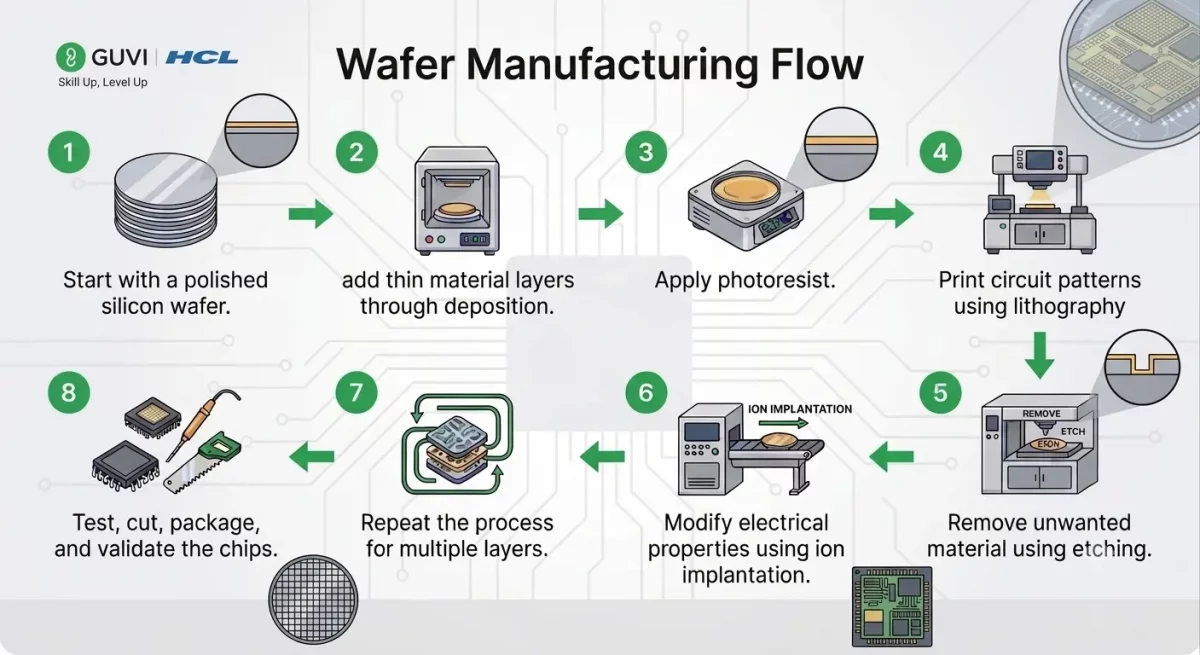
ASML lists deposition, photoresist, lithography, etch, ion implantation, and packaging as crucial semiconductor manufacturing steps.
Major Semiconductor Manufacturing Cost Drivers
| Cost Driver | Why It Is Expensive | Impact on Final Chip Cost |
| Fab construction | Requires ultra-clean, highly controlled facilities | Very high upfront investment |
| Lithography tools | EUV systems cost hundreds of millions | Raises advanced-node cost |
| Process chemicals | Requires high-purity gases, liquids, and materials | Increases recurring cost |
| Yield loss | Not every die on a wafer works | Raises cost per working chip |
| Skilled workforce | Needs rare engineering expertise | Adds long-term operational cost |
| Testing and packaging | Chips must meet reliability standards | Adds cost after wafer processing |
Where These Costs Show Up in Business
You can see semiconductor cost pressure across multiple industries, not just chip companies.
AI Data Centers
AI chips need advanced nodes, high-bandwidth memory, and advanced packaging. This is why GPUs and AI accelerators are expensive for cloud providers and enterprises.
SEMI projected worldwide 300mm memory equipment investment to surpass $50 billion in 2026, reaching $52 billion before rising to $57 billion in 2027.

Electric Vehicles
EVs use chips for battery management, motor control, sensors, infotainment, and safety systems. A shortage or price increase in automotive chips can affect vehicle pricing and delivery timelines.
Smartphones and Consumer Electronics
Premium phones use advanced processors, image sensors, memory, modems, and power management chips. The cost of chip fabrication directly affects device pricing.
National Semiconductor Projects
Large fab investments show how expensive local chip manufacturing can be. TSMC’s Arizona project expanded from $12 billion to $165 billion, according to TSMC’s Arizona site.
Common Myths Around Semiconductor Chip Manufacturing
Let’s bust some myths around semiconductor chip manufacturing:
Thinking Silicon Is the Main Cost
Many beginners assume chips are expensive because silicon is expensive. In reality, silicon is only one part of the story.
The real cost comes from converting that silicon into working circuits through hundreds of controlled steps. You are paying for precision equipment, process knowledge, cleanroom operations, testing, and yield management.
That is why two chips made from similar raw materials can have very different prices. The node, design complexity, yield, packaging, and production volume matter more than the silicon itself.
Assuming One Machine Makes the Whole Chip
A common misconception is that a chip comes out of one giant machine. That is not how chip fabrication works.
A wafer moves through many tools for deposition, lithography, etching, cleaning, inspection, and implantation. Each step must be aligned with the previous one.
Even the most advanced lithography machine is only one part of the fab. The full manufacturing ecosystem is what makes the process expensive and difficult to replicate.
Ignoring Yield
When learners ask, “Why Are Semiconductor Chips Expensive?”, they often forget yield.
A chip company does not earn from every die printed on a wafer. Only the working dies that pass testing can be sold.
Low yield means fewer usable chips from the same wafer, tools, labor, and time. This increases the cost of each successful chip.
Comparing Chip Manufacturing With Normal Assembly
Building a phone, laptop, or appliance is mainly assembly. Building a chip is nanoscale manufacturing.
In chip fabrication, the product is created through microscopic physical and chemical changes. The process needs extreme accuracy, not just skilled assembly.
That is why semiconductor manufacturing cost behaves differently from regular electronics manufacturing cost.
Underestimating the Role of Talent
Machines matter, but people make the process stable.
A fab needs engineers who understand VLSI design, process control, materials, device physics, EDA tools, validation, and reliability. Without skilled teams, expensive equipment cannot deliver high yield.
For learners, this is an important career insight. Semiconductor careers reward people who can connect theory with manufacturing realities.
If this topic made you curious about how chips are designed before they reach the fab, learning VLSI can give you a strong foundation in digital design, verification, and semiconductor workflows. You can explore IIT Delhi’s Certified Program in Digital VLSI Design to build practical skills aligned with the semiconductor industry. Through this course you get to experience the prestigious IIT Delhi campus as well as get trained by an esteemed faculty. Plus, the course holds an immense opportunity for you to network around with like-minded people.
Conclusion
So, why are semiconductor chips expensive? Because every chip carries the cost of billion-dollar fabs, advanced lithography, cleanrooms, wafer manufacturing, process engineering, testing, yield loss, and skilled talent. Semiconductor manufacturing cost rises further at advanced nodes because smaller transistors demand tighter control and more expensive tools. For learners, this is not just a cost story; it is a career opportunity. As India and the world invest more in semiconductors, skills in VLSI, chip design, verification, and manufacturing awareness can open strong future pathways.
Frequently Asked Questions
1. Why Are Semiconductor Chips Expensive?
Semiconductor chips are expensive because they require advanced fabs, cleanrooms, costly equipment, complex wafer manufacturing, skilled engineers, and strict testing. Yield loss also increases the cost of each working chip.
2. What is the biggest cost in semiconductor manufacturing?
The biggest costs usually come from fab construction, lithography equipment, process tools, cleanroom operations, and yield optimization. Advanced EUV lithography systems are among the most expensive tools.
3. Why is chip fabrication so difficult?
Chip fabrication is difficult because billions of microscopic components must be built with nanometer-level accuracy. Even tiny contamination or alignment errors can damage the chip.
4. What is wafer manufacturing?
Wafer manufacturing is the process of turning a silicon wafer into functional chips through repeated steps such as deposition, lithography, etching, ion implantation, cleaning, and testing.
5. Why do advanced chips cost more than older chips?
Advanced chips cost more because they need smaller transistors, tighter process control, more complex designs, expensive EUV machines, and higher engineering effort.
6. How long does it take to manufacture a semiconductor chip?
Microchip manufacturing can involve hundreds of steps and may take months depending on the chip type, process node, and production complexity. ASML notes that the process can take up to four months from design to mass production.
7. Does low yield make chips expensive?
Yes. If fewer chips pass testing on a wafer, the cost of failed chips is spread across the working ones. This increases the final price per usable chip.
8. Is semiconductor manufacturing a good career field?
Yes. Semiconductor growth in AI, EVs, telecom, defense, and consumer electronics is increasing demand for VLSI, verification, process, and manufacturing talent.
Success Stories










Did you enjoy this article?