


VLSI Design Articles
Why Chips Fail: A Basic Guide to Chip Defects and IC Failure Analysis
Fun Facts About the Semiconductor Industry
Why Are Semiconductor Chips Expensive? Manufacturing Cost Explained
Instruction Set Architecture: How ISA Shapes Modern Chip Design

Get In Touch For Details! Request More Information

VLSI Career Guide 2026: Skills, Salary & Roadmap for Students
Aug 21, 2026 9 Min Read 3198 Views
(Last Updated)
Have you ever wondered what truly goes into building the chips that power smartphones, cars, medical devices, and servers? Many students feel drawn to VLSI because it looks rewarding and highly technical, yet the real picture becomes clear only after understanding how this field works and what it demands.
A career in VLSI can shape your future in remarkable ways, although the decision requires clarity about roles, skills, challenges, and long-term opportunities. Each aspect connects to the next, so the more you understand these layers, the easier it becomes to decide whether this field aligns with your strengths and ambitions.
Continue reading this guide to explore every essential detail before choosing VLSI as your career path.
Quick Answer:
VLSI is a semiconductor engineering field focused on designing, verifying and preparing complex integrated circuits for manufacturing. Before choosing VLSI as a career in 2026, students should understand:
- RTL design, verification, physical design, DFT and analog design are major VLSI career paths.
- Digital electronics, CMOS and Verilog/SystemVerilog are core skills.
- Cadence, Synopsys, Siemens EDA and AMD Vivado are widely used tools.
- India offers growing opportunities in chip design, fabrication, packaging and testing.
- Salaries depend on specialization, skills, employer and experience.
Table of contents
- Introduction to VLSI and Its Importance for Students
- VLSI Career Options at a Glance
- What do VLSI Engineers Do?
- Digital Circuit Design
- Physical Layout Preparation
- Verification and Testing
- Power, Speed, and Timing Optimization
- Fabrication Readiness
- Who Should Choose a VLSI Career?
- Academic Background That Aligns With VLSI
- Skills and Personal Traits That Support Growth in VLSI
- Interest in Hardware and System-Level Thinking
- Comfort With Mathematics and Logical Reasoning
- Interest in Working With High-Impact Technologies
- Complete VLSI Career Guide for Students in India 2026
- Different Career Paths in VLSI
- Front-End VLSI Design
- Back-End / Physical Design
- Analog, Mixed-Signal, and RF Design
- Semiconductor Process and Manufacturing
- Emerging VLSI Career Options
- Pros and Cons of Choosing VLSI as a Career
- Advantages of a VLSI Course and Career
- Disadvantages of a VLSI Career
- Essential Skills to Master for a High-Paying VLSI Career
- Soft Skills for VLSI Engineers
- Core Technical Skills
- Tools Every VLSI Engineer Should Know in 2026
- VLSI Salary Overview
- How to Enter the VLSI Industry?
- For B.Tech/B.E Students
- For M.Tech/MS Students
- For Working Professionals Switching to VLSI
- Preparing for VLSI Interviews
- Technical Preparation Guide
- Soft Skills for Chip Design Jobs
- Building a Strong Resume and Portfolio
- Conclusion
- FAQs
- Is VLSI a good career in India in 2026?
- What qualifications are required to become a VLSI engineer?
- Which VLSI field is best for a career?
- Can a CSE student build a career in VLSI?
- What is the salary of a VLSI engineer in India?
Introduction to VLSI and Its Importance for Students
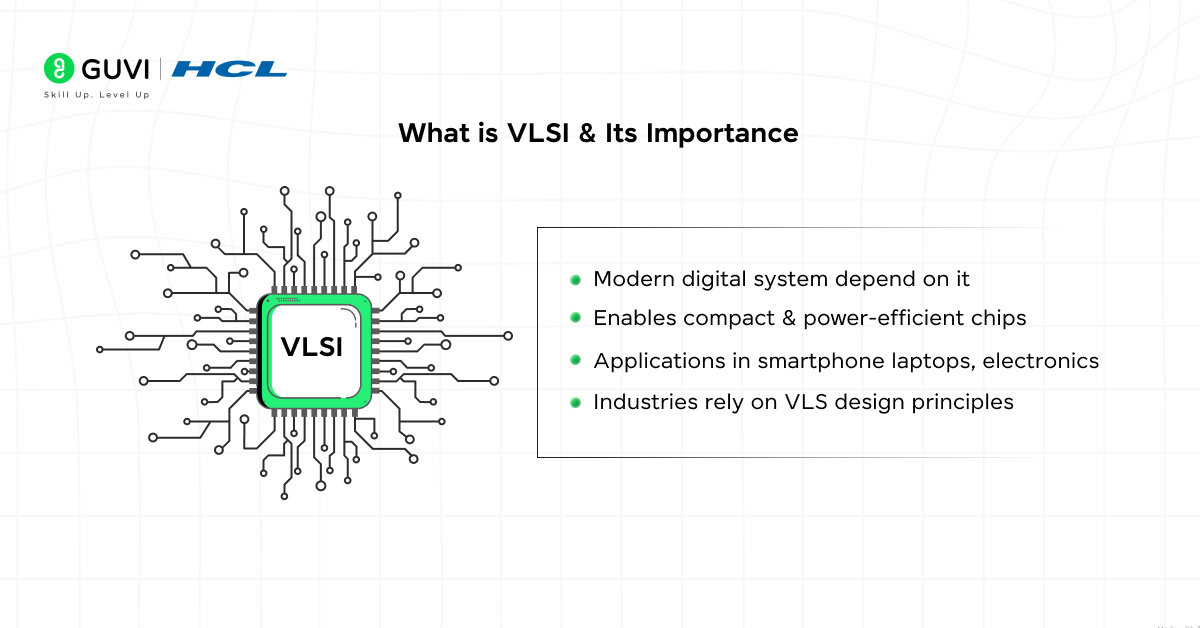
VLSI stands for Very Large Scale Integration, and it refers to the process of designing complex semiconductor chips that power everyday electronic devices. The field influences how processors and communication systems operate in products used by students and large industries. Many learners view VLSI as a career choice because it offers technical depth and long-term growth potential.
VLSI holds significant importance because modern digital systems depend on compact and power-efficient chips. Smartphones, laptops, and consumer electronics rely on chips built through VLSI design principles, and industries that depend on automation, medical equipment, and communication networks follow the same direction. Companies require VLSI engineers who understand how millions of electronic components work together inside a single chip, and this requirement increases steady demand in the job market.
VLSI Career Options at a Glance
Students should compare VLSI specializations before deciding which learning path suits their strengths.
| VLSI Career Path | Main Work | Important Skills | Common Tools | Best Suited For |
|---|---|---|---|---|
| Front-End / RTL Design | Develop digital logic and RTL | Verilog, SystemVerilog, digital electronics | VCS, Xcelium, Questa | Students who enjoy logic design |
| Design Verification | Test chip functionality before fabrication | SystemVerilog, UVM, debugging | Xcelium, Questa One, VCS | Students strong in debugging and testing |
| Physical Design | Convert netlists into chip layouts | PnR, STA, timing closure | Innovus, ICC2/Fusion Compiler | Students interested in implementation |
| Analog / Mixed-Signal | Design circuits handling real-world signals | CMOS, circuit theory, SPICE | Virtuoso, Spectre | Students strong in electronics |
| DFT | Make chips easier to test after manufacturing | Scan, ATPG, BIST | Tessent, DFT tools | Students interested in testing and reliability |
| FPGA Design | Prototype hardware using programmable devices | HDL, timing, digital design | Vivado, Quartus Prime | Beginners seeking hands-on hardware experience |
| Semiconductor Manufacturing | Support fabrication and process engineering | Semiconductor physics, process technology | Process and fab tools | Students interested in chip manufacturing |
What do VLSI Engineers Do?
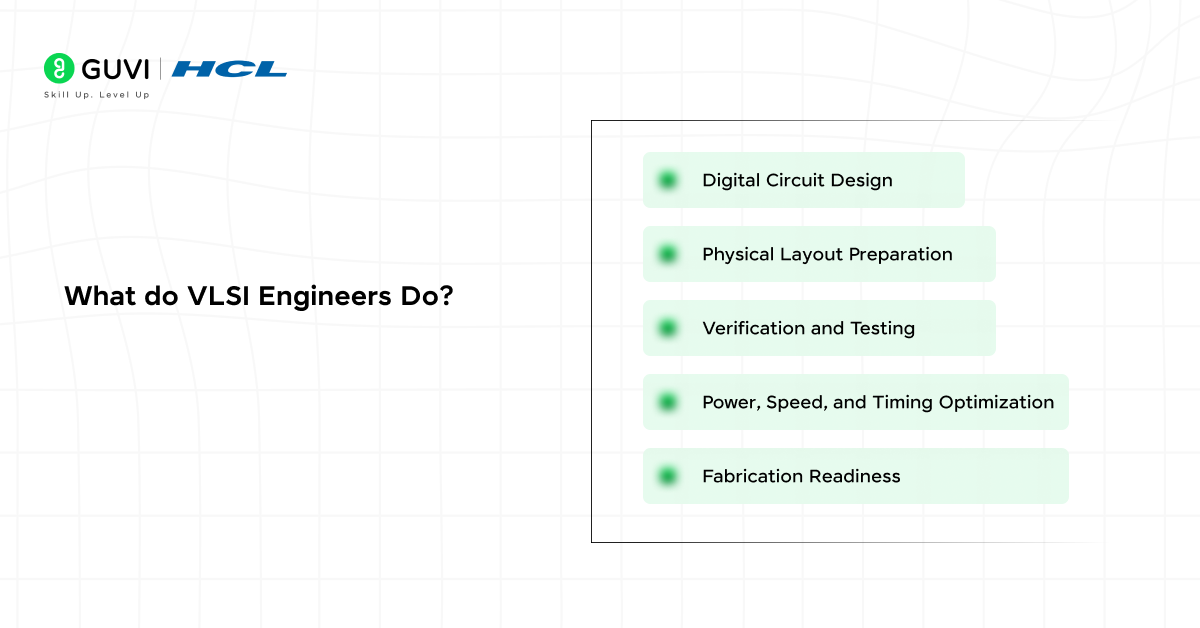
Before choosing VLSI as your career path, first learn what VLSI engineers actually do. Here is what they handle in real design and development work:
1. Digital Circuit Design
VLSI engineers create circuit structures that support specific logic behavior inside a semiconductor chip. Their work focuses on building functions that match system requirements and operate correctly under various electrical conditions.
The following is what they handle in digital design:
- VLSI engineers build logic blocks that follow the required specifications.
- They study signal flow so each block interacts correctly with the next.
- They review logic output to confirm that the circuit behaves as expected.
2. Physical Layout Preparation
VLSI engineers convert logical structures into physical layouts that fit within limited chip space. Their work keeps signal paths clear and maintains performance targets through careful placement choices.
Here is what they manage during layout preparation:
- They position components so signals move without unnecessary delays.
- They route connections between blocks while keeping interference low.
- They check layout rules so the design matches fabrication standards.
3. Verification and Testing
VLSI engineers confirm that the design operates as intended before fabrication. The process supports consistency and removes errors that may affect system response during real-world use.
Below is what VLSI experts perform during verification:
- VLSI engineers run simulations that reveal incorrect logic behavior.
- They correct issues found during testing so the design reaches stable performance.
- They review results with design teams to match expected outcomes.
4. Power, Speed, and Timing Optimization
VLSI engineers adjust circuits so the chip maintains the required balance between speed and energy use. Each adjustment links back to overall performance goals for the final product.
Here is what they refine in this area:
- VLSI experts reduce unnecessary power use without affecting functionality.
- They improve timing paths so signals move within acceptable limits.
- They adjust design parameters to improve system responsiveness.
5. Fabrication Readiness
VLSI designers prepare the final design data for manufacturing teams. This step confirms that the design follows all rules required for chip production.
The following is what they finalize before fabrication:
- VLSI professionals generate files that match foundry guidelines.
- They review the final layout to remove any remaining issues.
- They support coordination with fabrication teams during the release stage.
Who Should Choose a VLSI Career?
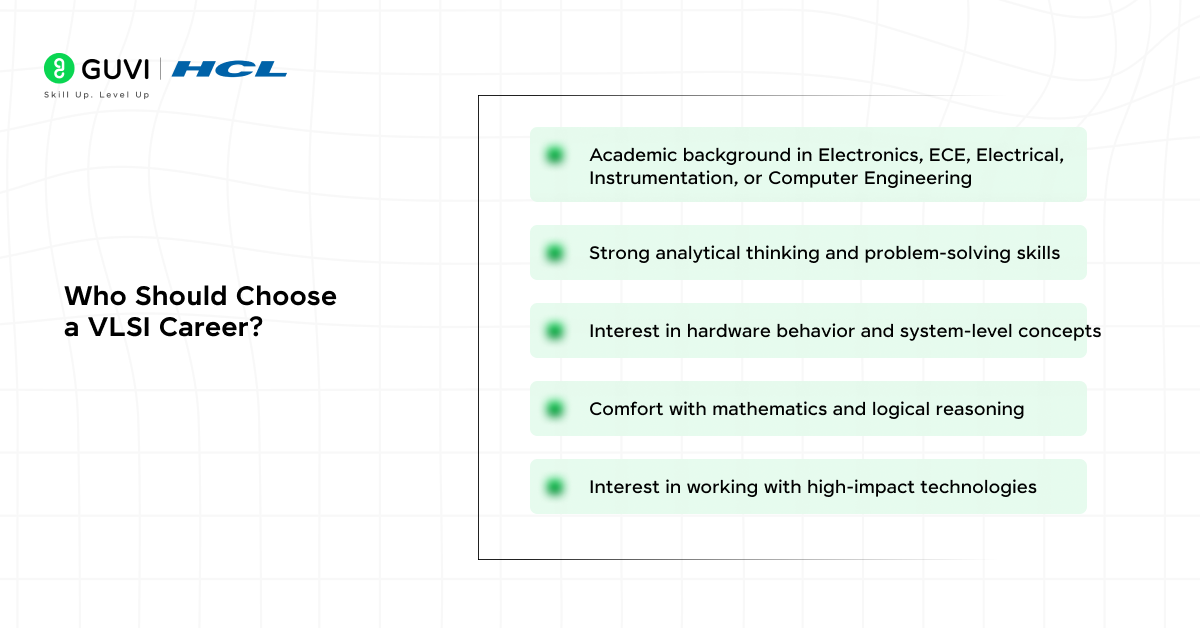
Also, before choosing VLSI as your career, you must understand whether this field truly matches your background, skills, and interests. The following section explains who should choose a VLSI career and why these traits matter for long-term success:
1. Academic Background That Aligns With VLSI
A suitable academic base helps students understand semiconductor concepts with confidence. Learners who study electronics, ECE, electrical engineering, instrumentation or computer engineering move through VLSI topics with greater clarity because these programs cover circuit theory and hardware principles.
Each subject area supports the next one, which creates a steady path toward chip design knowledge. Students in these fields adapt more smoothly because their coursework connects directly with topics such as digital logic, device behavior, and architecture.
2. Skills and Personal Traits That Support Growth in VLSI
A VLSI career suits students who enjoy structured problem-solving and consistent technical refinement. Engineers in this field rely on analytical thinking because it helps them review circuit responses with accuracy.
Knowledge of circuit fundamentals guides design decisions, and strong logic design proficiency supports the creation of stable digital structures. Patience also plays an important role because debugging requires steady focus and clear reasoning. These traits work together and shape how well a student progresses in semiconductor design.
3. Interest in Hardware and System-Level Thinking
A VLSI career fits students who feel naturally drawn to hardware behavior and system structure. They enjoy understanding how signals move through circuits and how each block contributes to the final output of a chip. Curiosity in this area helps them follow semiconductor concepts without confusion.
A steady interest in hardware allows them to connect classroom theory with real chip behavior, which strengthens long-term progress in the field. This interest also supports consistent learning because VLSI requires attention to detail and clear reasoning.
4. Comfort With Mathematics and Logical Reasoning
A strong connection to mathematics for machine learning helps students manage the analytical demands of VLSI. Circuit design and timing analysis use mathematical ideas that guide decisions during development. Students who enjoy logical reasoning follow these concepts with ease and apply them correctly during design tasks.
The link between mathematics and semiconductor behavior becomes clearer as they advance through the field. This connection supports smooth progress because they understand how numerical relationships influence chip performance.
5. Interest in Working With High-Impact Technologies
A VLSI career attracts students who want to contribute to technologies used across communication, automation testing, and personal devices. Semiconductor chips influence how entire systems function, which gives students a sense of purpose in their work. They feel motivated when they see how their knowledge connects with real-world applications, and this motivation supports long-term focus.
Complete VLSI Career Guide for Students in India 2026
India’s semiconductor ecosystem is expanding across chip design, fabrication, packaging and testing. India’s semiconductor end-demand revenue was estimated at US$54 billion in 2025 and is projected to reach US$108 billion by 2030, representing a 15% CAGR. Around 20% of the world’s chip designers are estimated to work in India.
The momentum has strengthened further in 2026. By July 2026, India had approved 12 semiconductor manufacturing projects with an investment pipeline of approximately ₹1.64 lakh crore. India Semiconductor Mission 2.0 has also been proposed with an allocation of ₹1.25 lakh crore to support areas including chip design, manufacturing, materials, equipment and semiconductor talent development.
Students planning a VLSI career can follow this path:
Step 1: Build Electronics Fundamentals
- Digital electronics
- Semiconductor devices
- CMOS technology
- Computer architecture
- Circuit theory
Step 2: Learn HDL
- Verilog
- SystemVerilog
- VHDL where relevant
Step 3: Choose a VLSI Specialization
- RTL design
- Design verification
- Physical design
- DFT
- Analog and mixed-signal design
- FPGA development
Step 4: Gain Tool Experience
Practice simulation, synthesis, verification or FPGA workflows depending on the specialization.
Step 5: Build Practical Projects
Develop RTL modules, verification environments, FPGA implementations or physical-design projects that demonstrate practical ability.
Step 6: Prepare for Industry Roles
Strengthen digital electronics, CMOS, HDL, timing concepts and specialization-specific interview topics before applying for internships and entry-level positions.
Different Career Paths in VLSI
Front-End VLSI Design
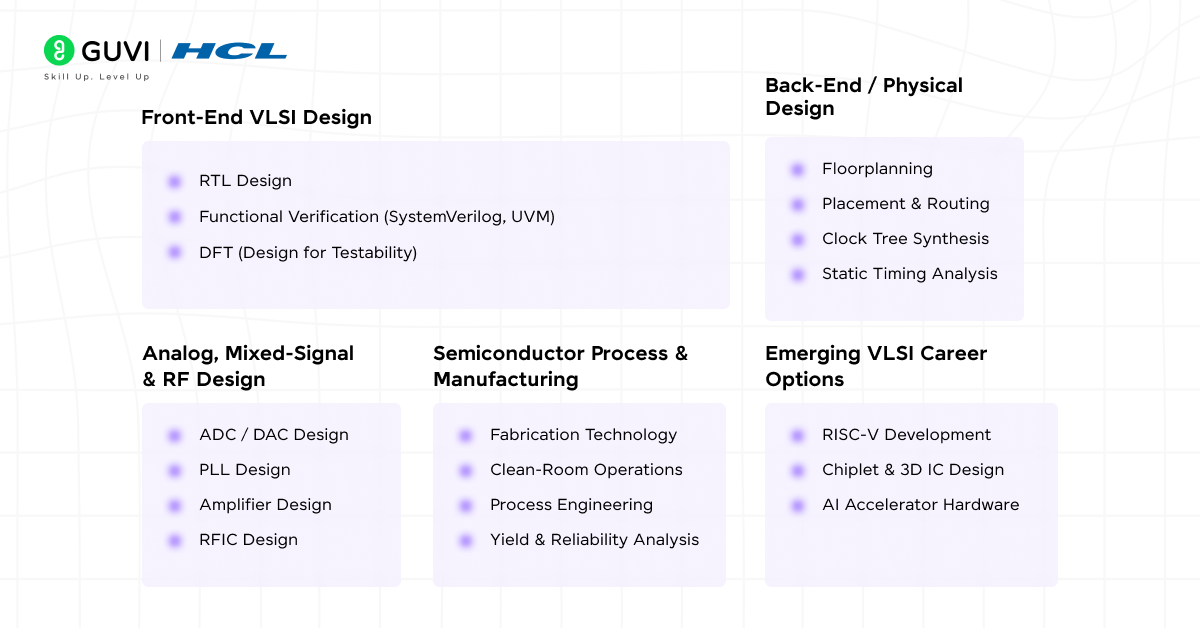
One of the best career options VLSI learners have is front-end design. This path focuses on the logical behavior of the chip and defines how each digital block performs its function. Engineers in this area work with hardware description languages and simulation tools that confirm correct operation before the design moves to physical stages.
RTL design shapes the functional blueprint of the chip and expresses the logic in a structured format. Verification ensures that this logic behaves as expected through simulation methods such as SystemVerilog and UVM. DFT introduces testing features into the design so faults can be identified after fabrication. Each role supports the creation of a reliable digital structure that guides all later stages.
Back-End / Physical Design
Another career path in VLSI involves back-end or physical design. This direction focuses on the physical form of the chip and converts logical structures into layouts that follow fabrication requirements. Engineers decide the placement of components, the routing of signals and the timing constraints that influence overall speed.
Floorplanning, placement, and routing shape the physical arrangement of blocks and the paths between them. Clock Tree Synthesis creates a stable clock network that reaches every section with consistent timing. Static Timing Analysis confirms that all paths meet speed targets and operate without delays.
Analog, Mixed-Signal, and RF Design
A further direction in VLSI focuses on circuits that interact with real-world signals. Students who feel comfortable with voltage behavior and signal flow may enjoy this area. Analog and mixed-signal design support features such as sensing, audio, power control, and communication.
ADC and DAC circuits manage the movement of signals between analog and digital forms. PLL circuits stabilize frequency behavior and guide timing. Amplifier circuits strengthen low-level signals used in various applications. RFIC design handles wireless communication used in phones, networks, and sensor devices.
Semiconductor Process and Manufacturing
One more area in VLSI involves semiconductor process engineering and manufacturing. This direction focuses on how a chip becomes a physical product. Engineers manage fabrication steps, inspect each layer, and maintain quality across the production line.
Fabrication technologies define the sequence used to create the complex structure of the chip. Clean-room roles support equipment that carries out deposition, etching, and inspection steps. Process engineers study patterns that influence yield and overall reliability. Their work ensures that the final chip matches the intended specifications.
Emerging VLSI Career Options
Another strong career opportunity involves emerging fields that grow rapidly as technology advances. These areas expand the range of VLSI and offer new paths for students who want to work with advanced architectures and systems.

RISC-V development supports flexible and open processor design. Chiplets and 3D IC methods introduce new ways of connecting components to improve performance and space usage. AI accelerator hardware focuses on circuits built for machine learning tasks, which require fast computation and efficient data movement. These roles reflect the future direction of semiconductor development.
Pros and Cons of Choosing VLSI as a Career
Advantages of a VLSI Course and Career
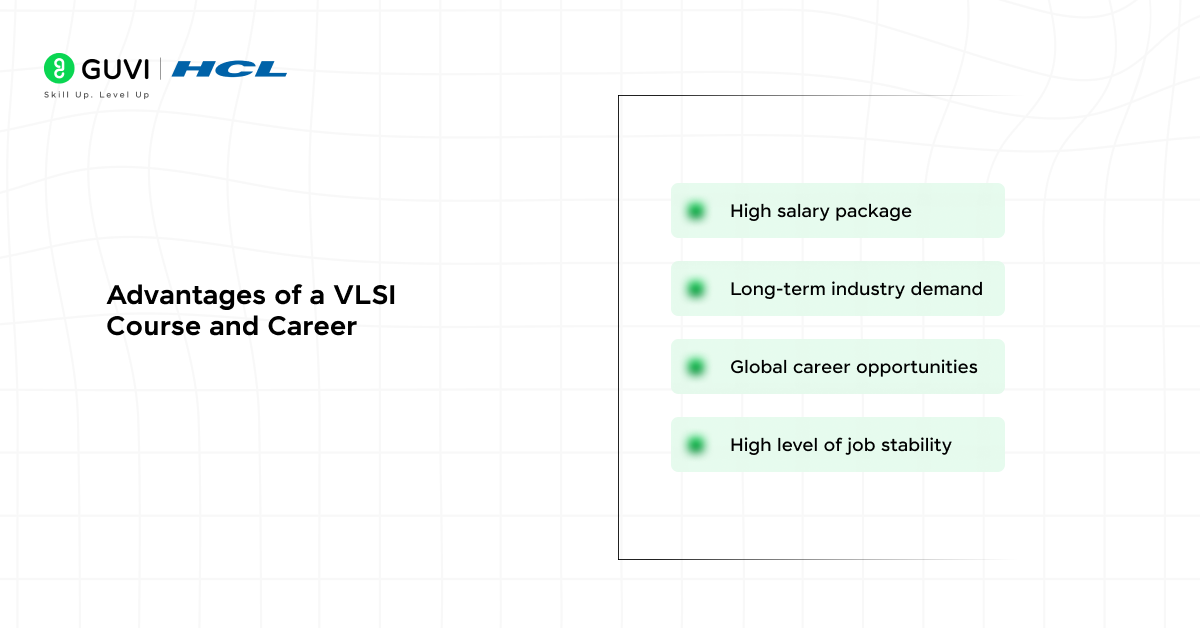
- High Salary Package: VLSI engineers receive strong pay because the work demands deep technical knowledge and careful decision-making at each stage of design. Companies value accuracy in circuit behavior because a single flaw affects large batches of manufactured chips. This value creates competitive compensation.
- Long-term Industry Demand: Semiconductor devices guide communication and computing. These areas depend on chips that support speed, power balance, and reliability. This dependence creates a consistent requirement for engineers who understand digital and physical design concepts.
- Global Opportunities: Countries with active semiconductor work include the United States, India, Taiwan, South Korea, Japa,n and Germany. These regions invest heavily in chip design and advanced processing systems. Engineers gain access to design centers and fabrication units across these locations, which helps them grow through exposure to large projects and diverse development practices.
- High Level of Job Stability: Companies invest heavily in semiconductor projects, and each project takes time to complete. This situation creates stable roles for engineers who develop strong fundamentals. Stability increases further because chip design teams require long-term commitment across multiple project cycles.
Disadvantages of a VLSI Career
- Difficult entry-level opportunities because companies expect strong fundamentals
- Competitive interviews that test logical reasoning and circuit understanding
- Tool-heavy environment that requires steady hands-on practice
- Long tape-out cycles that demand patience and consistent attention
- High expectations during project closure increase pressure on design teams
- Limited scope for quick job switches because skills are highly specialized
Essential Skills to Master for a High-Paying VLSI Career
Soft Skills for VLSI Engineers
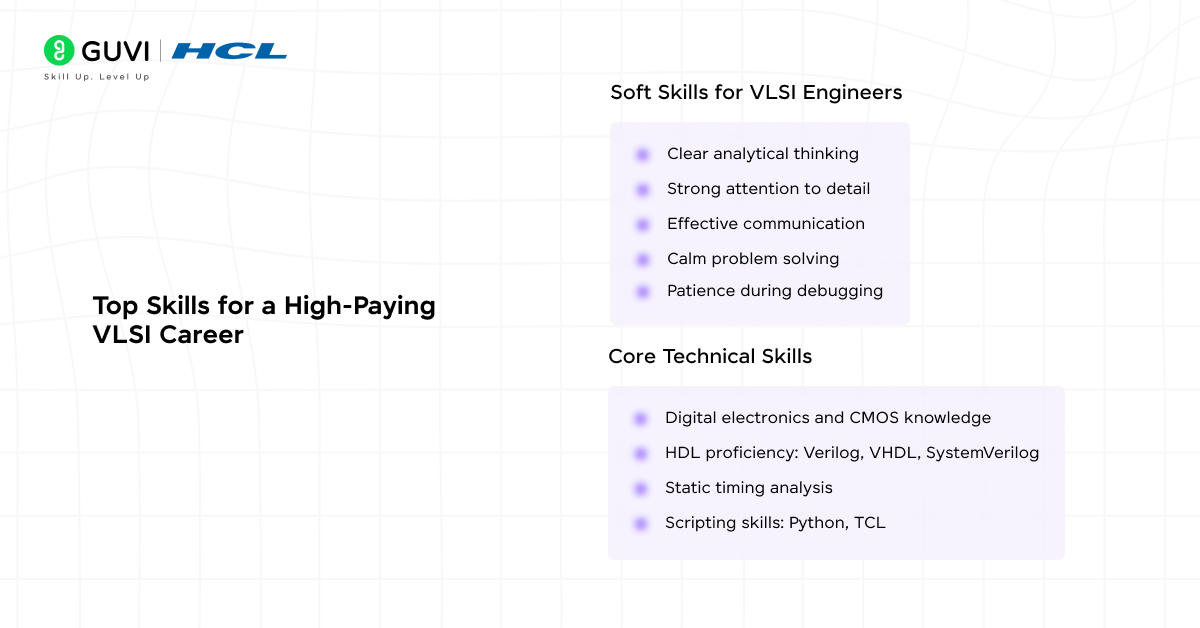
- Clear Analytical Thinking: This skill helps engineers study circuit responses with accuracy. It connects observations with logical outcomes.
- Strong Attention to Detail: Careful focus helps engineers detect small variations that influence how the chip behaves under different conditions.
- Effective Communication: Smooth coordination across design teams depends on clear explanation of findings, test results, and required changes.
- Calm Problem Solving: A steady approach helps engineers work through complex issues without confusion and maintain clarity during each step.
- Patience During Debugging: Debug tasks often involve several layers of analysis, and patience helps engineers move through each layer without losing direction.
Core Technical Skills
- Digital Electronics and CMOS Knowledge: A strong understanding of circuit behavior creates the base for logical design. It also supports accurate interpretation of signal flow.
- HDL Proficiency with Verilog, VHDL, and SystemVerilog: These languages express hardware behavior in a clear format, and skill in them helps engineers create reliable functional structures.
- Static Timing Analysis and Scripting Skills: Timing checks confirm signal movement across the chip, and scripting with Python or TCL supports automation that improves design efficiency.
Tools Every VLSI Engineer Should Know in 2026
The original tool stack remains relevant, but several platforms have received newer releases or major updates for 2026.
| Category | Tool / 2026 Release | Purpose |
| RTL Design | Verilog, VHDL, SystemVerilog | Hardware description and RTL development |
| Simulation | Cadence Xcelium 25.03 | Functional and mixed-signal simulation |
| Verification | Siemens Questa One | Simulation, formal verification and AI-assisted verification |
| Synthesis | Cadence Genus 25.1 | RTL synthesis and optimization |
| Synthesis | Synopsys Design Compiler / Fusion Compiler | Logic synthesis and implementation workflows |
| Physical Design | Cadence Innovus 25.1 | Placement, routing and timing closure |
| Physical Design | Synopsys IC Compiler II / Fusion Compiler | Physical implementation |
| Timing Analysis | PrimeTime, Tempus | Static timing analysis and sign-off |
| DFT | Siemens Tessent | Design-for-test and silicon test workflows |
| Layout Verification | Siemens Calibre, Cadence Pegasus | DRC, LVS and physical verification |
| FPGA | AMD Vivado 2026.1 | FPGA design, implementation and debugging |
| FPGA | Intel Quartus Prime Pro 25.3 | FPGA development and implementation |
VLSI Salary Overview
Here is a clear comparison that helps students understand how VLSI salaries progress across experience levels:
| Experience Level | Typical Salary Range | Notes |
| Entry Level | 8,00,000 – 12,00,000 Source | Freshers with strong fundamentals and project exposure reach the upper range |
| Mid Level | ₹12, 00,000-₹18,00,000 Source | Engineers with solid design flow knowledge and steady performance move into this range |
| Senior Level | ₹20,00,000 to ₹35,00,000 per year Source | Roles include lead positions, physical design experts and verification specialists |
How to Enter the VLSI Industry?
For B.Tech/B.E Students
Undergraduate students can enter the VLSI field by building a clear base in digital logic, device behavior, and HDL practice. Internships can help them connect classroom theory with real hardware tasks, and project work can strengthen their understanding through steady application.
This early exposure can prepare them for campus placements, where companies look for strong fundamentals and practical work. Students who follow this path gain a clear view of VLSI jobs for freshers and understand how to get a VLSI job after B.Tech.
For M.Tech/MS Students
Postgraduate students can move deeper into VLSI through specialized subjects that guide their technical direction. Courses in VLSI, microelectronics, and embedded systems can improve their understanding of advanced design concepts. Research projects and lab work can give them experience with detailed tasks that match industry expectations. This approach supports the M.Tech VLSI career path and expands the VLSI scope after a master’s for students who aim for advanced design or research roles.
For Working Professionals Switching to VLSI
Working professionals can transition to VLSI and learn it from scratch by following a structured learning plan. They can start with digital logic and circuit theory to build the essential foundation for hardware design. They can continue with HDL practice and gradually learn the stages of the VLSI design flow. This steady approach can guide them through questions about how to switch from IT to VLSI and help them follow a learning roadmap that supports confident progress into the field.
Strengthen your foundation for hardware design and chip-level systems with our VLSI Course: a comprehensive program that covers transistor fundamentals, circuit design, verification, and real-world workflows. Get hands-on training, an industry-relevant curriculum, and an industry-recognized certification that sets you up for success in semiconductor and embedded systems roles.
Preparing for VLSI Interviews
1. Technical Preparation Guide
Start your preparation with topics that interviewers value most. Digital logic strengthens your ability to explain how circuits behave under different inputs. A clear grasp of CMOS concepts helps you describe transistor behavior accurately. Regular practice in Verilog and SystemVerilog gives you the skill to express circuit logic with precision. By focusing on these subjects, you can build a strong technical base that supports confident performance during interviews.
2. Soft Skills for Chip Design Jobs
Strong communication and composure make technical knowledge more effective during interviews. Expressing ideas clearly helps you explain circuit responses and test results with confidence. Staying calm through challenging questions reflects maturity and focus. You can improve this skill by discussing your reasoning aloud while solving practice problems, which strengthens both your thought process and delivery. This approach builds clarity and assurance, and it will help your career shine bright as you present yourself with confidence and control.
3. Building a Strong Resume and Portfolio
You can work on building a resume that highlights meaningful VLSI projects and relevant skills. Add details of FPGA work, HDL designs, and verified project outcomes that reflect steady technical growth. You can also organize your GitHub repository or project folder clearly so interviewers can review your work without difficulty. A structured and transparent portfolio shows both skill and commitment, and it will help your career shine bright by leaving a lasting impression on employers.
Conclusion
A career in VLSI offers clear direction for students who enjoy hardware and steady technical growth. Each stage of the journey builds on the previous one, which helps learners understand chip behavior with increasing confidence. The field remains important in communication and computing, and the future scope of VLSI design continues to expand as industries demand faster and more efficient chips. Students who follow a focused learning path can find stable opportunities across several regions and specializations.
VLSI remains a valuable field for learners who prefer clear logic and long-term technical commitment. With consistent effort, the journey can lead to stable growth, strong compensation and opportunities that connect directly with global technology development.
FAQs
Is VLSI a good career in India in 2026?
Yes. VLSI can be a strong career choice for students interested in electronics, hardware and semiconductor technology. India’s growing semiconductor investment is expanding opportunities across chip design, verification, fabrication, packaging and testing. However, VLSI has a steep learning curve and employers usually expect strong fundamentals and practical skills.
What qualifications are required to become a VLSI engineer?
A B.E. or B.Tech in Electronics and Communication Engineering, Electronics Engineering, Electrical Engineering or a related discipline provides the most direct route into VLSI. Students can strengthen their profile through VLSI projects, internships and specialization in HDL, CMOS, verification or physical design. An M.Tech in VLSI or Microelectronics can be useful for advanced roles but is not mandatory for every position.
Which VLSI field is best for a career?
There is no single best VLSI specialization. RTL design suits students who enjoy digital logic while verification is better for those interested in testing and debugging. Physical design suits engineers interested in chip implementation and timing closure. Analog design is ideal for students with strong circuit fundamentals.
Students should choose a specialization based on their strengths rather than selecting one only because of salary.
Can a CSE student build a career in VLSI?
Yes, but the transition requires additional hardware knowledge. CSE students can enter areas such as digital design, verification, EDA automation and FPGA development by learning digital electronics, computer architecture, Verilog/SystemVerilog and semiconductor fundamentals.
Programming and scripting skills in Python, C/C++ and Tcl can also support several VLSI workflows.
What is the salary of a VLSI engineer in India?
VLSI freshers in India typically earn around ₹4–7 LPA in 2026. Professionals with five to eight years of experience may earn around ₹14–22 LPA, while experienced staff engineers, architects and engineering managers can reach ₹35–60+ LPA. Salary depends heavily on specialization, employer, practical experience and responsibility.
Success Stories

About the Author
Vaishali
I'm a seasoned writer with four years of experience across technical, non-technical, and just about every genre or niche you can imagine. Adaptable and curious, I enjoy exploring new topics and making information engaging and easy to understand. Fueled by a steady stream of tea, I approach each project with creativity, reliability, and genuine enthusiasm for storytelling.
View all posts by Vaishali
Connect with me @










Did you enjoy this article?