


Artificial Intelligence and Machine Learning Articles
How to Evaluate LLM Outputs in Production Deployments
AI/ML Skills Gap 2026: Why Companies Can't Find Job-Ready Talent
20 AI/ML Interview Questions Recruiters Can Use Without a Tech Background - Best Guide
How Industry-Backed AI/ML Bootcamps Are Changing the AI/ML Hiring Pipeline - Best Guide 2026


Get In Touch For Details! Request More Information
Diffusion Models in Machine Learning: How AI Learns to Create
Jul 10, 2026 6 Min Read 880 Views
(Last Updated)
Take a perfect photograph. Add a little noise. Add more. Keep going until nothing remains but static.
Now teach an AI to reverse that process, starting from pure static and rebuilding a coherent image step by step.
That is diffusion models. The results are not approximations. They are photorealistic images, medical scans, molecule structures, and entire videos generated from text descriptions alone. Stable Diffusion, DALL-E, Midjourney, and Sora all run on this same framework.
This guide will show you exactly how diffusion models work, why they outperform earlier generative approaches, where they are transforming industries, and what their real limitations look like in practice.
Table of contents
- Quick TL;DR Summary
- What Diffusion Models Actually Do
- How Diffusion Models Work: The Full Process
- Practice problems to try:
- Latent Diffusion Models: Making Diffusion Practical at Scale
- Diffusion Models vs. Earlier Generative Approaches
- Common Mistakes in Working With Diffusion Models
- Real-World Applications of Diffusion Models
- When to Use Diffusion Models vs. When to Choose Otherwise
- Use Diffusion Models When:
- Consider Alternative Approaches When:
- Final Thoughts
- FAQs
- Why do diffusion models require so many steps to generate an image?
- What is the difference between Stable Diffusion and DALL-E?
- Can diffusion models be fine-tuned on custom datasets?
- How do diffusion models make sure the generated image actually matches the text prompt?
- Are diffusion models suitable for real-time applications?
Quick TL;DR Summary
- Diffusion models are generative AI systems that learn to create data by reversing a gradual noise-adding process, recovering coherent outputs from pure static.
- They work in two phases: a forward process that destroys data with Gaussian noise, and a learned reverse process where a neural network removes that noise step by step.
- This guide covers how denoising works, how text conditioning steers generation, and how latent diffusion made high-quality image generation practical on consumer hardware.
- You will learn how diffusion models compare to GANs, VAEs, and autoregressive models, and when each approach fits best.
- The article also covers applications across image generation, video, medical imaging, drug discovery, and audio, along with key limitations and inference speed trade-offs.
What are Diffusion Models?
Diffusion models are deep learning generative AI models that learn to create data by reversing a gradual noise addition process over many steps. They train neural networks to reconstruct clean data from random noise, enabling the generation of realistic images, videos, audio, and other forms of content. These models power many of today’s most advanced generative AI systems.
What Diffusion Models Actually Do
- They Learn the Structure of Data by Learning to Destroy and Rebuild It
Every generative model faces the same fundamental challenge: learning the underlying distribution of real data well enough to sample new examples from it.
Diffusion models solve this by decomposing the problem across time. Instead of learning to generate a complete image in one shot, they learn to take one small denoising step at a time. Each step is a simpler problem. The model only needs to predict what the image looked like, slightly less noisy than it currently appears. Across hundreds of such steps, coherent structure emerges from chaos.
- They Are Probabilistic, Not Deterministic
Unlike a filter that transforms input to output through fixed operations, diffusion models are probabilistic. They model uncertainty explicitly at every denoising step.
This probabilistic nature is what gives them generative power. Sampling from that uncertainty at each step is what allows a single model to produce endlessly varied outputs from the same prompt. No two generation runs are identical because the model is sampling from a learned probability distribution, not executing a fixed transformation.
- They Separate the Generation Problem From the Architecture Problem
Diffusion models do not require a single specialized architecture to generate images end-to-end. They use standard neural network architectures, typically U-Nets or transformers, to perform the relatively simple task of predicting noise at each step.
This separation is powerful. Improvements in neural network architecture, training techniques, and conditioning methods all transfer directly into better diffusion models without requiring fundamental changes to the diffusion framework itself.
- They Scale Remarkably Well With Data and Compute
More data, more compute, and larger neural networks all improve diffusion model quality in predictable ways. There are no training instability issues like mode collapse that plagued earlier generative approaches.
This scalability is a primary reason why diffusion models have become the foundation of the largest and most capable generative AI systems available today.
Read More: Learn How to Use Stable Diffusion Easily
How Diffusion Models Work: The Full Process
- The Forward Process: Systematic Destruction
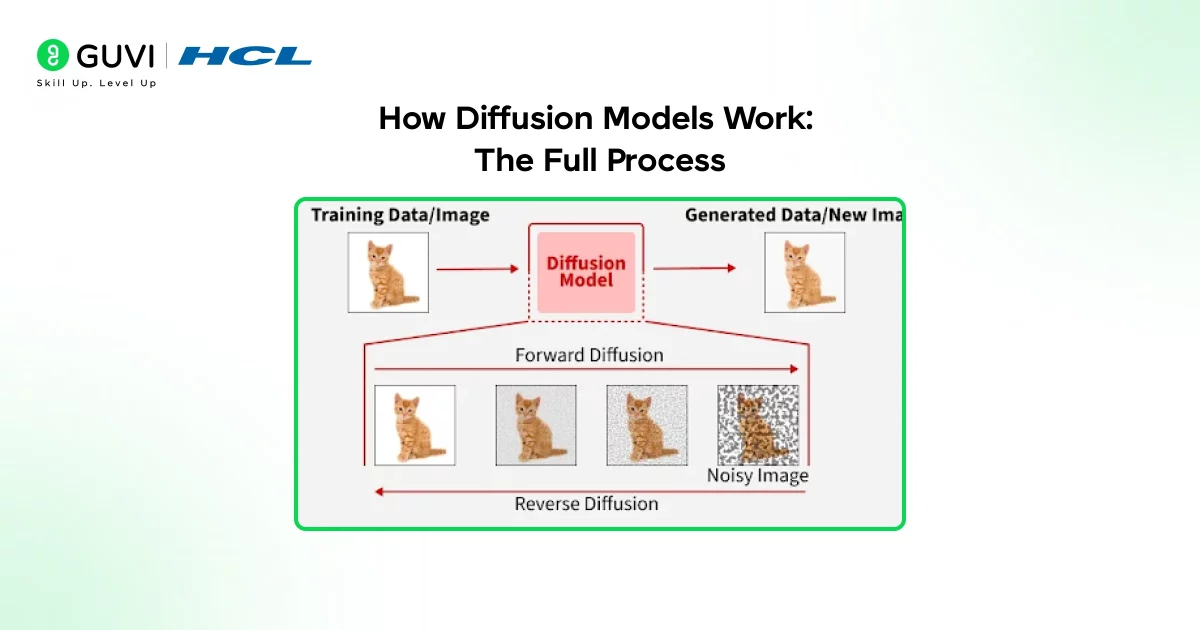
The forward diffusion process takes a real data sample and progressively corrupts it by adding small amounts of Gaussian noise at each of T timesteps.
At timestep zero, you have the original clean image. At each subsequent step, a little more noise is added according to a fixed noise schedule. By timestep T, typically 1000 steps in standard implementations, the image has been completely destroyed into pure Gaussian noise indistinguishable from random static.
This process is not learned. It is mathematically fixed. Its purpose is purely to define a training target for the reverse process.
- The Reverse Process: Learned Reconstruction
The reverse process is what the model actually learns. Starting from pure noise at timestep T, it predicts and removes noise step by step, working backward toward timestep zero.
At each reverse step, a neural network takes the current noisy image and the current timestep as input, and predicts either the noise that was added at that step or directly predicts the denoised image. The prediction is used to compute the slightly less noisy image at the previous timestep, and the process repeats until a clean sample is produced.
- The Training Objective: Predict the Noise
Training is simpler than the full generation process suggests. For each training example, randomly sample a timestep and add the corresponding amount of noise to the image. Train the neural network to predict the noise that was added.
That is the core training loop. Corrupt an image to a random noise level. Predict corruption. Minimize the prediction error. Repeat across millions of images and timesteps until the model can accurately denoise from any noise level.
- Conditioning: Steering Generation With Text or Other Signals
Unconditional diffusion models generate random samples from the data distribution. Conditional diffusion models accept additional input, such as a text prompt, a class label, or another image, that steers the generation toward a specific output.
Text conditioning is achieved by encoding the text prompt using a language model like CLIP, then injecting the resulting embedding into the denoising network at each step through cross-attention mechanisms. The denoising network learns to produce images consistent with the conditioning signal while still following the learned data distribution.
Practice problems to try:
- Explain why adding noise in the forward process must follow a fixed schedule rather than being learned during training.
- Describe what happens to sample quality when the number of reverse diffusion steps is reduced from 1000 to 10.
- Design a conditioning mechanism that would allow a diffusion model to generate images matching a specific art style.
Latent Diffusion Models: Making Diffusion Practical at Scale
- The Computational Problem With Pixel-Space Diffusion
Running the diffusion process directly on full-resolution images is computationally expensive. A 512×512 RGB image contains nearly 800,000 individual values. Running hundreds of denoising steps across all of them requires enormous compute at both training and inference time.
Early diffusion models were impractical for most applications precisely because of this cost.
- The Latent Space Solution
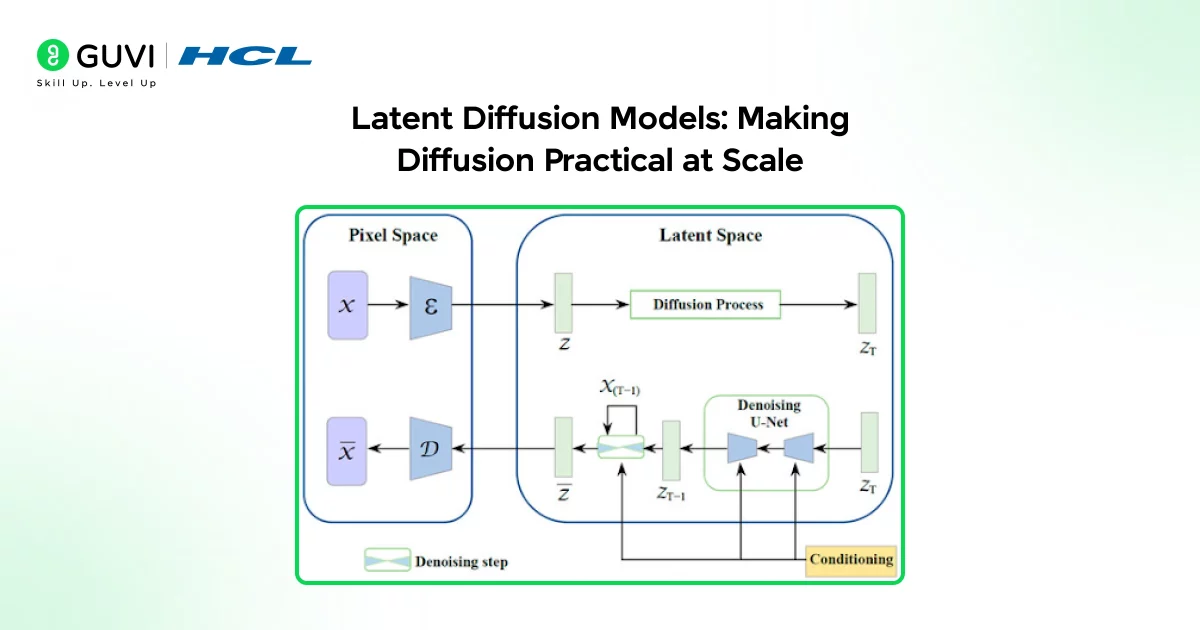
Latent diffusion models, which power Stable Diffusion, solve this by running the diffusion process not on pixels but on compressed latent representations produced by a separate encoder.
A variational autoencoder first compresses the image into a latent space typically 8 to 16 times smaller than the original pixel space. The entire diffusion process then operates in this compressed space. A decoder converts the final denoised latent back into a full-resolution image.
The quality loss from this compression is minimal. The computational savings are dramatic. Latent diffusion made high-resolution image generation practical on consumer hardware for the first time.
- Why Latent Space Diffusion Produces Better Semantics
Working in latent space has a secondary benefit beyond efficiency. Latent representations learned by autoencoders already capture semantic structure rather than raw pixel values.
Diffusion in this semantic space means the model is learning to navigate a space organized by meaning rather than by pixel intensity. The resulting generations tend to have better global coherence and semantic consistency than pixel-space equivalents trained with similar compute.
Stable Diffusion, one of the most widely used open-source image generation models, uses a technique called latent diffusion, where images are compressed into a latent representation roughly 64× smaller than the original pixel space before the diffusion process runs. This dramatically reduces computational requirements, allowing high-quality image generation to run on consumer GPUs with around 8GB of VRAM instead of requiring large-scale data center hardware.

Diffusion Models vs. Earlier Generative Approaches
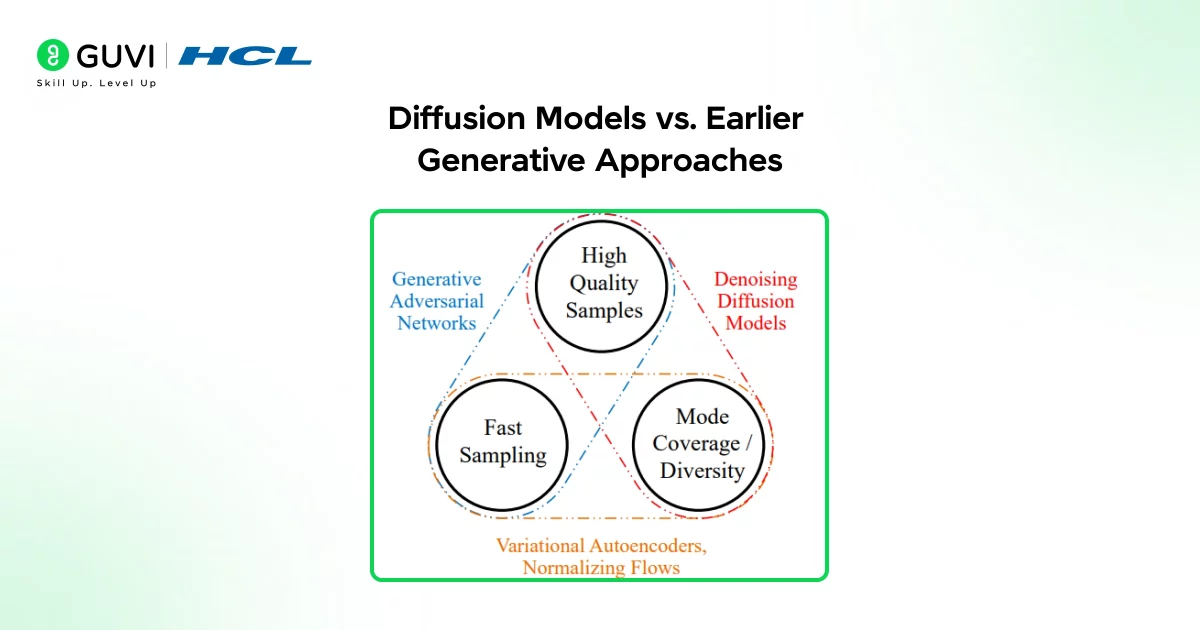
- vs. Generative Adversarial Networks (GANs)
GANs use a generator and discriminator trained against each other in a competitive game. At their best they produce extremely sharp, photorealistic images. Their core weakness is training instability: mode collapse, where the generator learns to produce a narrow range of outputs, and gradient vanishing, where training stalls entirely.
Diffusion models are dramatically more stable to train. They do not require adversarial dynamics. They cover the full data distribution rather than collapsing to high-density modes. The trade-off is slower inference: generating one image requires hundreds of sequential denoising steps rather than a single forward pass through a generator.
- vs. Variational Autoencoders (VAEs)
VAEs learn a compressed latent representation of data and generate new samples by decoding points sampled from the latent space. They are fast and stable but tend to produce blurry outputs because the reconstruction objective averages over uncertainty rather than sampling from it.
Diffusion models trade VAE speed for dramatically higher output quality. The iterative denoising process allows them to capture fine detail and texture that VAEs systematically smooth over.
- vs. Autoregressive Models
Autoregressive models like early pixel-level image generators produce images one pixel or token at a time, each conditioned on all previous outputs. They model the data distribution faithfully but are extremely slow for high-resolution image generation.
Diffusion models generate the entire image simultaneously at each denoising step rather than sequentially, making them faster than autoregressive approaches for images while achieving comparable or better quality.
In a landmark 2021 evaluation, diffusion models surpassed GANs (Generative Adversarial Networks) on the ImageNet image generation benchmark for the first time, achieving better Frechet Inception Distance (FID) scores while also generating more diverse and stable outputs. This breakthrough significantly shifted the AI research community’s focus toward diffusion-based image synthesis, paving the way for modern generative systems like Stable Diffusion and many of today’s state-of-the-art text-to-image models.
Common Mistakes in Working With Diffusion Models
- Treating Inference Steps as a Free Parameter to Reduce Casually
- Ignoring the Noise Schedule When Fine-Tuning
- Expecting Text Prompts to Work Like Database Queries
- Overlooking Classifier-Free Guidance Scale
Real-World Applications of Diffusion Models
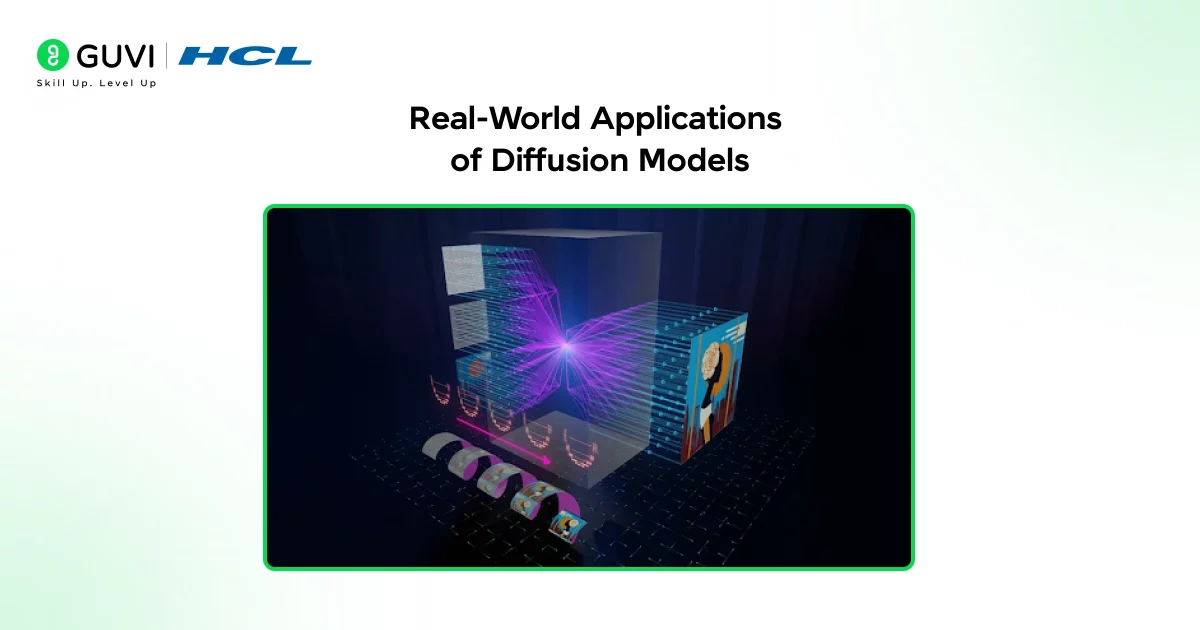
- Image Generation and Creative AI
Stable Diffusion, DALL-E 3, and Midjourney are all diffusion-based systems that generate photorealistic images, illustrations, and artwork from text descriptions.
These tools have transformed design workflows, advertising production, concept art generation, and visual content creation. A task that required hours of skilled human work now takes seconds of prompting, with the human role shifting from execution to direction and curation.
- Medical Imaging
Diffusion models generate synthetic medical images including MRI scans, CT images, and histopathology slides for augmenting training datasets where real labeled data is scarce.
They also enable image-to-image translation between imaging modalities, generating synthetic CT from MRI for patients who cannot receive radiation, and performing super-resolution on low-quality scans without requiring paired high-resolution training data.
- Drug Discovery and Molecular Design
Diffusion models have been applied to three-dimensional molecular structure generation, treating molecule design as a generative problem in continuous 3D space rather than a discrete sequence generation problem.
Models like DiffSBDD and DiffDock use diffusion frameworks to generate drug-like molecules that fit specific protein binding sites, dramatically accelerating early-stage drug discovery by proposing novel candidate structures rather than requiring exhaustive screening of existing compound libraries.
When to Use Diffusion Models vs. When to Choose Otherwise
Use Diffusion Models When:
- High-quality, diverse generative output is the primary requirement
- Training stability matters more than inference speed
- The task involves continuous data like images, audio, or video rather than discrete sequences
- Conditional generation from text, class labels, or other signals is needed
- Pre-trained models exist for the target domain and fine-tuning is feasible
- Output diversity and full coverage of the data distribution are more important than speed
Consider Alternative Approaches When:
- Real-time inference is required and the latency of iterative denoising is unacceptable
- The task involves discrete data like text tokens where autoregressive models are more natural
- Compute budget makes training or running diffusion models impractical
- Interpretability of the generation process is required for the application
- A simpler generative approach achieves sufficient quality for the use case
To learn more about Diffusion Models and how generative AI systems learn to create images, audio, and video from noise, do not miss the chance to enroll in HCL GUVI’s Intel & IITM Pravartak Certified Artificial Intelligence & Machine Learning course. Endorsed with Intel certification, this course adds a globally recognized credential to your resume, a powerful edge that sets you apart in the competitive generative AI job market.
Final Thoughts
Diffusion models succeeded not by being clever about architecture but by being correct about process. Breaking an impossible problem into hundreds of manageable steps, each learned independently, each contributing to an emergent whole.
The results speak for themselves. Images indistinguishable from photographs. Videos with physically coherent motion. Molecules designed atom by atom for specific biological targets. The framework that produces all of it is the same: destroy structure gradually, then learn to rebuild it.
The engineers who use diffusion models most effectively are the ones who understand the noise schedule, the guidance mechanism, and the latent space well enough to intervene intelligently when generation fails. The model is not a black box. It is a learned probability distribution navigated step by step, and understanding that navigation is what separates practitioners from prompt typists.
FAQs
1. Why do diffusion models require so many steps to generate an image?
Each denoising step makes only a small correction to the current noisy estimate, so many steps are needed to recover a clean, coherent output. Advanced samplers like DDIM and DPM-Solver reduce this to 20 to 50 steps by taking larger mathematically principled jumps through the reverse process without proportionally sacrificing quality.
2. What is the difference between Stable Diffusion and DALL-E?
Both generate images from text prompts using latent diffusion frameworks but differ in accessibility and openness. Stable Diffusion is open-source and runs locally on consumer hardware, while DALL-E is a closed proprietary system accessible only through OpenAI’s API.
3. Can diffusion models be fine-tuned on custom datasets?
Yes, techniques like DreamBooth and LoRA allow fine-tuning pre-trained diffusion models on small custom datasets to teach specific subjects, styles, or domains. LoRA is faster and more memory-efficient, fine-tuning only a small set of adapter weights while achieving results comparable to full model fine-tuning.
4. How do diffusion models make sure the generated image actually matches the text prompt?
Text alignment works through cross-attention mechanisms in the denoising network that condition every denoising step on the mencoded text embedding. Classifier-free guidance then amplifies this conditioning signal by interpolating between conditional and unconditional predictions, letting the guidance scale control how closely the output follows the prompt.
5. Are diffusion models suitable for real-time applications?
Standard diffusion models are too slow for real-time use due to their iterative inference requirements. Research into consistency models, progressive distillation, and flow matching is reducing generation to single or few-step inference, with some approaches already achieving near-real-time generation on modern hardware.
Success Stories

About the Author
Vishalini Devarajan
An Aerospace Engineer turned content writer, I focus on making complex concepts easy to understand through well-structured, reader-friendly blogs. Whether it’s a technical topic or a non-technical one, I love creating content that is clear, engaging, and impactful.
View all posts by Vishalini Devarajan
Connect with me @










Did you enjoy this article?