


Artificial Intelligence and Machine Learning Articles
Finance Manager to Data Analytics: Career Growth, Salary and Seniority
How to Evaluate LLM Outputs in Production Deployments
AI/ML Skills Gap 2026: Why Companies Can't Find Job-Ready Talent
20 AI/ML Interview Questions Recruiters Can Use Without a Tech Background - Best Guide


Get In Touch For Details! Request More Information
AdaGrad Optimizer in Deep Learning: Working & Use Cases
Aug 19, 2026 4 Min Read 954 Views
(Last Updated)
Deep learning models reduce errors during training by continuously updating weights. Traditional gradient descent methods often struggle because they use the same learning rate for every parameter, which can slow convergence and create instability in sparse datasets and large neural networks.
AdaGrad, short for Adaptive Gradient Algorithm, solves this by using adaptive learning rates for different parameters. Although newer optimizers like Adam are more widely used today, AdaGrad remains important for understanding modern AI optimization techniques.
In this article, you’ll learn what AdaGrad Optimizer is, how it works, its formula, advantages, limitations, use cases, and how it compares with other deep learning optimizers.
Table of contents
- TL;DR
- Why Traditional Gradient Descent Struggles
- Slow Convergence
- Overshooting
- Sparse Feature Challenges
- How AdaGrad Works
- AdaGrad Formula Explained
- Step-by-Step Working of AdaGrad
- Advantages of AdaGrad
- Effective for Sparse Features
- Reduces Learning Rate Tuning
- Can Learn Even Rare Features
- Stable Training
- Limitations of AdaGrad
- Aggressive Learning Rate Decay
- Generally Not for Deep Networks
- Can Fail to Reach Optimal
- AdaGrad vs SGD vs Adam
- When to Use AdaGrad
- When Not to Use AdaGrad
- Real World Use Cases of AdaGrad
- Natural Language Processing
- Recommendation Systems
- Search Engines
- Educational Importance
- Python Implementation of AdaGrad
- Best Practices While Using AdaGrad
- Use Moderate Initial Learning Rates
- Prefer Sparse Data Problems
- Monitor Training Convergence
- Combine with Proper Feature Engineering
- Common Mistakes to Avoid
- Treating AdaGrad as the Best Optimizer
- Ignoring Learning Rate Decay
- Using It for Every Neural Network
- Confusing AdaGrad with Adam
- Conclusion
- FAQs
- What is AdaGrad in deep learning?
- Why is AdaGrad good for sparse data?
- What is the main disadvantage of AdaGrad?
- Is AdaGrad better than Adam?
- Where is AdaGrad commonly used?
TL;DR
- AdaGrad is an adaptive gradient optimization algorithm used in machine learning and deep learning.
- Unlike traditional gradient descent, AdaGrad adjusts the learning rate individually for each parameter.
- It works especially well with sparse data and infrequent features such as NLP embeddings and recommendation systems.
- AdaGrad improves training convergence by reducing large updates and giving more importance to rare features.
- One major limitation is that its learning rate keeps shrinking over time, which can slow training in deep neural networks.
- Modern optimizers like RMSProp and Adam were later developed to solve AdaGrad’s decaying learning rate problem.
What is AdaGrad Optimizer?
AdaGrad, short for Adaptive Gradient Algorithm, is a deep learning optimization algorithm that adjusts learning rates individually for each parameter based on previously observed gradients instead of using a single fixed learning rate. This adaptive behavior makes it especially effective for handling sparse data and learning from rare features.
Why Traditional Gradient Descent Struggles
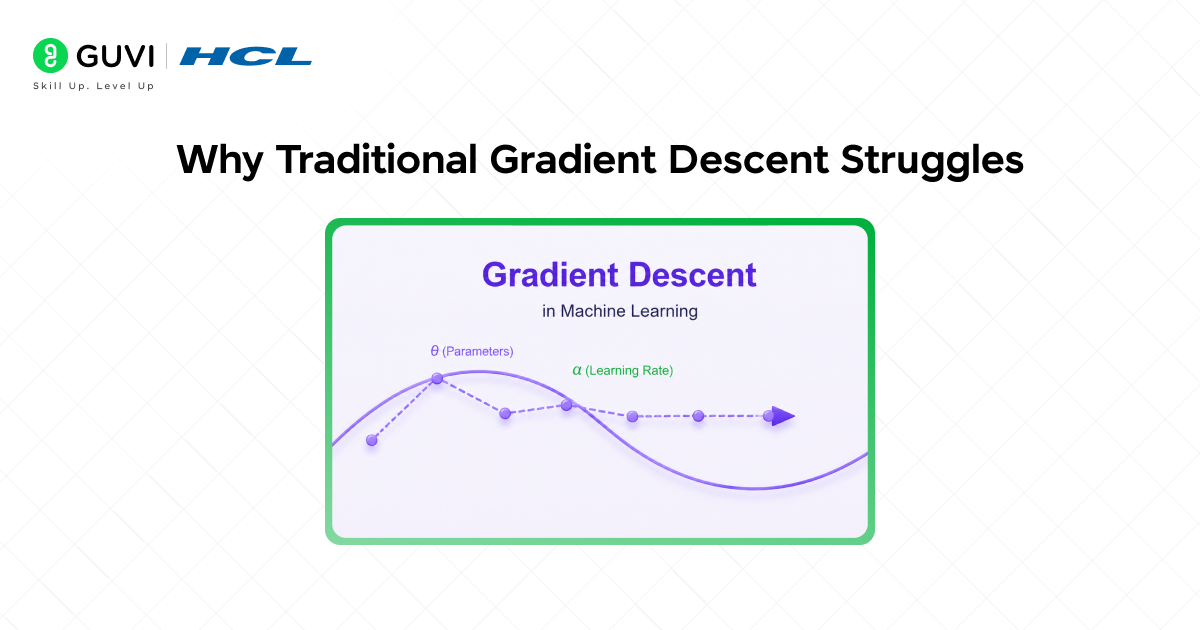
Standard gradient descent uses the same learning rate throughout training.
θ₍ₜ₊₁₎ = θₜ − ηgₜ
Here:
• θ represents model parameters
• η is the learning rate
• gₜ is the gradient
This creates several problems in neural network training:
Slow Convergence
If the learning rate is too low, training becomes extremely slow.
Overshooting
If the learning rate is too high, the optimizer may skip the minimum loss point and become unstable.
Sparse Feature Challenges
In NLP and recommendation systems, some features appear very rarely. Standard gradient descent treats all features equally, making it difficult for rare but important features to learn effectively.
AdaGrad solves this using learning rate adaptation.
How AdaGrad Works
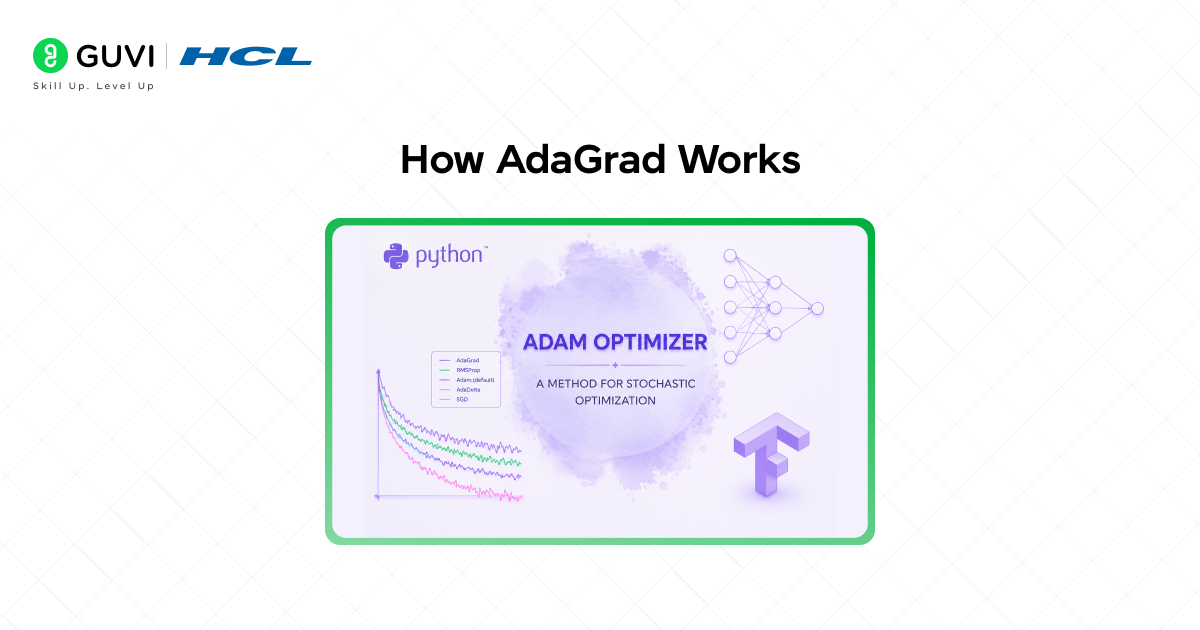
The core idea behind AdaGrad is simple:
Parameters with large historical gradients should receive smaller updates, while parameters with smaller or infrequent gradients should receive larger updates.
Instead of keeping one fixed learning rate, AdaGrad dynamically adjusts the learning rate for every parameter during stochastic optimization
This helps:
• Improve optimization efficiency
• Stabilize neural network training
• Handle sparse datasets better
• Reduce manual tuning of learning rates
Optimization algorithms become easier to follow once you understand how neural networks process and update parameters.
AdaGrad Formula Explained
AdaGrad stores the cumulative sum of squared gradients.
θ₍ₜ₊₁₎ = θₜ − (η / √(Gₜ + ε)) ⊙ gₜ
Where:
• θ = model parameters
• η = initial learning rate
• Gₜ = accumulated squared gradients
• ε = small constant preventing division by zero
• gₜ = current gradient
As Gₜ increases over time, the effective learning rate decreases automatically.
This adaptive behavior is what makes AdaGrad different from traditional gradient descent algorithms.
Step-by-Step Working of AdaGrad
How AdaGrad optimizes parameters in neural network training:
- Initialize weights: Initialize model weights and the learning rate.
- Calculate Gradients: Compute prediction errors and their associated gradients using the prediction error, and compute the required gradients to be applied.
- Accumulate Squared Gradients: Square all the past gradients and keep accumulating them for each parameter.
- Adapt Learning Rate: Give a specific learning rate to each parameter in the model with regard to their individual learning process.
- Update weights: Use these adaptive learning rates to update the parameters of the model.
- Repeat till convergence: Keep repeating steps 2–5 until the loss is minimized.
Advantages of AdaGrad
Effective for Sparse Features
AdaGrad’s performance can be very impressive for data that contains infrequent features. For example:
• NLP
• text classification
• recommendation engines
• search ranking systems
Reduces Learning Rate Tuning
The learning rates do not have to be fine-tuned manually; they are already dynamically adjusted by the optimizer.
Can Learn Even Rare Features
Each feature receives a relatively larger update for features that are encountered less frequently compared to features that occur frequently.
Stable Training
Avoids large parameter updates and optimizes the performance of training neural networks.
Modern adaptive optimizers became more important as deep learning and neural networks evolved toward larger-scale AI models.
Limitations of AdaGrad
Aggressive Learning Rate Decay
The square of the gradients of parameters that occur with a higher frequency grow continuously as training proceeds. Eventually, learning rates become infinitesimally small, which may:
• lead to very slow training
• stop learning prematurely
• cause performance issues in deep learning models
Generally Not for Deep Networks
Training of neural networks typically performs well with:
• Adam
• AdamW
• RMSProp
The reason these networks perform well compared to AdaGrad is due to them addressing AdaGrad’s learning rate decay problem.
Can Fail to Reach Optimal
Because learning rates shrink to become very small over time, optimization might fail to reach the best minimum.
AdaGrad was one of the first major optimization algorithms to introduce adaptive learning rates in deep learning. Earlier neural networks typically used a single fixed learning rate for every parameter, but AdaGrad changed this by automatically assigning larger updates to rare features and smaller updates to frequent ones. This made it especially effective for NLP, recommendation systems, and other applications involving sparse data, influencing many later optimizers such as RMSProp and Adam.

AdaGrad vs SGD vs Adam
| Optimizer | Learning Rate | Sparse Data Handling | Training Speed | Modern Usage |
| SGD | Fixed | Weak | Moderate | Still common |
| AdaGrad | Adaptive | Excellent | Slows over time | Limited |
| Adam | Adaptive + Momentum | Excellent | Fast | Very popular |
When to Use AdaGrad
AdaGrad is useful when:
• working with sparse datasets
• training NLP models
• handling infrequent features
• studying adaptive optimization algorithms
When Not to Use AdaGrad
Avoid AdaGrad for:
• very deep neural networks
• long training cycles
• transformer scale architectures
• large computer vision models
Real World Use Cases of AdaGrad
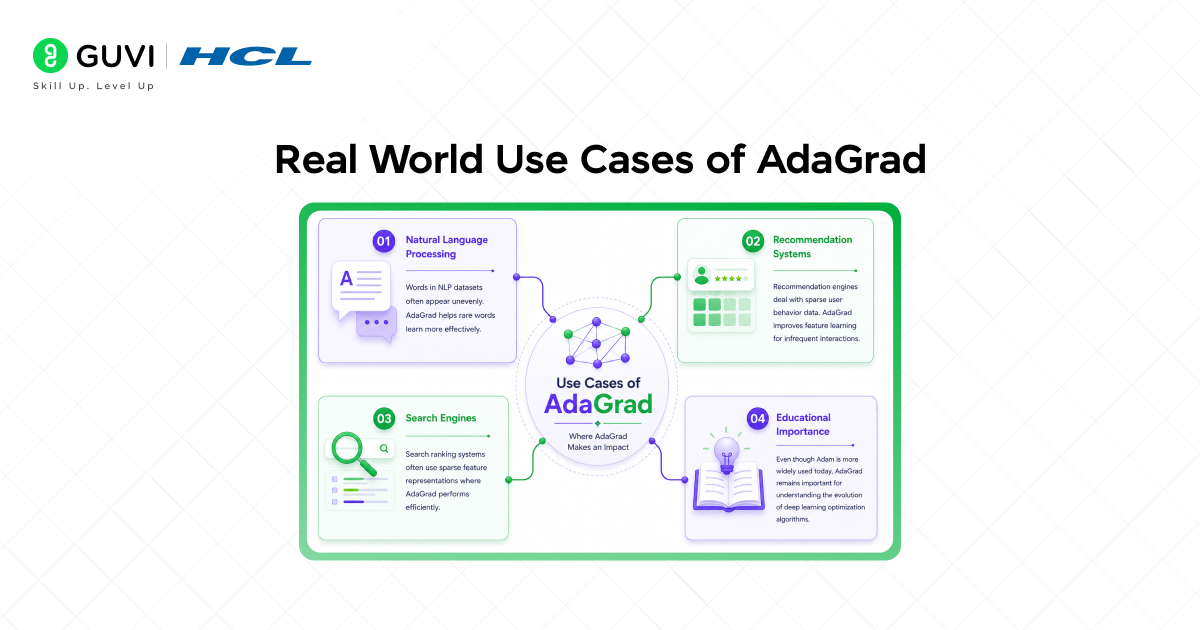
Natural Language Processing
Words in NLP datasets often appear unevenly. AdaGrad helps rare words learn more effectively.
Recommendation Systems
Recommendation engines deal with sparse user behavior data. AdaGrad improves feature learning for infrequent interactions.
Search Engines
Search ranking systems often use sparse feature representations where AdaGrad performs efficiently.
Educational Importance
Even though Adam is more widely used today, AdaGrad remains important for understanding the evolution of deep learning optimization algorithms.
Python Implementation of AdaGrad
Here’s a simple TensorFlow example:
import tensorflow as tf
model = tf.keras.Sequential([
tf.keras.layers.Dense(128, activation=’relu’),
tf.keras.layers.Dense(10, activation=’softmax’)
])
optimizer = tf.keras.optimizers.Adagrad(
learning_rate=0.01
)
model. compile(
optimizer=optimizer,
loss=’sparse_categorical_crossentropy’,
metrics=[‘accuracy’]
)
This implementation applies the AdaGrad optimizer during neural network training. You can also explore building a neural network using TensorFlow to understand optimizer behavior in practical training workflows.
After understanding optimizers like AdaGrad, learning how modern AI systems are trained becomes much easier.
Want to strengthen your understanding of neural networks, optimizers, and deep learning workflows? Check out HCL GUVI’s free AI ebook to learn core deep learning concepts through practical examples.
Best Practices While Using AdaGrad
Use Moderate Initial Learning Rates
AdaGrad already reduces learning rates automatically. Extremely high starting learning rates may still cause instability.
Prefer Sparse Data Problems
AdaGrad performs best in sparse feature environments rather than dense deep learning workloads.
Monitor Training Convergence
If learning slows too much, consider switching to RMSProp or Adam.
Combine with Proper Feature Engineering
Optimization works better when features are normalized and well-structured.
Common Mistakes to Avoid
Treating AdaGrad as the Best Optimizer
AdaGrad is historically important but not always the best choice for modern deep learning systems.
Ignoring Learning Rate Decay
Its shrinking learning rate is a serious limitation in long training tasks.
Using It for Every Neural Network
Different optimization algorithms suit different architectures and datasets.
Confusing AdaGrad with Adam
Both are adaptive optimizers, but Adam also includes momentum and improved convergence handling.
If you want hands-on experience with deep learning, neural networks, and practical AI projects, HCL GUVI’s AI & ML Course can help you build industry-ready skills through project-based learning.
Conclusion
AdaGrad introduced one of the most influential ideas in deep learning optimization: adaptive learning rates. By adjusting parameter updates dynamically, it improved how machine learning models handled sparse data and infrequent features.
Although newer optimizers like Adam and RMSProp are more widely used today, AdaGrad remains an important milestone in the evolution of AI optimization algorithms. Understanding how AdaGrad works also helps developers better understand modern neural network training techniques and optimization behavior.
If you are learning deep learning, machine learning, or neural networks, AdaGrad is still worth studying because many modern optimizers were built from its core concepts.
FAQs
1. What is AdaGrad in deep learning?
AdaGrad is an adaptive gradient optimization algorithm that adjusts learning rates individually for each parameter during neural network training.
2. Why is AdaGrad good for sparse data?
AdaGrad gives larger updates to infrequent features, making it highly effective for sparse datasets like NLP embeddings and recommendation systems.
3. What is the main disadvantage of AdaGrad?
Its learning rate continuously decreases over time, which can slow training and reduce performance in deep neural networks.
4. Is AdaGrad better than Adam?
Not usually. Adam generally performs better for modern deep learning tasks because it combines adaptive learning rates with momentum-based optimization.
5. Where is AdaGrad commonly used?
AdaGrad is commonly used in NLP, recommendation systems, sparse feature learning, and educational deep learning implementations.
Success Stories

About the Author
Vishalini Devarajan
An Aerospace Engineer turned content writer, I focus on making complex concepts easy to understand through well-structured, reader-friendly blogs. Whether it’s a technical topic or a non-technical one, I love creating content that is clear, engaging, and impactful.
View all posts by Vishalini Devarajan
Connect with me @













Did you enjoy this article?