


Artificial Intelligence and Machine Learning Articles
How to Evaluate LLM Outputs in Production Deployments
AI/ML Skills Gap 2026: Why Companies Can't Find Job-Ready Talent
20 AI/ML Interview Questions Recruiters Can Use Without a Tech Background - Best Guide
How Industry-Backed AI/ML Bootcamps Are Changing the AI/ML Hiring Pipeline - Best Guide 2026


Get In Touch For Details! Request More Information

Uninformed Search Strategies in AI: A Complete Guide
Jul 02, 2026 6 Min Read 1583 Views
(Last Updated)
Imagine you’re dropped into an unfamiliar city with no map, no GPS, and no clue where the train station is. You explore by trying one street, backtracking from dead ends, and picking another. This mirrors what an AI agent does with uninformed search strategies. It starts from a known point and hunts for the goal blindly, systematically probing possibilities.
Uninformed search, also called blind search, forms the bedrock of AI pathfinding. You only know the start and goal nodes, with zero guidance on traversal. All paths seem equally promising, so the agent picks child nodes one by one. Every advanced AI technique builds on these core fundamentals.
In this article, we will walk through each of the six major uninformed search strategies: Breadth-First Search, Depth-First Search, Depth-Limited Search, Iterative Deepening Depth-First Search, Uniform-Cost Search, and Bidirectional Search, explaining how each one works, what it is good for, and what its limitations are.
Table of contents
- Quick TL;DR
- OVERVIEW OF Uninformed Search Strategies in AI
- Understanding State Space and Problem Formulation
- State Space Framework
- Key State Space Components
- Essential Algorithm Properties
- Complexity Measures
- Breadth-First Search (BFS)
- Step 1: Core Intuition
- Step 2: Level-by-Level Process
- Step 3: Key Properties
- Step 4: Strengths and Weaknesses
- Depth-First Search (DFS)
- Depth-Limited Search (DLS)
- Iterative Deepening Depth-First Search (IDDFS)
- Step 1: Why IDDFS Excels
- Step 2: Core Process
- Step 3: Addressing Redundancy
- Step 4: Optimal Properties
- Uniform-Cost Search (UCS)
- Bidirectional Search
- Comparing the Six Algorithms
- Final Thoughts
- FAQs
- When to pick BFS over IDDFS?
- Is UCS uninformed?
- Can bidirectional work on puzzles like 8-queens?
- How to implement queues/stacks in Python?
- Real-world apps?
Quick TL;DR
- Foundation: Blind exploration of state spaces, no path guidance.
- BFS: Level-order, optimal/shortest, but memory hog.
- DFS: Depth-first, low memory, but risks infinity.
- IDDFS: Best hybrid BFS power, DFS space.
- UCS: Optimal for varying costs via priority queue.
- Bidirectional: Meet-in-middle for massive speedup.
What Are Uninformed Search Strategies in AI?
Uninformed search strategies in AI are algorithms that explore a problem’s state space using only the problem definition, start state, goal state, and available actions, without any additional domain knowledge to guide which path to try first.
OVERVIEW OF Uninformed Search Strategies in AI
Uninformed search algorithms provide basic search strategies for exploring problem spaces where no additional knowledge is available beyond the problem definition. These algorithms are important for solving a wide range of problems in AI, such as pathfinding, puzzle solving, and state-space search.
Four key criteria, completeness, optimality, time complexity, and space complexity, are used to evaluate and compare each strategy.
Understanding State Space and Problem Formulation
1. State Space Framework
Before diving into algorithms, grasp the framework they share. Every uninformed search problem uses a state space, a mathematical model of all possible situations an agent encounters. It defines the problem’s boundaries systematically.
2. Key State Space Components
State spaces include four essentials: initial state (starting point), actions (possible moves), transition model (action outcomes), and goal test (solution check). The search builds a tree from here, with nodes as states and edges as actions. This tree maps every potential path forward.
3. Essential Algorithm Properties
Evaluating search algorithms hinges on four key properties. Completeness ensures a solution exists if one does. Optimality guarantees the best solution, not just any. These form the foundation for reliable performance.
4. Complexity Measures
Time complexity tracks nodes examined in the worst case. Space complexity gauges memory for storing nodes. Both quantify efficiency, helping compare algorithms in real-world AI applications.
Breadth-First Search (BFS)
Step 1: Core Intuition
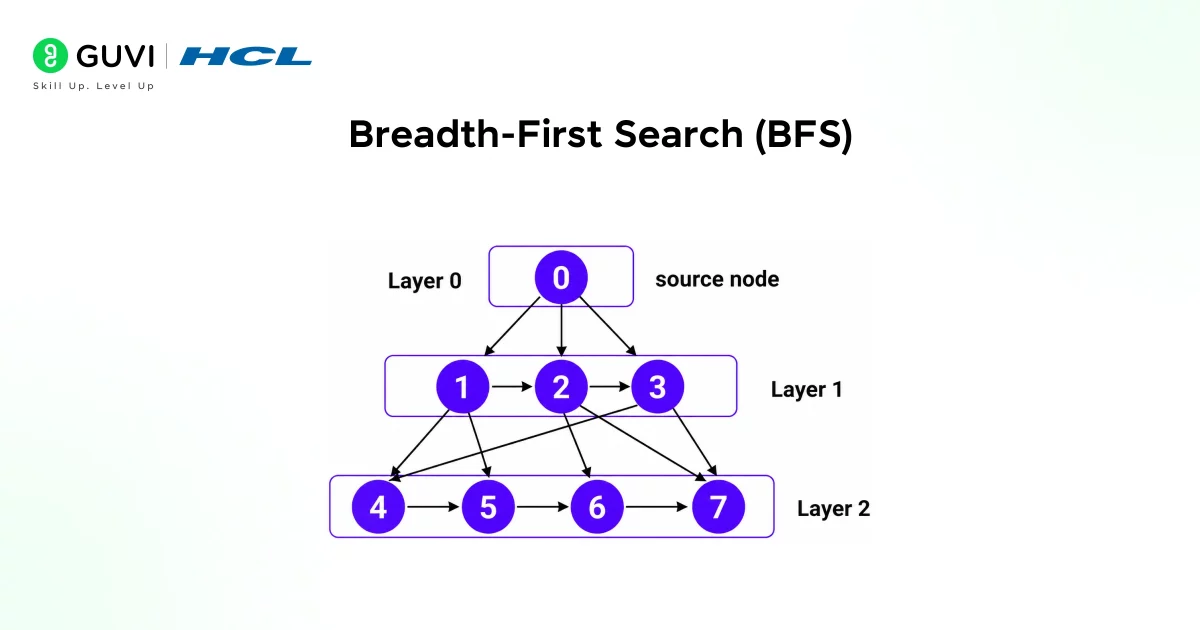
Breadth-first search is the simplest uninformed strategy. It explores level by level checking all depth 1 nodes before depth 2, depth 2 before depth 3, and so on. This systematic approach ensures no path gets overlooked early.
Step 2: Level-by-Level Process
BFS begins at the start node, processing all direct neighbors first. Next, it handles neighbors of those neighbors (excluding repeats), expanding outward. A queue enables this: add new nodes to the back, expand from the front. This FIFO structure enforces level order naturally.
Step 3: Key Properties
BFS is complete if the branching factor bbb is finite. Time complexity: O(bd)O(b^d)O(bd), with ddd as the shallowest goal depth. Space complexity: O(bd), O(b^d), O(bd). Optimal: yes, for unit step costs, it finds the shortest path first.
Step 4: Strengths and Weaknesses
Strength: Guarantees the shallowest solution in uniform-cost spaces. Weakness: Massive memory use for b=10b=10b=10, d=10d=10d=10, it stores ~10 billion nodes. Ideal for shallow trees, impractical for deep ones despite correctness.
Depth-First Search (DFS)
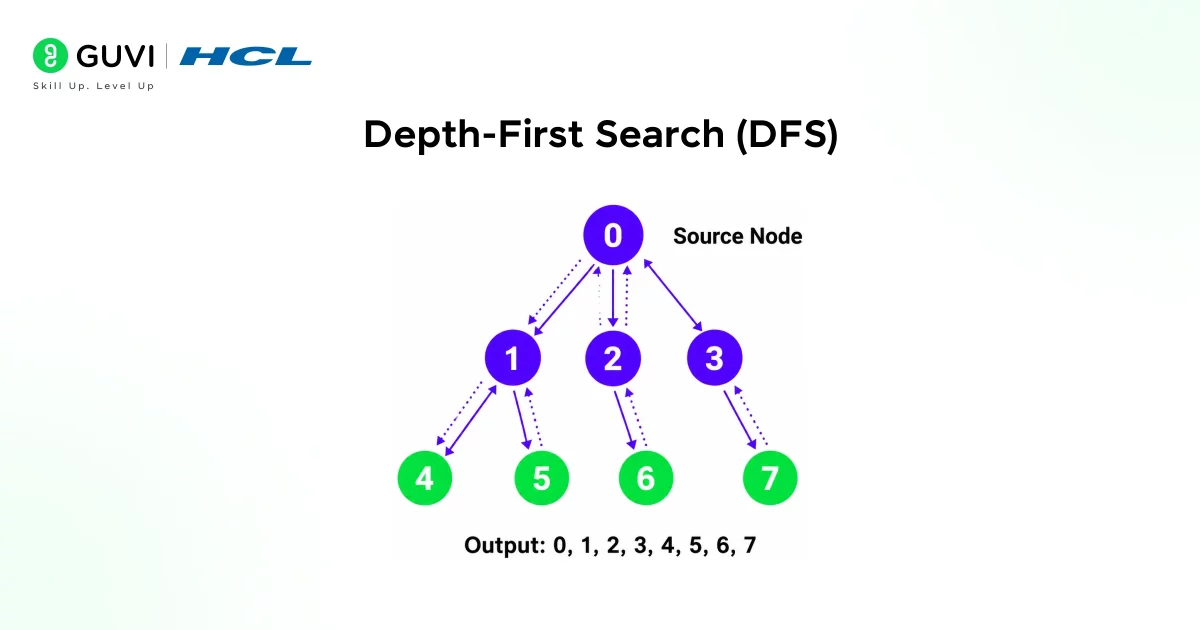
Depth-First Search takes the opposite approach. Instead of exploring level by level, it commits to one path all the way down to the deepest level before backtracking and trying a different branch.
- DFS always expands the deepest node in the frontier of the search tree. The search proceeds to the deepest level of the search tree, which does not have any children yet.
- If the deepest node is not a goal, DFS backtracks and tries another path. The data structure that drives DFS is a stack, a last-in, first-out structure.
- When DFS expands a node, it pushes all of that node’s children onto the stack. The next node to be expanded is always taken from the top of the stack, which means DFS naturally goes deep before going wide.
- The main advantage of DFS over BFS is memory efficiency. DFS only needs to store the nodes on the current path from root to the deepest node, plus any unexplored siblings at each level.
- If there exist cycles in the state space graph, this inevitably means that the corresponding search tree will be infinite in depth.
- Hence, there exists the possibility that DFS will get stuck searching for the deepest node in an infinite-sized search tree, doomed to never find a solution. This is DFS’s critical weakness.
- In a search space with infinite depth or cycles, DFS is not complete it may search forever without finding a solution. DFS is also not optimal because it finds the deepest solution along the first path it explores, not the shallowest or cheapest solution overall.
Depth-Limited Search (DLS)
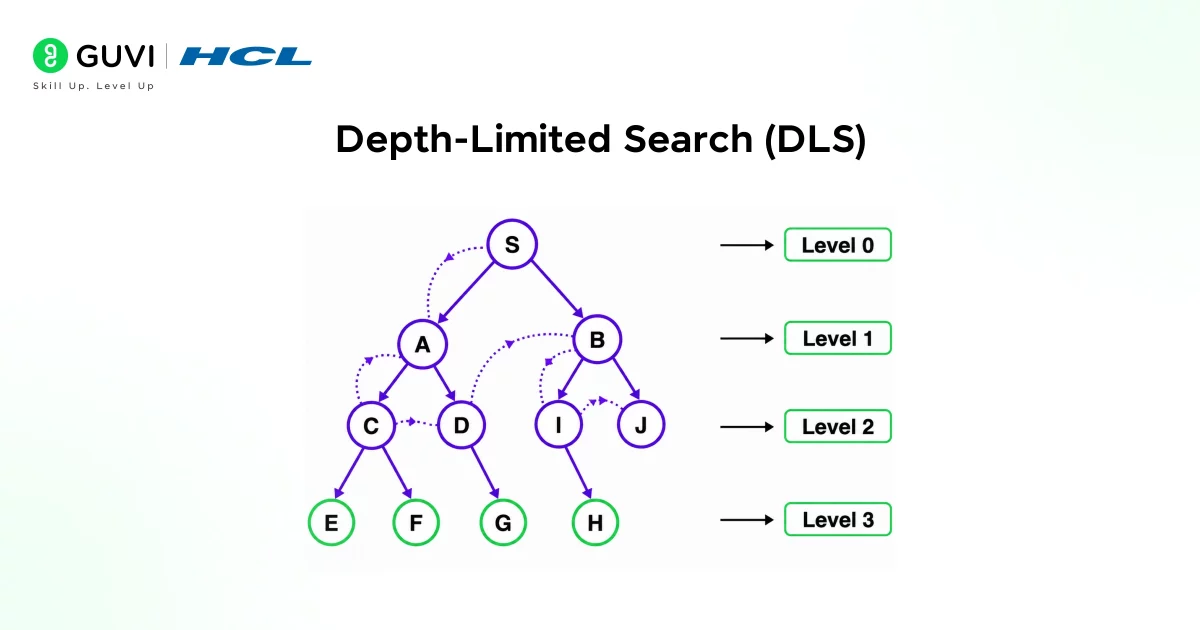
Depth-Limited Search is a practical modification of DFS that directly addresses its infinite-depth problem.
- The idea is simple: impose a maximum depth limit. DFS runs as normal, but any node at or beyond the depth limit is treated as if it has no children. DLS stops going deeper.
- Memory efficient: DLS limits the depth of the search tree, which means that it requires less memory compared to BFS or IDDFS. Time efficient: DLS can be faster than other search algorithms, especially if the solution is closer to the root node.
- Since DLS only explores a limited portion of the search space, it can quickly identify if a solution exists within that portion. Avoids infinite loops: Since DLS limits the depth of the search tree, it can avoid infinite loops that can occur in regular DFS if there are cycles in the graph.
- The limitation of DLS is that choosing the right depth limit is not always obvious. If you set the limit too low, you miss solutions that lie deeper in the tree, and the algorithm is incomplete for those cases.
- If you set it too high, you waste time exploring nodes that are far from the goal. DLS is also not optimal even if the goal exists within the depth limit; DLS finds the first one it reaches along its path, not necessarily the best one.
DLS is most appropriate when you have domain knowledge that tells you the solution lies within a specific depth range.
Iterative Deepening Depth-First Search (IDDFS)
Step 1: Why IDDFS Excels
IDDFS is often the top uninformed search for real-world problems. It blends BFS’s optimality and completeness with DFS’s low memory use. This hybrid avoids both algorithms’ major flaws effectively.
Step 2: Core Process
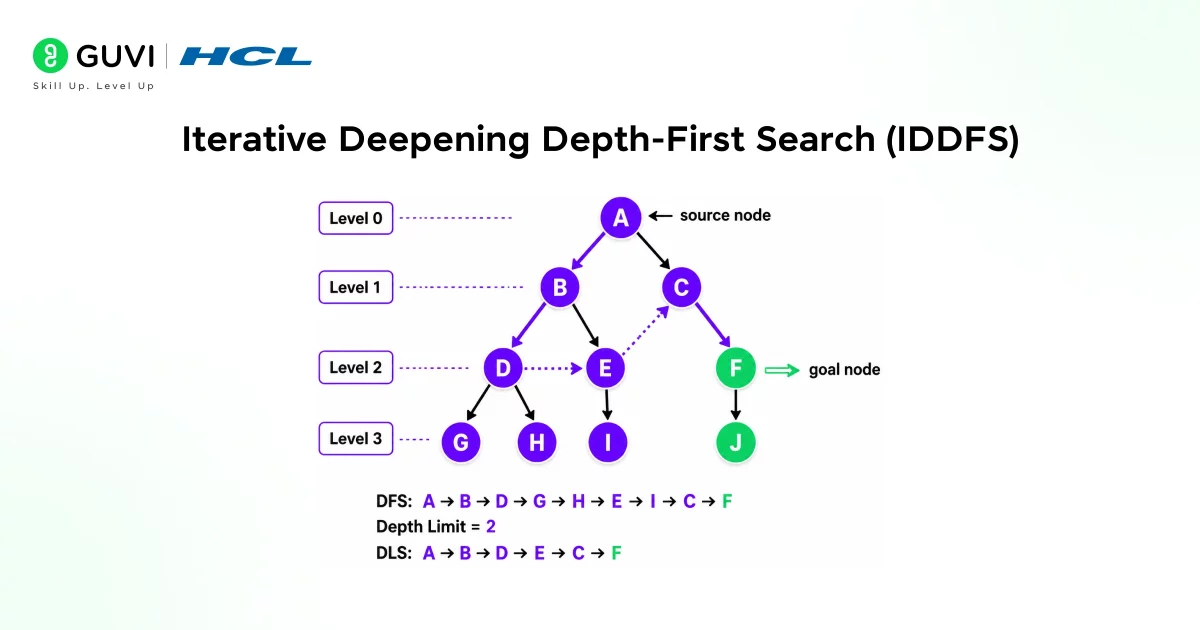
IDDFS runs Depth-Limited Search (DLS) starting at depth 0. It increments the depth limit iteratively until finding the goal. Each iteration does a full DFS up to the current limit, then repeats with a deeper limit. Perfect when the solution depth is unknown.

Step 3: Addressing Redundancy
Re-exploring upper levels seems inefficient at first. In reality, minor bottom levels dominate node count due to exponential growth. Deepest nodes expand only once; upper repeats add little overhead in uniform branching trees.
Step 4: Optimal Properties
Time complexity matches BFS: O(b^d), O(bd). Space complexity mirrors DFS: O(bd) far better than BFS’s O(b^d). Retains BFS completeness and optimality (for unit costs), ideal for memory-constrained, unknown-depth searches.
Uniform-Cost Search (UCS)
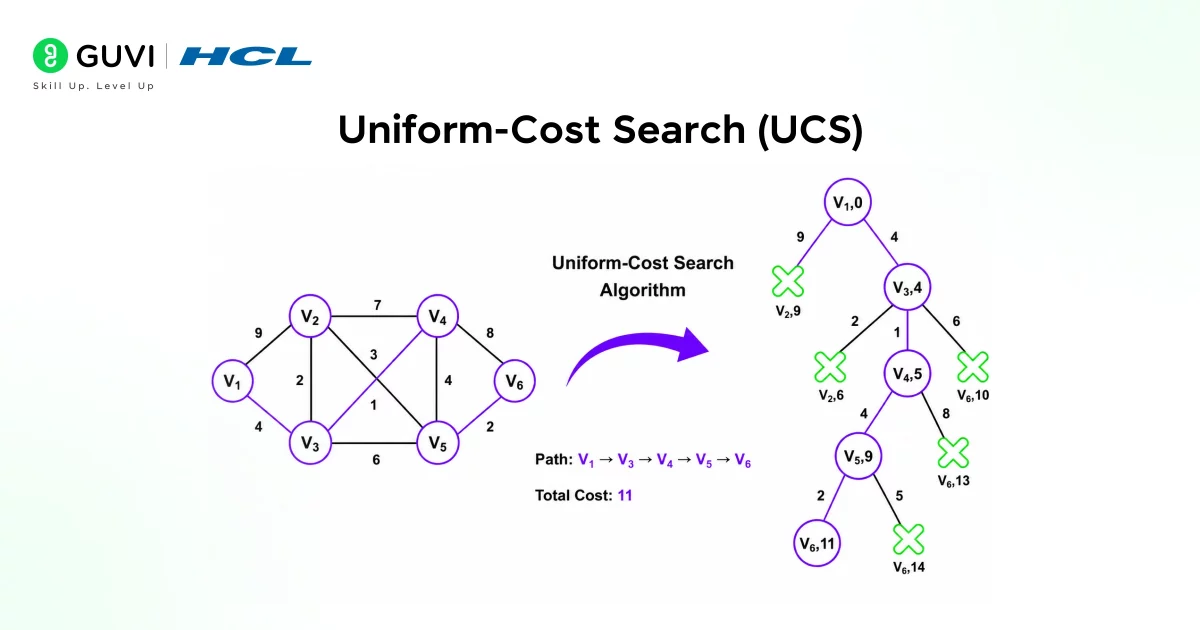
All the algorithms discussed so far treat every step as equal; moving from one state to another costs the same regardless of the action taken. Uniform-Cost Search is the first uninformed algorithm that handles situations where different actions have different costs.
- Uniform-Cost Search is a cost-based uninformed search algorithm that expands the node with the lowest cumulative path cost first. Unlike BFS or DFS, UCS takes into account the cost of reaching each node, ensuring that the path with the lowest overall cost is explored before more expensive paths.
- UCS is typically implemented using a priority queue, where nodes are added based on their cumulative cost, with the lowest-cost node being expanded first. This approach guarantees finding the optimal path in graphs with varying edge weights.
- Uniform cost search expands the node with the lowest path cost. Uniform cost search does not care about the number of steps a path has; instead, it considers its total cost.
- A real-world analogy: if you are routing a package and each road between cities has a different travel cost, UCS would find the cheapest delivery route rather than just the fewest stops.
- We must apply uniform-cost search only if the state costs are different and path costs are not a non-decreasing function of depth.
- In other cases, we could use BFS. UCS is always optimal; it is guaranteed to find the path with the lowest total cost, but its time and space complexity are higher than BFS in cases where all edge weights happen to be equal.
Bidirectional Search
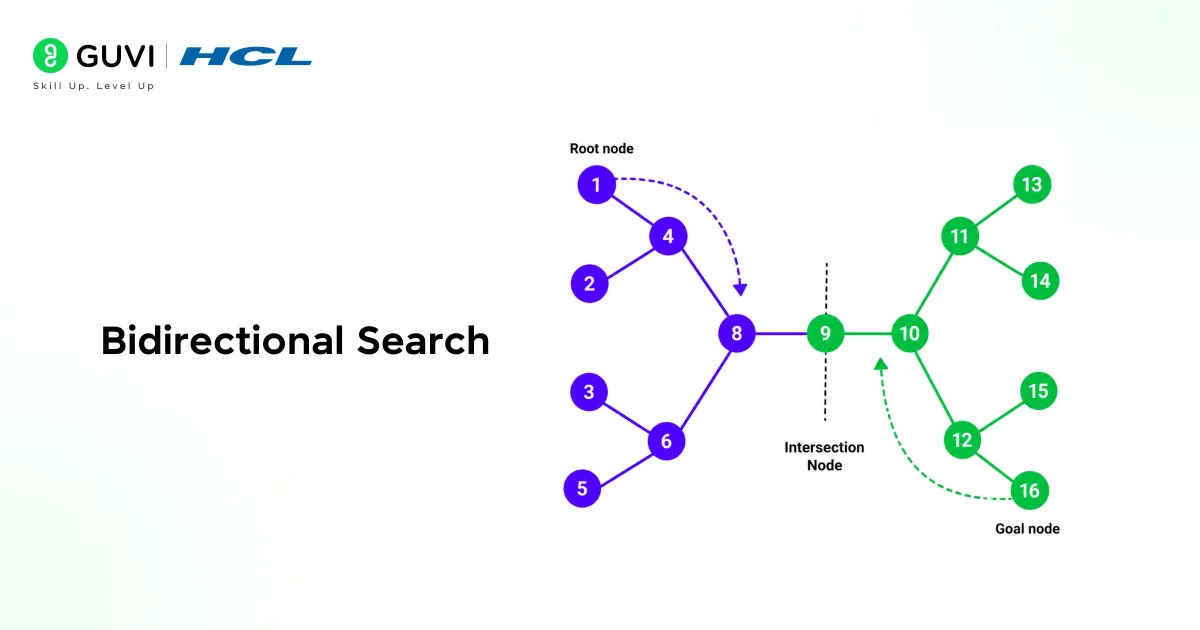
- Bidirectional Search is the most creative of the uninformed search strategies. Rather than searching from start to goal, it runs two simultaneous searches, one forward from the initial state and one backward from the goal state, and stops when the two frontiers meet in the middle.
- As the name suggests, “bi-directional” means two-directional searches are made in this technique. One is the forward search, which starts from the initial state, and the other is the backward search, which starts from the goal state.
- The two searches stop when both searches meet in the middle. The power of bidirectional search comes from the exponential nature of search space growth. If searching from start to goal requires O(b^d) time, searching halfway from each end requires O(b^(d/2)) from each direction, which is dramatically smaller.
- Two searches, each covering half the distance, are much faster combined than one search covering the full distance.
- We can perform two searches simultaneously to reduce the search time. The practical challenge of bidirectional search is that you need to be able to search backwards from the goal, which requires knowing the goal state exactly and being able to reverse the transitions.
- In problems where the goal is not a specific single state, or where actions are not easily reversible, bidirectional search cannot be applied directly. But when it can be applied, it is one of the most powerful techniques in the uninformed search toolkit.
Iterative Deepening DFS (IDDFS) may seem “wasteful” due to repeated exploration, but in practice it’s surprisingly efficient.
In trees with uniform branching, the deepest level contains the vast majority of nodes, so re-exploring shallow levels adds only a negligible overhead.
This allows IDDFS to combine the completeness of BFS with the low memory usage of DFS.
Variants of this approach were even used in space mission planning, showing how fundamental search strategies can scale to extreme, real-world problems.
Comparing the Six Algorithms
- A quick comparison helps you choose the right algorithm for your specific problem. BFS is complete and optimal for equal-cost problems but uses exponential memory.
- DFS is memory-efficient but not complete in infinite spaces and not optimal. DLS fixes DFS’s infinite-depth problem but introduces incompleteness if the depth limit is wrong.
- IDDFS gives you BFS-level completeness and optimality with DFS-level memory efficiency.
- UCS handles variable edge costs and is always optimal. Bidirectional search is the fastest when applicable, cutting effective search depth in half.
- For most problems where all step costs are equal, and memory allows it, BFS or IDDFS are the right starting points.
- For problems with varying costs, UCS is the answer. For problems with a clearly known and reversible goal state, bidirectional search is worth the extra implementation complexity.
If you’re serious about mastering uninformed search strategies like BFS, DFS, and UCS and their real-world AI applications, don’t miss the chance to enroll in HCL GUVI’s Intel & IITM Pravartak Certified Artificial Intelligence & Machine Learning Course, co-designed by Intel.
Final Thoughts
Uninformed search strategies are the building blocks of problem-solving in artificial intelligence. These algorithms are important for solving a wide range of problems in AI, such as pathfinding, puzzle solving, and state-space search.
Before an AI system can be smart about which path to take, it needs to be able to systematically explore all paths, and that is exactly what these six algorithms provide. Understanding the trade-offs between completeness, optimality, time complexity, and space complexity is what allows you to choose the right algorithm for each problem you encounter.
Start by implementing BFS and DFS on a simple graph problem. Write the code, trace through the execution, and verify that the outputs match what the theory predicts. Once those feel natural, implement IDDFS and UCS.
That hands-on practice will make the trade-offs between them feel concrete rather than abstract and will give you the foundation to understand the informed search strategies like A* that build directly on top of everything covered here.
FAQs
1. When to pick BFS over IDDFS?
BFS for shallow problems with ample memory; IDDFS for deeper/unknown depths.
2. Is UCS uninformed?
Yes, no heuristics, just path costs from problem definition.
3. Can bidirectional work on puzzles like 8-queens?
Rarely needs reversible actions and a single goal.
4. How to implement queues/stacks in Python?
Use collections. deque for both (append/popleft for the queue).
5. Real-world apps?
GPS routing (UCS), game AI (IDDFS), theorem proving (DFS).
Success Stories

About the Author
Vishalini Devarajan
An Aerospace Engineer turned content writer, I focus on making complex concepts easy to understand through well-structured, reader-friendly blogs. Whether it’s a technical topic or a non-technical one, I love creating content that is clear, engaging, and impactful.
View all posts by Vishalini Devarajan
Connect with me @













Did you enjoy this article?