


Announcements Articles
HCL GUVI Emerging Tech Skilling Centre Officially Inaugurated by Uttar Pradesh Chief Minister
Her Voice, Her Legacy: Celebrating Women Empowerment Through Stories That Inspire
Beyond the Batch: Our Alumni Stories Don't End at Certification
HCL GUVI Hosts Metaverse Hackathon: Real Stories of Discovery and Learning

Get In Touch For Details! Request More Information

Data Science is the Future: Are You Ready to Get Started?
Oct 15, 2026 5 Min Read 7830 Views
(Last Updated)
Data science now influences everything from personalized recommendations and fraud detection to healthcare analytics, forecasting, automation, and artificial intelligence. Businesses increasingly need professionals who can turn growing volumes of data into useful insights and better decisions.
That demand continues to create career opportunities. The U.S. Bureau of Labor Statistics projects 35% growth in data scientist employment from 2025 to 2035, with about 24,800 openings each year on average.
For beginners, however, the biggest challenge is often knowing where to start. Should you learn Python first? How much statistics do you need? When should you start machine learning? And which projects can actually help you build practical skills?
Read on to understand the essential data science skills, tools, learning roadmap, project ideas, and career steps that can help you get started with clarity.
Table of contents
- Quick Answer
- What Is Data Science and Why Should Beginners Learn It?
- Free 5-Day Data Science Course: Start With a Clear Roadmap
- What You’ll Gain in Just 5 Days
- Day 1: Understand Data Science, Skills, and Tools
- Day 2: Learn How Raw Data Becomes Useful
- Day 3: Understand Machine Learning and AI
- Day 4: Turn Skills Into Career Proof
- Day 5: Build a Data Science Career Roadmap
- Why This Course is Different?
- How Can You Get the Most From This Free Data Science Course?
- After Day 1: Build a Skill Map
- After Day 2: Explore One Dataset
- After Day 3: Define One Prediction Problem
- After Day 4: Create a Project Repository
- After Day 5: Build a 30-Day Learning Plan
- Start Your Free 5-Day Data Science Learning Journey
- How Much Time Should Beginners Spend Learning Data Science?
- What Should You Learn After the 5-Day Data Science Course?
- Step 1: Strengthen Python
- Step 2: Learn SQL
- Step 3: Build Statistics Foundations
- Step 4: Practice Pandas and NumPy
- Step 5: Learn Exploratory Data Analysis
- Step 6: Build Data Visualizations
- Step 7: Learn Machine Learning
- Step 8: Build End-to-End Projects
- What Skills Should a Data Science Beginner Learn First?
- Python
- SQL
- Statistics and Probability
- Data Analysis
- Data Visualization
- Machine Learning
- Can You Learn Data Science Without a Computer Science Degree?
- Do You Need Coding or Mathematics Before Starting Data Science?
- Conclusion
- FAQs
- Is data science a good career for beginners in 2026?
- How can I start learning data science from scratch?
- Can I learn data science for free?
- How long does it take to learn data science?
- What should I learn first: Python, SQL, or machine learning?
Quick Answer
HCL GUVI’s free 5-day Data Science email course introduces beginners to the core skills, tools, applications, and career paths in data science.
- Day 1: Data science fundamentals, tools, and skills
- Day 2: Data wrangling, EDA, and statistics
- Day 3: Machine learning, AI, and applications
- Day 4: Portfolio and interview preparation
- Day 5: Career roadmap and project ideas
- Best For: Students, freshers, beginners, and career switchers
- Cost: Free
What Is Data Science and Why Should Beginners Learn It?
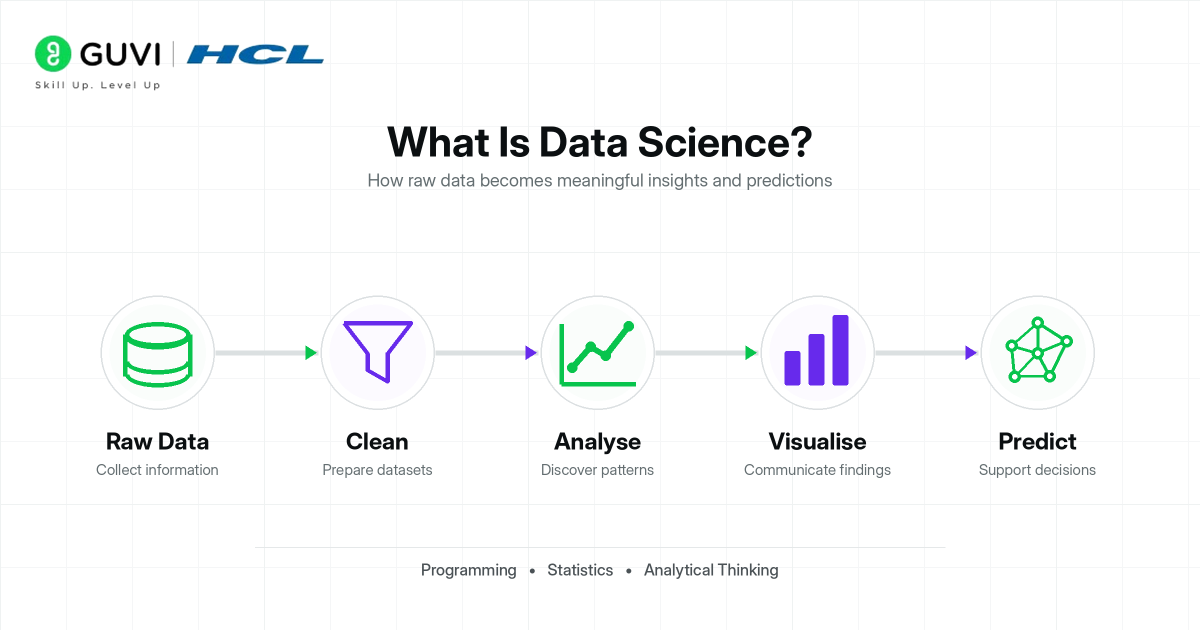
Data science combines programming, statistics, data analysis, domain knowledge, and machine learning to extract useful information from data.
A simplified data science workflow looks like this:
Problem → Data Collection → Data Cleaning → EDA → Modeling → Evaluation → Insights → Decision
Organizations use this process for problems such as:
- Predicting customer churn
- Detecting fraudulent transactions
- Forecasting product demand
- Building recommendation systems
- Segmenting customers
- Analyzing business performance
- Improving healthcare decisions
- Automating data-driven processes
This is why learning data science involves more than memorizing algorithms. Learners need to understand how different techniques work together to solve real problems.
Free 5-Day Data Science Course: Start With a Clear Roadmap
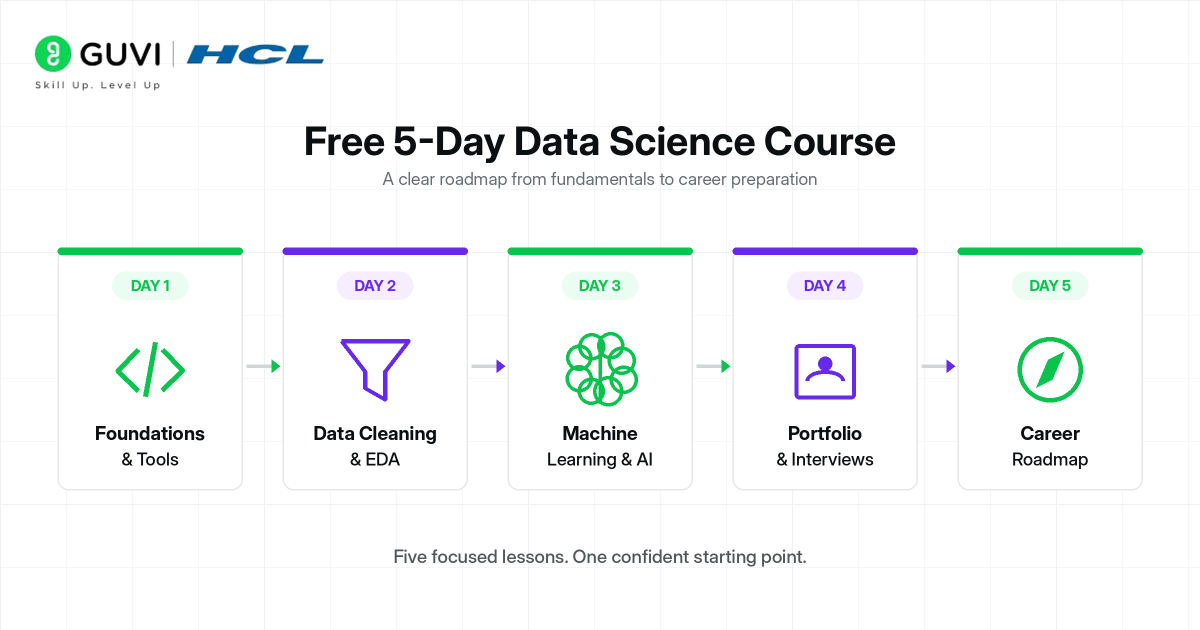
HCL GUVI’s free 5-day Data Science email course gives beginners a structured introduction to the field without overwhelming them with disconnected concepts. Over five focused lessons, learners explore data science fundamentals, Python and Pandas, data cleaning, exploratory data analysis, statistics, machine learning, AI applications, portfolio building, interview preparation, project ideas, and career roadmaps. The course is designed to help learners understand how these areas connect and identify the skills they should build next.
What You’ll Gain in Just 5 Days
The five-day course introduces data science in a logical sequence. Each day builds context for the next instead of treating individual tools as isolated topics.
Day 1: Understand Data Science, Skills, and Tools
The first lesson establishes the foundation.
Learners explore:
- What data science means
- What Data Scientists actually work on
- Core skills required in data science
- Python and its role in data analysis
- Pandas and data manipulation
- Common data science tools
- Where machine learning fits
The goal is not to master every tool immediately. It is to understand the complete landscape before choosing what to learn deeply.
Day 2: Learn How Raw Data Becomes Useful
Real-world datasets rarely arrive ready for analysis.
The second lesson introduces:
- Data cleaning
- Data wrangling
- Exploratory Data Analysis
- Statistical concepts
- Identifying patterns
- Understanding relationships between variables
These foundations help learners understand what happens before a machine learning model is built.
Day 3: Understand Machine Learning and AI
Machine learning enables systems to learn patterns from existing data and use them for predictions or decisions.
The third lesson introduces:
- Machine learning fundamentals
- Artificial intelligence applications
- Predictive modeling concepts
- Industry use cases
- How ML fits within data science
- How organizations use AI with data
This provides context before learners begin studying individual algorithms.
Day 4: Turn Skills Into Career Proof
Technical knowledge becomes more valuable when candidates can demonstrate it.
Day 4 focuses on:
- Building a data science portfolio
- Choosing useful projects
- Presenting project outcomes
- Improving resume positioning
- Preparing for technical interviews
- Demonstrating practical skills to recruiters
A strong portfolio shows how a learner applies concepts rather than merely listing technologies.
Day 5: Build a Data Science Career Roadmap
The final lesson connects the previous four days into a longer learning path.
Learners explore:
- Data science career paths
- Skills to develop next
- Beginner project ideas
- Practical learning priorities
- Portfolio progression
- Career preparation steps
By Day 5, learners should have a clearer answer to one important question: What should I learn next?
Why This Course is Different?
Finding free data science content is easy. Finding the correct learning order is much harder.
Beginners often collect tutorials on Python, machine learning, SQL, statistics, and AI without understanding how these topics connect.
This course follows a structured five-day sequence.
- No Fluff, Just Practical Learning
The lessons focus on foundational concepts, applications, and career direction rather than overwhelming beginners with unnecessary detail.
- Bite-Sized, Actionable Lessons
Each day has one clear learning focus. Beginners can build context gradually rather than consuming an entire curriculum at once.
- A Clear Learning Sequence
The course progresses through:
Fundamentals → Data Analysis → ML & AI → Portfolio → Career Roadmap
This gives each lesson a clear purpose.
- Practical Career Context
The learning does not stop at technical concepts. It also introduces projects, portfolios, interviews, and career planning.
- Guidance From Industry Experts
The lessons help learners understand which skills matter and where those skills fit into real data science workflows.
How Can You Get the Most From This Free Data Science Course?
Reading each email is only the first step. Learners can improve retention by completing one small action after every lesson.
After Day 1: Build a Skill Map
Create five categories:
- Programming
- Data Analysis
- Statistics
- Visualization
- Machine Learning
Add every newly discovered tool under the appropriate category.
After Day 2: Explore One Dataset
Take a simple dataset and answer:
- What does each column represent?
- Are any values missing?
- What patterns are visible?
- Which questions could the dataset answer?
After Day 3: Define One Prediction Problem
Examples include:
- Predicting customer churn
- Estimating house prices
- Classifying spam messages
- Forecasting sales
This develops problem-framing skills before model building begins.
After Day 4: Create a Project Repository
Start organizing a project with:
- Problem statement
- Dataset
- Notebook
- Visualizations
- Results
- README
After Day 5: Build a 30-Day Learning Plan
Choose the next skill based on the roadmap rather than starting several topics simultaneously.
A simple sequence is:
Python → SQL → Statistics → Pandas → EDA → Visualization → Machine Learning → Projects
Start Your Free 5-Day Data Science Learning Journey
Get one structured data science lesson each day for five days.
✓ Beginner-friendly lessons
✓ Practical concepts and examples
✓ Machine learning and AI introduction
✓ Portfolio and career guidance
✓ Project ideas and learning roadmap
✓ Free access
Sign up for the free email course
How Much Time Should Beginners Spend Learning Data Science?
Consistency matters more than trying to study for several hours occasionally.
During the five-day email course, learners can focus on one lesson at a time. After completing each lesson, they can spend a short period reviewing notes and practicing one concept.
After the introductory series, a useful weekly learning structure can include:

- Concept Learning: Understand one topic.
- Coding Practice: Apply the concept.
- Revision: Review weak areas.
- Project Work: Connect multiple skills.
- Documentation: Record what was learned.
The aim is steady progression.
Trying to learn Python, SQL, statistics, machine learning, deep learning, cloud computing, and Generative AI simultaneously can make the learning path unnecessarily difficult.
What Should You Learn After the 5-Day Data Science Course?
The five-day course provides orientation. The next phase should focus on hands-on skill development.
Step 1: Strengthen Python
Build confidence with programming fundamentals and data structures.
Step 2: Learn SQL
Practice querying, joining, filtering, aggregating, and transforming structured datasets.
Step 3: Build Statistics Foundations
Focus on probability, distributions, variability, correlation, and statistical interpretation.
Step 4: Practice Pandas and NumPy
Use them for cleaning, transforming, and analyzing real datasets.
Step 5: Learn Exploratory Data Analysis
Practice asking questions, identifying patterns, and investigating relationships.
Step 6: Build Data Visualizations
Learn how to communicate findings through meaningful charts and dashboards.
Step 7: Learn Machine Learning
Start with foundational algorithms and model evaluation.
Step 8: Build End-to-End Projects
A strong beginner project should demonstrate more than model training.
Use a workflow such as:
Problem → Data → Cleaning → EDA → Modeling → Evaluation → Visualization → Insights
Projects turn individual skills into practical evidence.
What Skills Should a Data Science Beginner Learn First?
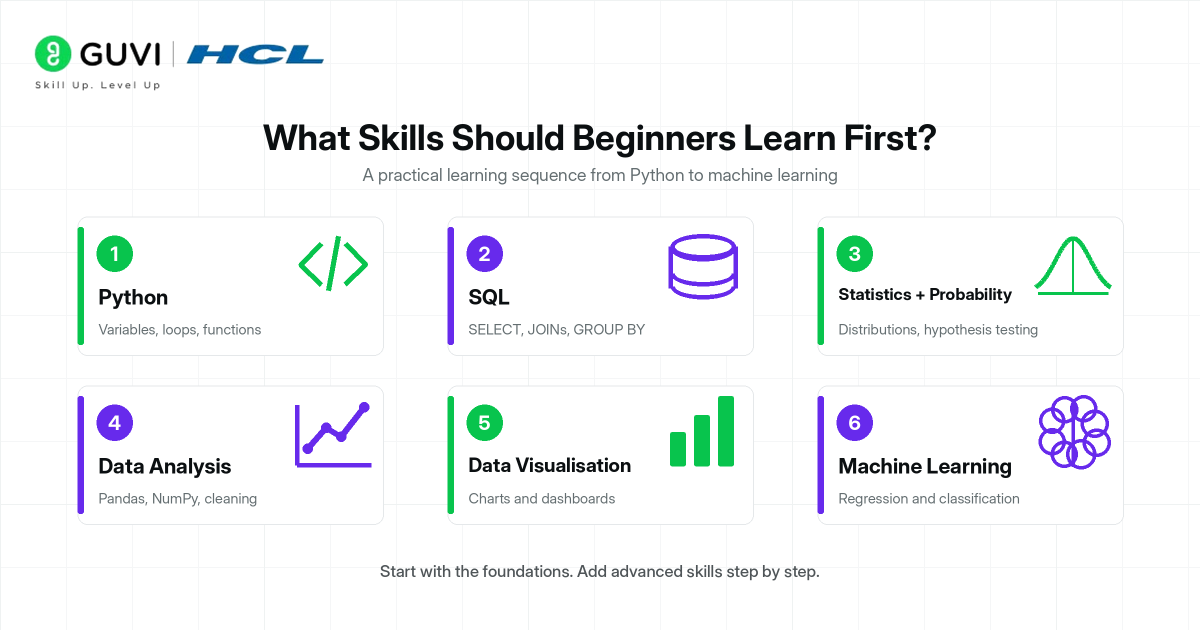
Beginners do not need to study every data technology simultaneously.
A practical sequence is:
1. Python
Start with:
- Variables
- Data types
- Conditions
- Loops
- Functions
- Lists and dictionaries
Python later becomes useful for analysis, machine learning, automation, and model development.
2. SQL
SQL helps learners retrieve and manipulate structured data.
Important concepts include:
- SELECT
- WHERE
- GROUP BY
- ORDER BY
- JOINs
- Aggregate functions
- Window functions
3. Statistics and Probability
Statistics helps learners understand what data actually means.
Core areas include:
- Mean and median
- Variance and standard deviation
- Probability
- Distributions
- Correlation
- Hypothesis testing
4. Data Analysis
Libraries such as Pandas and NumPy help learners clean, transform, and explore datasets.
5. Data Visualization
Charts and dashboards help convert analysis into understandable insights.
6. Machine Learning
Once the foundations are comfortable, beginners can move into:
- Regression
- Classification
- Clustering
- Feature engineering
- Model evaluation
Learning in this order helps connect programming, statistics, analysis, and machine learning instead of treating them as separate subjects.
Can You Learn Data Science Without a Computer Science Degree?
Yes. A computer science degree can be useful, but it is not the only route into data science. Beginners from mathematics, statistics, engineering, economics, business, science, and other backgrounds can build the required skills through structured learning and hands-on practice.
What matters more is developing competence in areas such as:
- Python: For data analysis, automation, and machine learning
- SQL: For accessing and working with structured data
- Statistics: For interpreting patterns and evaluating results
- Data Analysis: For cleaning, exploring, and understanding datasets
- Visualization: For communicating insights clearly
- Machine Learning: For building predictive and classification models
- Projects: For demonstrating how you apply these skills to real problems
Learners from non-technical backgrounds may need additional time for programming fundamentals, while technical learners may need to strengthen statistics or business interpretation.
The key is to identify your existing strengths and systematically close the gaps rather than assuming one academic background is required.
Do You Need Coding or Mathematics Before Starting Data Science?
Advanced coding or mathematics is not required to begin understanding data science.
Beginners can start while gradually strengthening both areas.
Useful starting knowledge includes:
- Basic computer skills
- Logical thinking
- Basic mathematics
- Curiosity about data
- Willingness to practice
As learners progress, Python, SQL, statistics, probability, and machine learning become increasingly important.
The first goal should be understanding the field. Deeper technical mastery can follow through structured practice and projects.
Conclusion
Data science is becoming an important part of how businesses analyze information, automate decisions, build predictive systems, and develop AI-driven applications. For beginners, the challenge is not finding resources but learning the right skills in the right order.
A structured approach can make the journey easier. Start with Python, SQL, statistics, data analysis, and visualization. Then move into machine learning and hands-on projects that show how these skills work together in real-world problems.
HCL GUVI’s free 5-day Data Science email course gives beginners a simple way to understand the field, explore essential tools and concepts, and build a clearer roadmap before moving into deeper learning.
The goal is not to master data science in five days. It is to understand where to begin, what to learn next, and how to turn foundational knowledge into practical skills over time.
FAQs
1. Is data science a good career for beginners in 2026?
Yes. Data science can be a strong career option for beginners who are willing to build skills in Python, SQL, statistics, data analysis, visualization, and machine learning. Beginners should focus on developing practical skills and projects instead of trying to learn every tool at once.
2. How can I start learning data science from scratch?
A practical beginner roadmap is to start with Python, SQL, statistics, Pandas, exploratory data analysis, data visualization, and machine learning. Once these foundations are comfortable, learners should build end-to-end projects that combine multiple skills.
3. Can I learn data science for free?
Yes. Beginners can start learning data science through free courses, tutorials, datasets, coding practice, and project-based resources. HCL GUVI’s free 5-day Data Science email course provides a structured introduction to data science fundamentals, machine learning, portfolio preparation, and career planning.
4. How long does it take to learn data science?
There is no fixed timeline because it depends on your background, consistency, and career goal. A beginner can understand the fundamentals quickly, but becoming job-ready usually requires sustained practice in programming, statistics, machine learning, data handling, and projects.
5. What should I learn first: Python, SQL, or machine learning?
Most beginners should start with Python and SQL before moving deeply into machine learning. Python helps with data analysis and modeling, while SQL helps with retrieving and working with structured data. Once these foundations are strong, statistics and machine learning become easier to understand.
Success Stories

About the Author
Vaishali
I'm a seasoned writer with four years of experience across technical, non-technical, and just about every genre or niche you can imagine. Adaptable and curious, I enjoy exploring new topics and making information engaging and easy to understand. Fueled by a steady stream of tea, I approach each project with creativity, reliability, and genuine enthusiasm for storytelling.
View all posts by Vaishali
Connect with me @









Did you enjoy this article?