


Artificial Intelligence and Machine Learning Articles
How to Evaluate LLM Outputs in Production Deployments
AI/ML Skills Gap 2026: Why Companies Can't Find Job-Ready Talent
20 AI/ML Interview Questions Recruiters Can Use Without a Tech Background - Best Guide
How Industry-Backed AI/ML Bootcamps Are Changing the AI/ML Hiring Pipeline - Best Guide 2026


Get In Touch For Details! Request More Information
Statistics Fundamentals for Machine Learning: A Beginner’s Complete Guide
Jul 15, 2026 7 Min Read 1304 Views
(Last Updated)
Imagine you run a small online store and want to understand your customers better. How much do people typically spend? Are sales increasing or decreasing? Which products are most popular? These questions require more than just looking at numbers. You need statistics.
Statistics is the science of collecting, analyzing, and interpreting data to make informed decisions. It helps you find patterns, measure uncertainty, and draw meaningful conclusions from numbers.
If you are working with data, building machine learning models, or trying to make sense of numbers in any field, understanding statistics fundamentals is essential.
This guide explains the core concepts of statistics in simple terms, from describing data with averages to understanding probability and making predictions.
Table of contents
- Quick TL;DR Summary
- Descriptive Statistics: Summarizing Data
- Mean, Median, and Mode Explained
- Variance and Standard Deviation
- Probability Basics
- Normal Distribution
- Inferential Statistics: Making Predictions
- Hypothesis Testing
- Correlation and Causation
- Conclusion
- FAQs
- What is the difference between descriptive and inferential statistics?
- When should I use mean versus median?
- What does standard deviation tell me?
- What is a p-value in simple terms?
- How does statistics relate to machine learning?
Quick TL;DR Summary
- This guide explains statistics fundamentals, the essential concepts you need to understand data, including how to describe datasets using measures like mean, median, and standard deviation.
- You will learn the difference between descriptive statistics that summarize data and inferential statistics that help you make predictions and draw conclusions about larger populations.
- The guide covers probability basics, distributions, hypothesis testing, and correlation, showing how these concepts connect to real-world decision making.
- Step-by-step examples show you how to calculate common statistics by hand and interpret what they mean, making abstract concepts concrete and practical.
- You will understand when to use different statistical measures, how to avoid common mistakes, and how statistics foundations support machine learning and data science work.
What Is Statistics?
Statistics is a branch of mathematics that focuses on collecting, organizing, analyzing, interpreting, and presenting data. It provides methods and tools to make sense of raw numbers, identify patterns, and extract meaningful insights from data. Statistics is widely used in fields such as data science, machine learning, economics, healthcare, and social sciences to support decision-making and predictions.
There are two main branches: descriptive statistics, which summarizes data you have, and inferential statistics, which helps you make conclusions about data you do not have based on samples.
Statistics answers questions like “What is typical?”, “How much does the data vary?”, “Is this pattern real or just random?”, and “Can I trust this conclusion?”
Descriptive Statistics: Summarizing Data
- What descriptive statistics do
Descriptive statistics take a dataset and reduce it to a few numbers that capture its essential features. Instead of looking at thousands of individual values, you can understand the data through summary statistics like averages and ranges.
- Measures of central tendency
These statistics tell you where the center or typical value of your data is. The mean (average) adds all values and divides by the count. The median is the middle value when data is sorted. The mode is the most frequently occurring value. Each measure highlights different aspects of what is typical.
- Measures of spread
These statistics tell you how much the data varies. The range is the difference between the largest and smallest values. Variance measures average squared distance from the mean. Standard deviation is the square root of variance and shows typical distance from the mean in the original units.
- Why summary statistics matter
A dataset with 10,000 numbers is hard to understand. Knowing the mean is 50, standard deviation is 10, and range is 20 to 80 gives you a clear picture. Summary statistics make data digestible and comparable.
The word “statistics” originates from the Latin word “status”, meaning state. Early forms of statistics were not mathematical in nature but were instead practical tools used by governments to collect and analyze information about populations, resources, and economic activity for purposes such as taxation, governance, and military planning. Over time, these state-driven data collection practices evolved into a formal scientific discipline. Today, statistics has become a foundational branch of mathematics and data science, powering decision-making in fields ranging from artificial intelligence and economics to healthcare and social sciences.
Mean, Median, and Mode Explained
- Mean: The arithmetic average
The mean is calculated by adding all values and dividing by how many values you have. For the dataset [2, 4, 6, 8, 10], the mean is (2+4+6+8+10)/5 = 30/5 = 6. The mean represents the balance point of the data.
- When mean is misleading
The mean is sensitive to extreme values called outliers. If you have salaries [30k, 35k, 40k, 45k, 500k], the mean is 130k, which does not represent most people. The one extremely high salary pulls the average up dramatically.
- Median: The middle value
The median is the middle number when you sort the data. For [30k, 35k, 40k, 45k, 500k], the median is 40k, which better represents a typical salary. With an even number of values, the median is the average of the two middle numbers.
- Mode: The most common value
The mode is the value that appears most frequently. In [2, 3, 3, 4, 5, 5, 5, 6], the mode is 5 because it appears three times. A dataset can have multiple modes or no mode if all values appear equally.
- Choosing the right measure
Use the mean when your data is relatively symmetric without extreme outliers. Use the median when you have skewed data or outliers. Use the mode for categorical data like “most popular product” or “most common eye color.”
Read More: A Guide to Probability and Statistics for Data Science
Variance and Standard Deviation
- Understanding variance
Variance measures how spread out data is from the mean. Calculate it by finding the squared distance of each value from the mean, then averaging those squared distances. Large variance means data is spread out. Small variance means data clusters near the mean.
- Formula for variance
For a dataset with mean μ, variance is the average of (each value minus μ)². For [2, 4, 6, 8, 10] with mean 6: variance = [(2-6)² + (4-6)² + (6-6)² + (8-6)² + (10-6)²]/5 = [16 + 4 + 0 + 4 + 16]/5 = 40/5 = 8.
- Why we square the differences
Squaring makes negative differences positive. Otherwise, values above and below the mean would cancel out. Squaring also emphasizes larger deviations more than smaller ones, which is often desirable in measuring spread.
- Standard deviation: Back to original units
Standard deviation is the square root of variance. It measures spread in the same units as your original data. For variance of 8, standard deviation is √8 ≈ 2.83. If your data is in dollars, standard deviation is also in dollars, making it easier to interpret.
- Interpreting standard deviation
A small standard deviation means most values are close to the mean. A large standard deviation means values are spread out. In a normal distribution, about 68% of values fall within one standard deviation of the mean, and 95% fall within two standard deviations.
The concept of standard deviation was formalized by Karl Pearson in the late 19th century as part of his broader work in establishing modern statistical theory. Before this development, statisticians had limited tools to consistently measure and interpret variability in data. Standard deviation provided a clear and mathematically grounded way to quantify how spread out values are around the mean. Today, it remains a core concept in statistics, data science, and machine learning, where understanding data dispersion is essential for building reliable models, assessing uncertainty, and evaluating performance.
Probability Basics

- What is probability?
Probability measures how likely an event is to occur. It ranges from 0 (impossible) to 1 (certain). A probability of 0.5 means the event has a 50% chance of happening. Probability is the foundation of inferential statistics.
- Calculating basic probability
Probability of an event = (number of favorable outcomes) / (total number of possible outcomes). The probability of rolling a 4 on a six-sided die is 1/6 ≈ 0.167 because there is one favorable outcome (rolling 4) and six total possible outcomes.
- Independent events
Events are independent if one does not affect the other. Flipping a coin twice gives independent events. The probability of getting heads on the second flip is still 0.5 regardless of what happened on the first flip.
- Dependent events
Events are dependent if one affects the probability of the other. Drawing cards from a deck without replacement creates dependent events. After drawing one ace, the probability of drawing another ace changes because there are fewer aces and fewer total cards.
- Addition and multiplication rules
For mutually exclusive events (cannot both happen), add probabilities. Probability of rolling a 2 or a 4 is 1/6 + 1/6 = 2/6. For independent events occurring together, multiply probabilities. Probability of two heads in two coin flips is 0.5 × 0.5 = 0.25.
Normal Distribution
- The bell curve
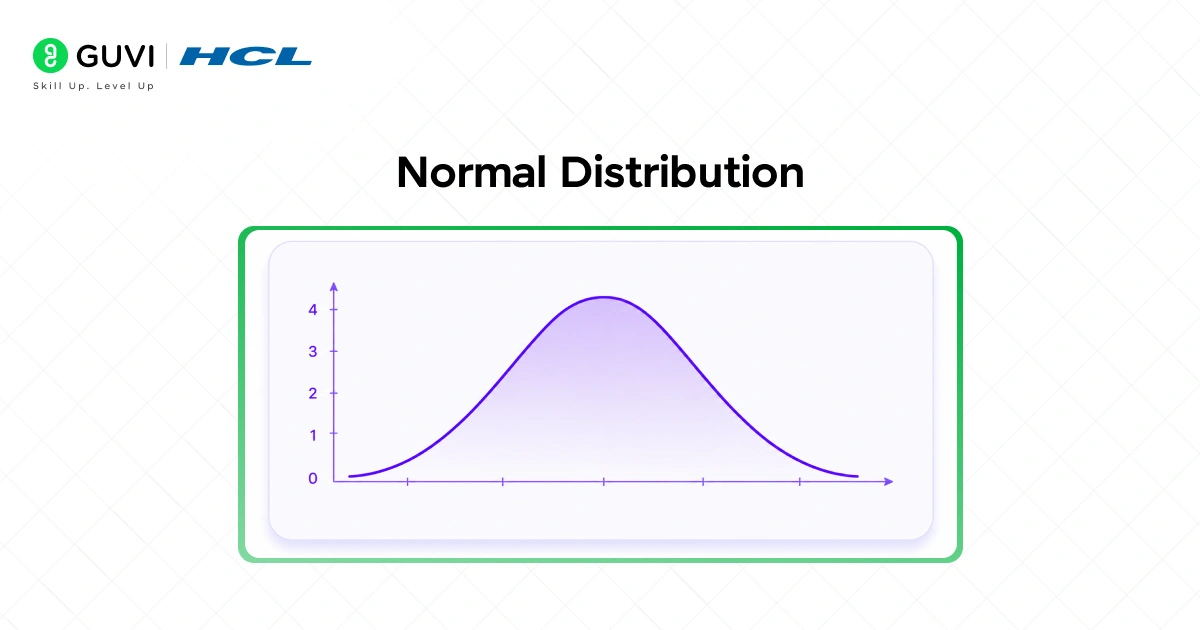
The normal distribution, also called the Gaussian distribution, is the familiar bell-shaped curve. It is symmetric around the mean, with most values near the center and fewer values farther out. Many natural phenomena follow approximately normal distributions.

- Why normal distribution matters
The normal distribution appears everywhere in nature and statistics. Heights, test scores, measurement errors, and many other datasets are approximately normal. Many statistical methods assume normal distribution, making it central to statistical analysis.
- Parameters of normal distribution
A normal distribution is completely defined by two parameters: the mean (center of the curve) and standard deviation (width of the curve). Different means shift the curve left or right. Different standard deviations make it wider or narrower.
- The 68-95-99.7 rule
In a normal distribution, approximately 68% of values fall within one standard deviation of the mean, 95% within two standard deviations, and 99.7% within three standard deviations. This rule helps you understand how extreme a particular value is.
- Standard normal distribution
The standard normal distribution has mean 0 and standard deviation 1. You can convert any normal distribution to standard normal using z-scores. This standardization allows you to compare values from different distributions.
Inferential Statistics: Making Predictions
- What inferential statistics do
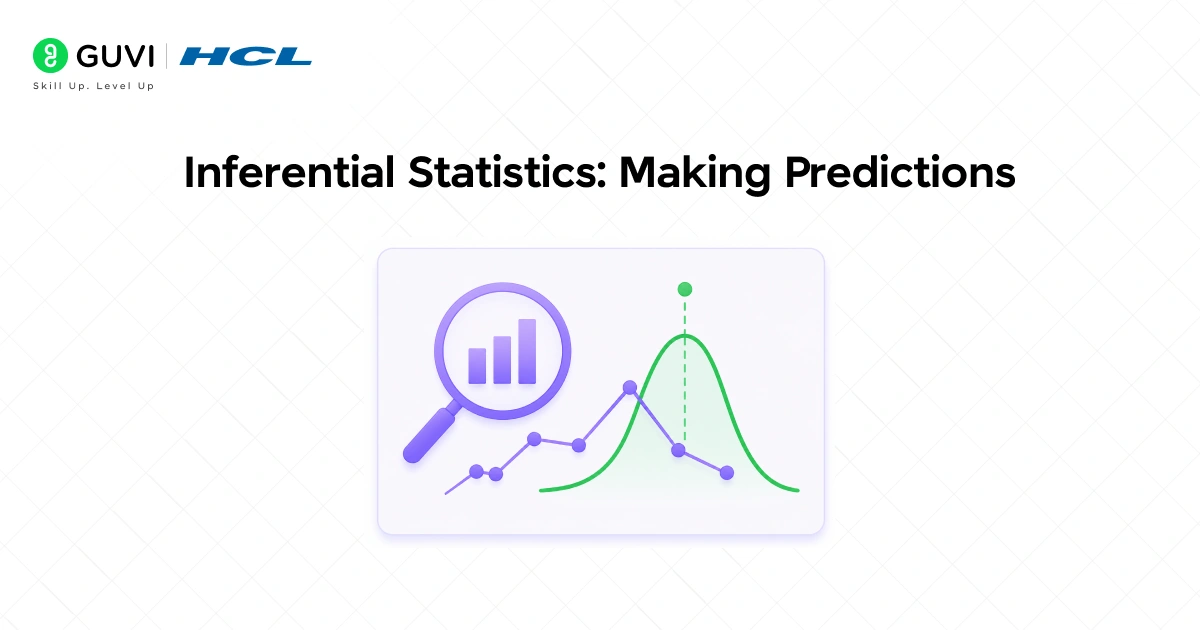
Inferential statistics use sample data to make conclusions about a larger population. You cannot survey every customer, but you can survey 1000 customers and infer characteristics of all customers. This is powerful but requires careful methods.
- Population versus sample
A population is the entire group you want to understand. A sample is the subset of the population you actually collect data from. Good samples are representative, meaning they accurately reflect the population’s characteristics.
- Sampling methods
Random sampling gives every member of the population an equal chance of being selected. This reduces bias. Stratified sampling divides the population into groups and samples from each group. Proper sampling is crucial for making valid inferences.
- Why we need inferential statistics
Collecting data from entire populations is often impossible or impractical. You cannot test every light bulb to measure average lifetime because testing destroys them. You cannot survey every voter. Inferential statistics let you draw conclusions from practical sample sizes.
- Confidence and uncertainty
Inferential statistics always involve uncertainty. Confidence intervals and margins of error quantify this uncertainty. Understanding and communicating this uncertainty is as important as the estimate itself.
Hypothesis Testing

- What is a hypothesis?
A hypothesis is a statement you want to test. The null hypothesis is usually a claim of no effect or no difference. The alternative hypothesis is what you think might be true. For example, null: “this drug has no effect”, alternative: “this drug reduces symptoms.”
- Testing the hypothesis
You collect data and calculate a test statistic that measures how far your data is from what you would expect if the null hypothesis were true. If the data is very unlikely under the null hypothesis, you reject the null hypothesis.
- P-values explained simply
The p-value is the probability of getting your observed results (or more extreme) if the null hypothesis is true. A small p-value (typically less than 0.05) suggests your results are unlikely to occur by random chance alone, leading you to reject the null hypothesis.
- Type I and Type II errors
A Type I error is rejecting a true null hypothesis (false positive). A Type II error is failing to reject a false null hypothesis (false negative). You cannot eliminate both errors, so you choose acceptable error rates based on consequences.
- Practical significance versus statistical significance
A result can be statistically significant (unlikely due to chance) but practically insignificant (too small to matter). With large enough samples, tiny differences become statistically significant even if they are not meaningful in the real world.
Correlation and Causation
- What is correlation?
Correlation measures the strength and direction of the relationship between two variables. Positive correlation means when one increases, the other tends to increase. Negative correlation means when one increases, the other tends to decrease.
- Correlation coefficient
The correlation coefficient (usually denoted r) ranges from -1 to +1. A value of +1 means perfect positive correlation. A value of -1 means perfect negative correlation. A value of 0 means no linear correlation. Values near 0 indicate weak correlation.
- Correlation does not imply causation
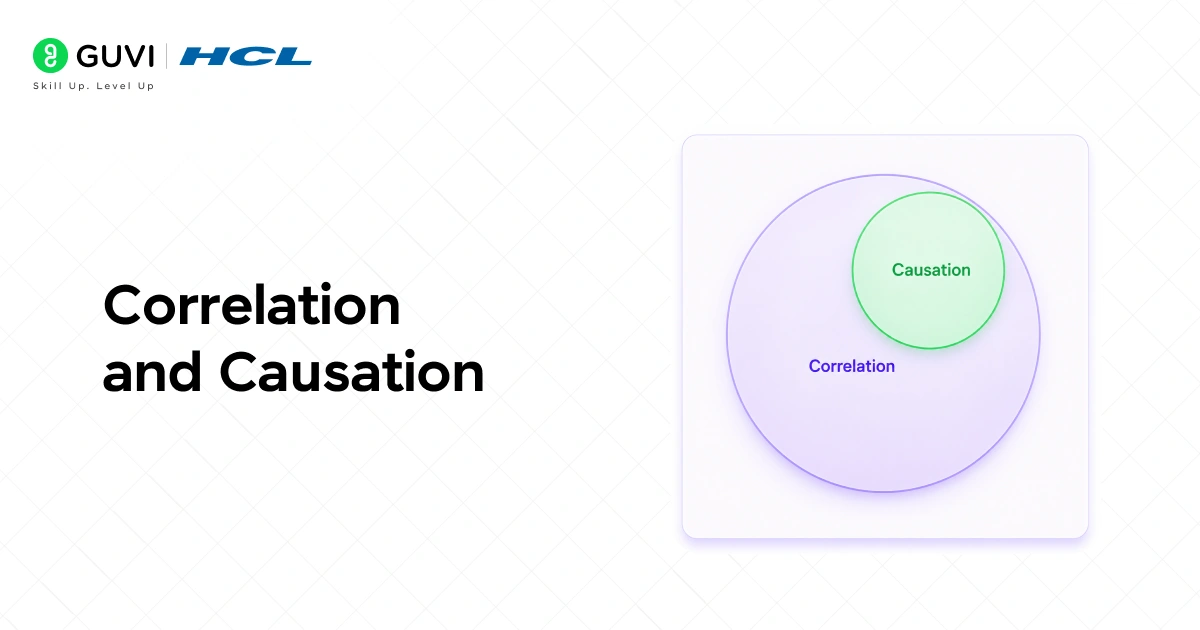
Just because two variables correlate does not mean one causes the other. Ice cream sales and drowning deaths correlate, but ice cream does not cause drowning. Both increase in summer for different reasons. Correlation shows association, not causation.
- Establishing causation
To establish causation, you need controlled experiments where you manipulate one variable and measure effects while controlling other factors. Observational data can suggest relationships but cannot prove causation without eliminating confounding variables.
- Why this matters in data analysis
In machine learning and data science, understanding the difference between correlation and causation is critical. Models can use correlations for prediction without implying causation. Claiming causation requires much stronger evidence than correlation.
To learn more about Statistics Fundamentals, do not miss the chance to enroll in this AI and Machine Learning course covering AI fundamentals, Python, deep learning, NLP, and computer vision through hands-on projects and expert guidance with certification.
Conclusion
Statistics provides the tools to understand data, measure uncertainty, and make informed decisions. Descriptive statistics summarize data while inferential statistics let you draw conclusions about populations from samples.
Understanding probability, distributions, and hypothesis testing enables you to analyze data scientifically. Knowing the difference between correlation and causation prevents false conclusions.
Statistics is the foundation of machine learning and data science. Every model, every A/B test, and every analysis relies on statistical principles.
Start with the basics: calculate means and standard deviations, understand normal distributions, and learn to interpret p-values. Build on these fundamentals to master more advanced techniques.
Statistics is not just formulas. It is a way of thinking about data, uncertainty, and evidence.
FAQs
1. What is the difference between descriptive and inferential statistics?
Descriptive statistics summarize and describe data you have, using measures like mean, median, and standard deviation. Inferential statistics use sample data to make conclusions and predictions about larger populations you have not fully measured. Descriptive answers “what is this data like?” while inferential answers “what can I conclude beyond this data?”
2. When should I use mean versus median?
Use mean when your data is roughly symmetric without extreme outliers. Use median when your data is skewed or contains outliers, as median is not affected by extreme values. For income data, median is usually better because high earners skew the mean upward.
3. What does standard deviation tell me?
Standard deviation measures how spread out your data is from the mean. Small standard deviation means values cluster tightly around the mean. Large standard deviation means values are more spread out. It is expressed in the same units as your data, making it easy to interpret.
4. What is a p-value in simple terms?
A p-value is the probability of getting your observed results (or more extreme) if the null hypothesis is true. A small p-value (typically less than 0.05) suggests your results are unlikely to occur by random chance, leading you to conclude there is a real effect. It measures evidence against the null hypothesis.
5. How does statistics relate to machine learning?
Statistics provides the foundation for machine learning. Concepts like probability distributions, variance, correlation, and hypothesis testing are essential for understanding how machine learning algorithms work, evaluating model performance, and making valid conclusions from data. Strong statistical knowledge makes you a better machine learning practitioner.
Success Stories

About the Author
Vishalini Devarajan
An Aerospace Engineer turned content writer, I focus on making complex concepts easy to understand through well-structured, reader-friendly blogs. Whether it’s a technical topic or a non-technical one, I love creating content that is clear, engaging, and impactful.
View all posts by Vishalini Devarajan
Connect with me @













Did you enjoy this article?