


Python Articles
Freelancing as a Python Developer: Getting Your First Client
Common Python Mistakes Beginners Make And How to Fix Them
Python Best Practices: Writing Clean, Maintainable Code Like a Pro
How to Build a Python Developer Portfolio That Gets You Hired

Get In Touch For Details! Request More Information
11 Essential Python Developer Skills in 2026: A Career Guide for Aspiring and Working Developers
Aug 27, 2026 8 Min Read 9190 Views
(Last Updated)
Are you ready to turn your Python skills into a powerful career asset? Python is more than just a beginner-friendly language; it’s the backbone of countless innovations in web development, data science, automation, and AI.
Essential Python developer skills span core language fundamentals, object-oriented programming, web frameworks, data libraries, APIs, version control, and increasingly, machine learning and front-end basics. Mastering these Python developer skills is what separates someone who can write Python from someone who can ship real, maintainable software with it.
This guide breaks down all 11 essential Python developer skills, a quick-reference table, real salary data by specialization, and where these skills matter most for Indian tech jobs in 2026.
Table of contents
- Python Developer Skills at a Glance
- 11 Essential Python Developer Skills
- Mastering Python Fundamentals
- Object-Oriented Programming (OOP)
- Familiarity with Python Web Frameworks
- Proficiency with ORM Libraries
- Data Analysis and Visualization Libraries
- Building and Using RESTful APIs
- Version Control with Git
- Knowledge of Machine Learning and AI Libraries
- Midway Challenge: Build Your Own Mini Python Stack!
- Understanding Front-End Technologies (HTML, CSS, JavaScript)
- Testing and Debugging Skills
- Communication and Collaboration Skills
- Which Python Developer Skills Actually Pay More? Salary by Specialization
- Best Python Developer Skills to Prioritize for Indian Tech Jobs in 2026
- Conclusion
- Frequently Asked Questions
- Can I learn Python without any programming experience?
- How long does it take to become proficient in Python?
- What career paths can a Python developer pursue?
Python Developer Skills at a Glance
Before the full breakdown, here’s how all 11 essential Python developer skills compare side by side.
| # | Skill | Key Tools/Libraries | Why It Matters |
|---|---|---|---|
| 1 | Python Fundamentals | Core syntax, built-in data structures, standard library | The foundation every other skill builds on |
| 2 | Object-Oriented Programming | Classes, inheritance, polymorphism, encapsulation | Enables scalable, maintainable code |
| 3 | Web Frameworks | Django, Flask | Required for most web development roles |
| 4 | ORM Libraries | SQLAlchemy, Django ORM | Removes the need to write raw SQL constantly |
| 5 | Data Analysis & Visualization | Pandas, NumPy, Matplotlib, Seaborn | Useful even outside dedicated data roles |
| 6 | RESTful APIs | Flask, Django REST Framework, FastAPI, Requests | Lets applications talk to each other |
| 7 | Version Control | Git, GitHub, GitLab | Non-negotiable for any professional team |
| 8 | Machine Learning & AI Libraries | Scikit-Learn, TensorFlow, PyTorch | The highest-paying of all Python developer skills in this list |
| 9 | Front-End Basics | HTML, CSS, JavaScript | Essential for full-stack Python roles |
| 10 | Testing & Debugging | PyTest, unittest, pdb | Catches bugs before they reach production |
| 11 | Communication & Collaboration | Documentation, code reviews, Git commit hygiene | Determines how far your technical skills actually take you |
11 Essential Python Developer Skills
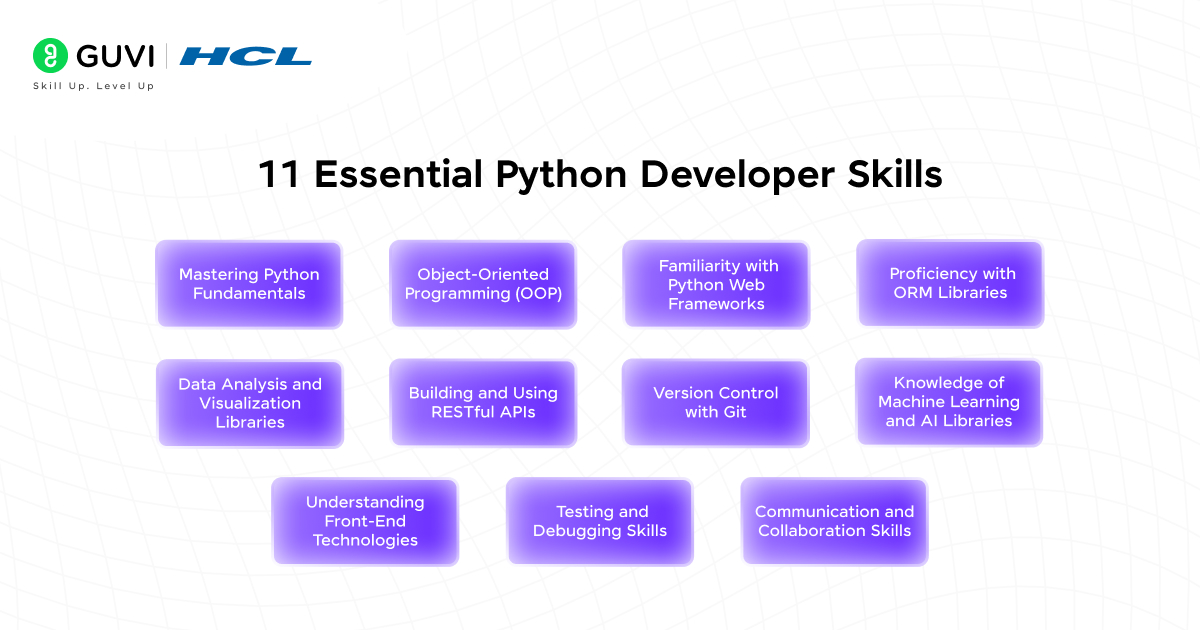
For Python developers, building a strong skill set is crucial for tackling a wide range of challenges, from backend programming to integrating advanced libraries. Each core skill adds value to a developer’s toolkit, making tasks, projects, and real-world applications smoother and more efficient. Let’s take a closer look at these essential Python developer skills that can make all the difference in achieving success.
1. Mastering Python Fundamentals
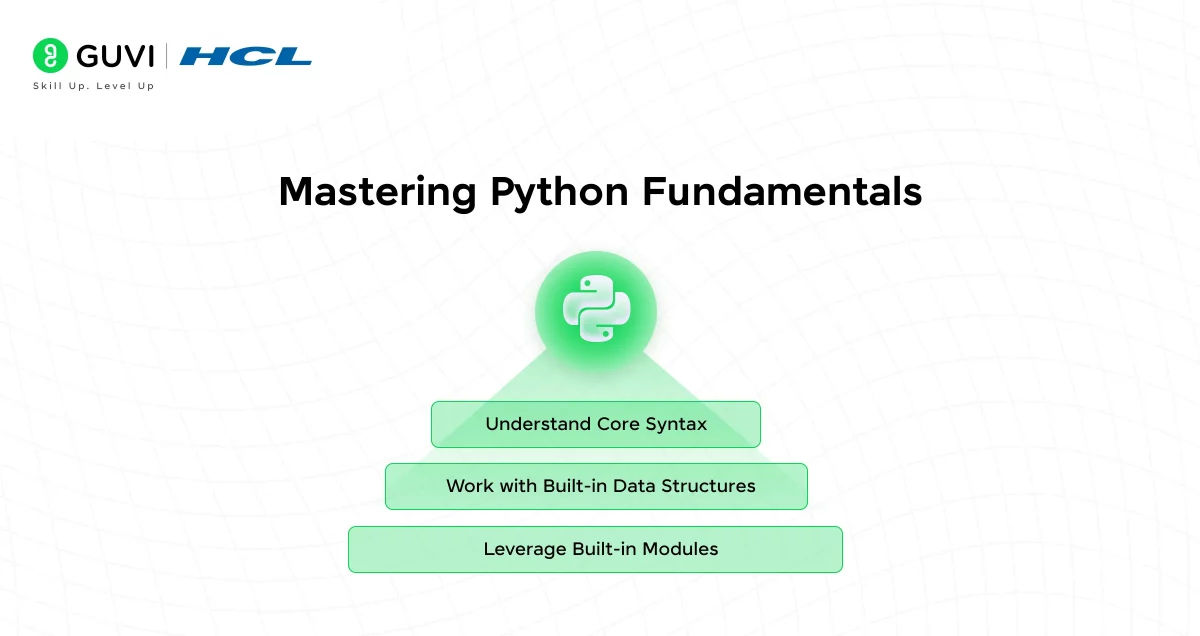
The most foundational of all Python developer skills. Every Python developer’s journey begins with a solid grasp of Python fundamentals. This means understanding the basic syntax and language features that form the building blocks of any program.
If you’re serious about Python development, it all starts here. Python’s simplicity is one of its biggest strengths, but don’t let that fool you, mastering the fundamentals is non-negotiable.
- Understand Core Syntax: Get comfortable with variables, data types, loops, and conditional statements. These building blocks, core to fundamental Python developer skills, let you create logic, automate tasks, and structure programs efficiently.
- Work with Built-in Data Structures: Python’s lists, dictionaries, tuples, and sets are powerful tools for managing and organizing data. Learn how and when to use each to write clean, efficient code.
- Leverage Built-in Modules: From math and datetime to os and random, Python’s standard library is packed with time-saving features. These built-ins help you solve common problems without reinventing the wheel.
Explore: The Asynchronous IO Revolution in Python Explained
2. Object-Oriented Programming (OOP)
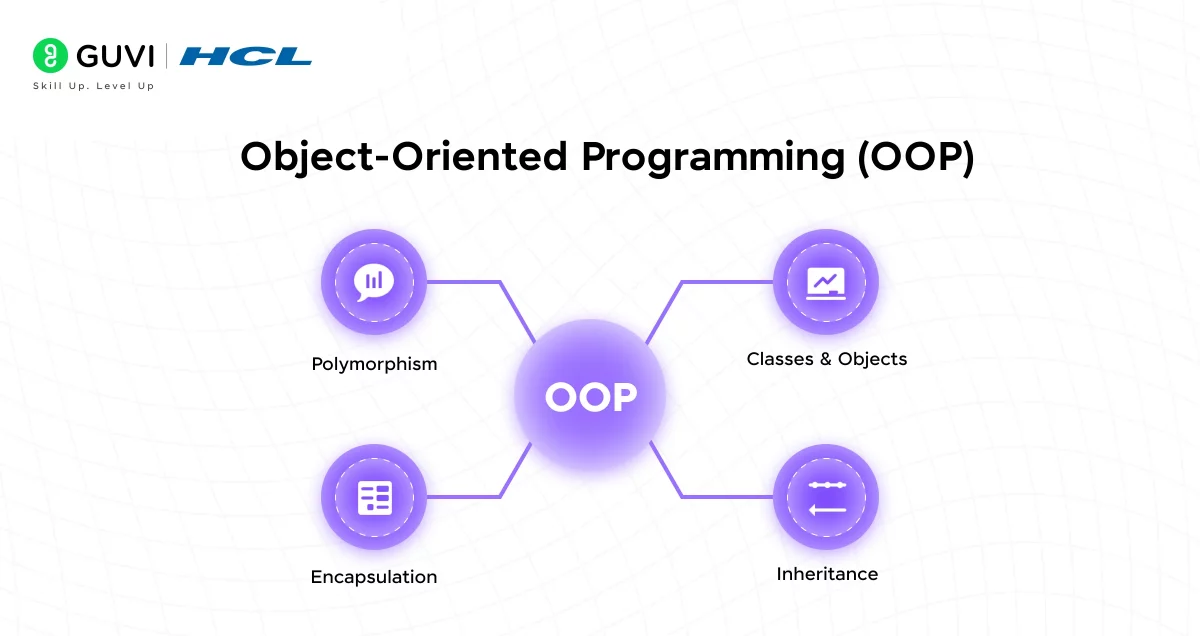
Understanding Object-Oriented Programming is a must for any Python developer aiming to build scalable and maintainable applications. OOP allows you to model real-world entities as “objects” in code, using classes to define blueprints (attributes and behaviors) for those objects.
By encapsulating logic into classes, you create modular code where each part has a clear responsibility. Core OOP concepts to master include:
- Classes & Objects: Create classes to define data (attributes) and functions (methods), then instantiate objects from those classes to represent specific entities.
- Inheritance: Derive new classes from existing ones to reuse and extend functionality (e.g., a Car class inheriting from a general Vehicle class).
- Polymorphism: Design classes so that objects of different types can be treated interchangeably through a common interface, increasing flexibility.
- Encapsulation: Keep data and methods that operate on that data bundled together, and control access via public or private attributes/methods. This leads to clearer, safer code.
3. Familiarity with Python Web Frameworks
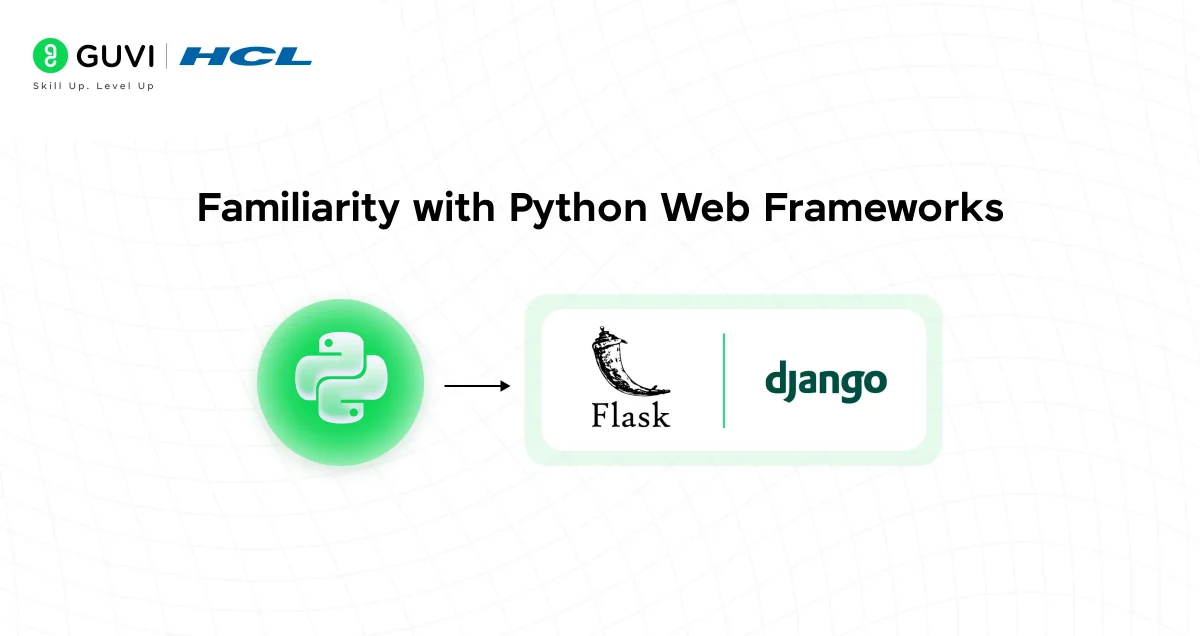
Among practical Python developer skills, this one shows up in the widest range of job postings. These days, many Python developers work on web applications. Knowing how to use Python web frameworks is, therefore, a critical skill. Two of the most popular frameworks tied to these Python developer skills are Django and Flask:
- Django – The “Batteries-Included” Framework
Django comes packed with tools for database integration, authentication, admin panels, and more. Ideal for building large applications fast with minimal boilerplate. - Flask – Lightweight and Flexible
Flask offers a minimalist core with room to customize. It’s perfect for smaller apps or when you need more control over your architecture.
Know When to Use Which:
Choose Django when you want a full-featured setup out of the box. Opt for Flask if you’re building microservices or want to handpick components.
If you want to read more about how Python works and its use cases, consider reading HCL GUVI’s Free Python eBook: A Beginner’s Guide to Coding & Beyond, which covers the key concepts of Python, including OOPs, File Handling, and even database connectivity.
4. Proficiency with ORM Libraries
Most applications need to interact with a database. As a Python developer, you’ll save a ton of time (and avoid SQL-related errors) by using an Object-Relational Mapping (ORM) library.
ORMs act as a bridge between your Python code and the database, allowing you to manipulate database entries using Python objects instead of writing raw SQL queries.
Rounding out this part of your Python developer skills, two widely used ORM tools in the Python ecosystem are SQLAlchemy and Django’s built-in ORM (which comes with the Django framework):
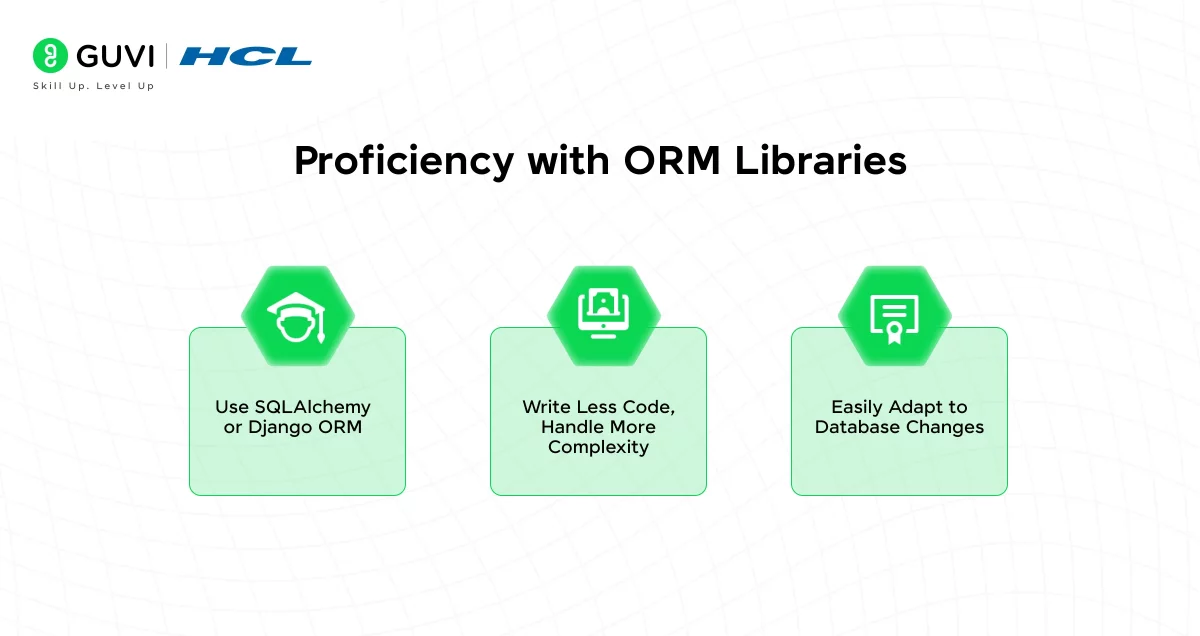
- Use SQLAlchemy or Django ORM
These tools let you define models as Python classes and perform CRUD operations intuitively. Whether you prefer the flexibility of SQLAlchemy or the seamless integration of Django ORM, both simplify data interaction. - Write Less Code, Handle More Complexity
ORMs come with built-in methods for querying, filtering, and updating data, making complex operations cleaner and less error-prone. - Easily Adapt to Database Changes
Changing database structures is smoother with ORMs. You make adjustments in Python models instead of rewriting SQL queries from scratch.
5. Data Analysis and Visualization Libraries
One of the more transferable Python developer skills, useful well beyond dedicated data roles. Python isn’t just for web development, it’s a dominant language in data analysis, science, and visualization. Even if you’re not a full-time data analyst, as a Python developer, you’ll likely encounter scenarios to process data, generate reports, or simply debug issues using data insights.
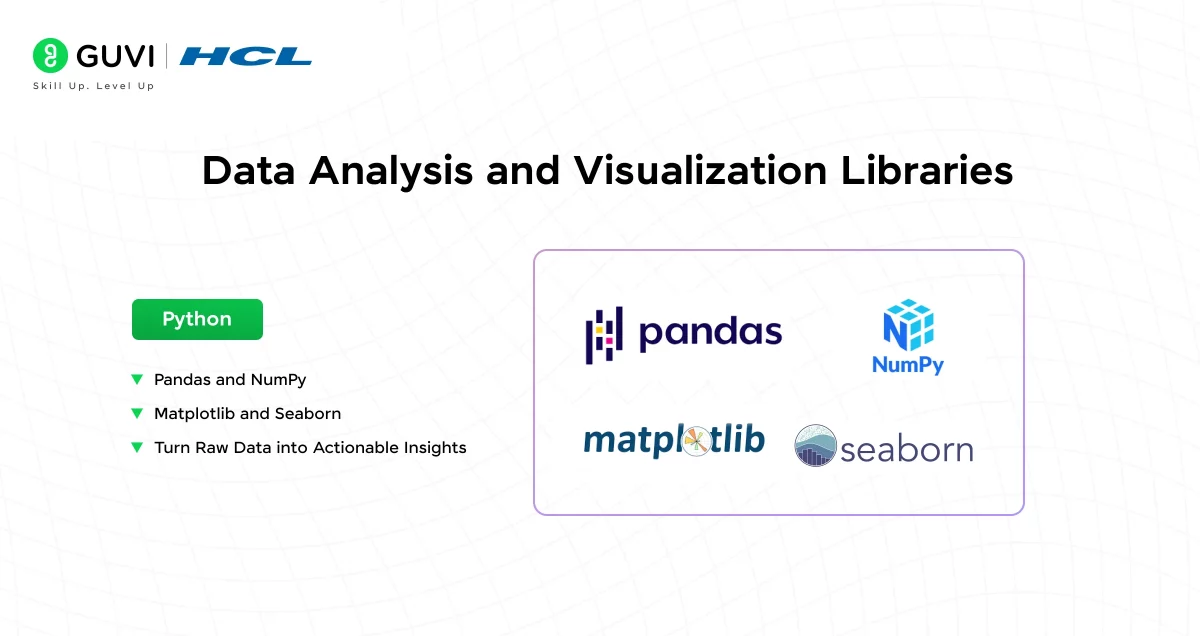
That’s where Python’s rich ecosystem of data analysis and visualization libraries comes in. Some essential libraries to be familiar with include:
- Pandas and NumPy
Pandas helps you clean, organize, and transform datasets. NumPy handles large numerical arrays and matrix operations with blazing speed. - Matplotlib and Seaborn
Create stunning charts, graphs, and plots that make insights easy to understand — crucial for reports, dashboards, or debugging. - Turn Raw Data into Actionable Insights
Whether you’re debugging a user flow or building analytics features, these libraries help you interpret and present complex data with clarity.
Familiarity with these libraries is crucial if you plan to work in any data-heavy application domain.
6. Building and Using RESTful APIs
API fluency is one of the Python developer skills that separates junior from mid-level engineers fastest. Modern software systems often need to communicate with each other, front-end with back-end, or one service with another. This is where knowledge of RESTful APIs and web services becomes important.
A RESTful API (Representational State Transfer) is a way to structure communication between a client and server over HTTP, using endpoints (URLs) to perform standard operations like GET (retrieve data), POST (create data), PUT/PATCH (update data), and DELETE (remove data).
As a Python developer, you should know how to build and consume APIs:
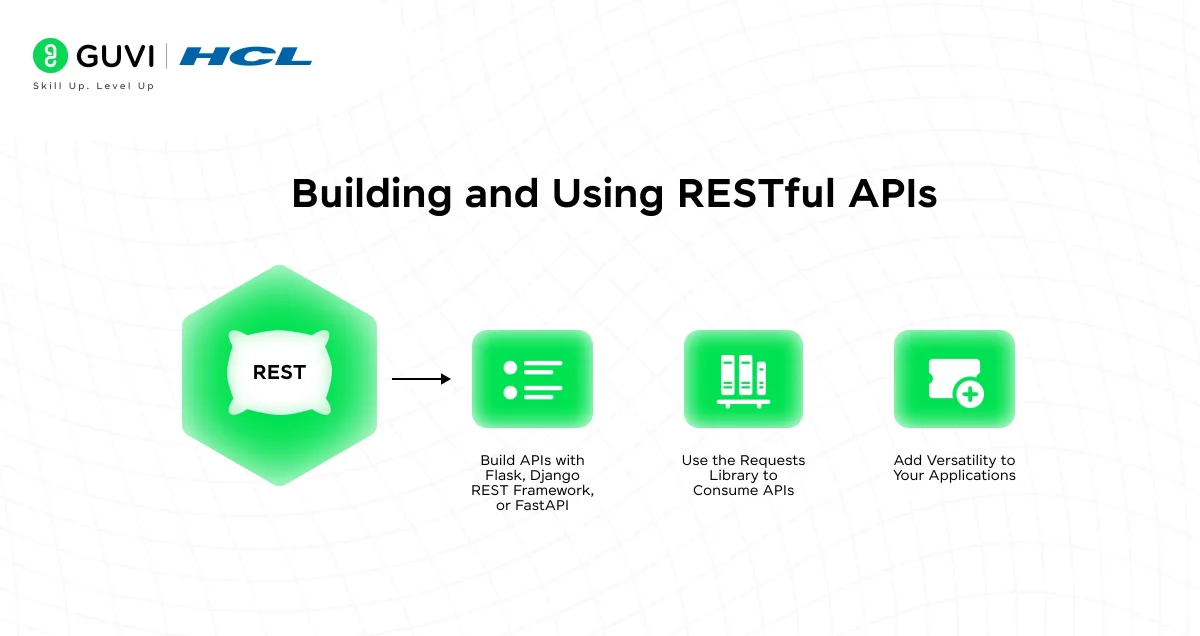
- Build APIs with Flask, Django REST Framework, or FastAPI
Create endpoints to handle data, authenticate users, and process inputs — all while maintaining REST principles. - Use the Requests Library to Consume APIs
Want to pull in weather data, social media feeds, or integrate payments? Requests make it easy to fetch and work with external data. - Add Versatility to Your Applications
APIs open the door to real-time updates, third-party integrations, and a wider range of functionalities — from chatbots to AI services.
By mastering API development, you enable your Python applications to participate in the broader ecosystem of web services.
7. Version Control with Git
In professional software development, using version control is non-negotiable, and Git is by far the most widely used version control system today.
As a Python developer, you should be comfortable with Git for tracking changes in your code and collaborating with others. Version control skills ensure that you can manage your codebase effectively and contribute to team projects without stepping on anyone’s toes.
Key Git-related Python developer skills to learn include:
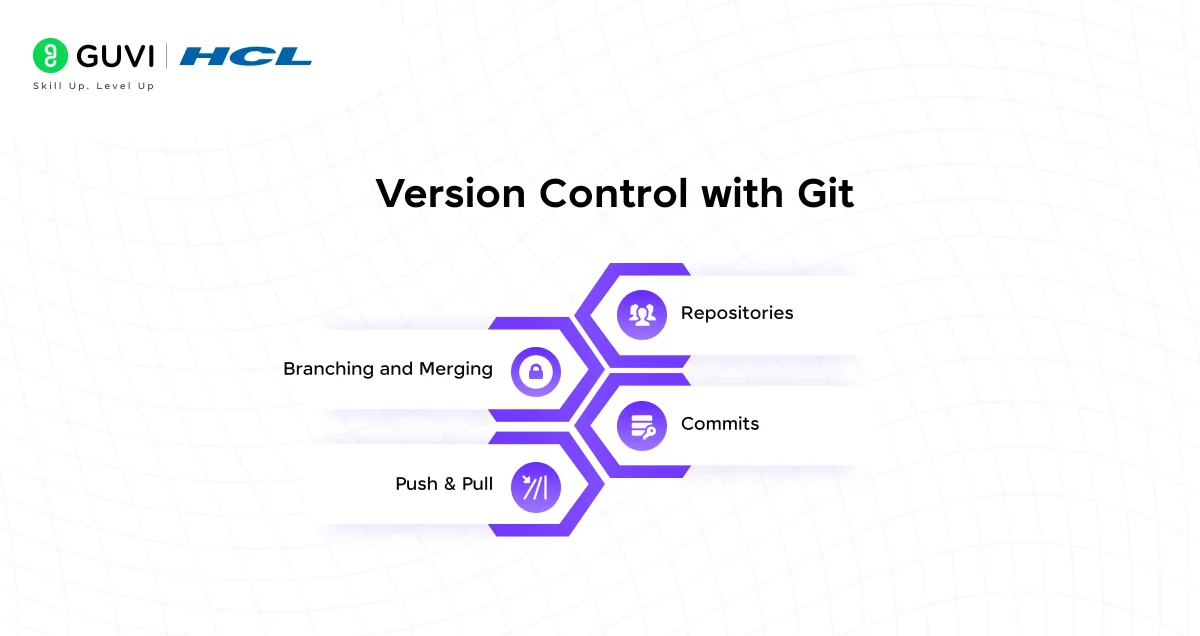
- Repositories: A Git repository (repo) is a history of your project’s files. You’ll need to know how to initialize a repo or clone an existing one from a service like GitHub or GitLab.
- Commits: Git tracks changes as snapshots called commits. Get used to making frequent commits with clear, descriptive messages about what changed and why. This creates a useful history you can refer back to.
- Branching and Merging: Branches let you work on new features or bug fixes in isolation from the main code. Handling merge conflicts, situations where two changes touched the same part of the code, is an important skill as well.
- Push & Pull: When collaborating, you’ll push your commits to a remote repository (like on GitHub) and create Pull Requests for your team to review your changes. You’ll also pull updates from others to keep your local copy in sync.
8. Knowledge of Machine Learning and AI Libraries
In recent years, Machine Learning (ML) and Artificial Intelligence (AI) have become some of the hottest areas in tech, and Python is the dominant language in this domain. Even if you’re not aiming to become a data scientist or ML engineer, having some familiarity with Python’s ML/AI libraries can greatly expand the kinds of projects you can work on.

Essential ML/AI Python developer skills and frameworks in this category include:
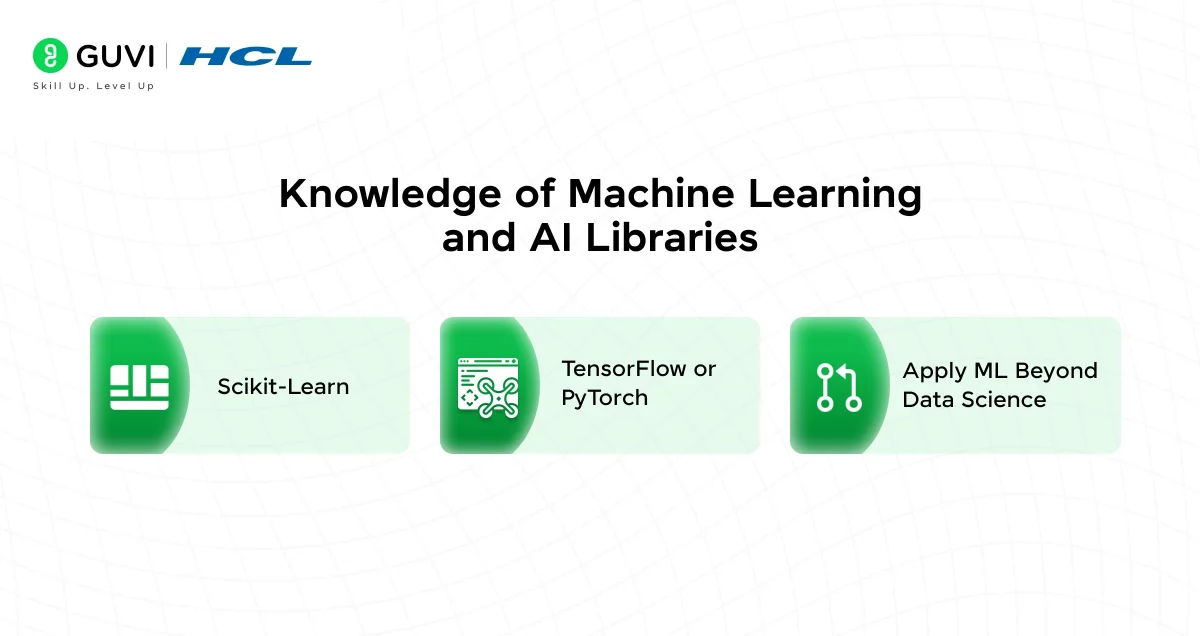
- Scikit-Learn
Perfect for beginners, it covers everything from linear regression to decision trees. With simple syntax and clear documentation, it’s your gateway into ML. - TensorFlow or PyTorch
These are the powerhouses behind deep learning. Build neural networks, handle large datasets, and create intelligent models that learn and adapt. - Apply ML Beyond Data Science
Whether it’s predicting user behavior, personalizing content, or automating tasks, ML is becoming a core part of everyday applications.
Midway Challenge: Build Your Own Mini Python Stack!
You’ve come this far, now it’s time to put your skills to the test with a fun challenge that brings multiple concepts together.
Your Mission:
Build a simple task manager API using Python, where users can:
- Add a task
- View all tasks
- Mark a task as complete
- Delete a task
Tech Stack to Use:
- Flask for building the RESTful API
- Python lists/dictionaries to store tasks (no database needed for now!)
- Requests (optional): Write a separate Python script to test your API endpoints
Bonus Points If You:
- Add input validation
- Return meaningful HTTP status codes
- Create a simple front-end using HTML + JS (just a basic form will do!)
- Host it locally and test it with Postman or curl
Why This Challenge?
It reinforces your knowledge of Python fundamentals, OOPs, REST APIs, and version control if you push it to GitHub.
Need help getting started?
Check out:
- Flask Quickstart
- Requests Library Docs
- HTTP Status Codes
Challenge yourself to complete it in 2–3 hours. Once done, share it on GitHub and link it in your portfolio, also share the link in the comment box for us to review!
9. Understanding Front-End Technologies (HTML, CSS, JavaScript)
Why would a Python developer need to know front-end technologies? The reason is that Python is often used in web development, typically on the back-end (server side), but a strong developer understands how the front-end and back-end work together to deliver a complete application.
Knowing the basics of HTML, CSS, and JavaScript will make you far more effective when building web applications or working with front-end developers:
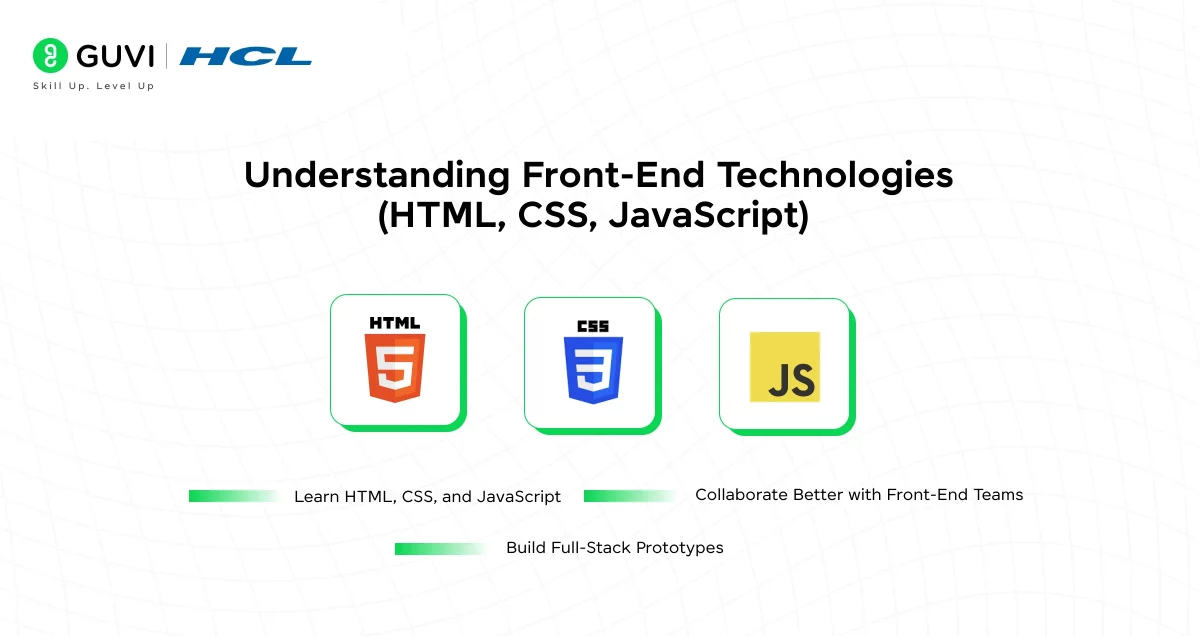
- Learn HTML, CSS, and JavaScript
These are the building blocks of the web. Knowing how pages are structured and styled helps you integrate your backend logic smoothly. - Collaborate Better with Front-End Teams
Speak their language, troubleshoot integration issues, and deliver APIs that work seamlessly with client-side code. - Build Full-Stack Prototypes
Especially in startups or agile teams, you might have to wear multiple hats. With basic front-end knowledge, you can build and test end-to-end solutions quickly.
For Python developers aiming to be full-stack developers, learning front-end basics is even more crucial. It means you can prototype entire applications on your own.
If you want to learn more about Frontend and Backend development and how it enables developers to work seamlessly with Python, consider enrolling in HCL GUVI’s IIT-M Pravartak-certified Full Stack Development Course that not only teaches you the basics but also makes you an experienced developer through hands-on projects guided by an actual mentor.
10. Testing and Debugging Skills
Often the most underrated of all Python developer skills. Writing code is one thing, making sure it works correctly is another. That’s why testing and debugging are listed among essential Python developer skills.
Bugs are inevitable in software development, and this is where testing rounds out your Python developer skills. With solid testing and debugging practices, you can catch issues early and fix them efficiently. Let’s break this skill into two parts:
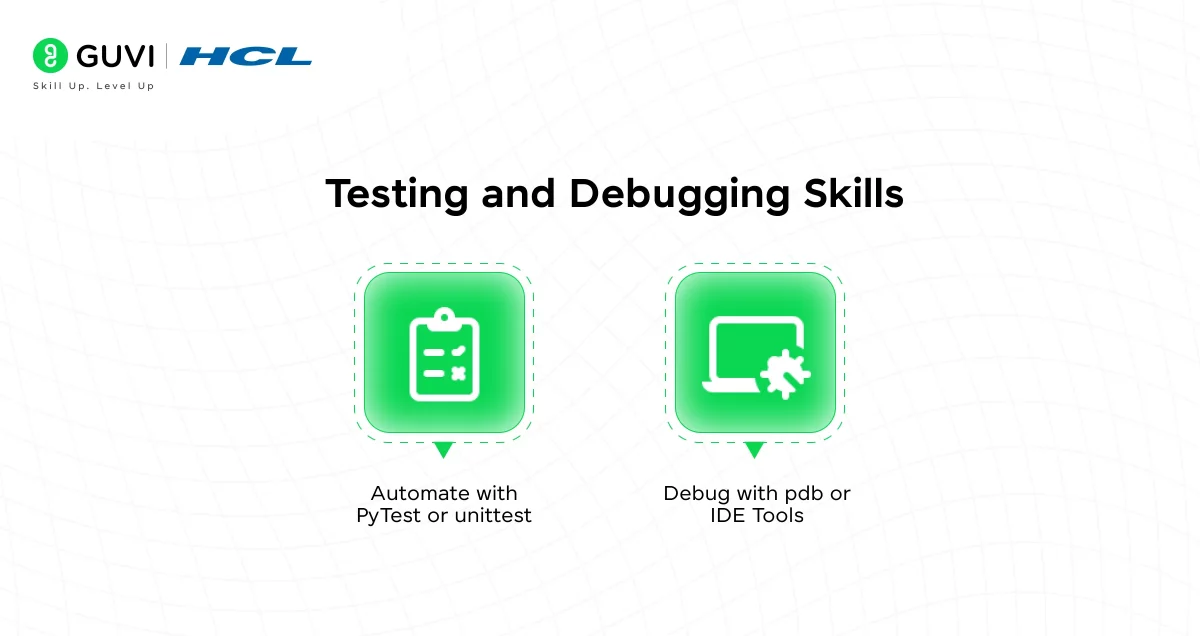
- Automate with PyTest or unittest
Write unit tests to validate individual components of your application. It helps catch bugs early and supports a reliable, scalable codebase. - Debug with pdb or IDE Tools
Python’s built-in debugger lets you pause execution, inspect variables, and step through code. IDEs like VSCode and PyCharm make it even easier.
11. Communication and Collaboration Skills
Finally, let’s talk about a skill that’s not strictly about writing code, but is essential to being a successful developer: communication.
Being technically sound is crucial, but your ability to communicate ideas, collaborate with others, and articulate problems is what makes these Python developer skills actually usable on a real team, not just on your own machine.
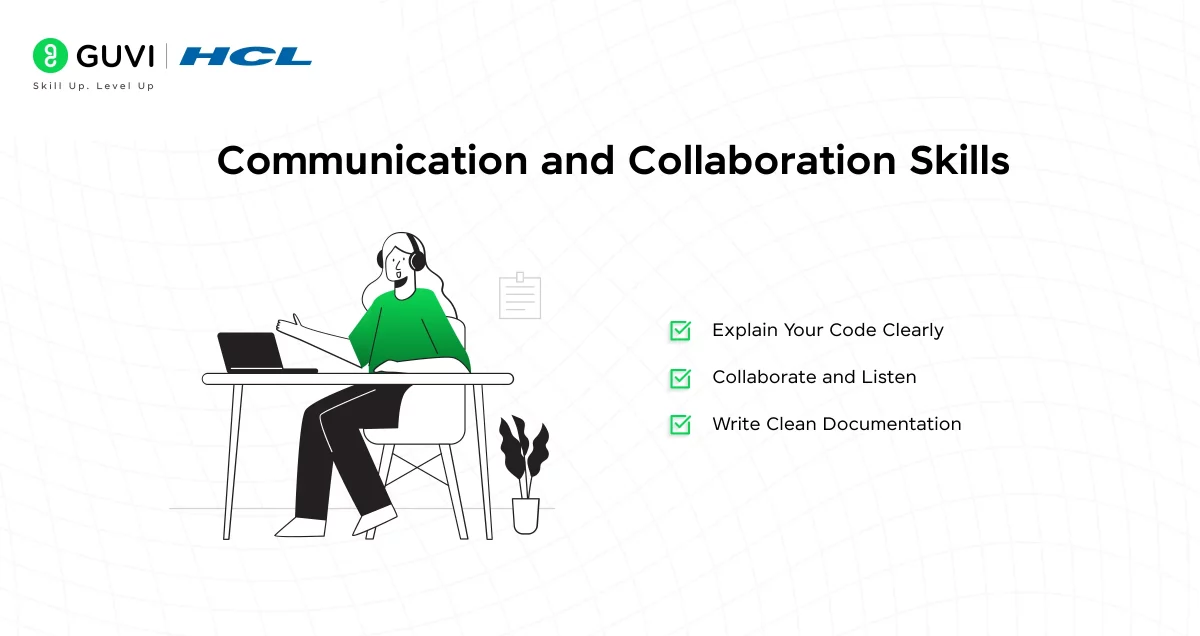
- Explain Your Code Clearly
Whether through documentation or during team meetings, the ability to make others understand your logic is invaluable. - Collaborate and Listen
Great teams thrive on respectful, open communication. Give and receive feedback, clarify doubts, and work towards shared goals. - Write Clean Documentation
Good code comments, README files, and clear Git commits help others (and your future self) make sense of your work.
Keep learning continuously. The Python ecosystem grows with new libraries and best practices over time. Stay curious and up-to-date by reading articles, following Python communities, and experimenting with new tools.
If you want to learn more about Python through a structured course material, consider enrolling in HCL GUVI’s Free Self-Paced IITM Pravartak Certified Python Course that lets you start from scratch and gradually move towards the level where you can write programs to gather, clean, analyze, and visualize data.
Which Python Developer Skills Actually Pay More? Salary by Specialization
Not all Python developer skills carry the same weight on your paycheck.
| Specialization | Python Developer Skills Emphasized | Experienced Salary Range (India) |
|---|---|---|
| General Backend (Django/Flask) | Web frameworks, ORM, REST APIs | ₹10L to ₹25L |
| Backend with FastAPI | Web frameworks, async programming, REST APIs | ₹10L to ₹45L |
| Data Engineering | Data analysis libraries, ORM, automation | ₹12L to ₹40L |
| Machine Learning / AI Engineering | ML/AI libraries, data analysis, APIs | ₹15L to ₹80L |
| Full-Stack Python | Front-end basics, web frameworks, APIs | ₹8L to ₹30L |
Fresher Python developers in India typically start around ₹3L to ₹7L, with those who’ve built ML/AI or data science project portfolios often starting closer to ₹5L to ₹9L even without prior work experience.
The gap between a developer who only knows core syntax and one with a real GitHub portfolio showing 2 to 3 solid projects can be 30 to 40% in starting offers alone.
Best Python Developer Skills to Prioritize for Indian Tech Jobs in 2026
If you’re building your Python developer skills specifically for the Indian job market, prioritize in roughly this order.
| Priority | Skill | Why It’s a Top Priority in India |
|---|---|---|
| 1 | Python Fundamentals + OOP | Tested at every company type, from IT services majors to startups; the baseline for everything else |
| 2 | Django or Flask | Still the most-requested framework skill across Indian job postings, especially at IT services firms |
| 3 | REST API Development | A near-universal requirement across backend roles regardless of company size |
| 4 | SQL and ORM Libraries | Every company works with databases; treated as a baseline expectation, not a bonus |
| 5 | Git and Version Control | Non-negotiable at any company, from a 10-person startup to a 200,000-person IT services firm |
| 6 | FastAPI and Async Programming | The fastest-growing skill demand at Indian product companies, fintech, and startups |
| 7 | Machine Learning / AI Libraries | Commands the highest salary premium, driven by GCC and AI-startup hiring specifically |
IT services majors (TCS, Infosys, Wipro) weight priorities 1 through 4 most heavily, while product companies and startups, concentrated in Bangalore, Pune, Hyderabad, and Chennai, increasingly expect priorities 5 through 7 on top.
A real portfolio demonstrating 2 to 3 of these skills together, a Django app with a database and API layer, for instance, consistently outweighs a resume that simply lists every skill in this table.
Conclusion
In conclusion, Python remains a powerhouse language, and mastering these essential skills will help you ride the wave of opportunity it offers. The demand for well-rounded Python developers continues to grow.
Stay curious and up-to-date by reading articles, following Python communities, and experimenting with new tools. Combining that curiosity with the core skills we discussed will not only make you a proficient Python developer today, but also an adaptable one ready for the technologies of tomorrow. Good luck on your Python journey, and happy coding!
Frequently Asked Questions
Can I learn Python without any programming experience?
Yes, Python is widely recommended for beginners due to its simple syntax and readability. Many beginner resources, tutorials, and interactive platforms are available to help those new to programming build a solid foundation.
How long does it take to become proficient in Python?
With regular practice, you can build basic Python skills within a few weeks. However, becoming skilled enough for specialized areas, like data science or web development, may take several months to a year, depending on how much time you dedicate.
What career paths can a Python developer pursue?
Python developers can work in various fields, including web development, data science, artificial intelligence, automation, and even roles like DevOps or system administration. Each field offers unique opportunities for specialization.
Success Stories

About the Author
Jebasta
I translate the language of data into stories that anyone can understand. As a writer with a data science background, I simplify analytics, AI, and decision-making so beginners and enthusiasts can confidently explore the world of data.
View all posts by Jebasta
Connect with me @






Did you enjoy this article?