


Python Articles
Freelancing as a Python Developer: Getting Your First Client
Common Python Mistakes Beginners Make And How to Fix Them
How to Build a Python Developer Portfolio That Gets You Hired


Get In Touch For Details! Request More Information
Python Best Practices: Writing Clean, Maintainable Code Like a Pro
Aug 17, 2026 3 Min Read 464 Views
(Last Updated)
Writing code that works is only part of becoming a skilled developer. As projects grow, maintaining clean and readable code becomes increasingly important. Following Python best practices helps improve readability, consistency, and scalability while reducing bugs and maintenance effort.
Table of contents
- TL;DR
- Data Point
- Quick Answer
- What Are Python Best Practices?
- Key Components of Python Best Practices
- Did You Know?
- Why Are Python Best Practices Important?
- Benefits of Following Python Best Practices
- Data Point
- Top Python Best Practices Every Developer Should Follow
- Follow PEP 8 Guidelines
- Use Meaningful Variable and Function Names
- Keep Functions Small and Focused
- Avoid Code Duplication
- Document Your Code
- Handle Exceptions Properly
- Write Automated Tests
- Use Code Quality Tools
- Warning
- How Python Best Practices Improve Development
- Key Areas Improved by Clean Code
- Real-World Applications of Python Best Practices
- Web Development
- Data Science Projects
- Automation Scripts
- Machine Learning Systems
- Enterprise Software
- Best Practice
- Key Takeaways
- What To Do Next
- Conclusion
- FAQs
- What are Python's best practices?
- Why is PEP 8 important?
- What are the most important Python best practices?
- Which tools help improve Python code quality?
- Why should developers write automated tests?
- How does documentation improve maintainability?
- Are Python best practices useful for beginners?
TL;DR
- Python best practices help developers write cleaner, more maintainable, and scalable code.
- Following coding standards improves readability, collaboration, and debugging efficiency.
- Key practices include using meaningful names, writing modular code, documenting functions, and testing regularly.
- Tools like Black, Pytest, and Pylint help automate code quality checks.
- Strong coding habits reduce technical debt and improve long-term software quality.
Data Point
The Zen of Python includes the famous principle “Readability counts,” highlighting the importance of writing code that humans can easily understand and maintain.
Source: https://peps.python.org/pep-0020/
Quick Answer
Python best practices are a set of coding guidelines that improve code readability, maintainability, reliability, and scalability. They include the following style conventions: using meaningful variable names, writing reusable functions, documenting code properly, handling exceptions effectively, and testing applications regularly to ensure long-term code quality.
Source: https://realpython.com/python-pep8/
What Are Python Best Practices?

Python best practices refer to recommended techniques and standards used by developers to create clean and maintainable software. These practices help teams write consistent code, reduce bugs, and improve collaboration across projects.
Since Python emphasizes simplicity and readability, following these guidelines allows developers to fully leverage the language’s strengths. Good coding habits not only make programs easier to understand but also simplify future enhancements and maintenance.
Key Components of Python Best Practices
- Coding Standards – Maintain consistency across projects.
- Readability – Make code easier to understand.
- Modularity – Break applications into reusable components.
- Documentation – Explain functionality clearly.
- Testing – Verify expected behavior.
- Error Handling – Prevent unexpected failures.
Did You Know?
PEP stands for Python Enhancement Proposal. The PEP process allows Python developers worldwide to propose improvements, discuss language changes, and establish community standards.
Source: https://peps.python.org/
Why Are Python Best Practices Important?
Following Python best practices helps developers build software that is easier to maintain, debug, and scale. Clean code reduces confusion, improves team collaboration, and lowers the risk of introducing bugs during future updates.
Benefits of Following Python Best Practices
| Benefit | Why It Matters |
| Better Readability | Makes code easier to understand |
| Easier Maintenance | Simplifies updates and bug fixes |
| Improved Collaboration | Supports teamwork and code reviews |
| Fewer Bugs | Encourages cleaner development practices |
| Greater Scalability | Makes applications easier to expand |
Data Point
Code quality tools and development best practices help teams reduce maintenance costs and improve software reliability throughout a project’s lifecycle.
Source: https://sourcery.ai/blog/python-best-practices
If you’re just starting your Python journey, HCL GUVI’s Python eBook can help you strengthen your programming fundamentals before exploring advanced development practices.
Top Python Best Practices Every Developer Should Follow
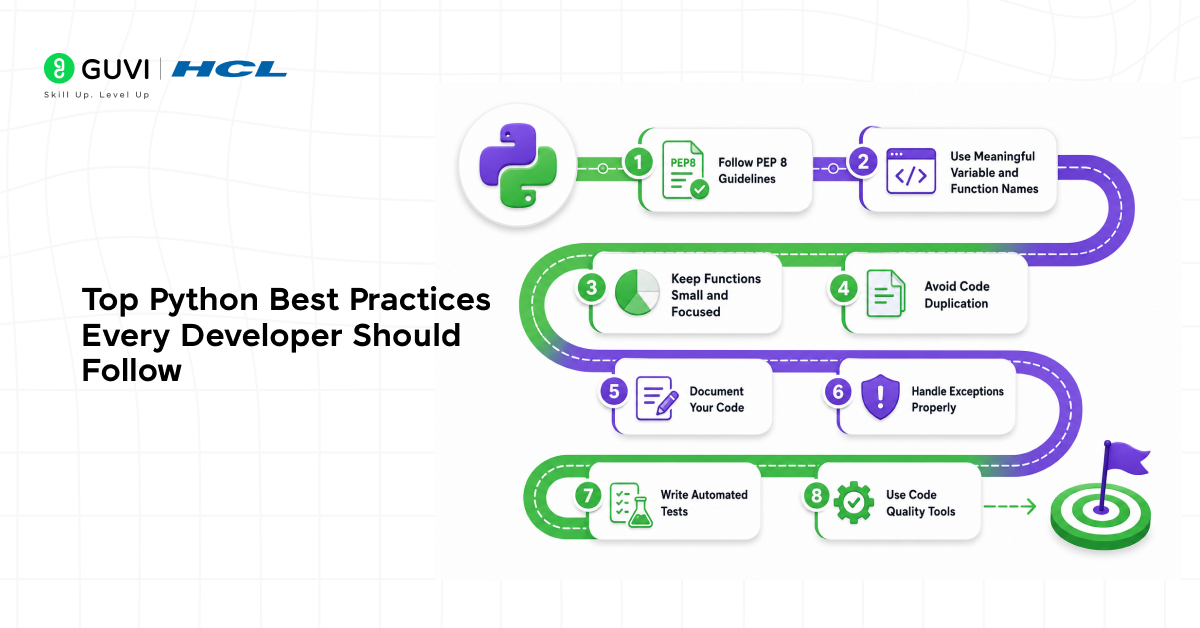
1. Follow PEP 8 Guidelines
PEP 8 is Python’s official style guide. It defines standards for indentation, naming conventions, line lengths, and formatting.
Following PEP 8 makes your code easier for other developers to read and understand.
2. Use Meaningful Variable and Function Names
Names should clearly communicate purpose and intent.
For example, a variable named user_email is far more informative than a generic name like x. Descriptive names reduce confusion and improve readability.
3. Keep Functions Small and Focused
A function should ideally perform one specific task.
Smaller functions are easier to test, debug, and reuse across projects. They also improve overall code organization.
4. Avoid Code Duplication
Repeated code increases maintenance effort and creates opportunities for bugs.
Instead of copying logic throughout an application, create reusable functions and modules that can be called whenever needed.
5. Document Your Code
Documentation helps developers understand how code works without analyzing every implementation detail.
Use docstrings to explain function behavior, parameters, and return values.
6. Handle Exceptions Properly
Errors are inevitable in software development. Proper exception handling allows applications to recover gracefully instead of crashing unexpectedly.
Well-designed error handling improves user experience and application stability.
7. Write Automated Tests
Testing helps ensure that code behaves as expected after updates and modifications.

Frameworks like Pytest make it easier to create and manage tests while improving software reliability.
8. Use Code Quality Tools
Modern development tools can automatically identify formatting issues, coding mistakes, and potential bugs.
Popular tools include:
Warning
Ignoring coding standards may not create immediate problems, but poor coding practices often lead to technical debt. Over time, applications become harder to maintain, debug, and extend, resulting in higher development costs and slower progress.
Source: https://martinfowler.com/bliki/TechnicalDebt.html
How Python Best Practices Improve Development
Applying Python best practices positively impacts every stage of software development.
Instead of spending excessive time understanding poorly written code, developers can focus on delivering features, fixing bugs, and improving application performance.
Key Areas Improved by Clean Code
- Code Readability
- Debugging Efficiency
- Testing Accuracy
- Collaboration
- Project Scalability
- Code Reusability
- Maintenance
- Long-Term Reliability
Organizations that prioritize code quality often experience smoother development workflows and reduced maintenance challenges.
Real-World Applications of Python Best Practices
1. Web Development
Frameworks such as Django and Flask rely heavily on maintainable code structures for long-term project success.
2. Data Science Projects
Clean code improves reproducibility and simplifies collaboration among analysts and engineers.
3. Automation Scripts
Well-structured scripts are easier to modify and troubleshoot when business requirements change.
4. Machine Learning Systems
Maintainable code supports efficient model deployment, monitoring, and updates.
5. Enterprise Software
Large development teams depend on coding standards to ensure consistency across thousands of lines of code.
Best Practice
Establish coding standards at the beginning of every project and combine them with automated tools, code reviews, and testing processes. Consistency is often more valuable than perfection when maintaining large codebases.
To further strengthen your development skills, HCL GUVI’s Python Course offers practical projects that help learners apply professional coding standards in real-world scenarios.
Key Takeaways
- Python best practices improve readability and maintainability.
- PEP 8 provides the foundation for Python coding standards.
- Meaningful names make code easier to understand.
- Testing and documentation improve software quality.
- Clean code reduces technical debt and supports scalability.
What To Do Next
After learning these concepts, explore:
- Object-Oriented Programming
- Python Design Patterns
- Unit Testing with Pytest
- Advanced Error Handling
- Code Refactoring Techniques
- Python Project Architecture
Developing strong coding habits today will help you build more reliable software in the future.
Conclusion
Following Python best practices transforms code from something that simply works into something that delivers long-term value. Well-structured Python applications are easier to extend, troubleshoot, and optimize, allowing developers to focus on innovation rather than maintenance. By prioritizing clean, consistent, and maintainable code, you can build software that remains efficient, reliable, and ready for future growth.
FAQs
1. What are Python’s best practices?
Python best practices are coding guidelines that improve readability, maintainability, consistency, and software quality.
2. Why is PEP 8 important?
PEP 8 provides standard coding conventions that help developers write clean and consistent Python code.
3. What are the most important Python best practices?
Some key practices include following PEP 8, writing reusable functions, documenting code, handling exceptions, and testing regularly.
4. Which tools help improve Python code quality?
Popular tools include Black, Pylint, Flake8, MyPy, and Pytest.
5. Why should developers write automated tests?
Automated tests help detect bugs early and ensure software behaves as expected.
6. How does documentation improve maintainability?
Documentation helps developers understand code functionality and reduces onboarding time for new contributors.
7. Are Python best practices useful for beginners?
Yes. Learning good coding habits early helps beginners write cleaner, more professional, and maintainable code.
Success Stories

About the Author
Vishalini Devarajan
An Aerospace Engineer turned content writer, I focus on making complex concepts easy to understand through well-structured, reader-friendly blogs. Whether it’s a technical topic or a non-technical one, I love creating content that is clear, engaging, and impactful.
View all posts by Vishalini Devarajan
Connect with me @









Did you enjoy this article?