


Data Structure Articles
Sliding Window Technique: Explained with Examples
Two Pointer Technique: Problems and Applications


Get In Touch For Details! Request More Information
Types of Data Structures in Python That Every Coder Should Know!
Sep 15, 2026 7 Min Read 2484 Views
(Last Updated)
The types of data structures in Python fall into two groups: four built-in ones (lists, tuples, sets, dictionaries) that ship with the language, and four advanced ones (stacks, queues, trees, graphs) you build on top of them. Picking the right one is often the difference between code that runs instantly and code that crawls.
Ever written a program that worked fine with 10 items, then completely froze with 10,000? That’s usually not bad code. It’s the wrong data structure doing more work than it needs to.
This guide walks you through all 8 types of data structures in Python, in plain language, with real code you can run yourself. By the end, you’ll know exactly which one to reach for and why, instead of guessing.
Table of contents
- AI Overview
- What Are Data Structures in Python?
- Why This Actually Matters
- How Python Handles Data Structures
- 8 Essential Data Structures Every Python Programmer Should Know
- Lists
- Tuples
- Sets
- Dictionaries
- Stacks
- Queues
- Trees
- Graphs
- Types of Data Structures in Python: Quick Comparison Table
- Understanding Built-in vs Advanced Data Structures
- 1) Built-in Types of Data Structures in Python: Lists, Tuples, Sets, Dictionaries
- 2) Advanced Types of Data Structures in Python: Stacks, Queues, Trees, Graphs
- 3) When to Use Which Type
- Common Mistakes Beginners Make with Python Data Structures
- Best Way to Learn Types of Data Structures in Python in India (2026)
- Real-World Applications and Interview Relevance
- 1) Common Use Cases for the Types of Data Structures in Python in Web, AI, and Data Science
- 2) Top Interview Questions by Structure
- 3) How to Actually Prepare on the Types of Data Structures in Python
- How to Choose the Right Data Structure in Python
- Concluding Thoughts…
- FAQs
- Q1. What are the essential data structures every Python programmer should know?
- Q2. How do data structures impact performance and memory in Python?
- Q3. What's the difference between built-in and advanced data structures in Python?
- Q4. How important are data structures for technical interviews?
- Q5. What are some real-world applications of data structures in Python?
AI Overview
Python provides built-in collection types such as lists, tuples, sets, and dictionaries. Developers also commonly use stacks, queues, trees, heaps, and graphs, which can be implemented using Python’s built-in collections, custom classes, or libraries. Each structure has different properties for ordering, mutability, uniqueness, access, and performance. Choosing the right structure helps make Python programs simpler and more efficient.
What Are Data Structures in Python?
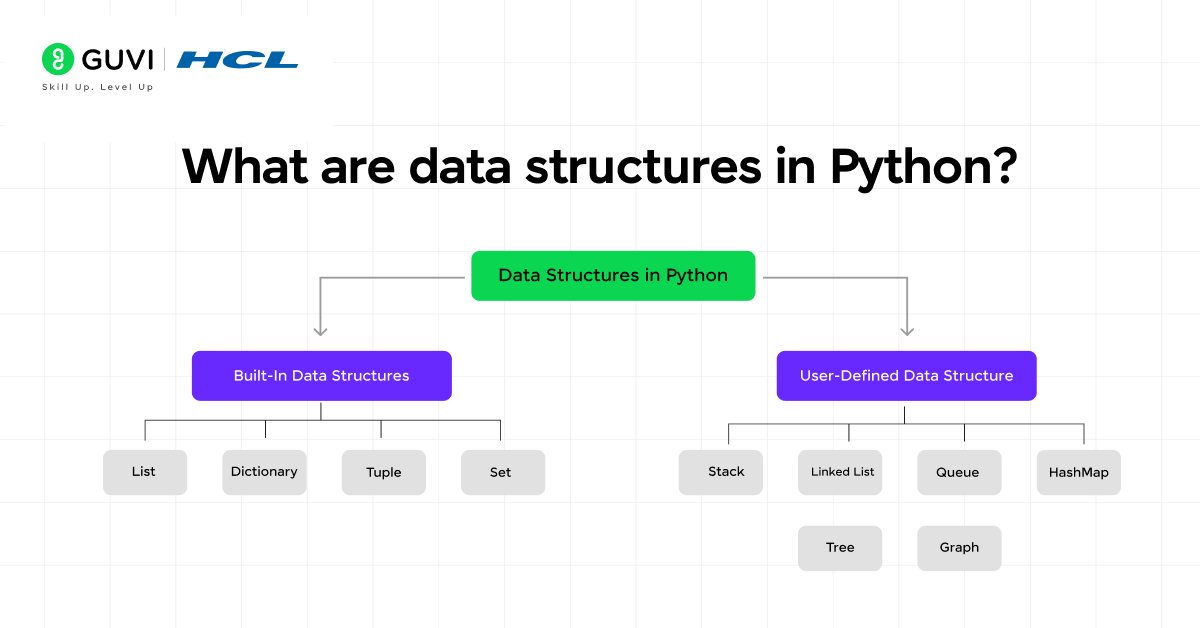
Think of the types of data structures in Python as different ways to organize your stuff. A data structure is just a format for storing data so your program can find and use it quickly.
Picture a messy desk covered in invoices, reports, and sticky notes. You’d probably sort them into labeled folders.
That’s exactly what the Types of Data Structures in Python do for your code: they keep information organized so you’re not hunting for it every time.
Why This Actually Matters
Choosing the right one from the Types of Data Structures in Python changes how your code performs, not just how it looks:
- Speed: the right structure makes searching, adding, and removing data much faster.
- Memory: a memory-efficient structure lets your app handle bigger datasets without slowing down.
- Problem-solving: some problems are nearly impossible to solve cleanly without the right structure.
This isn’t just theory. A dictionary lookup can stay in the millisecond range even across millions of records, while the same search on a list can stretch into minutes. That gap is exactly why the Types of Data Structures in Python matter so much once your data grows past a toy example.
How Python Handles Data Structures
Python takes a simpler approach to the Types of Data Structures in Python than most languages do. It ships with a handful of built-in structures that cover almost everything you’ll need day to day.
Python splits its data structures into two camps:
- Mutable: you can change these after creating them (lists, dictionaries, sets).
- Immutable: you can’t change these once they’re made (tuples).
One quirk worth knowing: when you modify a mutable structure (like insert(), remove(), or sort() on a list), Python returns None, not the updated list. It’s a consistent rule across the language, but it trips up a lot of beginners the first time.
Python also keeps naming simple. In Java, a list is either a LinkedList or an ArrayList. Python just calls it a list, even though the underlying implementation is still carefully optimized.
Dictionaries deserve a special mention here: they’re hash tables under the hood, giving you O(1) average-case speed for lookups, inserts, updates, and deletes. That’s why they’re everywhere in Python code.
New to Python itself, not just data structures? HCL GUVI’s Python Zero to Hero course covers the fundamentals first, so the rest of this guide makes even more sense.
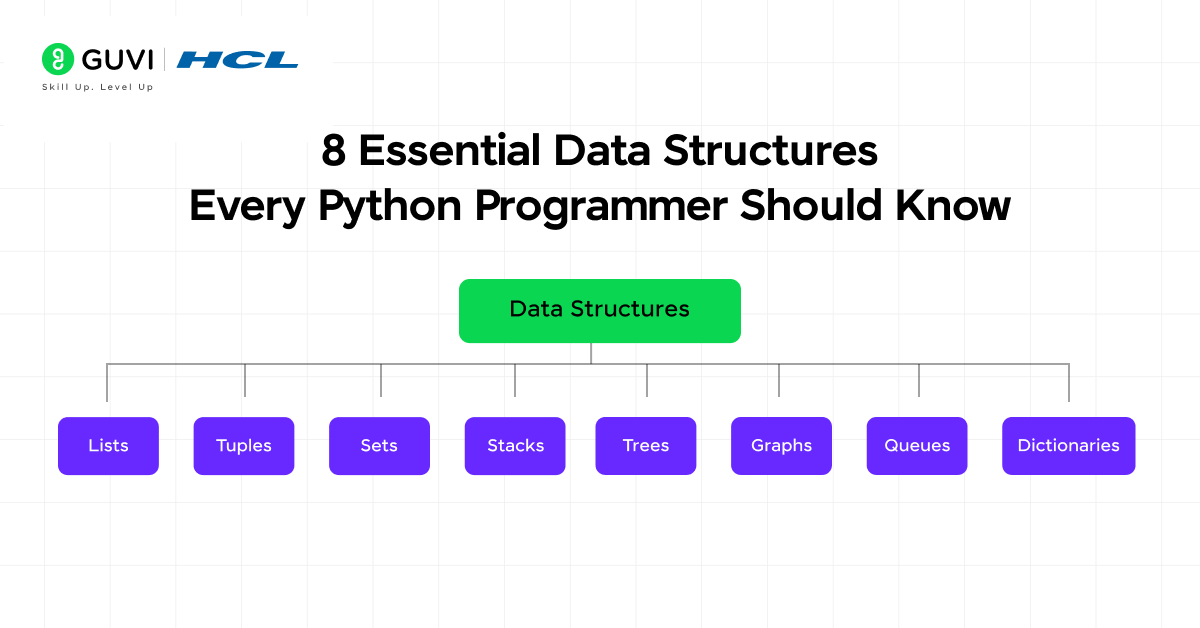
8 Essential Data Structures Every Python Programmer Should Know
Let’s get into the actual Types of Data Structures in Python. Here are all 8, with working code for each.
1. Lists
One of the most-used Types of Data Structures in Python, lists store an ordered collection of items. Unlike arrays in most other languages, a single Python list can hold mixed data types.
They’re dynamic and mutable, so you can append, insert, and remove items freely.
friends = ["Aliyan", "Humayoon", "Mudasar"]
friends.append("Rahim")   # Add an item
friends.remove("Mudasar") # Remove an item
Reach for a list when you’re storing related items you’ll modify often. Since they keep order, they’re great whenever position matters.
2. Tuples
Another of the built-in Types of Data Structures in Python, tuples look like lists but with one key difference: they’re immutable. Once you create one, you can’t change it.
coordinates = (1, 5) # Creating a tupleUse a tuple when data shouldn’t change, like coordinates or fixed settings. They can also work as dictionary keys, which lists can never do, and they use slightly less memory too.
3. Sets
Sets, one of the built-in Types of Data Structures in Python, store unique items only, with no guaranteed order. Duplicates get dropped automatically.
numbers = {1, 2, 3, 3, 4} # Creates {1, 2, 3, 4}Sets are great at membership checks (“is this item in here?”) and operations like union and intersection. Checking if something exists in a set is dramatically faster than checking a list.
4. Dictionaries
Among the Types of Data Structures in Python, dictionaries store key-value pairs, which makes them perfect for fast lookups. Keys must be unique and immutable (strings, numbers, or tuples of immutable values).
student = {"name": "Alice", "age": 25}
student["grade"] = "A"  # Adding new key-value pair
Because dictionaries run on hash tables, accessing, inserting, or deleting a value stays fast no matter how large the dictionary grows.
5. Stacks
One of the advanced Types of Data Structures in Python, stacks follow Last-In-First-Out (LIFO): picture a stack of plates where you always add and remove from the top. The two core operations are push (add) and pop (remove).
stack = []
stack.append(1)  # Push
stack.pop()       # Pop
Stacks are ideal for tracking state, building undo features, or managing function calls behind the scenes.
6. Queues
Another advanced entry among the Types of Data Structures in Python, queues work on First-In-First-Out (FIFO), just like a line at a shop. You enqueue (add) and dequeue (remove).
from collections import deque
queue = deque()
queue.append(1)    # Enqueue
queue.popleft()    # Dequeue
Queues are perfect anywhere tasks need to run in the order they arrived, think scheduling, resource allocation, or buffering a data stream.
7. Trees
One of the more complex Types of Data Structures in Python, trees are hierarchical: one root node, with child nodes branching out below it. Unlike a list, a single node can connect to several others.
Trees show up constantly in real systems:
- File systems, with folders inside folders.
- Organization charts.
- Database indexing.
- Priority queues.
Binary trees, where each node has at most two children, are the most common variant and the foundation for structures like Binary Search Trees.
8. Graphs
The most network-focused of the Types of Data Structures in Python, graphs are made of vertices (nodes) and edges connecting them. They’re built for modeling relationships and networks.
class Graph:
    def __init__(self):
        self.graph = {}

    def add_edge(self, from_node, to_node):
        if from_node in self.graph:
            self.graph[from_node].append(to_node)
        else:
            self.graph[from_node] = [to_node]
Graphs are the natural fit for social networks, transportation routes, web page links, or any data where connections matter more than order.
You’ll run into these Types of Data Structures in Python again and again as you build. Our DSA e-book can help you get comfortable with all of them faster.
To make your learning a little more interesting, here are some fascinating facts about Python’s data structures that might surprise you:
Lists Aren’t Just Arrays: Unlike many languages where arrays can only store one data type, Python lists can hold integers, strings, floats, and even other lists all at once—making them incredibly flexible for diverse data handling.
Dictionaries Preserve Order (Now): Before Python 3.7, dictionaries didn’t maintain insertion order. Today, they do—allowing developers to rely on predictable iteration over key-value pairs.
These facts show how Python’s data structures have evolved to balance simplicity, power, and performance—one of the many reasons Python remains a top choice for programmers worldwide.
Types of Data Structures in Python: Quick Comparison Table
Not sure which of the Types of Data Structures in Python fits your problem? Here’s all 8, side by side.
| Data Structure | Mutable? | Ordered? | Duplicates Allowed? | Lookup Time | Best Use Case |
|---|---|---|---|---|---|
| List | Yes | Yes | Yes | O(n) | General-purpose ordered collections |
| Tuple | No | Yes | Yes | O(n) | Fixed data, dictionary keys |
| Set | Yes | No | No | O(1) average | Membership testing, removing duplicates |
| Dictionary | Yes | Yes (3.7+) | Keys: No | O(1) average | Fast key-based lookups |
| Stack | Yes | Yes | Yes | O(n) | Undo features, function call tracking |
| Queue | Yes | Yes | Yes | O(1) with deque | Task scheduling, streaming buffers |
| Tree | Yes | N/A (hierarchical) | Depends on type | O(log n) balanced | File systems, indexing, hierarchies |
| Graph | Yes | N/A (networked) | Depends on implementation | O(V + E) traversal | Social networks, routing, connections |
Understanding Built-in vs Advanced Data Structures
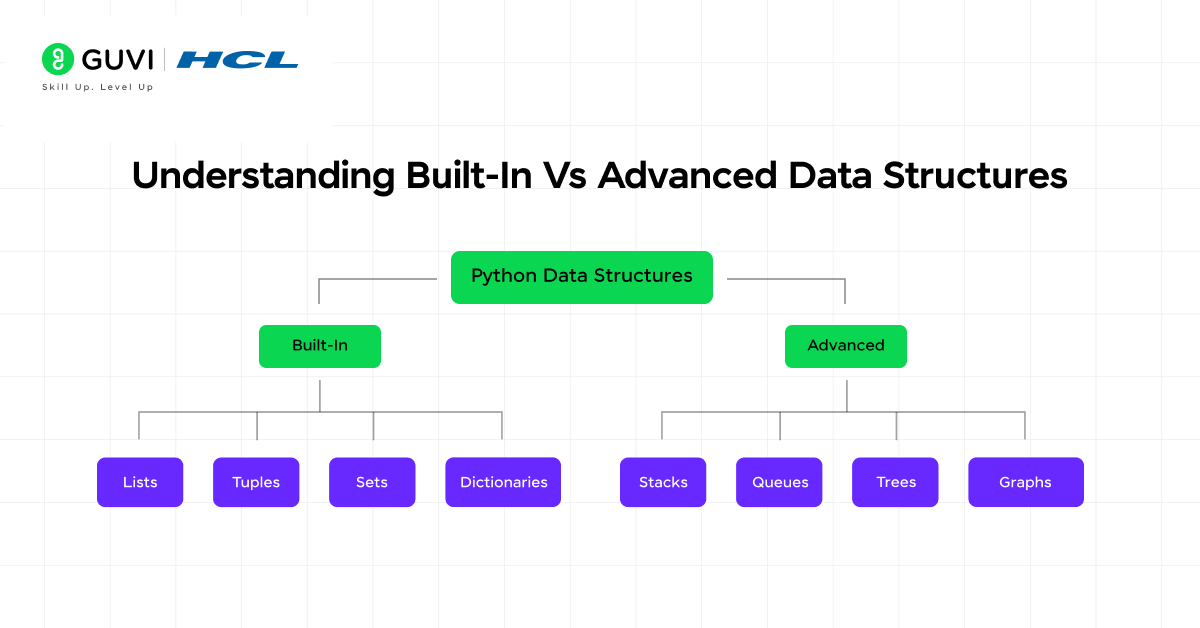
Python splits the types of data structures in Python into two broad camps, and knowing the difference helps you pick the right tool fast.
1) Built-in Types of Data Structures in Python: Lists, Tuples, Sets, Dictionaries
These four ship with Python itself and are implemented in C, which is why they’re so fast. Since Python 3.6/3.7, dictionaries also use a more compact internal layout that cuts their memory footprint by roughly 20 to 25% compared to the older implementation.
These aren’t toy structures, either. They power everything from social media backends to scientific computing at research labs, all running on the same built-ins you use in a beginner script.

2) Advanced Types of Data Structures in Python: Stacks, Queues, Trees, Graphs
These four don’t come built into Python directly. You build them using the built-ins above or your own classes.
You can technically build a stack or queue out of a plain list, but it’s often the wrong move. Removing an item from the front of a list is an O(n) operation, while deque.popleft() does the same job in O(1):
# Inefficient queue using list
queue = []
queue.append("item")  # OK
queue.pop(0)           # Slow, O(n)

# Efficient queue using deque
from collections import deque
queue = deque()
queue.append("item")   # Fast
queue.popleft()        # Fast, O(1)
Trees and graphs go a step further: Python has no built-in type for either, so you’ll write your own class or lean on a library like NetworkX.
3) When to Use Which Type
Here’s the decision laid out as a table instead of scattered bullets.
| Scenario | Best Fit | Why |
|---|---|---|
| Simple, fast data organization | Built-in (list, dict, set, tuple) | Readable, idiomatic, and optimized in C |
| Appending items or key-value lookups | Built-in (list or dictionary) | Matches their core strength directly |
| Need FIFO, LIFO, or hierarchy | Advanced (queue, stack, or tree) | Built-ins don’t enforce this behavior on their own |
| One operation’s speed is critical | Advanced (deque, set, or hash-based structure) | Purpose-built for that exact operation |
| Modeling complex relationships | Advanced (graph) | Represents connections directly, not just order |
| Memory-constrained environment | array.array instead of a list | Stores one data type, far less overhead |
| Heavy numerical computing | NumPy arrays | Vectorized operations, much faster at scale |
| True parallelism | Thread-safe options like queue.Queue | Built-in list and dict aren’t thread-safe by default |
| Checking membership often, on a big collection | Set or dictionary | O(1) average lookup vs. O(n) for a list |
Here’s a concrete example of why this matters: checking membership 100,000 times in a 10,000-item list can take seconds. The same check on a set takes milliseconds.
Common Mistakes Beginners Make with Python Data Structures
Even once you know all 8 types of data structures in Python, it’s easy to slip up. These are the mistakes that trip up beginners most often.
- Using a list when you need fast lookups. Checking
if x in my_listgets slow as the list grows. If you’re checking membership often, switch to a set or dictionary. - Trying to use a list as a dictionary key. Lists aren’t hashable, so Python will throw a
TypeError. Use a tuple instead if you need a fixed, key-friendly sequence. - Modifying a list while looping over it. This silently skips items or throws unexpected errors. Loop over a copy (
for item in my_list[:]) if you need to remove items mid-loop. - Confusing a shallow copy with a deep copy.
list2 = list1.copy()still shares nested objects with the original. Usecopy.deepcopy()if your list contains other lists or dictionaries you need fully independent. - Assuming a set keeps order. Sets are unordered by design. If order matters to you, you actually need a list or a dictionary, not a set.
- Reaching for a list by default, instead of weighing all the types of data structures in Python. Lists are the easiest to reach for, but they’re not always the right call. Before you write one, ask whether a set, tuple, or dictionary actually fits the job better.
Catching these early, and knowing your types of data structures in Python well, saves you hours of confusing debugging later.
Best Way to Learn Types of Data Structures in Python in India (2026)
Learning the types of data structures in Python in India? Here’s how to make sure it actually sticks, not just for exams, but for interviews too.
- GATE relevance: Data structures are a heavily weighted section of the GATE Computer Science and Data Science & AI syllabus, so this pays off whether you’re aiming for placements or a GATE-based PSU or postgraduate route.
- How Indian companies test this: Product companies like Amazon, Flipkart, and Microsoft lean harder on trees, graphs, and complexity trade-offs. Service companies like TCS, Infosys, and Wipro tend to stick closer to lists, dictionaries, and core logic.
- Where to practice: Pair your reading with daily coding on LeetCode, HackerRank, or Codeforces. Try implementing each structure from scratch at least once instead of only using Python’s built-ins; that’s what actually makes the logic stick.
- A structured path: If you’d rather follow a guided route than piece tutorials together yourself, HCL GUVI’s DSA Using Python Course walks through every one of these structures with self-paced modules and real coding challenges.
Real-World Applications and Interview Relevance
These types of data structures in Python aren’t just exam material. Here’s where they actually show up in the industry.
1) Common Use Cases for the Types of Data Structures in Python in Web, AI, and Data Science
In web development, dictionaries handle session management and user data. Lists are great for collecting user input and managing shopping carts.
In AI, frameworks like PyTorch, TensorFlow, and Keras all lean on optimized data structures under the hood. Data scientists use them constantly for statistical computing and data manipulation.
2) Top Interview Questions by Structure
In interviews, dictionaries show up in frequency counting, anagram, and LRU cache questions. Tree questions usually cover traversal and binary search trees.
Graph questions focus on BFS/DFS and shortest-path problems. Stack questions often test balanced parentheses or expression evaluation.
3) How to Actually Prepare on the Types of Data Structures in Python
Start by understanding the time and space complexity of every operation you use. Then practice combining structures; a dictionary paired with a list or set solves a surprising number of problems elegantly.
Explain your thinking out loud as you solve problems. When you get stuck, run through each of the 8 structures and ask whether it fits.
How to Choose the Right Data Structure in Python
| Requirement | Recommended Structure |
|---|---|
| Ordered, changeable collection | List |
| Fixed collection | Tuple |
| Remove duplicates or check membership | Set |
| Key-value lookup | Dictionary |
| Last-In-First-Out operations | Stack |
| First-In-First-Out operations | Queue |
| Hierarchical data | Tree |
| Connected data or relationships | Graph |
The best choice depends on the operations your program performs most often, not just the amount of data.
You can also become a job-ready AI software developer with HCL GUVI’s IITM-certified AI Software Development Course, covering full-stack, DSA, Gen AI tools, and real-world projects.
Concluding Thoughts…
Understanding the types of data structures in Python is one of the most useful skills you can build as a Python programmer in 2026. You’ve now seen all 8: lists, tuples, sets, and dictionaries for everyday tasks, and stacks, queues, trees, and graphs for the trickier problems.
Don’t stress about memorizing the syntax of every one of the types of data structures in Python. Focus on understanding when and why each one earns its place. That mindset is what actually makes your code faster and your problem-solving sharper.
FAQs
Q1. What are the essential data structures every Python programmer should know?
The eight essential data structures for Python programmers are lists, tuples, sets, dictionaries, stacks, queues, trees, and graphs. Each serves different purposes and is crucial for efficient programming and problem-solving.
Q2. How do data structures impact performance and memory in Python?
Data structures significantly affect performance and memory usage. Choosing the right structure can reduce time complexity from O(n) to O(1) in some cases. For example, using a set instead of a list for membership testing can dramatically improve efficiency, especially with large datasets.
Q3. What’s the difference between built-in and advanced data structures in Python?
Built-in data structures like lists, tuples, sets, and dictionaries come with Python and are highly optimized. Advanced structures like stacks, queues, trees, and graphs are implemented using built-in structures or custom classes and are designed for specific complex problems.
Q4. How important are data structures for technical interviews?
Data structures are crucial for technical interviews. Questions about hash tables, trees, and graph algorithms are common. Understanding when and why to use each data structure is key to interview success and demonstrates problem-solving skills valued by employers.
Q5. What are some real-world applications of data structures in Python?
Data structures have numerous real-world applications. In web development, dictionaries are used for session management. In AI, optimized data structures are essential for implementing machine learning models. Data scientists use these structures for efficient data manipulation and analysis in various fields.
Success Stories

About the Author
Jebasta
I translate the language of data into stories that anyone can understand. As a writer with a data science background, I simplify analytics, AI, and decision-making so beginners and enthusiasts can confidently explore the world of data.
View all posts by Jebasta
Connect with me @













Did you enjoy this article?