


Python Articles
Freelancing as a Python Developer: Getting Your First Client
Common Python Mistakes Beginners Make And How to Fix Them
Python Best Practices: Writing Clean, Maintainable Code Like a Pro
How to Build a Python Developer Portfolio That Gets You Hired


Get In Touch For Details! Request More Information
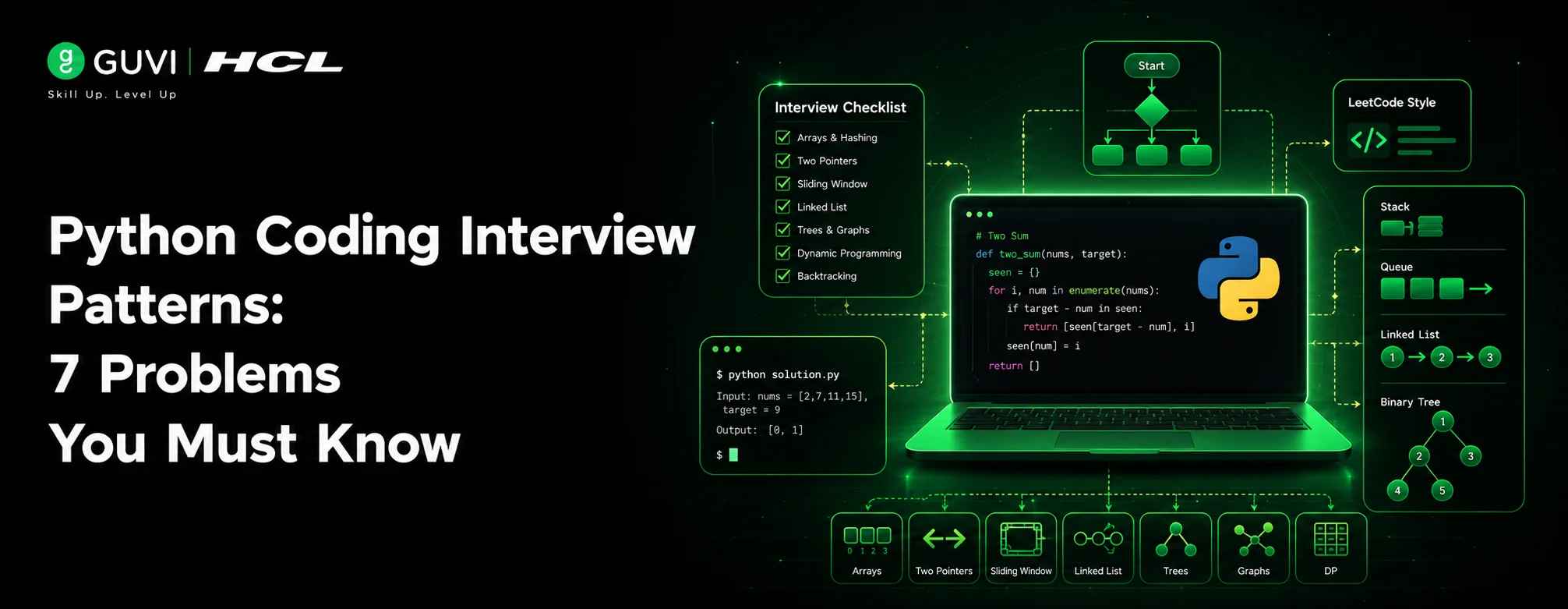
Python Coding Interview Patterns: 7 Problems You Must Know
Aug 05, 2026 4 Min Read 488 Views
(Last Updated)
TL;DR
- Most coding interview questions follow recurring patterns.
- Learning patterns is more effective than memorizing solutions.
- Two pointers and sliding window appear frequently in Python interviews.
- Binary Search and DFS are common in medium-to-hard questions.
- Dynamic programming often appears in senior-level interviews.
Table of contents
- Introduction to Python Coding Interview Patterns: 7 Problems You Must Know
- Quick Answer
- What Are Coding Interview Patterns?
- Why Do Companies Use Pattern-Based Questions?
- Pattern 1: Two Pointers
- When Should You Use Two Pointers?
- Pattern 2: Sliding Window
- What Problems Use Sliding Window?
- Pattern 3: Fast and Slow Pointers
- Why Is This Pattern Important?
- Pattern 4: Merge Intervals
- How Do You Identify Merge Interval Problems?
- Pattern 5: Binary Search
- When Should You Use Binary Search?
- Pattern 6: Depth-First Search (DFS)
- Why Is DFS Frequently Asked?
- Pattern 7: Dynamic Programming
- What Makes Dynamic Programming Challenging?
- How to Recognize Patterns During Interviews
- Does the problem involve pairs?
- Is it about a contiguous sequence?
- Is there a linked list cycle?
- Are there overlapping ranges?
- Is the data sorted?
- Is it a tree or a graph?
- Are subproblems repeating?
- Conclusion
- FAQs
- What are coding interview patterns?
- Which coding interview pattern appears most often?
- Why should I learn patterns instead of memorizing questions?
- Is dynamic programming required for coding interviews?
- Are Python coding interview questions different from other languages
- How can I improve pattern recognition skills?
Introduction to Python Coding Interview Patterns: 7 Problems You Must Know
A surprising number of coding interview questions aren’t truly unique. Behind hundreds of seemingly different problems lie a handful of recurring patterns. Once you recognize these patterns, solving interview questions becomes much faster and more systematic.
Many candidates spend months memorizing solutions only to struggle when an interviewer slightly changes the problem. The better approach is to master the underlying problem-solving patterns. In this article, you’ll learn the seven most important Python coding interview patterns, when to use them, practical examples, and how to identify them during technical interviews.
Preparing for your next technical interview? Start by mastering one pattern this week and solve a few related problems daily. Over time, you’ll build the pattern recognition skills that top candidates rely on to succeed. Start your Python journey here
Quick Answer
Python coding interview patterns are reusable problem-solving techniques that appear repeatedly across technical interviews. Instead of memorizing hundreds of questions, candidates can master patterns such as Two Pointers, Sliding Window, Fast & Slow Pointers, Merge Intervals, Binary Search, Depth-First Search (DFS), and dynamic programming. Recognizing these patterns helps you solve unfamiliar problems quickly and efficiently.
What Are Coding Interview Patterns?
Coding interview patterns are common algorithmic approaches used to solve groups of related problems. Instead of treating every interview question as unique, you identify the underlying structure and apply the appropriate pattern.
For example, finding a pair of numbers in a sorted array often uses the Two Pointers pattern, while finding the longest substring typically uses a Sliding Window approach.
Learning patterns helps you:
- Solve problems faster
- Improve code quality
- Reduce interview stress
- Recognize hidden similarities between questions
- Perform better in timed assessments
Why Do Companies Use Pattern-Based Questions?
Interviewers rarely care whether you’ve seen a specific problem before. They want to evaluate how you analyze requirements, choose algorithms, and write efficient code.
Pattern-based questions reveal:
- Problem-solving ability
- Algorithm knowledge
- Time complexity awareness
- Coding fluency
- Communication skills
Data Point
A review of popular interview preparation platforms shows that a significant percentage of medium-level coding questions can be solved using a small set of recurring algorithmic patterns.
Pattern 1: Two Pointers
When Should You Use Two Pointers?
The Two Pointers pattern works well when dealing with sorted arrays, linked lists, or problems involving pairs of elements.
Common signals include:
- Sorted array
- Pair sum problems
- Removing duplicates
- Palindrome checks
Example Problem
Find two numbers that add up to a target.
Python Solution
def two_sum_sorted(nums, target):

    left = 0

    right = len(nums) - 1

    while left < right:

        current_sum = nums[left] + nums[right]

        if current_sum == target:

            return [left, right]

        elif current_sum < target:

            left += 1

        else:

            right -= 1

    return []
Pro Tip
If the array is sorted, think about Two Pointers before considering nested loops.
Pattern 2: Sliding Window
What Problems Use Sliding Window?
Sliding Window is ideal for contiguous sequences such as substrings and subarrays.
Common interview questions include:
- Longest substring
- Maximum sum subarray
- Fixed-size window calculations
- String analysis
Example Problem
Find the maximum sum of a subarray of size k.
Python Solution
def max_sum_subarray(nums, k):

    window_sum = sum(nums[:k])

    max_sum = window_sum

    for i in range(k, len(nums)):

        window_sum += nums[i] - nums[i-k]

        max_sum = max(max_sum, window_sum)

    return max_sum
Best Practice
Sliding Window often reduces O(n²) solutions to O(n).
Pattern 3: Fast and Slow Pointers
Why Is This Pattern Important?
Fast and slow pointers are commonly used in linked list problems where you need to detect cycles or locate middle elements.
Example Problem
Detect a cycle in a linked list.
Python Solution
def has_cycle(head):

    slow = head
    fast = head

    while fast and fast.next:

        slow = slow.next
        fast = fast.next.next

        if slow == fast:
            return True

    return False
Common Uses
- Cycle detection
- Middle node finding
- Happy Number problems
Pattern 4: Merge Intervals
How Do You Identify Merge Interval Problems?
If a question contains overlapping ranges, schedules, or intervals, this pattern is often the solution.

Example Problem
Merge overlapping intervals.
Python Solution
def merge(intervals):

    intervals.sort()

    merged = [intervals[0]]

    for current in intervals[1:]:

        previous = merged[-1]

        if current[0] <= previous[1]:
            previous[1] = max(previous[1], current[1])

        else:
            merged.append(current)

    return merged
Typical Applications
- Calendar scheduling
- Meeting rooms
- Time range processing
Preparing for your next technical interview? Start by mastering one pattern this week and solve a few related problems daily. Over time, you’ll build the pattern recognition skills that top candidates rely on to succeed. Start your Python journey here
Pattern 5: Binary Search
When Should You Use Binary Search?
Binary Search works whenever the search space is sorted or can be divided into predictable halves.
Example Problem
Find a target value in a sorted array.
Python Solution
def binary_search(nums, target):

    left = 0
    right = len(nums) - 1

    while left <= right:

        mid = (left + right) // 2

        if nums[mid] == target:
            return mid

        if nums[mid] < target:
            left = mid + 1

        else:
            right = mid - 1

    return -1
Data Point
Binary Search reduces search complexity from O(n) to O(log n), making it one of the most efficient algorithms in interviews.
Pattern 6: Depth-First Search (DFS)
Why Is DFS Frequently Asked?
DFS is one of the most common patterns for tree and graph problems.
Example Problem
Calculate the maximum depth of a binary tree.
Python Solution
def max_depth(root):

    if not root:
        return 0

    return 1 + max(
        max_depth(root.left),
        max_depth(root.right)
    )
Common Interview Questions
- Tree traversal
- Graph traversal
- Path finding
- Connected components
Pattern 7: Dynamic Programming
What Makes Dynamic Programming Challenging?
Dynamic Programming (DP) solves complex problems by breaking them into smaller subproblems and storing intermediate results.
Example Problem
Calculate the nth Fibonacci number.
Python Solution
def fibonacci(n):

    if n <= 1:
        return n

    dp = [0] * (n + 1)

    dp[1] = 1

    for i in range(2, n + 1):
        dp[i] = dp[i-1] + dp[i-2]

    return dp[n]
Warning
Many candidates jump directly to recursion. Interviewers often expect an optimized DP solution.
Preparing for your next technical interview? Start by mastering one pattern this week and solve a few related problems daily. Over time, you’ll build the pattern recognition skills that top candidates rely on to succeed. Start your Python journey here
Comparison Table: The 7 Essential Patterns
| Pattern | Typical Data Structure | Time Complexity Benefit | Interview Frequency |
| Two Pointers | Arrays | O(n²) → O(n) | Very High |
| Sliding Window | Arrays, Strings | O(n²) → O(n) | Very High |
| Fast & Slow Pointers | Linked Lists | Efficient Detection | High |
| Merge Intervals | Arrays | Simplified Range Logic | High |
| Binary Search | Sorted Arrays | O(n) → O(log n) | Very High |
| DFS | Trees, Graphs | Structured Traversal | Very High |
| Dynamic Programming | Various | Avoid Recalculation | High |
How to Recognize Patterns During Interviews
The biggest challenge is not coding it’s pattern recognition.
Ask yourself:
Does the problem involve pairs?
Use Two Pointers.
Is it about a contiguous sequence?
Consider a sliding window.
Is there a linked list cycle?
Think Fast & Slow Pointers.
Are there overlapping ranges?
Use Merge Intervals.
Is the data sorted?
Try Binary Search.
Is it a tree or a graph?
Use DFS.
Are subproblems repeating?
Dynamic programming is likely the answer.
Conclusion
Python coding interviews become much more manageable when you focus on patterns rather than isolated problems. The seven patterns covered in this guide Two Pointers, Sliding Window, Fast & Slow Pointers, Merge Intervals, Binary Search, DFS, and Dynamic Programming form the foundation of countless interview questions.
By learning when to use each pattern, understanding their strengths, and practicing representative problems, you’ll approach interviews with greater confidence and consistency.
FAQs
What are coding interview patterns?
Coding interview patterns are reusable algorithmic approaches that solve groups of similar problems efficiently.
Which coding interview pattern appears most often?
Two Pointers, Sliding Window, Binary Search, and DFS are among the most frequently tested patterns in technical interviews.
Why should I learn patterns instead of memorizing questions?
Patterns help you solve unfamiliar problems by recognizing common structures rather than relying on memorized solutions.
Is dynamic programming required for coding interviews?
Many mid-level and senior-level interviews include Dynamic Programming questions, especially at large technology companies.
Are Python coding interview questions different from other languages
The underlying algorithms remain the same, but Python’s concise syntax often allows faster implementation during interviews.
How can I improve pattern recognition skills?
Practice grouped problem sets, analyze solved questions, and focus on identifying problem characteristics before writing code.
Success Stories

About the Author
HCL GUVI
This article was selected and published as part of the HCL GUVI AI Blogathon 2026, an initiative designed to encourage students, AI enthusiasts, and aspiring tech writers to simplify complex AI concepts through impactful technical content. The contest recognized high-quality, original, and insightful AI-focused blogs, with selected authors receiving publication opportunities on the HCL GUVI blog platform along with official author credits and recognition.
View all posts by HCL GUVI
Connect with me @











Did you enjoy this article?