


Artificial Intelligence and Machine Learning Articles
How to Evaluate LLM Outputs in Production Deployments
AI/ML Skills Gap 2026: Why Companies Can't Find Job-Ready Talent
20 AI/ML Interview Questions Recruiters Can Use Without a Tech Background - Best Guide
How Industry-Backed AI/ML Bootcamps Are Changing the AI/ML Hiring Pipeline - Best Guide 2026


Get In Touch For Details! Request More Information

DFS in AI: Depth-First Search Explained Simply
Sep 09, 2026 6 Min Read 1289 Views
(Last Updated)
When you first start learning artificial intelligence or computer science, you quickly realize that a lot of it comes down to one core question: how does a machine explore possibilities and find answers? Whether it is solving a puzzle, finding a route, or making decisions in a game, AI systems need a way to search through a space of options.
This is where search algorithms come in, and Depth First Search is one of the most important ones you will ever learn. Uninformed search algorithms operate without domain-specific knowledge, exploring the search space systematically until a solution is found. DFS falls right into this category, making it a foundational concept for anyone stepping into the world of AI and algorithms.
In this article, we will break down exactly what DFS in AI is, how it works step by step, why it matters in AI, what its strengths and weaknesses are, and where it is actually used in the real world all in the simplest way possible.
Table of contents
- AI Overview
- Understanding Graphs and Trees First
- How Does DFS Actually Work?
- Step 1: Start at the Root and Visualize the Logic
- Step 2: Leverage LIFO Structure with a Stack
- Step 3: Mark the Starting Node as Visited
- Step 4: Explore Deeper via Unvisited Neighbors
- Step 5: Backtrack When Stuck
- Step 6: Continue Until Complete
- DFS and the Stack Data Structure
- DFS as an Uninformed Search Strategy
- Backtracking: DFS's Most Powerful Feature
- Time Complexity and Space Complexity of DFS
- DFS vs. BFS: What Is the Difference?
- Real-World Applications of DFS in AI
- Limitations of DFS to Keep in Mind
- Wrapping Up
- FAQs
- What's the main data structure in DFS?
- DFS vs. BFS: When to use DFS?
- Time/space complexity?
- Common pitfalls?
- Real-world AI use?
AI Overview
Depth-First Search (DFS) in AI is an uninformed search algorithm that explores one branch of a search space as deeply as possible before backtracking. It uses a stack, either explicitly or through recursion, to keep track of nodes to explore. DFS is useful for maze solving, game-tree exploration, backtracking, cycle detection, and graph traversal. However, it does not guarantee the shortest or optimal solution.
What is DFS in AI?
Depth-First Search (DFS) is an algorithm used for traversing or searching tree and graph data structures. It explores each branch of a graph or tree as deeply as possible before backtracking to explore other branches. In simple terms, it works like navigating a maze by following one path all the way until a dead end, then returning and trying a different path.
Understanding Graphs and Trees First
Before diving into how DFS works, it helps to understand what graphs and trees actually are. A graph is simply a collection of nodes (also called vertices) connected by edges. Think of cities on a map; each city is a node, and the roads between them are edges.
- A tree is just a special type of graph that has no cycles and follows a parent-child structure, like a family tree.
- When AI needs to solve a problem, it often models that problem as a graph or tree. For example, each possible move in a chess game can be a node, and the connections between moves are the edges.
- The AI then needs to search through this structure to find the best move or a winning path. This is why graph traversal algorithms like DFS are so central to AI problem-solving.
- Depth-first search is a traversing algorithm used in tree and graph-like data structures. It generally starts by exploring the deepest node in the frontier.
- Starting at the root node, the algorithm proceeds to search to the deepest level of the search tree until nodes with no successors are reached. Once those leaf nodes are reached, it starts backtracking.
Depth-First Search (DFS) plays a key role in several foundational computing systems. It is conceptually similar to how web crawlers explore links by going deep into a chain of pages before backtracking, helping index large portions of the internet efficiently. DFS also underlies game-tree search techniques like Minimax, which are used in chess engines to explore possible move sequences. Systems such as Deep Blue leveraged these search principles, combined with evaluation heuristics, to explore deep strategic possibilities and identify winning moves that are difficult for humans to anticipate.
How Does DFS Actually Work?
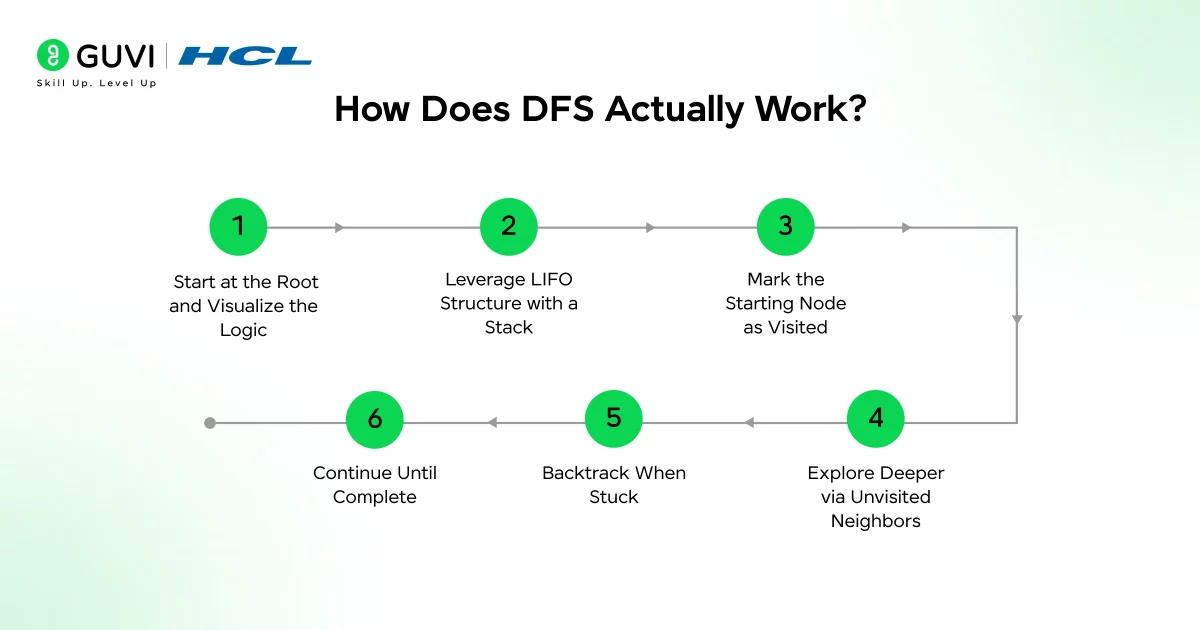
Step 1: Start at the Root and Visualize the Logic
The logic behind DFS is straightforward once you visualize it. You begin at a root node and move to one of its neighbors, plunging deeper into that path while avoiding already-explored nodes. When you can’t go further, you backtrack to the most recent node with unexplored neighbors and resume from there.
Step 2: Leverage LIFO Structure with a Stack
DFS relies on a LIFO (Last In, First Out) queue, essentially a stack, to track unvisited vertices. The most recently added node expands next, driving the search to the deepest levels first, where nodes lack successors. This stack manages the traversal path efficiently.
Step 3: Mark the Starting Node as Visited
Kick off at the starting node: mark it as visited to prevent revisits. This ensures the algorithm doesn’t loop infinitely in cycles.
Step 4: Explore Deeper via Unvisited Neighbors
Select an unvisited neighbor of the current node, move to it, and mark it visited. Repeat this process, always prioritizing depth over breadth, to dive as far as possible along the current path.
Step 5: Backtrack When Stuck
When the current node has no unvisited neighbors, backtrack to the previous node (pop from the stack). From there, pick another unvisited neighbor and resume exploration.
Step 6: Continue Until Complete
Repeat steps 3-5 until all nodes are visited or your target is found. The stack, explicit (via list) or implicit (recursion’s call stack), tracks progress; recursion simplifies this for beginners.
DFS and the Stack Data Structure
The stack is what makes DFS tick. If you have ever stacked books on a table, you already understand how a stack works. The last book you place on top is the first one you pick up, which is Last In, First Out. DFS uses this exact behavior.
- When DFS visits a new node, it adds it to the stack. It keeps going deeper by exploring neighbors. If it reaches a dead end, a node with no more children, it backtracks by removing nodes from the stack.
- This process of pushing nodes onto the stack when visiting them and popping them off when backtracking is the core mechanical operation of DFS.
- The beauty of using a stack is that it naturally preserves the path taken so far. At any moment during the traversal, the stack contains exactly the sequence of nodes from the root down to the current node. This is why DFS can backtrack so efficiently; it always knows which node to return to.
DFS as an Uninformed Search Strategy
- In AI, search algorithms are broadly divided into two types: informed and uninformed. Informed search algorithms like A* use additional knowledge (called heuristics) to guide their search toward the goal more efficiently.
- Uninformed search algorithms have no such extra knowledge and simply explore the space systematically.
- DFS is a classic uninformed search strategy. DFS dives deep into one branch before backtracking, using a stack. It is memory-efficient but not guaranteed to find the shortest path.
- This makes it useful in many situations, especially when you just need to find any valid solution rather than the optimal one.
- DFS is not cost-optimal because it does not guarantee finding the shortest path to the goal. It may find a solution quickly, but that path might not be the shortest or the cheapest one.
- For scenarios where the shortest path matters, algorithms like BFS or A* are better choices. But for scenarios where you just need to explore all possibilities, like solving puzzles or detecting cycles, DFS is excellent
Backtracking: DFS’s Most Powerful Feature
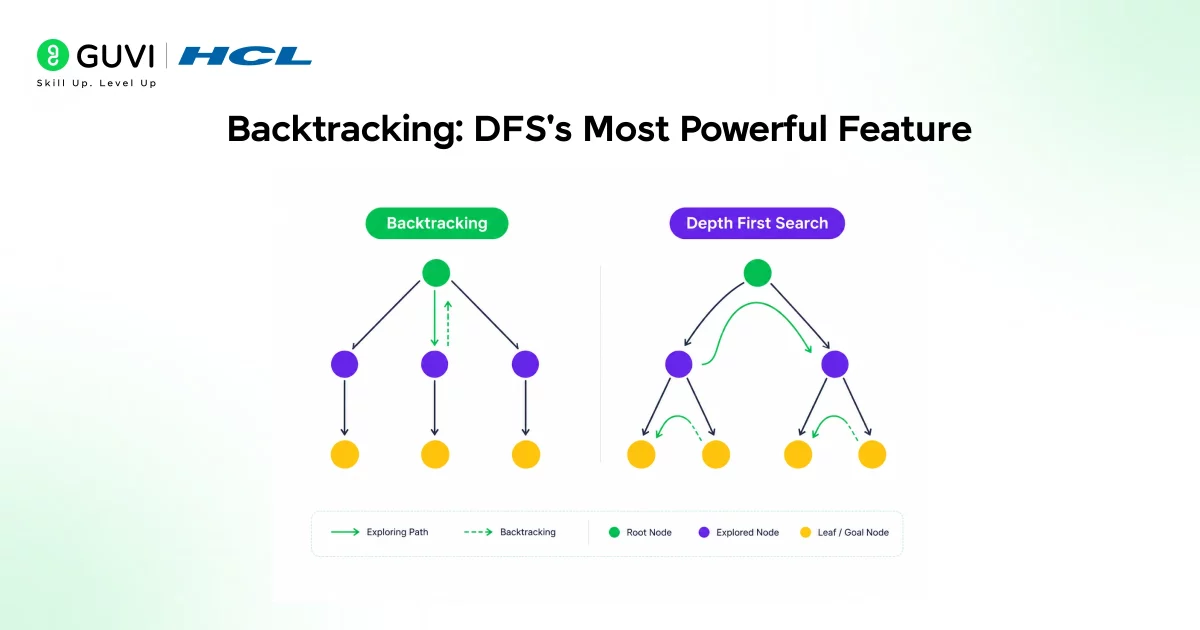
One of the most important concepts tied to DFS is backtracking. The two terms are often used together, and for good reason: backtracking is essentially what gives DFS its problem-solving power in AI.
- DFS is the brute-force exploration of every possible path down a decision tree, while backtracking is the intelligent sibling that knows when to cut losses on a dead-end path and try a different route.
- The critical distinction is that backtracking has a clear goal, solving a problem, usually with constraints, and will backtrack more efficiently than a standard DFS approach by pruning paths that do not satisfy the problem constraints.
- In practical AI tasks, backtracking powered by DFS is used to solve constraint satisfaction problems like Sudoku, the N-Queens puzzle, and crossword generation. Depth-first search is a common way that many people naturally approach solving problems like mazes.
- You select a path and follow it until you hit a dead end or reach the finishing point. If a given path does not work, you backtrack and take an alternative path from a past junction, and try that path. This mimics very natural human problem-solving behavior.

Time Complexity and Space Complexity of DFS
Understanding how efficient an algorithm is matters a lot in AI, especially when dealing with large graphs. DFS is quite efficient in both time and memory compared to many alternatives.
- The time complexity of DFS is O(V + E), where V is the number of vertices and E is the number of edges in the graph. This is because every vertex and every edge will be explored in the worst-case scenario. This linear time complexity makes DFS a practical choice for large graphs.
- Memory requirement is only linear with respect to the search graph. The algorithm only needs to store a stack of nodes on the path from the root to the current node. This is a significant advantage over Breadth First Search (BFS), which needs to store all nodes at the current level in memory.
- DFS stores as much memory as the depth of the tree, giving it a space usage of O(h) where h is the height of the tree. In deep graphs where memory is limited, this makes DFS the smarter choice.
DFS vs. BFS: What Is the Difference?
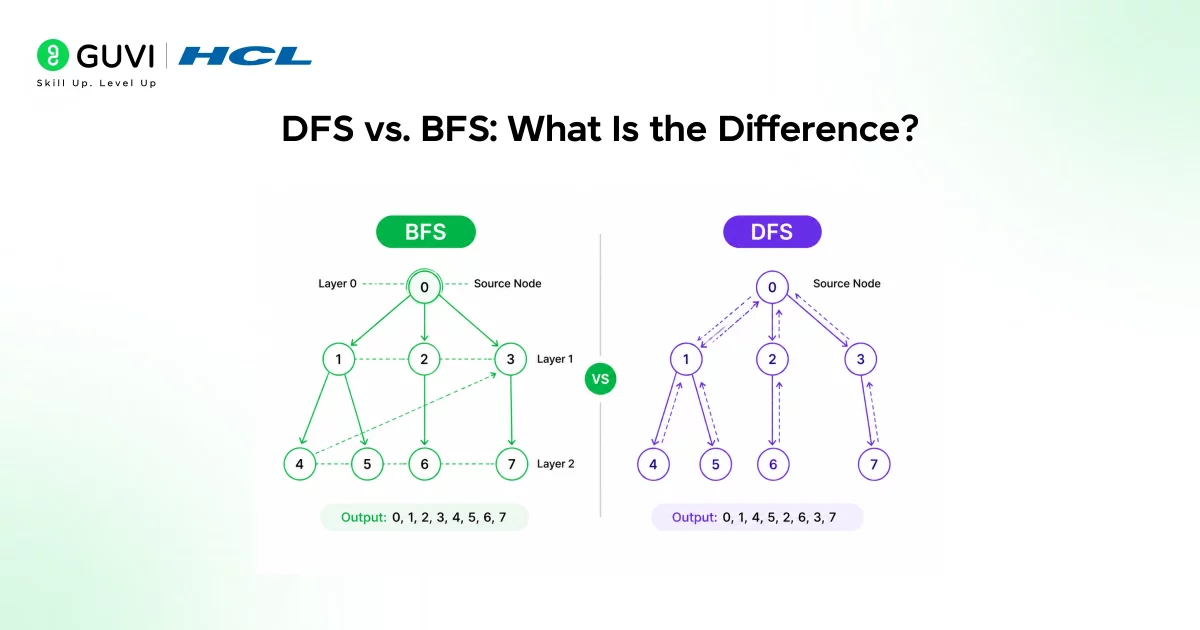
- A lot of beginners wonder how DFS compares to BFS (Breadth First Search). Both are fundamental graph traversal algorithms, but they work quite differently and suit different problems.
- DFS goes deep first; it fully explores one branch before trying another. BFS goes wide first; it explores all neighbors at the current level before moving deeper.
- BFS explores level by level using a queue and guarantees the shortest path in unweighted graphs, making it better when you need the shortest path and the graph is not too large. Use DFS when memory is limited, and the solution depth is unknown.
- BFS uses more memory because it expands all children of a vertex and keeps them in memory. If the tree is very wide, BFS might need too much memory. In those cases, DFS is a much more practical option.
- The key takeaway is that neither algorithm is universally better; the choice depends entirely on the nature of the problem you are solving.
Real-World Applications of DFS in AI
DFS is not just a textbook concept; it shows up in real AI systems and software all the time. Here are some of the most important applications.
- Maze and Puzzle Solving
DFS is a great way to solve mazes and other puzzles that have a single solution. Since DFS fully explores one path before trying another, it naturally fits the trial-and-error nature of maze solving. It is also used to generate random mazes procedurally in games.
- Game Tree Search
DFS is used in AI for game tree exploration, such as in chess or tic-tac-toe. When an AI needs to evaluate possible future moves in a game, it builds a game tree where each node is a game state. DFS explores these states deeply, which forms the basis for algorithms like Minimax that power game-playing AI.
- Topological Sorting
In directed acyclic graphs, DFS is used for topological sorting, arranging vertices in a linear order based on dependencies. A practical example is task scheduling, where certain tasks must be completed before others. This is widely used in build systems, package managers, and project planning tools.
- Cycle Detection
A graph has a cycle if and only if we see a back edge during DFS. So we can run DFS on a graph and check for back edges to detect cycles. This is very useful in networking, dependency resolution, and database systems where circular references can cause problems.
- Web Crawling
Search engines use DFS to traverse web pages and index content. A web crawler powered by DFS will follow links on a page deep into a website before backtracking and exploring other links. This allows search engines to discover and index pages efficiently.
- Connected Components in Social Networks
DFS can identify all connected components in a graph. In social networks, this means finding clusters or groups of users connected by friendships. Platforms can use this to suggest friends, identify communities, or detect isolated users.
Limitations of DFS to Keep in Mind
As powerful as DFS is, it does have some limitations that are important to know.
- DFS is not cost-optimal; it does not guarantee finding the shortest path to the goal. It may find a solution quickly, but that path might not be the shortest or cheapest one. So if you need the most efficient route, DFS alone is not the right tool.
- Another risk with DFS is getting stuck in very deep or infinite graphs. If a graph has cycles and you do not track visited nodes properly, DFS can loop infinitely.
- Common pitfalls include failing to mark nodes as visited, which can lead to infinite loops in cyclic graphs, and recursive implementations causing stack overflow for very large graphs. These are manageable with careful implementation, but they are real concerns for beginners.
If you’re serious about mastering DFS in AI understanding recursive backtracking, stack-based exploration, maze solving, and its role in game AI pathfinding, don’t miss the chance to enroll in HCL GUVI’s Intel & IITM Pravartak Certified Artificial Intelligence & Machine Learning Course, co-designed by Intel.
Wrapping Up
DFS in AI is one of those foundational ideas that everything else builds on. Once you understand how it explores a graph, going as deep as possible before backtracking, you start to see its logic everywhere. From solving a maze to powering a chess engine to helping a search engine crawl the web, Depth First Search is at work behind the scenes.
Depth-First Search is a powerful and intuitive algorithm for traversing trees and graphs. Its recursive nature makes it simple to implement, and its deep exploration strategy makes it suitable for a wide range of applications, from problem-solving to AI pathfinding.
As you continue learning AI and data structures, DFS will keep showing up as a building block for more advanced algorithms. Getting comfortable with it now will save you a lot of confusion later.
The best way to really internalize DFS is to implement it yourself, start with a simple tree, trace through the logic manually, and then try it on a graph with cycles. Once you see it work with your own code, it will click in a way that reading about it alone never quite does.
FAQs
1. What’s the main data structure in DFS?
A stack (LIFO), an explicit list, or implicitly via recursion for tracking paths and backtracking.
2. DFS vs. BFS: When to use DFS?
Use DFS for memory-limited deep searches or any solution (not the shortest); use BFS for shortest paths in unweighted graphs.
3. Time/space complexity?
Time: O(V + E); Space: O(h), where h is tree height, which is efficient for deep graphs.
4. Common pitfalls?
Infinite loops in cycles (fix: mark visited); stack overflow in recursion on huge graphs.
5. Real-world AI use?
Game AI (chess trees), web crawlers, puzzle solvers (Sudoku), and social network analysis.
Success Stories

About the Author
Vishalini Devarajan
An Aerospace Engineer turned content writer, I focus on making complex concepts easy to understand through well-structured, reader-friendly blogs. Whether it’s a technical topic or a non-technical one, I love creating content that is clear, engaging, and impactful.
View all posts by Vishalini Devarajan
Connect with me @













Did you enjoy this article?