


Deep Learning Articles
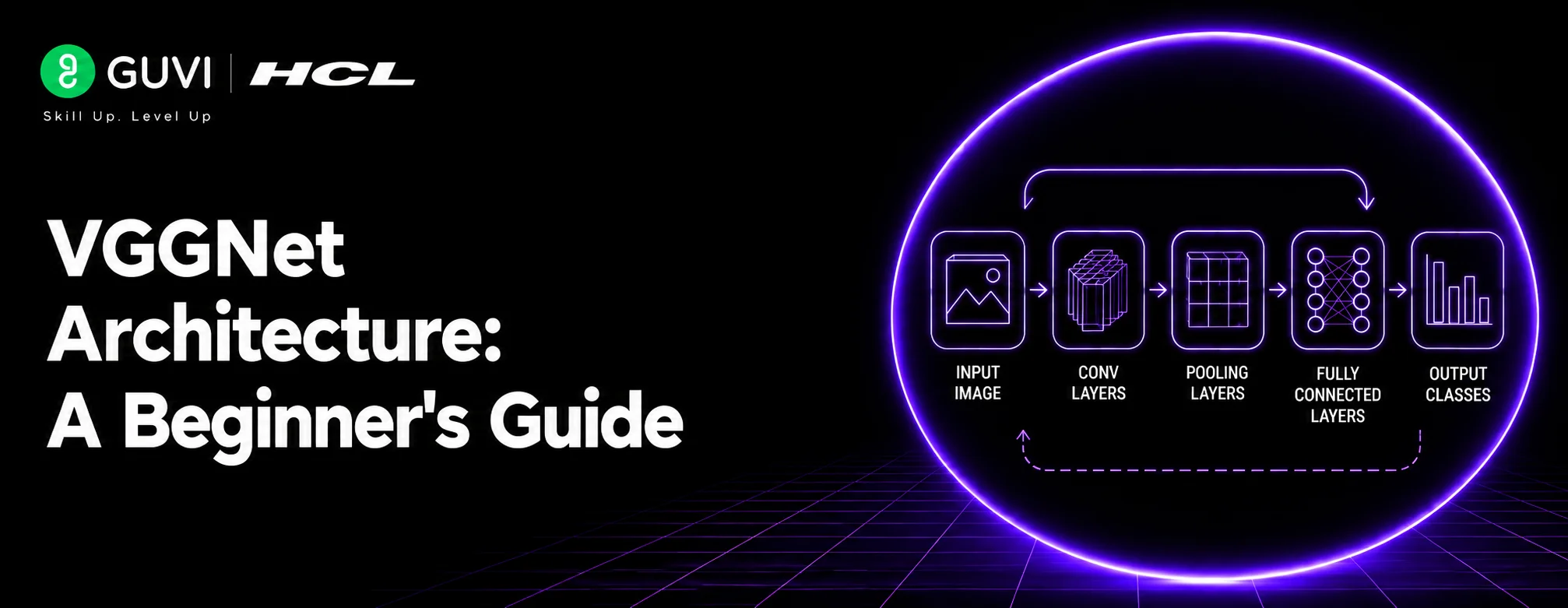
VGGNet Architecture: A Beginner's Guide
Dropout Regularization in Neural Networks


Get In Touch For Details! Request More Information
Neural Network Skills to Succeed in Data Science
Oct 17, 2026 6 Min Read 9783 Views
(Last Updated)
Neural networks power modern AI applications, including image recognition, speech processing, forecasting, and natural language processing. Understanding these networks helps data scientists analyse complex data and solve challenging problems.
Different neural network architectures serve different purposes, making it essential to understand their functions and applications.
This guide explores the relationship between data science and deep learning, covering five essential neural networks: Perceptrons, Multilayer Perceptrons (MLPs), Convolutional Neural Networks (CNNs), Recurrent Neural Networks (RNNs), and Long Short-Term Memory Networks (LSTMs).
Table of contents
- Quick Answer
- What Is Deep Learning?
- How Are Data Science and Deep Learning Connected?
- Top 10 Deep Learning Skills for Data Scientists
- Neural Network Fundamentals
- Activation Functions
- Perceptrons
- Multilayer Perceptrons
- Convolutional Neural Networks
- Recurrent Neural Networks
- Long Short-Term Memory Networks
- Model Training and Optimization
- Data Preparation and Model Evaluation
- Deep Learning Frameworks and Practical Implementation
- Skills to Prioritize First
- Roadmap to Learn Deep Learning for Data Science
- Step 1: Build Data Science Fundamentals
- Step 2: Strengthen Python Skills
- Step 3: Learn Machine Learning Basics
- Step 4: Understand Neural Network Fundamentals
- Step 5: Start With Perceptrons and MLPs
- Step 6: Learn CNNs
- Step 7: Learn RNNs and LSTMs
- Step 8: Learn TensorFlow or PyTorch
- Step 9: Build Real-World Projects
- Step 10: Practice Model Evaluation and Improvement
- Conclusion
- FAQs
- What are neural networks in data science?
- Which neural networks should a data scientist learn?
- What is the difference between deep learning and neural networks?
- What is the difference between CNN, RNN, and LSTM?
- Why are neural networks important for data scientists?
- Should beginners learn machine learning before neural networks?
Quick Answer
Neural networks are deep learning models that learn patterns from data through interconnected layers of artificial neurons.
- Perceptron: Best for simple linear and binary classification
- Multilayer Perceptron (MLP): Handles more complex prediction and classification tasks
- Convolutional Neural Network (CNN): Primarily used for image and computer vision problems
- Recurrent Neural Network (RNN): Designed for sequential and temporal data
- Long Short-Term Memory (LSTM): Handles longer dependencies within sequential data
- Key Skills: Understand layers, weights, activation functions, training, and model selection
What Is Deep Learning?
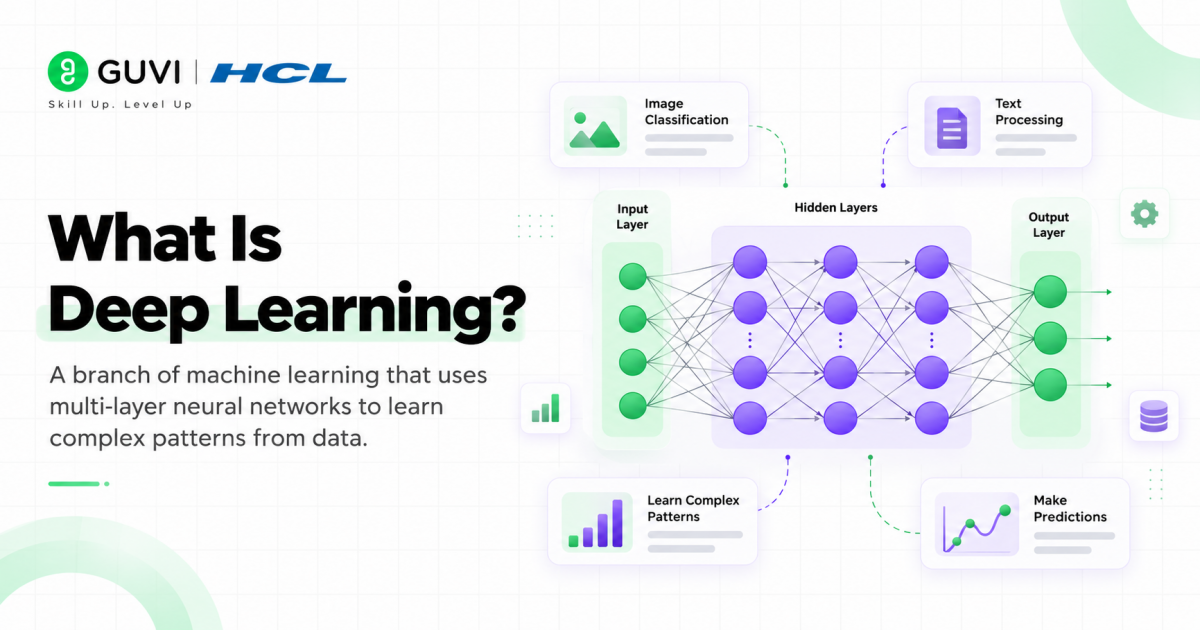
Deep learning is a branch of artificial intelligence and machine learning that uses layered neural networks to learn complex patterns from large datasets. Instead of relying entirely on manually defined rules, deep learning models repeatedly process data, adjust internal weights, and improve their predictions during training. It is widely used for tasks such as image recognition, speech processing, language translation, forecasting, and other complex data-driven applications.
How Are Data Science and Deep Learning Connected?
Data science focuses on collecting, processing, analyzing, and modeling data to generate useful insights, while deep learning provides advanced techniques for solving complex prediction and pattern-recognition problems. Data scientists can use deep learning when working with large datasets, images, text, speech, sequential information, or other data where simpler analytical methods may not be sufficient.
To work effectively with deep learning, data scientists should build a combination of mathematical, programming, modeling, and neural network skills:
Top 10 Deep Learning Skills for Data Scientists
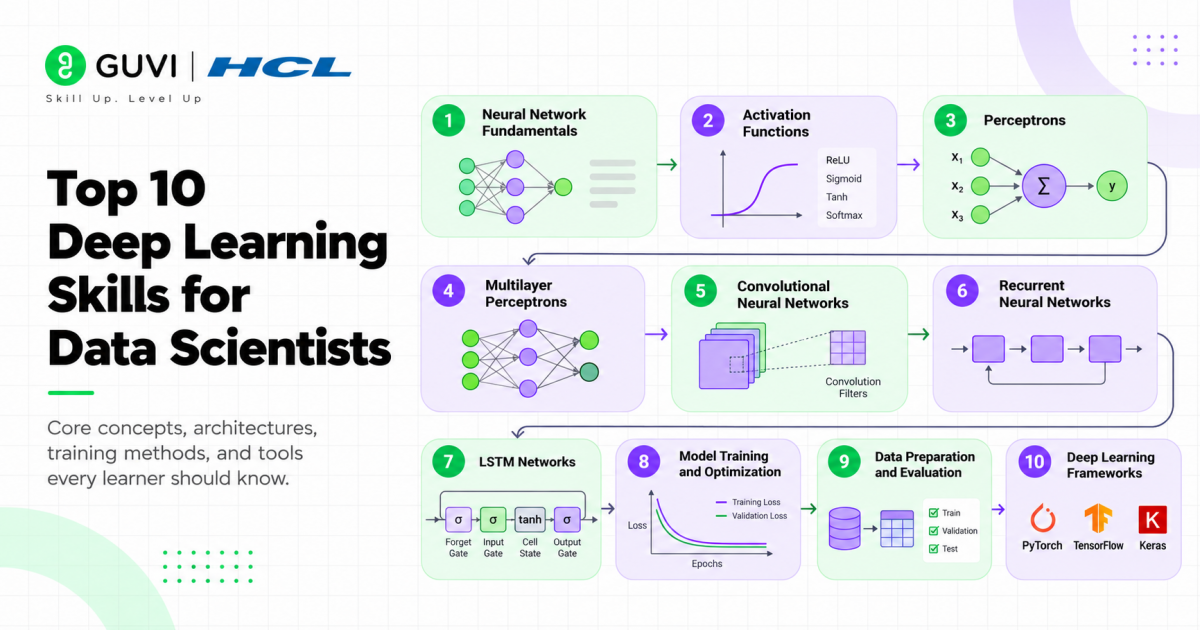
1. Neural Network Fundamentals
Understanding the basic architecture of neural networks is the first step toward learning deep learning.
- Artificial Neurons: Learn how individual neurons receive inputs, apply weights and biases, and generate outputs.
- Input Layer: Receives raw features or transformed input data.
- Hidden Layers: Learn increasingly complex patterns and representations from the input.
- Output Layer: Produces the final classification, probability, or prediction.
- Weights and Biases: Parameters adjusted during training to improve model predictions.
- Forward Propagation: Moves information from the input layer through hidden layers to generate an output.
- Network Depth: Understand how adding multiple hidden layers creates deeper neural networks capable of learning complex representations.
2. Activation Functions
Activation functions introduce non-linearity into neural networks, allowing them to learn relationships that simple linear models cannot capture.
- ReLU: Commonly used in hidden layers because of its computational simplicity.
- Sigmoid: Produces values between 0 and 1 and is commonly associated with binary classification outputs.
- Softmax: Converts outputs into class probabilities for multiclass classification.
- Tanh: Produces values between -1 and 1.
- Function Selection: Understand that choosing an activation function depends on the layer and problem being solved.
- Non-Linearity: Learn why activation functions allow neural networks to model complex data patterns.
3. Perceptrons
A perceptron is one of the simplest neural network models and provides a foundation for understanding more advanced architectures.
- Weighted Inputs: Each input is multiplied by a corresponding weight.
- Bias Term: Helps shift the model’s decision boundary.
- Activation Function: Converts the weighted input into an output.
- Binary Classification: Perceptrons are mainly suited to simple linearly separable classification problems.
- Decision Boundaries: Learn how perceptrons separate classes using a linear boundary.
- Foundation for MLPs: Multiple perceptron-like units can be connected to create more powerful neural networks.
4. Multilayer Perceptrons
Multilayer Perceptrons, or MLPs, extend basic perceptrons by adding one or more hidden layers.
- Fully Connected Layers: Neurons in one layer connect with neurons in adjacent layers.
- Hidden Representations: Intermediate layers learn increasingly complex patterns from input features.
- Classification: MLPs can handle more complex classification problems than single-layer perceptrons.
- Regression: They can also be used for numerical prediction tasks.
- Non-Linear Relationships: Multiple layers and activation functions help model complex relationships.
- Overfitting: Larger networks may memorize training data, making regularization and validation important.
- Use Cases: MLPs can support prediction, recognition, and general supervised learning problems.
5. Convolutional Neural Networks
Convolutional Neural Networks, or CNNs, are designed to identify spatial patterns and are especially important in computer vision.
- Convolution Layers: Apply filters across input data to detect useful features.
- Filters or Kernels: Learn patterns such as edges, textures, shapes, and increasingly complex visual features.
- Feature Maps: Represent features detected by convolution operations.
- Pooling: Can reduce feature-map dimensions while retaining important information.
- Hierarchical Feature Learning: Early layers may detect simple patterns while deeper layers identify more complex structures.
- Image Classification: CNNs can classify images into predefined categories.
- Object Detection: They can help identify and locate objects within images.
- Medical Imaging: CNNs are widely applicable to visual analysis tasks such as detecting abnormalities from medical images.
- Computer Vision: Facial recognition, handwriting recognition, and visual object recognition are common applications.
6. Recurrent Neural Networks
Recurrent Neural Networks, or RNNs, are designed for data where sequence and order matter.
- Sequential Processing: RNNs process information in an ordered sequence.
- Previous-State Information: Earlier information can influence later predictions.
- Temporal Dependencies: Useful when current observations depend on previous observations.
- Time-Series Forecasting: RNNs can analyze sequences of measurements collected over time.
- Text Processing: Words can be interpreted based on surrounding or preceding sequence information.
- Speech Processing: Sequential audio signals can also be modeled using recurrent architectures.
- Sequence Prediction: RNNs can predict subsequent values or elements within a sequence.
- Limitation: Standard RNNs may struggle to retain information across very long sequences.
7. Long Short-Term Memory Networks
Long Short-Term Memory networks, or LSTMs, are specialized recurrent neural networks designed to handle longer-term dependencies.
- Long-Term Memory: LSTMs can retain relevant information across longer sequences than basic RNNs.
- Memory Cell: Stores information that may remain useful across several sequence steps.
- Gating Mechanisms: Control which information should be retained, updated, or discarded.
- Sequence Modeling: Useful when relationships span long periods or long text sequences.
- Time-Series Forecasting: LSTMs can model complex temporal patterns.
- Language Translation: They can retain context across sequences of words.
- Text Summarization: LSTMs can help process long textual sequences.
- Speech Recognition: They can model dependencies across sequential audio information.
- Anomaly Detection: Sequential patterns can be learned to identify unusual behavior.
8. Model Training and Optimization
Data scientists should understand how a neural network learns rather than treating model training as a black box.
- Loss Functions: Measure the difference between predictions and expected outputs.
- Backpropagation: Calculates how model parameters contributed to the prediction error.
- Gradient Descent: Updates weights to reduce the loss function.
- Learning Rate: Controls how much model parameters change during each optimization step.
- Epochs: Represent complete passes through the training dataset.
- Batch Size: Determines how many training examples are processed before parameter updates.
- Optimizers: Algorithms such as SGD and Adam help adjust network parameters during training.
- Training Loss: Shows how well the model is learning from the training data.
- Validation Loss: Helps determine whether performance generalizes beyond the training dataset.
9. Data Preparation and Model Evaluation
Even powerful neural networks depend heavily on well-prepared data and reliable evaluation.
- Data Cleaning: Identify missing values, incorrect records, duplicates, and inconsistent data.
- Normalization: Scale numerical values into suitable ranges for model training.
- Encoding: Convert categorical or textual information into numerical representations.
- Training Set: Used to teach the neural network.
- Validation Set: Helps tune model choices and monitor generalization.
- Test Set: Measures final model performance on unseen data.
- Class Imbalance: Understand how uneven class distributions may affect predictions.
- Evaluation Metrics: Use suitable metrics such as accuracy, precision, recall, F1-score, or error measures based on the task.
- Overfitting: Detect when a model performs well on training data but poorly on unseen data.
- Underfitting: Identify when a model is too simple to capture meaningful relationships.

10. Deep Learning Frameworks and Practical Implementation
A data scientist should be comfortable implementing neural networks using widely used deep learning tools.
- TensorFlow: Supports neural network development, training, and large-scale deep learning workflows.
- PyTorch: Widely used for building and experimenting with deep learning models.
- NumPy: Supports numerical computation and matrix operations.
- pandas: Helps clean, transform, and organize datasets before training.
- Matplotlib: Useful for visualizing data, training curves, and model performance.
- scikit-learn: Supports preprocessing, evaluation, data splitting, and traditional machine learning workflows.
- Model Building: Practice creating input, hidden, and output layers programmatically.
- Model Training: Learn how to configure loss functions, optimizers, epochs, and batch sizes.
- Performance Monitoring: Track training and validation metrics to detect problems early.
- Hands-On Projects: Apply these tools to image classification, forecasting, text classification, anomaly detection, and other practical problems.
Skills to Prioritize First
For beginners, the learning order should be:
Python → Statistics → Machine Learning → Neural Network Basics → Activation Functions → Training and Backpropagation → MLPs → CNNs → RNNs and LSTMs → TensorFlow/PyTorch → Real-World Projects
Build strong neural network and deep learning foundations to advance your data science career with HCL GUVI’s Data Science Course. Learn Python, machine learning, data analytics, and real-world AI applications through 6 months of live online classes, expert mentorship, 1:1 doubt sessions, and placement assistance with 1000+ hiring partners. The program offers weekday and weekend classes in English, Hindi, Telugu, and Tamil.
Roadmap to Learn Deep Learning for Data Science
A structured learning path can help beginners move from basic data science concepts to practical neural network development.
Step 1: Build Data Science Fundamentals
Start with:
- Data collection
- Data cleaning
- Data visualization
- Statistics
- Data analysis
- Basic machine learning
These skills help you understand how data is prepared before model training.
Step 2: Strengthen Python Skills
Learn:
- Python fundamentals
- NumPy
- pandas
- Matplotlib
- Data manipulation
- Basic model implementation
Python is widely used for deep learning experimentation and model development.
Step 3: Learn Machine Learning Basics
Understand:
- Classification
- Regression
- Training and testing
- Model evaluation
- Overfitting
- Prediction workflows
These concepts provide the foundation for understanding deep learning.
Step 4: Understand Neural Network Fundamentals
Study:
- Neurons
- Layers
- Weights
- Biases
- Activation functions
- Forward propagation
- Loss functions
This makes advanced architectures easier to understand.
Step 5: Start With Perceptrons and MLPs
Begin with simpler architectures before moving to specialized networks.
Practice:
- Binary classification
- Multiclass classification
- Simple prediction tasks
- Fully connected networks
Step 6: Learn CNNs
Move into image-based deep learning.
Focus on:
- Convolution
- Filters
- Feature extraction
- Image classification
- Object recognition
Step 7: Learn RNNs and LSTMs
Next, study models designed for sequential information.
Practice with:
- Time-series forecasting
- Text sequences
- Speech data
- Sequence prediction
- Language-based tasks
Step 8: Learn TensorFlow or PyTorch
Choose at least one major deep learning framework and practice:
- Building networks
- Training models
- Evaluating performance
- Adjusting model architecture
- Saving and reusing trained models
Step 9: Build Real-World Projects
Create projects involving:
- Image classification
- Object recognition
- Time-series forecasting
- Text classification
- Speech recognition
- Anomaly detection
Projects help connect theoretical neural network concepts with practical data science problems.
Step 10: Practice Model Evaluation and Improvement
Finally, learn how to improve model performance by working with:
- Validation results
- Loss values
- Overfitting
- Model architecture
- Training iterations
- Data quality
The goal is not only to build neural networks but also to understand which architecture fits a particular data science problem and why.
Conclusion
Neural networks are essential to modern data science and deep learning. They help identify complex patterns and process data that simpler machine learning models may struggle to handle.
Different architectures serve different purposes. Perceptrons support basic classification, MLPs learn complex relationships, CNNs process visual data, and RNNs and LSTMs handle sequential information.
Beginners should start with machine learning fundamentals, neural network architecture, activation functions, and model training. They can then explore different networks through practical projects.
The key is understanding when and why to use each architecture. Hands-on experience with classification, computer vision, forecasting, text, and speech helps build practical data science skills.
FAQs
1. What are neural networks in data science?
Neural networks are machine learning models made of interconnected artificial neurons organized into layers. They learn patterns from training data and can be used for tasks such as classification, prediction, image recognition, speech processing, and sequence analysis.
2. Which neural networks should a data scientist learn?
Data scientists should understand Perceptrons, Multilayer Perceptrons (MLPs), Convolutional Neural Networks (CNNs), Recurrent Neural Networks (RNNs), and Long Short-Term Memory networks (LSTMs). Each architecture is useful for different types of data and problems.
3. What is the difference between deep learning and neural networks?
A neural network is a model built from interconnected layers of artificial neurons. Deep learning generally refers to neural networks with multiple processing layers that can learn increasingly complex representations from data.
4. What is the difference between CNN, RNN, and LSTM?
A CNN is primarily designed for spatial data such as images. An RNN processes sequential information by incorporating previous states. An LSTM is a specialized RNN architecture designed to retain useful information across longer sequences.
5. Why are neural networks important for data scientists?
Neural networks help data scientists solve complex problems involving large datasets, images, text, speech, sequences, and other forms of unstructured data. They are particularly valuable when relationships within the data are difficult to model using simpler algorithms.
6. Should beginners learn machine learning before neural networks?
Yes. Beginners should first understand basic machine learning concepts such as training data, features, model evaluation, classification, regression, and overfitting. These fundamentals make neural networks and deep learning architectures easier to understand and apply.
Success Stories

About the Author
Vaishali
I'm a seasoned writer with four years of experience across technical, non-technical, and just about every genre or niche you can imagine. Adaptable and curious, I enjoy exploring new topics and making information engaging and easy to understand. Fueled by a steady stream of tea, I approach each project with creativity, reliability, and genuine enthusiasm for storytelling.
View all posts by Vaishali
Connect with me @











Did you enjoy this article?