


Deep Learning Articles
Dropout Regularization in Neural Networks
Generative Adversarial Networks (GANs): The Complete Guide
What is Object Detection? A Beginner’s Guide [2026]
What is the Minerva Deep Learning Model? An Exclusive Beginner’s Guide [2025]


Get In Touch For Details! Request More Information
VGGNet Architecture: A Beginner’s Guide
Sep 01, 2026 3 Min Read 320 Views
(Last Updated)
Deep learning has revolutionized computer vision, enabling machines to recognize images with remarkable accuracy. One of the most influential convolutional neural network architectures is the VGGNet, which demonstrated that increasing network depth with small convolution filters significantly improves image classification performance. Despite newer architectures emerging, VGGNet remains an essential model for understanding modern CNNs and transfer learning. This guide explains VGGNet Architecture, how it works, its key components, and real-world applications.
Table of contents
- TL;DR Summary
- Why VGGNet Architecture Matters
- What is VGGNet Architecture?
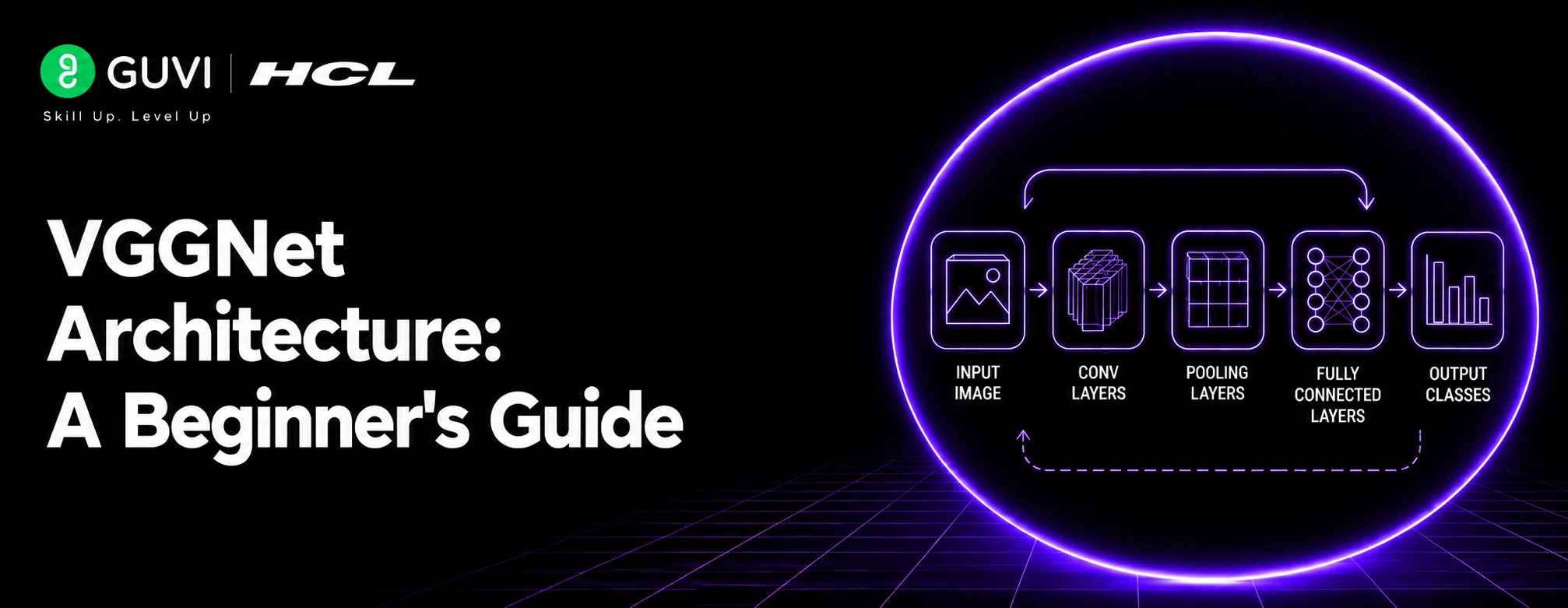
- How VGGNet Works
- Step 1: Input Image
- Step 2: Convolution Layers
- Step 3: Pooling Layers
- Step 4: Fully Connected Layers
- Key Features of VGGNet
- Small Convolution Filters
- Deep Architecture
- Uniform Design
- Strong Transfer Learning
- Popular VGGNet Variants
- VGG-11
- VGG-13
- VGG-16
- VGG-19
- Applications of VGGNet Architecture
- Healthcare
- Retail
- Security
- Manufacturing
- Agriculture
- Benefits of VGGNet Architecture
- Simple Design
- Excellent Feature Extraction
- Proven Performance
- Widely Used in Research
- When Should You Use VGGNet?
- Image Classification
- Transfer Learning
- Feature Extraction
- Medical Imaging
- Industrial Inspection
- Key Concepts to Remember
- Real-World Applications
- Healthcare
- Retail
- Security
- Manufacturing
- Best Practices
- Conclusion
- FAQs
- What is VGGNet Architecture?
- Why does VGGNet use 3×3 filters?
- What is the difference between VGG-16 and VGG-19?
- Is VGGNet still used today?
- What are the advantages of VGGNet?
- What are the limitations of VGGNet?
- Why is VGGNet important in deep learning?
TL;DR Summary
- VGGNet is a deep convolutional neural network.
- It uses small 3×3 convolution filters throughout the network.
- Increasing depth improves feature learning.
- VGGNet remains popular for transfer learning.
- It laid the foundation for many modern CNN architectures.
Direct Answer
| VGGNet Architecture is a deep convolutional neural network (CNN) that uses multiple small 3×3 convolution filters to learn increasingly complex image features. By stacking more convolutional layers instead of using larger filters, VGGNet achieves strong image classification performance while maintaining a simple architecture, making it an important milestone in deep learning and computer vision. |
Why VGGNet Architecture Matters
Before VGGNet, CNN architectures often varied significantly in filter sizes and complexity. VGGNet demonstrated that a simple, consistent design with deeper networks could deliver outstanding image recognition performance.
Benefits include:
- Simple architecture
- Strong feature extraction
- High image classification accuracy
- Effective transfer learning
- Easy architectural understanding
- Foundation for modern CNN research
What is VGGNet Architecture?
VGGNet is a convolutional neural network developed by researchers at the University of Oxford’s Visual Geometry Group (VGG).
The architecture uses repeated 3×3 convolutional layers followed by pooling layers, enabling the network to learn increasingly complex visual patterns while maintaining a straightforward design.
Popular versions include VGG-16 and VGG-19, containing 16 and 19 learnable layers, respectively.
Professionals interested in VGGNet Architecture, convolutional neural networks, image classification, and deep learning can strengthen their expertise through HCL GUVI’s Artificial Intelligence and Machine Learning Course.
How VGGNet Works
VGGNet processes images through multiple convolution and pooling stages.
Step 1: Input Image
The network receives an input image and converts it into numerical pixel values.
Step 2: Convolution Layers
Small 3×3 convolution filters detect edges, textures, shapes, and increasingly complex visual features.
Step 3: Pooling Layers
Pooling reduces feature map dimensions while preserving important information and lowering computational complexity.
Step 4: Fully Connected Layers
Extracted features are passed to fully connected layers that perform the final image classification.
Key Features of VGGNet
Small Convolution Filters
VGGNet consistently uses 3×3 filters, allowing deeper feature extraction with fewer parameters than larger filters.
Deep Architecture
Multiple stacked convolution layers enable the network to learn complex hierarchical image representations.
Uniform Design
The architecture follows a simple and consistent structure, making it easier to understand than many earlier CNN models.
Strong Transfer Learning
Pretrained VGGNet models are widely reused for image classification, feature extraction, and computer vision research.
Popular VGGNet Variants
Several versions of VGGNet are commonly used.
VGG-11
A smaller architecture suitable for learning CNN fundamentals.
VGG-13
Adds additional convolution layers for improved feature extraction.
VGG-16
The most widely used VGG architecture for image classification and transfer learning.
VGG-19
A deeper version that provides greater representational capacity while requiring more computational resources.
Applications of VGGNet Architecture
Healthcare
- Medical image classification
- Disease diagnosis
- X-ray analysis
Retail
- Product recognition
- Image search
- Visual recommendation systems
Security
- Face recognition
- Image verification
- Surveillance systems
Manufacturing
- Defect detection
- Product inspection
- Quality control automation
Agriculture
- Plant disease detection
- Crop monitoring
- Image-based yield analysis
Although newer architectures such as ResNet, EfficientNet, and Vision Transformers often achieve higher efficiency, the VGGNet Architecture remains an excellent learning model because its simple, sequential design makes convolutional neural networks easier to understand before exploring more advanced architectures.
Benefits of VGGNet Architecture
Simple Design
Its consistent layer structure makes implementation and learning straightforward.
Excellent Feature Extraction
VGGNet learns rich visual features that transfer effectively across many computer vision tasks.
Proven Performance
It achieved outstanding results on large-scale image classification benchmarks.
Widely Used in Research
Many deep learning projects continue using pretrained VGG models for feature extraction and transfer learning.
When Should You Use VGGNet?
VGGNet is a strong choice for computer vision tasks that require reliable feature extraction and straightforward CNN architecture. Although newer models are more computationally efficient, VGGNet remains valuable for learning deep learning concepts and transfer learning.

Image Classification
VGGNet performs well in classifying objects across large image datasets by learning hierarchical visual features.
Transfer Learning
Pretrained VGG models can be fine-tuned for custom datasets, reducing training time and improving performance when labeled data is limited.
Feature Extraction
Many computer vision applications use VGGNet as a feature extractor before applying classification, clustering, or object detection algorithms.
Medical Imaging
Healthcare researchers use VGGNet for disease diagnosis, medical image classification, and identifying abnormalities in X-rays, CT scans, and MRI images.
Industrial Inspection
Manufacturers use VGGNet to automate defect detection, quality inspection, and product verification in production environments.
Key Concepts to Remember
Understanding these concepts will help you master VGGNet Architecture.
- VGGNet uses only small 3×3 convolution filters.
- Increasing network depth improves feature learning.
- Pooling layers gradually reduce image dimensions.
- Features become more complex in deeper layers.
- VGG-16 and VGG-19 are the most widely used variants.
- Pretrained VGG models are commonly used for transfer learning.
Real-World Applications
VGGNet powers numerous AI applications across industries.
Healthcare
- Disease diagnosis
- Medical image classification
- Tumor detection
- Radiology image analysis
Retail
- Product recognition
- Visual product search
- Inventory management
- Customer shopping assistance
Security
- Face recognition
- Identity verification
- Surveillance monitoring
- Access control systems
Manufacturing
- Product quality inspection
- Defect detection
- Assembly verification
- Industrial automation
The HCL GUVI’s Artificial Intelligence eBook introduces the fundamentals of generative AI, computer vision, convolutional neural networks, deep learning, and modern AI development. It helps learners understand how architectures like VGGNet support image recognition, transfer learning, and practical AI applications across multiple industries.
Best Practices
- Begin with pretrained VGG models for most projects.
- Resize and normalize images before training.
- Apply data augmentation to improve generalization.
- Fine-tune higher layers instead of retraining the entire model.
- Monitor validation accuracy to avoid overfitting.
- Use GPUs for faster model training.
- Evaluate performance using unseen test datasets.
Conclusion
VGGNet Architecture remains one of the most influential convolutional neural networks in deep learning. Its consistent use of small convolution filters, simple design, and excellent feature extraction capabilities established important design principles for modern CNNs. Understanding VGGNet provides beginners with a strong foundation for learning computer vision, transfer learning, and advanced deep learning architectures.
FAQs
1. What is VGGNet Architecture?
VGGNet Architecture is a deep convolutional neural network that uses multiple small 3×3 convolution layers to learn hierarchical image features for accurate image classification.
2. Why does VGGNet use 3×3 filters?
Small 3×3 filters reduce the number of parameters while allowing deeper networks to learn increasingly complex visual features more efficiently.
3. What is the difference between VGG-16 and VGG-19?
VGG-16 contains 16 learnable layers, while VGG-19 contains 19 learnable layers, offering greater representational capacity at the cost of higher computational requirements.
4. Is VGGNet still used today?
Yes. Although newer architectures are more efficient, VGGNet is still widely used for transfer learning, feature extraction, education, and computer vision research.
5. What are the advantages of VGGNet?
Its major advantages include a simple architecture, excellent feature extraction, strong transfer learning performance, and consistent convolutional design.
6. What are the limitations of VGGNet?
VGGNet has a large number of parameters, requires significant memory, and is computationally more expensive than many modern CNN architectures such as ResNet or EfficientNet.
7. Why is VGGNet important in deep learning?
VGGNet Architecture demonstrated that increasing network depth using small convolution filters significantly improves image classification performance, influencing the design of many modern deep learning models.
Success Stories

About the Author
HCL GUVI
This article was selected and published as part of the HCL GUVI AI Blogathon 2026, an initiative designed to encourage students, AI enthusiasts, and aspiring tech writers to simplify complex AI concepts through impactful technical content. The contest recognized high-quality, original, and insightful AI-focused blogs, with selected authors receiving publication opportunities on the HCL GUVI blog platform along with official author credits and recognition.
View all posts by HCL GUVI
Connect with me @











Did you enjoy this article?