


Artificial Intelligence and Machine Learning Articles
Finance Manager to Data Analytics: Career Growth, Salary and Seniority
How to Evaluate LLM Outputs in Production Deployments
AI/ML Skills Gap 2026: Why Companies Can't Find Job-Ready Talent
20 AI/ML Interview Questions Recruiters Can Use Without a Tech Background - Best Guide


Get In Touch For Details! Request More Information
Generative Adversarial Networks (GANs): The Complete Guide
Aug 26, 2026 5 Min Read 384 Views
(Last Updated)
Generative Adversarial Networks, or GANs, are one of the most influential ideas in modern deep learning. Introduced by Ian Goodfellow and colleagues in 2014, GANs frame data generation as a competition between two neural networks.
The result is a system that can generate strikingly realistic images, audio, and other data. This guide explains how GANs work, how they are trained, and when to use them.
Generative Adversarial Networks (GANs) are deep learning models that generate realistic data by pitting two neural networks against each other. A generator creates synthetic samples from random noise, while a discriminator tries to distinguish real data from fake data. Through this adversarial game, the generator learns to produce increasingly authentic outputs that resemble the training distribution.
Table of contents
- TL;DR Summary
- What Is a GAN?
- How Do GANs Work?
- The Generator
- The Discriminator
- The Adversarial Game
- Loss Functions in GANs
- Training Dynamics and Challenges
- Common Training Issues
- Major GAN Variants
- DCGAN (Deep Convolutional GAN)
- Conditional GAN (cGAN)
- WGAN (Wasserstein GAN) and WGAN-GP
- StyleGAN
- Real-World Applications
- A Simple Training Sketch (Conceptual)
- Common Mistakes to Avoid
- What to Do Next
- Conclusion
- FAQs
- What does GAN stand for?
- How does a GAN generate data?
- What are the main components of a GAN?
- Why are GANs hard to train?
- What are common GAN variants?
- What are GANs used for?
- Should I use a GAN or another generative model?
TL;DR Summary
- GANs consist of a generator and a discriminator trained in an adversarial setup.
- The generator learns to create realistic data; the discriminator learns to detect fakes.
- Training is a minimax game that balances both networks.
- GANs are widely used for image synthesis, style transfer, super-resolution, and data augmentation.
- Training can be unstable; variants like DCGAN, WGAN, and StyleGAN address common issues.
What Is a GAN?
A Generative Adversarial Network (GAN) is a generative model that learns to create new data samples resembling a training dataset. It does this by training two networks together: a generator and a discriminator.
- The generator takes random noise and produces synthetic data.
- The discriminator takes real and generated samples and predicts whether each is real or fake.
The two networks are trained together in an adversarial loop. The generator tries to fool the discriminator. The discriminator tries to label real and fake data correctly. Over time, this pushes the generator toward more realistic outputs.
GANs pit a generator against a discriminator to create realistic synthetic data like images, audio, and video. Learn AI & ML with HCL GUVI’s Artificial Intelligence and Machine Learning course.
How Do GANs Work?
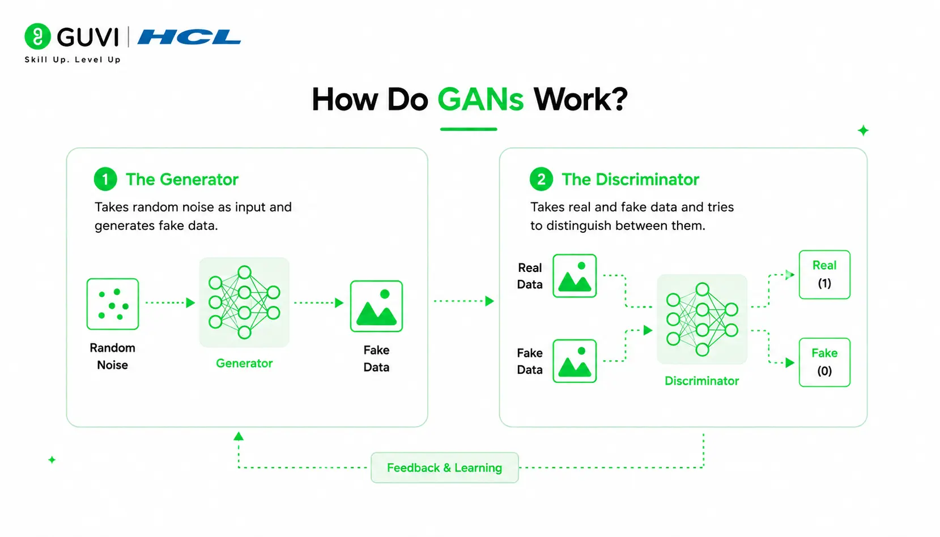
The core idea is simple: treat generation as a two-player game.
1. The Generator
The generator
G
G maps a random noise vector
z
z to a synthetic sample
G(z)
G(z).
- Input: random noise (for example, from a normal or uniform distribution).
- Output: synthetic data (for example, an image).
Early in training, outputs look noisy and unrealistic. As training progresses, they start to resemble real data.
2. The Discriminator
The discriminator
D
D is a classifier that estimates the probability that a sample is real.
- Input: a data sample (real or generated).
- Output: a probability between 0 and 1.
A high score means “likely real,” and a low score means “likely fake.” The discriminator is trained on both real data and generator outputs.
The Adversarial Game
GAN training is often described as a minimax game:
- The discriminator tries to maximize its ability to distinguish real from fake.
- The generator tries to minimize the discriminator’s ability to do so.
In practice, this means:
- Sample real data and compute discriminator loss on real samples.
- Sample noise, generate fake data, and compute discriminator loss on fake samples.
- Update the discriminator to improve real-vs-fake classification.
- Sample noise again, generate fake data, and compute generator loss based on how well it fooled the discriminator.
- Update the generator to produce more convincing fakes.
This loop repeats for many iterations until the generator produces high-quality samples.
Loss Functions in GANs
The original GAN formulation uses a minimax objective with binary cross-entropy-style losses.
A simplified view:
- Discriminator loss encourages:
- High scores for real data.
- Low scores for generated data.
- Generator loss encourages:
- High discriminator scores for generated data (so the discriminator thinks fakes are real).
Many modern variants modify this basic loss to improve stability. For example, Wasserstein GANs (WGAN) use a different objective that correlates better with sample quality and reduces some training issues.
Pro Tip: If you are new to GANs, start with well-tested implementations (for example, DCGAN on MNIST or CIFAR) before experimenting with custom architectures or losses.
Training Dynamics and Challenges
GANs are powerful but notoriously tricky to train. The generator and discriminator must stay balanced. If one becomes too strong too quickly, learning can stall.
Common Training Issues
- Non-convergence: The models may oscillate instead of settling into a stable state.
- Mode collapse: The generator produces limited varieties of samples, even if they look realistic.
- Vanishing gradients: If the discriminator is too good early on, the generator may receive weak learning signals.
- Sensitivity to hyperparameters: Learning rate, architecture, and loss choice all matter.
Researchers have proposed many techniques to stabilize training:
- Careful architecture design (for example, convolutional layers with batch normalization).
- Modified loss functions (for example, WGAN, WGAN-GP).
- Regularization and gradient penalty terms.
- Learning rate schedules and careful optimizer choice.
Warning: Do not judge GAN training only by discriminator accuracy. Monitor generated samples over time and use metrics like visual quality and diversity.
Major GAN Variants
Several GAN variants have become standard tools.
1. DCGAN (Deep Convolutional GAN)
DCGAN introduced convolutional architectures for both generator and discriminator, making GANs much more effective for images.
- Uses transposed convolutions in the generator.
- Uses strided convolutions in the discriminator.
- Includes batch normalization and careful activation choices.
DCGAN is often the first architecture people try for image generation.
2. Conditional GAN (cGAN)
Conditional GANs add extra information (for example, class labels) to both generator and discriminator.
- Generator: takes noise plus a condition (for example, a class label).
- Discriminator: takes a sample plus a condition and predicts real-vs-fake.
This enables controlled generation, such as “generate a digit 3” or “generate a face with glasses.”
3. WGAN (Wasserstein GAN) and WGAN-GP
Wasserstein GANs replace the original loss with a Wasserstein distance-based objective.
- More stable training dynamics.
- Loss values correlate better with sample quality.
- WGAN-GP adds a gradient penalty to further stabilize training.
These variants are widely used when training high-quality image GANs.
4. StyleGAN
StyleGAN and its successors focus on high-resolution, photorealistic image synthesis.
- Separate control over style and content.
- Excellent for faces, landscapes, and artistic images.
- Enables fine-grained editing in latent space.
StyleGAN is a go-to choice for state-of-the-art image generation.
Real-World Applications
GANs are used across many domains.
- Generate photorealistic faces, animals, and scenes.
- Create art, textures, and design assets.
- Convert sketches to photos.
- Turn day images into night images.
- Perform semantic segmentation to image synthesis.
- Enhance low-resolution images.
- Improve medical or satellite imagery.
- Generate synthetic training data when real data is scarce.
- Balance classes in imbalanced datasets.
- Change hairstyle, age, or expression in portraits.
- Modify artistic style while preserving content.
- Audio synthesis (music, speech).
- Video frame prediction.
- 3D object generation (with appropriate extensions).
Data Point: GANs excel when you need high-quality, realistic samples and can invest in careful training and evaluation. For simpler tabular data, other generative models may be more practical.
GANs pit a generator against a discriminator to create realistic synthetic data like images, audio, and video. Learn AI & ML with HCL GUVI’s Artificial Intelligence and Machine Learning course.

A Simple Training Sketch (Conceptual)
Here is a high-level outline of a typical GAN training loop in code-like steps:
python
# Conceptual sketch, not runnable as-is

for epoch in range(num_epochs):

    for real_images in dataloader:

        # 1. Train discriminator on real data

        noise = sample_noise(batch_size)

        fake_images = generator(noise)

        d_loss_real = discriminator_loss(real_images, labels=real)

        d_loss_fake = discriminator_loss(fake_images, labels=fake)

d_loss = (d_loss_real + d_loss_fake) / 2

        update(discriminator, d_loss)

        # 2. Train generator

        noise = sample_noise(batch_size)

        fake_images = generator(noise)

        g_loss = generator_loss(fake_images, labels=real)  # try to fool D

        update(generator, g_loss)

    # Optionally: log losses, save generated samples, evaluate metrics
In practice, you would use a framework like TensorFlow or PyTorch and a well-tested GAN implementation as a starting point.
Best Practice: Begin with a standard architecture (for example, DCGAN) on a small dataset. Once stable, scale up resolution, data complexity, or switch to advanced variants like WGAN-GP or StyleGAN.
Common Mistakes to Avoid
- Training without monitoring generated samples visually.
- Using an overly strong discriminator early in training.
- Ignoring mode collapse and only checking loss curves.
- Expecting GANs to work “out of the box” with arbitrary architectures.
- Using GANs when simpler models (for example, VAEs or diffusion) might be more appropriate for your task.
- Overlooking ethical and legal issues around synthetic media.
What to Do Next
If you want to work with GANs:
- Start with a tutorial implementation (for example, DCGAN on MNIST or CIFAR-10).
- Visualize generated samples at regular intervals.
- Experiment with different latent dimensions and learning rates.
- Try conditional GANs if you need controlled generation.
- Explore WGAN-GP or StyleGAN for higher-quality image synthesis.
- Read the original GAN paper and key follow-ups to understand the theory behind the practice.
GANs are a powerful tool in the generative AI toolkit. Understanding their mechanics, strengths, and limitations will help you choose when to use them and how to train them effectively.
GANs were originally inspired by game theory, where the generator and discriminator play a minimax game similar to a forger versus an art detective. Despite their success in images, GANs are rarely the first choice for tabular or low-dimensional data, where other generative models often train more stably.
Conclusion
Generative Adversarial Networks (GANs) are a class of generative models that learn to create realistic data by training a generator and a discriminator in an adversarial setup. The generator produces synthetic samples from noise, while the discriminator learns to distinguish real from fake. Through this competition, the generator improves until its outputs closely match the training distribution.
GANs have driven major advances in image synthesis, style transfer, super-resolution, and data augmentation. They require careful training and monitoring, but when used well, they can produce some of the most convincing synthetic data in deep learning.
FAQs
What does GAN stand for?
GAN stands for Generative Adversarial Network. It is a generative model that uses two neural networks, a generator and a discriminator, trained against each other.
How does a GAN generate data?
A GAN generates data by feeding random noise into the generator, which produces synthetic samples. The discriminator evaluates these samples along with real data, and the adversarial training pushes the generator toward more realistic outputs.
What are the main components of a GAN?
The main components are the generator, which creates synthetic data, and the discriminator, which classifies data as real or fake. Both are neural networks trained together in an adversarial loop.
Why are GANs hard to train?
GANs are hard to train because the generator and discriminator must stay balanced. Issues like non-convergence, mode collapse, and vanishing gradients can arise if the training dynamics are not carefully managed.
What are common GAN variants?
Common variants include DCGAN (for images with convolutional layers), conditional GANs (for controlled generation), WGAN and WGAN-GP (for more stable training), and StyleGAN (for high-resolution photorealistic images).
What are GANs used for?
GANs are used for image synthesis, image-to-image translation, super-resolution, style transfer, data augmentation, and generating realistic audio, video, and other data types.
Should I use a GAN or another generative model?
Use a GAN when you need high-quality, realistic samples and can invest in careful training and evaluation. For some tasks, especially with tabular data or when stability is critical, other generative models like VAEs or diffusion models may be more suitable.
Success Stories

About the Author
HCL GUVI
This article was selected and published as part of the HCL GUVI AI Blogathon 2026, an initiative designed to encourage students, AI enthusiasts, and aspiring tech writers to simplify complex AI concepts through impactful technical content. The contest recognized high-quality, original, and insightful AI-focused blogs, with selected authors receiving publication opportunities on the HCL GUVI blog platform along with official author credits and recognition.
View all posts by HCL GUVI
Connect with me @







Did you enjoy this article?