


Artificial Intelligence and Machine Learning Articles
How to Evaluate LLM Outputs in Production Deployments
AI/ML Skills Gap 2026: Why Companies Can't Find Job-Ready Talent
20 AI/ML Interview Questions Recruiters Can Use Without a Tech Background - Best Guide
How Industry-Backed AI/ML Bootcamps Are Changing the AI/ML Hiring Pipeline - Best Guide 2026


Get In Touch For Details! Request More Information
Recurrent Neural Networks: Sequential Learning in AI
Jul 14, 2026 7 Min Read 586 Views
(Last Updated)
Imagine trying to understand a sentence by reading only one word at a time without remembering what came before. Traditional neural networks work exactly like that. They look at each input independently, with no memory of what they have seen before. They cannot understand sequences, predict what comes next, or learn from patterns that unfold over time.
Recurrent Neural Networks change everything. They have memory and use information from previous steps to make better decisions about what they are seeing now. This is why RNNs power voice assistants like Siri and Alexa, Google Translate, and next-word prediction on your phone.
This guide explains what Recurrent Neural Networks are, how they work, and how to use them for real-world sequential data problems.
Table of contents
- Quick TL;DR Summary
- Why Traditional Neural Networks Cannot Handle Sequential Data
- How Recurrent Neural Networks Work: The Core Mechanism
- Step 1: Initialize the hidden state
- Step 2: Process the first input with the hidden state
- Step 3: Update the hidden state for the next step
- Step 4: Process subsequent inputs using updated hidden states
- Step 5: Generate final output from the sequence
- The Hidden State: Why It Changes Everything
- How to Implement a Recurrent Neural Network: Step-by-Step Process
- Step 1: Define Your Sequential Data Structure
- Step 2: Choose Your RNN Architecture
- Step 3: Initialize the Network Parameters
- Step 4: Implement the Forward Pass
- Step 5: Implement Backpropagation Through Time
- Step 6: Handle the Vanishing Gradient Problem
- Step 7: Train and Evaluate Your Model
- Common Mistakes Developers Make
- Getting Maximum Performance From Recurrent Neural Networks
- Real-World Applications of Recurrent Neural Networks
- Conclusion
- FAQs
- What is the difference between RNN and LSTM?
- When should I use RNN over other neural networks?
- Can RNNs handle sequences of different lengths?
- What is the vanishing gradient problem in RNNs?
- How do I choose between LSTM and GRU?
Quick TL;DR Summary
- This guide explains what Recurrent Neural Networks are and how they use hidden states to process sequential data and remember information over time.
- You will learn the difference between RNNs and traditional neural networks and when each architecture is the right choice for your problem.
- The guide covers the role of hidden states, backpropagation through time, and how RNNs handle sequences of varying lengths.
- Step-by-step instructions show you how to implement RNNs from scratch and apply them to real problems like text generation and time series prediction.
- You will understand the vanishing gradient problem, why LSTM and GRU networks were created to solve it, and how to choose between RNN variants for your specific use case.
What Is a Recurrent Neural Network?
A Recurrent Neural Network (RNN) is a type of neural network designed to process sequential data by maintaining a hidden state that stores information from previous steps in the sequence. Unlike traditional neural networks, RNNs can use past inputs to influence current predictions, making them effective for tasks involving time-dependent or ordered data such as language modeling, speech recognition, text generation, and time-series forecasting.
Why Traditional Neural Networks Cannot Handle Sequential Data
- They have no memory of previous inputs
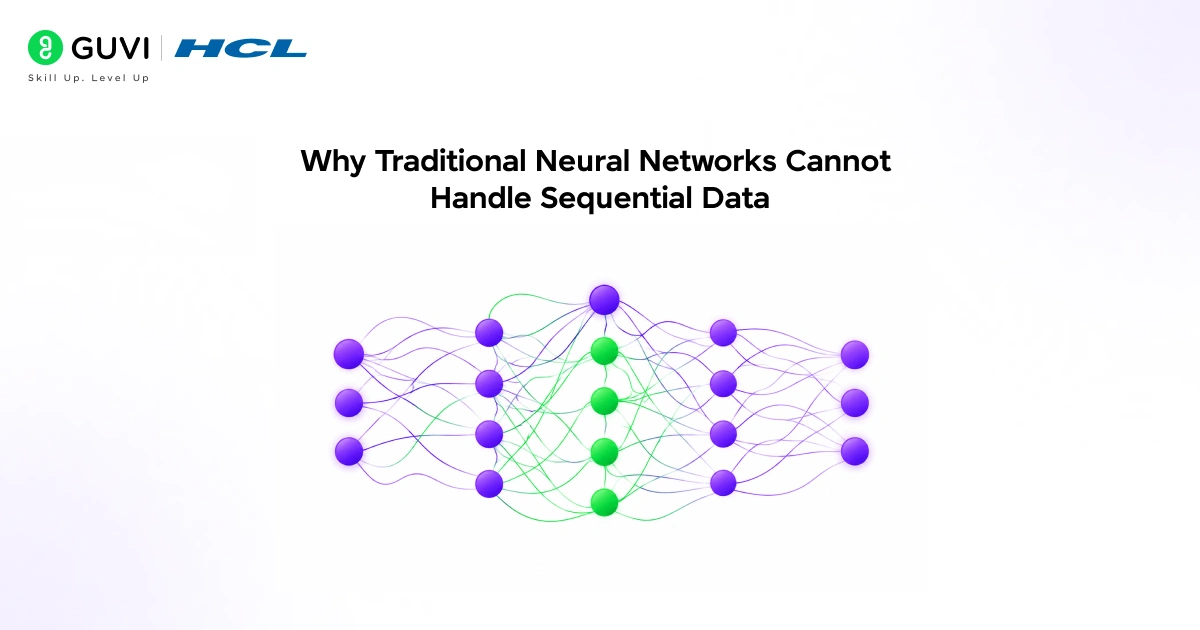
Feedforward neural networks process each input completely independently. When they see the fifth word in a sentence, they have already forgotten the first four words. This makes them useless for tasks where context and order matter, like understanding language or predicting time series.
- They cannot handle variable-length inputs
Traditional networks require fixed-size inputs. A network trained on images that are 256×256 pixels cannot process a 512×512 image without modification. For sequential data where sequences have different lengths like sentences with different numbers of words, this limitation makes standard architectures impractical.
- They cannot capture temporal dependencies
The relationship between events that happen at different times is invisible to feedforward networks. They cannot learn that yesterday’s stock price affects today’s price, or that the beginning of a sentence determines how it should end. Temporal patterns are fundamental to sequential data but completely inaccessible to traditional architectures.
- They treat order as irrelevant
Shuffle the pixels in an image and a convolutional neural network will still recognize the object. But shuffle the words in a sentence and the meaning changes completely. Sequential data has inherent order that traditional networks ignore because they have no mechanism to preserve it.
- They scale poorly with sequence length
To process a sequence with a traditional network, you would need to feed the entire sequence as a single massive input vector. For a sentence with 50 words, you would need 50 times as many input neurons. For a video with thousands of frames, this becomes completely impractical from both a memory and computation perspective.
Read More: Neural Network Skills to Succeed in Data Science
How Recurrent Neural Networks Work: The Core Mechanism
Step 1: Initialize the hidden state
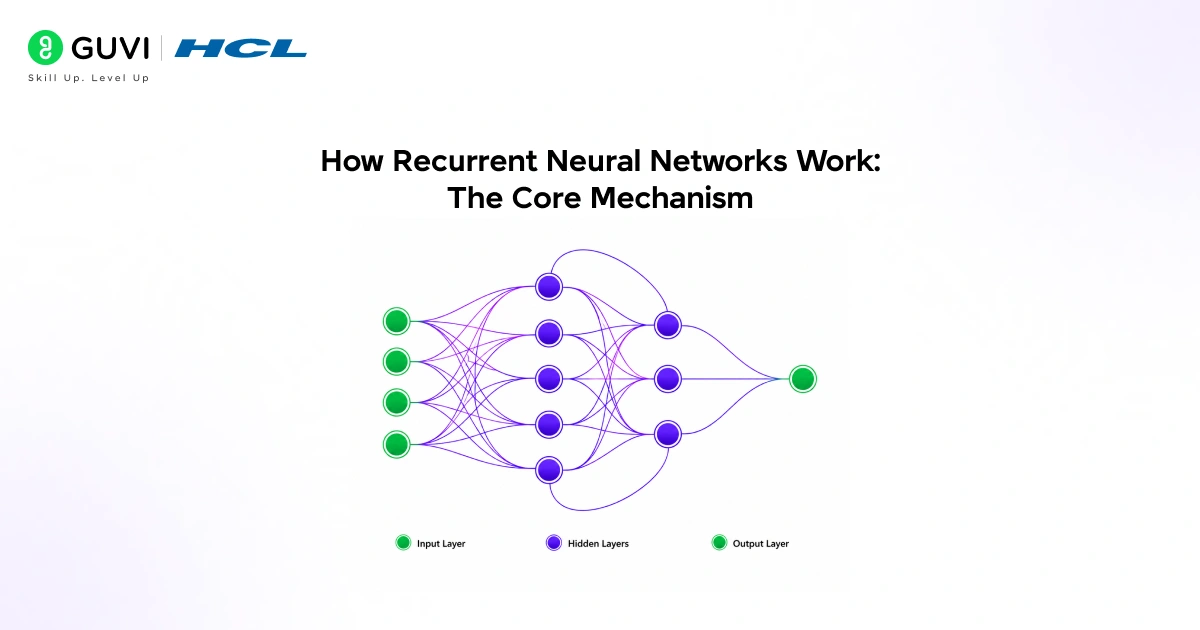
RNNs start with an initial hidden state, typically a vector of zeros. This hidden state is the memory of the network. It stores information about everything the network has seen so far in the sequence. As the network processes each new input, it updates this hidden state with new information.
Step 2: Process the first input with the hidden state
The network takes the first element of the sequence and combines it with the current hidden state. It applies learned weights to both the input and the hidden state, adds them together, and passes the result through an activation function like tanh or ReLU. This produces two things: an output for this step and a new hidden state.
Step 3: Update the hidden state for the next step
The new hidden state becomes the memory that carries forward to the next step. It contains information about the first input combined with whatever was in the previous hidden state. This is how RNNs build up context as they move through a sequence.
Step 4: Process subsequent inputs using updated hidden states
For each new input in the sequence, the RNN repeats the process. It takes the input, combines it with the hidden state from the previous step, computes a new output and a new hidden state, then moves to the next input. The same weights are used at every step, which is why RNNs can handle sequences of any length.
Step 5: Generate final output from the sequence
Depending on the task, the RNN might output a value at every step (like labeling each word in a sentence), output only at the final step (like classifying the sentiment of an entire review), or generate a new sequence as output (like translating a sentence to another language). The hidden state at each step contains the accumulated context from all previous steps.
The concept of recurrent neural networks (RNNs) dates back to the 1980s, when researchers explored neural architectures capable of processing sequential information by feeding previous outputs back into the network. However, RNNs only became practical for large-scale real-world applications in the 2010s after advances in training algorithms, architectures such as LSTMs and GRUs, and the rise of powerful GPU hardware made it possible to train deep sequential models efficiently on massive datasets. These advances helped RNNs become foundational for early breakthroughs in speech recognition, machine translation, and natural language processing.
The Hidden State: Why It Changes Everything
- What makes a good hidden state representation
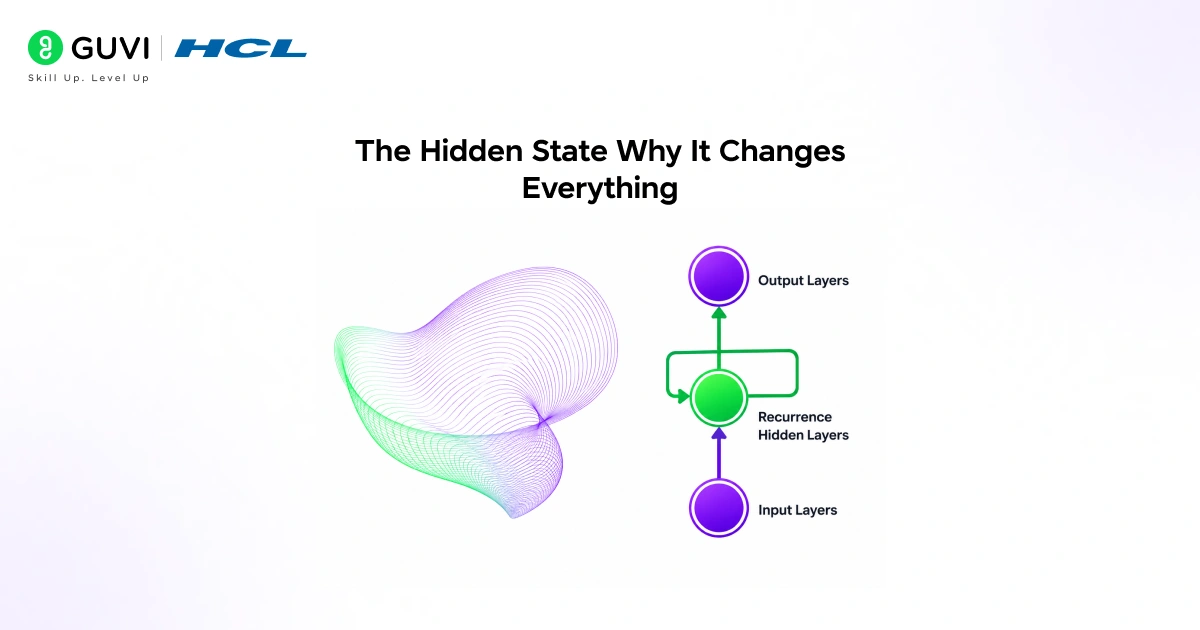
A good hidden state captures the most relevant information from the sequence so far while forgetting irrelevant details. It needs enough capacity to store important context but not so much that it memorizes noise. The network learns during training what information to keep and what to discard at each step.
- How hidden states capture temporal dependencies
When processing the word “bank” in a sentence, the hidden state contains information about whether previous words were about rivers or money. This context determines how the network interprets the current word. The hidden state is how RNNs learn that meaning depends on sequence, not just individual elements.
- What happens with a poorly initialized hidden state
Starting with a bad initial hidden state can bias the network’s predictions for the entire sequence. Most implementations initialize with zeros to avoid introducing any bias. Some advanced approaches learn the optimal initial hidden state as part of the training process for specific types of sequences.
- Why hidden state size matters for performance
A small hidden state cannot remember enough context for complex tasks. A hidden state that is too large makes training slow and can cause overfitting. The hidden state size is one of the most important hyperparameters you will tune when building an RNN, and the right size depends entirely on your specific problem and sequence complexity.
How to Implement a Recurrent Neural Network: Step-by-Step Process
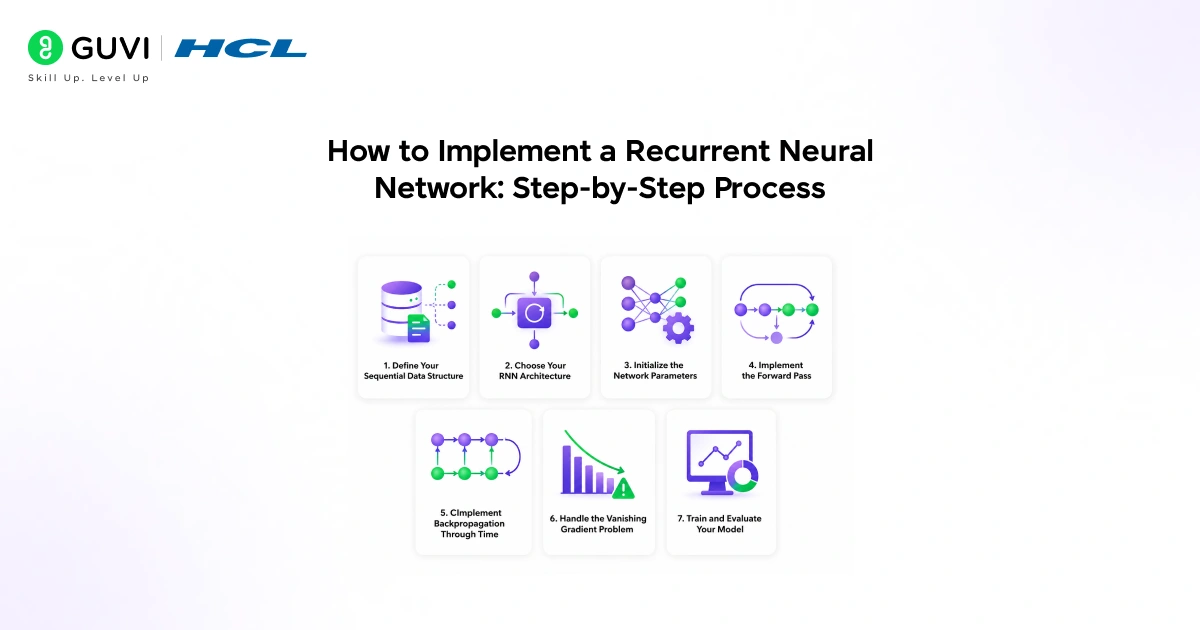
Here is exactly how to implement a Recurrent Neural Network for a sequential learning problem from start to finish.
Step 1: Define Your Sequential Data Structure
Represent your problem before writing any network code
Decide how your sequences are represented. Each sequence is a list of inputs, where each input might be a word embedding, a sensor reading, a price value, or any feature vector. All sequences need to be converted to numerical form. Determine whether you need padding to handle variable-length sequences or whether you will process them in batches of similar lengths.
Step 2: Choose Your RNN Architecture
This determines what problems your network can solve effectively
Start with a basic RNN for simple sequences with short-term dependencies. If your sequences are long or you need to remember information from many steps back, use LSTM (Long Short-Term Memory) or GRU (Gated Recurrent Unit) architectures instead. These variants solve the vanishing gradient problem that makes basic RNNs fail on long sequences.

Step 3: Initialize the Network Parameters
Set up weights and hidden state before training begins
Create weight matrices for the input-to-hidden connections, hidden-to-hidden connections, and hidden-to-output connections. Initialize these weights using methods like Xavier or He initialization to avoid vanishing or exploding gradients during training. Set the initial hidden state to zeros. Choose your activation functions, typically tanh for hidden states and softmax for classification outputs.
Step 4: Implement the Forward Pass
Process sequences step by step through the network
For each element in the input sequence, compute the new hidden state by multiplying the current input by the input weights, multiplying the previous hidden state by the recurrent weights, adding them together, and applying the activation function. Compute the output at this step by multiplying the hidden state by the output weights. Store all hidden states because you will need them during backpropagation.
Step 5: Implement Backpropagation Through Time
Training RNNs requires unrolling the network across time steps
Backpropagation Through Time (BPTT) computes gradients by treating the RNN as a very deep feedforward network where each time step is a layer. Start at the final time step, compute the gradient of the loss with respect to the output, then propagate this gradient backwards through each time step, accumulating gradients for the shared weights across all steps.
Step 6: Handle the Vanishing Gradient Problem
This is where basic RNNs break down on long sequences
When gradients backpropagate through many time steps, they can shrink exponentially, making it impossible for the network to learn long-term dependencies. Use LSTM or GRU cells instead of basic RNN cells, apply gradient clipping to prevent exploding gradients, or use shorter sequences during training. This is the most important consideration for RNN training success.
Step 7: Train and Evaluate Your Model
Test your implementation on sequences with known patterns
Train your RNN on your sequential dataset using an appropriate loss function like cross-entropy for classification or mean squared error for regression. Monitor the training loss to ensure it decreases over time. Evaluate on held-out sequences to check for overfitting. Test whether the model has learned the temporal patterns by examining its predictions on sequences with clear patterns you understand.
Common Mistakes Developers Make
- Using basic RNNs for long sequences instead of LSTM or GRU cells
- Forgetting to reset hidden states between independent sequences during training
- Not handling variable-length sequences correctly with padding or masking
- Initializing weights poorly and causing vanishing or exploding gradients immediately
- Using too large a hidden state size and overfitting to training data
- Not applying gradient clipping and letting gradients explode during training
- Treating RNN outputs at different time steps as independent when they share weights
Getting Maximum Performance From Recurrent Neural Networks
- Use LSTM or GRU for anything beyond toy problems
- Apply gradient clipping with a threshold between 1 and 10
- Experiment with bidirectional RNNs for tasks where future context helps
- Use dropout between layers but not between time steps
- Start with a hidden state size of 128 or 256 and tune from there
Long Short-Term Memory (LSTM) networks were introduced in 1997 by Sepp Hochreiter and Jürgen Schmidhuber to solve the famous vanishing gradient problem that limited traditional recurrent neural networks. LSTMs introduced specialized gating mechanisms that regulate how information is stored, updated, and forgotten over time, enabling neural networks to capture long-range dependencies in sequential data. This breakthrough became a major foundation for modern advances in speech recognition, machine translation, and early large-scale language modeling systems before Transformers became dominant.
Real-World Applications of Recurrent Neural Networks
- Natural language processing and text generation
Language models use RNNs to predict the next word in a sequence based on all previous words. This powers autocomplete features, chatbots, and text generation systems. The hidden state captures grammatical structure and semantic context, allowing the network to generate coherent sentences.
- Speech recognition and audio processing
Voice assistants use RNNs to convert audio waveforms into text. The network processes audio features frame by frame, with the hidden state accumulating context about phonemes and words as the sequence progresses. This sequential processing is essential because speech is inherently temporal.
- Machine translation between languages
Translation systems use encoder-decoder RNN architectures. The encoder RNN processes the source sentence into a fixed-length context vector (its final hidden state), and the decoder RNN generates the target sentence from this context. Attention mechanisms improve this by letting the decoder access all encoder hidden states.
- Time series forecasting and prediction
Financial systems use RNNs to predict stock prices, sales, and demand based on historical sequences. The network learns temporal patterns and dependencies in the data. The hidden state captures trends and seasonal patterns that influence future values.
To learn more about Recurrent Neural Networks and deep learning, do not miss the chance to enroll in this AI and Machine Learning course covering AI fundamentals, Python, deep learning, NLP, and computer vision through hands-on projects and expert guidance with certification.
Conclusion
Recurrent Neural Networks revolutionized how artificial intelligence handles sequential data. The core insight is simple but transformative: adding memory to neural networks lets them understand patterns that unfold over time rather than just static snapshots.
The hidden state is what makes them intelligent. It stores context from previous steps and carries that information forward, allowing networks to learn dependencies across time steps that traditional architectures cannot see.
RNNs also give you the foundation to understand LSTM, GRU, attention mechanisms, and transformers. The concept of processing sequences step by step with a maintained state appears in all modern sequence models.
If you are building anything that involves understanding language, processing time series, or learning from sequential patterns, Recurrent Neural Networks belong in your toolkit.
FAQs
1. What is the difference between RNN and LSTM?
Basic RNNs have a simple hidden state that updates at each step. LSTM adds gates that control information flow, solving the vanishing gradient problem and allowing the network to learn long-term dependencies that basic RNNs cannot capture.
2. When should I use RNN over other neural networks?
Use RNNs when your data is sequential and order matters. Use convolutional networks for images, feedforward networks for fixed-size tabular data, and RNNs for text, time series, speech, video, or any data where temporal dependencies exist.
3. Can RNNs handle sequences of different lengths?
Yes. RNNs process sequences step by step with the same weights at each step, so they naturally handle any length. For batch training, you typically pad shorter sequences or group similar-length sequences together for efficiency.
4. What is the vanishing gradient problem in RNNs?
During backpropagation through time, gradients can shrink exponentially as they propagate backwards through many time steps. This makes it impossible to learn long-term dependencies. LSTM and GRU architectures solve this with gating mechanisms.
5. How do I choose between LSTM and GRU?
LSTM has more parameters and can model more complex patterns but trains slower. GRU is simpler, faster, and works nearly as well for most tasks. Start with GRU for efficiency, switch to LSTM if you need the extra modeling capacity for very complex sequences.
Success Stories

About the Author
Vishalini Devarajan
An Aerospace Engineer turned content writer, I focus on making complex concepts easy to understand through well-structured, reader-friendly blogs. Whether it’s a technical topic or a non-technical one, I love creating content that is clear, engaging, and impactful.
View all posts by Vishalini Devarajan
Connect with me @












Did you enjoy this article?