


Artificial Intelligence and Machine Learning Articles
How to Evaluate LLM Outputs in Production Deployments
AI/ML Skills Gap 2026: Why Companies Can't Find Job-Ready Talent
20 AI/ML Interview Questions Recruiters Can Use Without a Tech Background - Best Guide
How Industry-Backed AI/ML Bootcamps Are Changing the AI/ML Hiring Pipeline - Best Guide 2026


Get In Touch For Details! Request More Information
Regression in Machine Learning: A Complete Guide
Aug 19, 2026 7 Min Read 1508 Views
(Last Updated)
Predicting the future is not magic, it is mathematics. When a bank estimates the credit risk of a loan applicant, when a real estate platform values a property, or when a hospital forecasts a patient’s length of stay, it is using regression.
Regression is one of the oldest and most widely applied techniques in statistics and machine learning. It answers a deceptively simple question: given what we know about a situation, what numerical value should we expect as the outcome?
In supervised learning, regression is the family of algorithms that learns a mapping from input features to a continuous output variable. Unlike classification, which predicts a category, regression predicts a quantity: a price, a temperature, a probability score, a demand figure, a risk level.
This guide explains how regression works, covers the most important regression types, walks through key evaluation metrics, including RMSE and R-squared, and shows how to implement regression analysis with scikit-learn (sklearn).
Table of contents
- TL;DR
- Regression vs Classification: Key Distinction
- How Regression Works: The Core Concept
- The Training Process
- The Regression Equation
- Linear Regression: The Foundation
- Simple Linear Regression
- Multiple Linear Regression
- Assumptions of Linear Regression
- Polynomial Regression: Capturing Curves
- The Overfitting Risk
- Ridge Regression (L2 Regularisation)
- Lasso Regression (L1 Regularisation)
- Elastic Net Regression
- Decision Tree Regression
- Random Forest and Gradient Boosting Regression
- Support Vector Regression (SVR)
- Regression Metrics: Measuring Model Performance
- Mean Absolute Error (MAE)
- Mean Squared Error (MSE)
- Root Mean Squared Error (RMSE)
- R-Squared (Coefficient of Determination)
- Implementing Regression with Sklearn
- Standard sklearn Regression Workflow
- Cross-Validation and Hyperparameter Tuning
- Common Challenges in Regression Analysis
- Overfitting and Underfitting
- Multicollinearity
- Outliers and Influential Points
- Feature Scaling
- Conclusion
- FAQs
- What is the difference between regression and classification?
- When should I use Ridge instead of Lasso regression?
- What is a good R-squared value for regression?
- Why is RMSE preferred over MSE for reporting?
- How do I choose the right regression model in sklearn?
TL;DR
- Regression is a supervised learning method for predicting continuous numerical values.
- Linear regression models a straight-line relationship; polynomial regression captures curves.
- Key regression types include Ridge, Lasso, Decision Tree, and Support Vector Regression.
- Regression metrics such as RMSE, MAE, and R-squared measure prediction quality.
- Python’s sklearn regression library provides efficient, production-ready implementations.
What Is Regression in Machine Learning?
Regression is a supervised machine learning technique used to model the relationship between one or more input features and a continuous output variable. The model learns from labeled training data by identifying the mapping function that best fits the relationship between inputs and outputs while minimizing prediction error. Once trained, the regression model can predict continuous values for new, unseen data, making it widely used in forecasting, finance, healthcare, engineering, and scientific analysis.
Regression vs Classification: Key Distinction
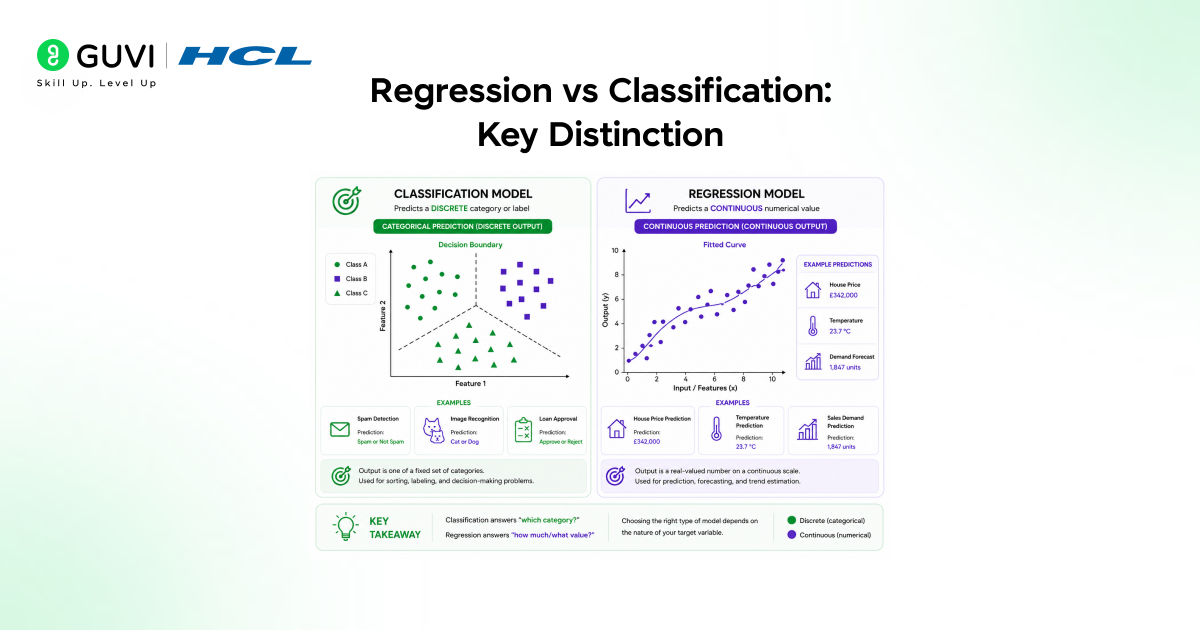
Understanding when to use regression versus classification is foundational to machine learning.
Both are supervised learning approaches, both train on labelled examples, and both produce predictions. The key difference lies in the output.
• Classification predicts a discrete class label “spam” or “not spam”, “malignant” or “benign”, “cat” or “dog”. The output comes from a finite, defined set of categories.
• Regression predicts a continuous numerical value £342,000, 23.7°C, 1,847 units. The output can take any value within a range.
A useful rule of thumb: if you can ask “how much?” or “how many?”, regression is likely the right tool. If you can ask “which category?”, classification is.
Some problems sit at the boundary. Predicting whether a customer will churn is classification; predicting how many days until churn is regression. The framing of the problem determines the approach.
How Regression Works: The Core Concept
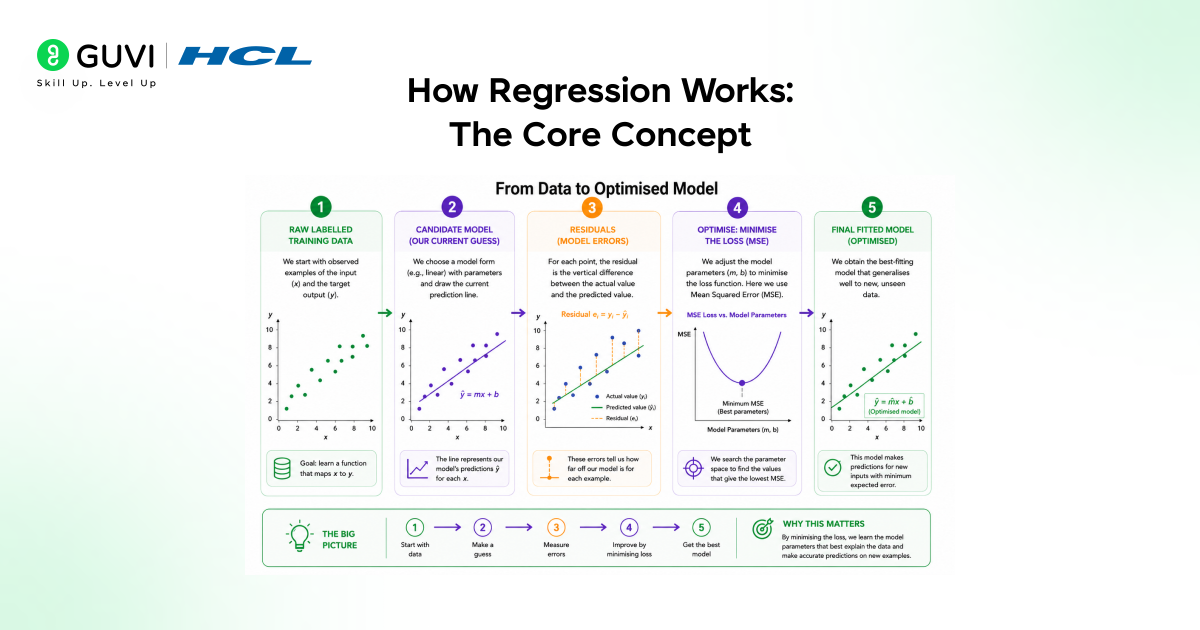
At its core, regression finds the mathematical function that best describes the relationship between input features and a continuous output.
The Training Process
Given a labelled training dataset of input-output pairs, regression works as follows:
• A model with learnable parameters (coefficients, weights) is initialised.
• The model makes predictions on the training inputs.
• A loss function, typically Mean Squared Error (MSE), measures how far predictions are from actual values.
• An optimisation algorithm (gradient descent) adjusts the parameters to minimise the loss.
• This process iterates until the loss converges to a minimum, giving the best-fit model.
The trained model is then applied to new inputs to generate continuous predictions. The quality of those predictions is measured using regression metrics.
The Regression Equation
Every regression model learns a function f(X) such that:
ŷ = f(X) + ε
Where ŷ is the predicted value, X is the vector of input features, f is the learned mapping function, and ε is the irreducible error, the noise in the data that no model can eliminate. The goal of regression is to learn f(X) as accurately as possible.
Linear Regression: The Foundation
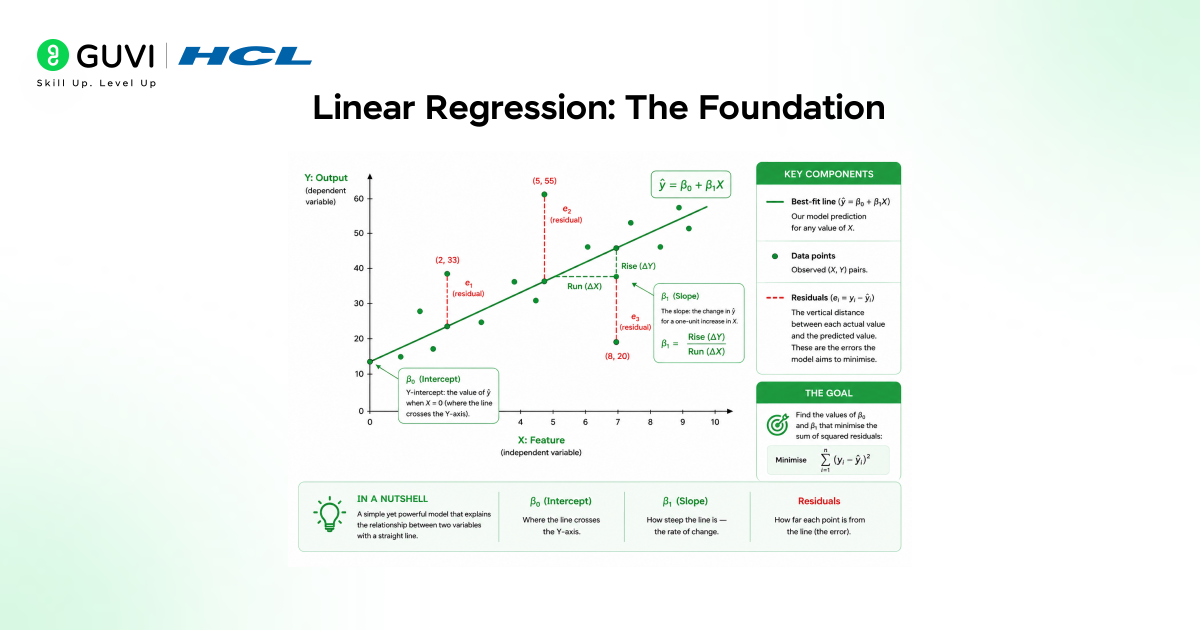
Linear regression is the simplest and most interpretable regression model. It assumes a straight-line relationship between the input features and the output variable.
Simple Linear Regression
Simple linear regression involves a single input feature:
ŷ = β₀ + β₁X
Where β₀ is the intercept (the predicted value when X = 0) and β₁ is the slope (the change in ŷ for a one-unit increase in X). The model finds the values of β₀ and β₁ that minimise the sum of squared residuals the vertical distances between each data point and the fitted line.
Multiple Linear Regression
Multiple linear regression extends this to several input features:
ŷ = β₀ + β₁X₁ + β₂X₂ + … + βₙXₙ
Each coefficient βᵢ represents the marginal effect of feature Xᵢ on the output, holding all other features constant. Multiple linear regression is used extensively in economics, finance, and social science, wherever the outcome is influenced by several independent factors simultaneously.
Assumptions of Linear Regression
Linear regression relies on several assumptions that, when violated, reduce model reliability:
• Linearity: The relationship between features and output is linear.
• Independence: Observations are independent of each other.
• Homoscedasticity: Residuals have constant variance across all values of X.
• Normality: Residuals are approximately normally distributed.
• No multicollinearity: Input features are not highly correlated with each other.
Checking and addressing these assumptions through residual plots, variance inflation factors, and data transformations is an essential part of regression analysis.
Polynomial Regression: Capturing Curves
Real-world relationships are rarely perfectly linear. Polynomial regression extends linear regression by including higher-degree terms of the input features, allowing the model to fit curved relationships in the data.
The polynomial regression equation for a single feature is:
ŷ = β₀ + β₁X + β₂X² + β₃X³ + … + βₙXⁿ
The degree n of the polynomial controls the flexibility of the curve. A degree-2 polynomial fits a parabola; degree 3 fits a cubic curve; higher degrees allow increasingly complex shapes.
The Overfitting Risk
Polynomial regression’s flexibility is also its primary risk. A high-degree polynomial can fit training data almost perfectly, including its noise, while performing poorly on unseen data. This is overfitting.
Selecting the right polynomial degree requires cross-validation: fitting models of different degrees and comparing their performance on held-out data to find the degree that generalises best.
Did You Know?
Key Regression Types in Machine Learning
Ridge Regression (L2 Regularisation)
Ridge regression adds a penalty term to the loss function proportional to the square of the coefficients. This shrinks large coefficients toward zero, reducing overfitting when many correlated features are present. Ridge is the preferred choice when all features are expected to contribute to the output; it retains all features but limits their influence.
Lasso Regression (L1 Regularisation)
Lasso (Least Absolute Shrinkage and Selection Operator) penalises the absolute value of the coefficients. Unlike Ridge, Lasso can shrink coefficients all the way to zero effectively performing feature selection by eliminating irrelevant inputs. Lasso is valuable when the true model is sparse: most features are irrelevant and only a few drive the output.
Elastic Net Regression
Elastic Net combines L1 and L2 penalties, blending the feature selection of Lasso with the stability of Ridge. It is the most robust regularised regression choice when the number of features exceeds the number of observations, or when groups of correlated features are present.
Decision Tree Regression
Decision tree regression partitions the feature space into rectangular regions and predicts the mean output value within each region. It captures non-linear relationships and feature interactions naturally, without requiring feature scaling. Its weakness is high variance — small changes in training data can produce very different trees.
Random Forest and Gradient Boosting Regression
Ensemble methods address the variance of individual trees by combining many models:
- Random Forest: Trains many decision trees on bootstrap samples and averages their predictions, reducing variance without increasing bias.
- Gradient Boosting (XGBoost, LightGBM): Builds trees sequentially, each one correcting the residual errors of the previous,s producing high accuracy at the cost of greater tuning complexity.
Support Vector Regression (SVR)
Support Vector Regression applies the margin concept from SVM classification to regression. It finds a function that fits within an ε-tube around the true values, penalising only predictions that fall outside the tube. SVR is effective on high-dimensional data and robust to outliers when the kernel and hyperparameters are well-chosen.
Regression Metrics: Measuring Model Performance
Choosing the right regression metrics is as important as choosing the right model. Metrics quantify how well predictions align with actual values, and different metrics penalise errors differently.

Mean Absolute Error (MAE)
MAE is the average of the absolute differences between predicted and actual values. It is easy to interpret that an MAE of 5,000 means the model is off by £5,000 on average and is robust to outliers because it does not square the errors. However, it treats all errors equally, regardless of magnitude.
Mean Squared Error (MSE)
MSE averages the squared differences between predicted and actual values. Squaring amplifies large errors, making MSE sensitive to outliers. This property is useful when large errors are particularly costly and must be penalised heavily common in financial and safety-critical applications.
Root Mean Squared Error (RMSE)
RMSE is the square root of MSE, returning the metric to the same units as the target variable. An RMSE of 5,000 means the model’s predictions deviate from actual values by approximately £5,000 in standard deviation terms. RMSE is the most widely reported regression accuracy metric because it combines the error-amplifying property of MSE with the interpretability of original units.
R-Squared (Coefficient of Determination)
R-squared measures the proportion of variance in the target variable explained by the model. It ranges from 0 to 1, where 0 means the model explains none of the variance (no better than predicting the mean) and 1 means it explains all variance perfectly. An R-squared of 0.85 means the model accounts for 85% of the variability in the output.
R-squared has an important limitation: it always increases (or stays the same) as more features are added, even irrelevant ones. Adjusted R-squared corrects for this by penalising the addition of non-contributory features and is preferred for comparing models with different numbers of predictors.
Implementing Regression with Sklearn
Python’s scikit-learn (sklearn regression) library provides a consistent, well-documented interface for implementing, tuning, and evaluating regression models.
Standard sklearn Regression Workflow
The sklearn regression workflow follows five consistent steps regardless of which model is chosen:
- Data preparation: Load data, handle missing values, encode categorical features, and scale numerical features where required (critical for Ridge, Lasso, SVR).
- Train-test split: Divide the dataset into training and test sets using train_test_split, typically 80/20 or 70/30, to evaluate generalisation on unseen data.
- Model instantiation: Initialise the chosen regression model (e.g. LinearRegression(), Ridge(alpha=1.0), RandomForestRegressor(n_estimators=100)).
- Model fitting: Call model. fit(X_train, y_train) to train the model on the training data.
- Evaluation: Generate predictions with the model. predict(X_test) and compute metrics using mean_squared_error, mean_absolute_error, and r2_score from sklearn. metrics.
Cross-Validation and Hyperparameter Tuning
A single train-test split can produce unreliable estimates if the split is lucky or unlucky. K-fold cross-validation available through sklearn’s cross_val_score — divides the data into k folds, trains on k-1 folds, and validates on the remaining fold, repeating k times and averaging the result. This produces a more robust estimate of model performance.
Hyperparameter tuning, selecting the regularisation strength α for Ridge or Lasso, the depth limit for decision trees, or the number of estimators for Random Forest, is best done using GridSearchCV or RandomizedSearchCV, which systematically search the hyperparameter space while using cross-validation to prevent overfitting to the tuning set.
Common Challenges in Regression Analysis
Overfitting and Underfitting
Overfitting occurs when the model learns the training data — including its noise — too closely, losing the ability to generalise. Underfitting occurs when the model is too simple to capture the true relationship. Both are detectable through learning curves: plotting training and validation error against training set size or model complexity reveals whether a model is over- or under-fitting.
Multicollinearity
When input features are highly correlated, their individual coefficients become unstable and difficult to interpret. A small change in the data can produce large swings in coefficient values. Variance Inflation Factor (VIF) quantifies multicollinearity; VIF values above 5–10 signal a problem. Solutions include removing one of the correlated features, using PCA to create orthogonal components, or switching to Ridge regression, which handles multicollinearity naturally.
Outliers and Influential Points
Outliers in the target variable can disproportionately distort the regression line, particularly for models minimising squared error. Cook’s Distance identifies influential points in observations whose removal would significantly change the model. Solutions include robust regression methods that down-weight outliers, data transformation (log-scaling), or domain-informed removal of erroneous records.
Feature Scaling
Algorithms that use distance or gradient-based optimisation, such as Ridge, Lasso, and SVR, are sensitive to the scale of input features. A feature measured in millions will dominate one measured in units unless both are standardised. Standard scaling (zero mean, unit variance) or min-max normalisation should be applied before fitting these models, using sklearn’s StandardScaler fitted only on training data to avoid data leakage.
If you want practical experience working with activation functions, neural networks, and deep learning models, HCL GUVI’s AI and ML programs can help you understand how concepts like sigmoid, backpropagation, and gradient descent are implemented using frameworks such as TensorFlow and PyTorch through hands-on projects.
Conclusion
Regression is the backbone of predictive modelling. From the elegant simplicity of linear regression to the flexibility of ensemble methods and Support Vector Regression, the regression family covers an enormous range of real-world prediction tasks wherever the goal is estimating a continuous quantity.
Mastering regression means understanding more than the algorithms themselves. It means knowing how to assess whether your data meets model assumptions, how to select and tune the right model for your problem, and how to evaluate performance rigorously using metrics like RMSE and R-squared rather than training accuracy alone.
The sklearn regression ecosystem makes implementing and comparing these models straightforward. But the insight to interpret results, diagnose problems, and deploy models that generalise to new data comes from a deep understanding of what regression analysis is actually doing: fitting a function to data, quantifying uncertainty, and making calibrated predictions about a continuous world.
Whether you are predicting housing prices, modelling customer lifetime value, or forecasting energy demand, regression remains one of the most powerful and transferable tools in the machine learning practitioner’s toolkit.
FAQs
1. What is the difference between regression and classification?
Regression predicts a continuous numerical value (price, temperature, demand). Classification predicts a discrete category (spam/not spam, cat/dog). The output type determines which approach to use.
2. When should I use Ridge instead of Lasso regression?
Use Ridge when all features are expected to contribute, and you want to shrink coefficients without eliminating any. Use Lasso when you expect only a few features to matter and want automatic feature selection.
3. What is a good R-squared value for regression?
It depends on the domain. Social science models often accept an R-squared of 0.5–0.7; engineering models may require an R-squared above 0.95. Always compare to a baseline and use adjusted R-squared when comparing models with different feature counts.
4. Why is RMSE preferred over MSE for reporting?
RMSE is in the same units as the target variable, making it directly interpretable. An RMSE of £5,000 is immediately meaningful; an MSE of 25,000,000 squared pounds is not. Both measure the same underlying error.
5. How do I choose the right regression model in sklearn?
Start with linear regression as a baseline. If residuals show non-linearity, try polynomial or tree-based models. If features are many and correlated, apply Ridge or Lasso. Use cross-validation and RMSE/R-squared to compare candidates objectively.
Success Stories

About the Author
Vishalini Devarajan
An Aerospace Engineer turned content writer, I focus on making complex concepts easy to understand through well-structured, reader-friendly blogs. Whether it’s a technical topic or a non-technical one, I love creating content that is clear, engaging, and impactful.
View all posts by Vishalini Devarajan
Connect with me @











Did you enjoy this article?