


Roadmap Articles
Angular Roadmap: Best Guide for Beginners in 2026
Embedded Systems Roadmap: Best Guide for Beginners in 2026
TypeScript Roadmap 2026: Complete Beginner to Advanced Guide
C++ Developer Roadmap 2026: Complete Beginner to Advanced Guide


Get In Touch For Details! Request More Information
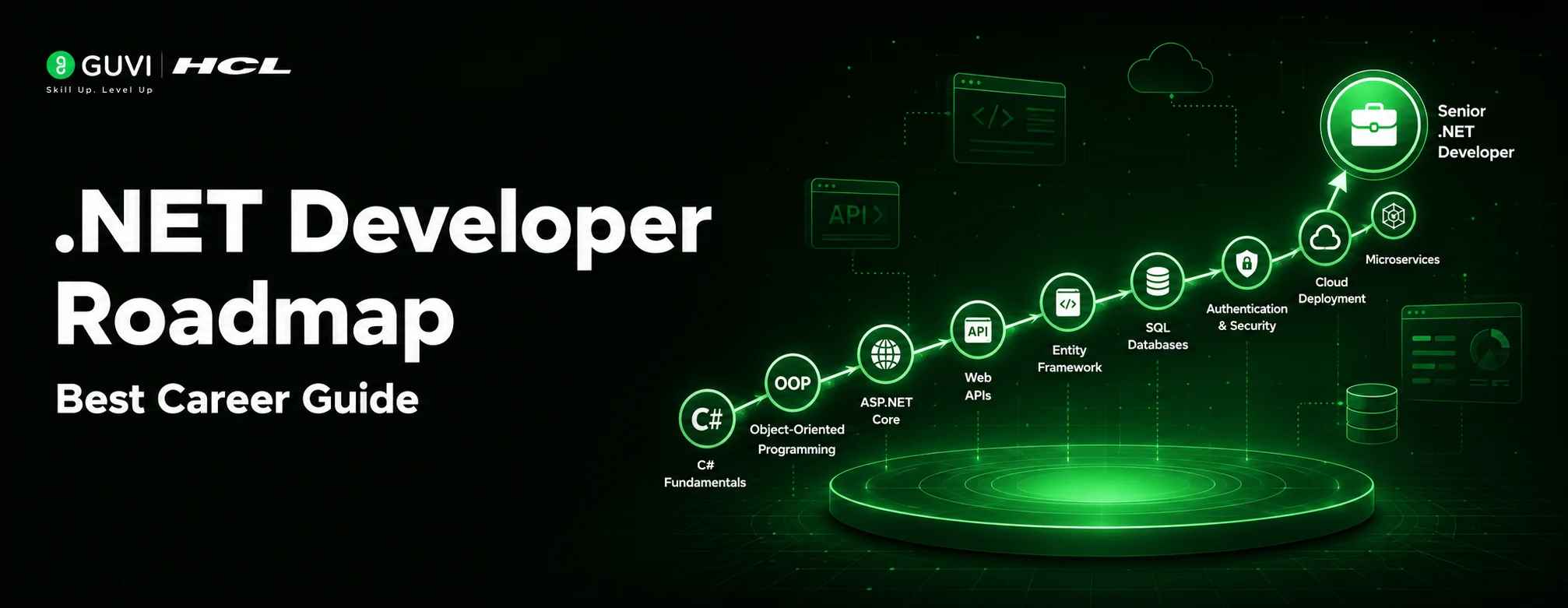
.NET Developer Roadmap 2026: Best Career Guide
Jun 01, 2026 4 Min Read 1556 Views
(Last Updated)
Feeling overwhelmed by all the technologies and career paths you come across while exploring .NET development?
Don’t worry, it happens to almost everyone in the beginning.
This .NET Developer Roadmap will simplify things and help you understand the skills, technologies, and career paths required to become a .NET developer in 2026.
In 2026, .NET development is no longer limited to desktop applications. Modern .NET developers work on:
- Cloud applications,
- APIs,
- Scalable Systems,
- AI-powered solutions using the latest versions of .NET and C#.
Table of contents
- TL;DR Summary
- .NET Developer Roadmap
- Phase 1: Understanding .NET Development
- Phase 2: Building Core Fundamentals
- Phase 3: Choosing Your .NET Specialization
- Phase 4: Core Skills & Tools Used in Real Projects
- Phase 5: Understanding Modern .NET Development
- Phase 6: Building Real-World Experience
- Phase 7: Becoming Industry Ready
- .NET Developer Salary in 2026
- Conclusion
- FAQs
- Is .NET development still a good career in 2026?
- Which is the latest version of .NET in 2026?
- How long does it take to learn .NET development?
- What is frontend development in .NET?
- What is backend development in .NET?
- Is ASP.NET Core important for .NET developers?
TL;DR Summary
- This .NET Developer Roadmap helps you start your .NET development journey in 2026.
- It covers core fundamentals, real-world tools, and modern .NET technologies.
- It explains different paths like frontend, backend, and full stack .NET development.
- It includes project ideas, portfolio-building tips, and career opportunities.
- It also highlights the skills and industry trends needed to begin confidently as a .NET developer.
.NET Developer Roadmap
Phase 1: Understanding .NET Development
Who is a .NET Developer?
A .NET developer is a software developer who builds applications using Microsoft’s .NET technologies like C#. They create websites, backend systems, APIs, cloud applications, and enterprise software used by businesses every day.
For example, companies like Microsoft, Stack Overflow, and GoDaddy use .NET technologies in different parts of their platforms to handle large-scale applications and services.
Why Choose .NET Development in 2026?
- High demand across industries
- Multiple career opportunities
- Modern and scalable technology
- Strong salary potential
- Future-ready ecosystem
Microsoft released the first version of .NET in 2002, and today the platform powers thousands of enterprise applications, cloud services, and large-scale business systems used worldwide.
Phase 2: Building Core Fundamentals
Core Fundamentals Every .NET Developer Must Learn
Before choosing a specialization in this .NET Developer Roadmap, focus on the core fundamentals first. These are the skills used in almost every real-world .NET project and will make your learning journey much smoother.
From learning C# and ASP.NET Core to understanding databases, APIs, Git, and cloud basics, these fundamentals create the base for becoming a confident .NET developer.
Focus on understanding the concepts clearly instead of rushing through too many tools at once.
Before moving deeper into specialization paths, it is important to understand one of the most important frameworks in modern .NET development.
Why ASP.NET Core is Important for .NET Developers
ASP.NET Core is one of the most important frameworks in modern .NET development. It is widely used for building APIs, web applications, cloud-native systems, and scalable backend services.
In 2026, most backend and full stack .NET roles expect developers to understand ASP.NET Core fundamentals like APIs, routing, authentication, middleware, and dependency injection.
Common Uses of ASP.NET Core
- REST API development
- Backend web applications
- Cloud-native applications
- Enterprise systems
- Microservices
These fundamentals might look like a lot in the beginning, but don’t worry, you do not need to master everything at once.
Start step by step, practice consistently, and slowly connect the concepts while building projects. That is how most developers actually learn in the real world.
Phase 3: Choosing Your .NET Specialization
Choose Your Specialization
Once your basics are clear, the next step is to focus on the skills that match your career goals. You don’t have to learn everything at once — just concentrate on what’s actually important for the path you want to take.
Frontend .NET Developer
Works on user interfaces and interactive web experiences.
Backend .NET Developer
Builds APIs, databases, authentication systems, and server-side applications.
Full Stack .NET Developer
Handles both frontend and backend development to build complete applications.
Learning Resources for Your Chosen Path
Frontend .NET Developer
Backend .NET Developer
- Microservices Architecture
- REST API Tutorial
- SQL project for Developers
- Database Management System Guide
Full Stack .NET Developer
Phase 4: Core Skills & Tools Used in Real Projects
As you progress through this .NET Developer Roadmap, it is important to understand the tools and technologies commonly used in real-world projects. These skills are widely used across frontend, backend, and full stack .NET development roles.
| Skill / Tool | Used For | Mostly Used In |
| C# | Main programming language for .NET development | Frontend, Backend, Full Stack |
| ASP.NET Core | Building APIs and web applications | Backend, Full Stack |
| Entity Framework Core | Connecting applications with databases | Backend, Full Stack |
| SQL Server | Storing and managing application data | Backend, Full Stack |
| HTML, CSS, JavaScript | Creating user interfaces | Frontend, Full Stack |
| React / Angular | Building modern frontend applications | Frontend, Full Stack |
| REST APIs | Communication between frontend and backend | Backend, Full Stack |
| Git & GitHub | Version control and collaboration | All Roles |
| Azure | Cloud hosting and deployment | Backend, Full Stack |
| Docker | Containerizing applications | Backend, Full Stack |
| Microservices | Building scalable enterprise systems | Backend |
| Postman | API testing and debugging | Backend, Full Stack |
| Visual Studio / VS Code | Writing and managing code | All Roles |
| AI Tools (ChatGPT, Copilot) | Faster development and debugging | All Roles |
Quick Tip: Many beginners focus only on coding skills and ignore soft skills. Communication, teamwork, and problem-solving are equally important in real-world development and professional projects.

Phase 5: Understanding Modern .NET Development
Latest .NET Trends in 2026
As highlighted in this .NET Developer Roadmap, the .NET ecosystem is evolving rapidly with AI integrations, cloud-native development, modern architectures, and high-performance applications becoming major industry trends in 2026.
If you want to become a backend or full stack .NET developer, learning ASP.NET Core is almost essential in 2026. These trends are shaping how modern .NET applications are built in 2026, especially in cloud-native and enterprise environments.
Phase 6: Building Real-World Experience
Build Projects Based on Your Career Path
Frontend .NET Developer
- Admin Dashboard UI
- E-commerce Frontend
Backend .NET Developer
- REST API for Task Management
- Authentication & User Management System
Full Stack .NET Developer
- Full Stack E-commerce Application
- Employee Management Portal
Beginner Tip
Start with simple projects first and improve them gradually by adding databases, authentication, APIs, and deployment features. Following this .NET Developer Roadmap step by step will help you build stronger practical skills and real-world development experience.
Phase 7: Becoming Industry Ready
Build Portfolio
A strong portfolio helps recruiters understand your practical skills, project experience, and development knowledge beyond resumes and certifications.
Even 2–3 well-built projects with proper documentation and deployment can create a stronger impact than multiple unfinished tutorial projects.
.NET Developer Salary in 2026
Here’s what this .NET Developer Roadmap and career path can lead to in terms of opportunities, growth, and salary potential in 2026.
| Role | Average Salary Range in India |
| Frontend .NET Developer | ₹4 – ₹8 LPA |
| Backend .NET Developer | ₹5 – ₹12 LPA |
| Full Stack .NET Developer | ₹6 – ₹15 LPA |
| Senior .NET Developer | ₹15+ LPA |
| Cloud / Azure .NET Developer | ₹10 – ₹20 LPA |
Ready to Become a .NET Developer?
Build strong .NET fundamentals, work on real-world projects, and gain hands-on experience with HCL GUVI’s industry-focused courses designed for beginners and aspiring developers.
EXPLORE FULL-STACK DEVELOPMENT COURSE BY HCL GUVI
Conclusion
This .NET Developer Roadmap is not about learning every framework at once. Start with strong fundamentals, choose the right specialization, and focus on building real-world projects consistently.
The .NET ecosystem is huge, so learn step by step, stay consistent, and keep improving your practical skills. That is what truly helps you grow into a confident .NET developer in 2026.
FAQs
Is .NET development still a good career in 2026?
Yes, .NET development remains one of the most in-demand careers for backend, cloud, enterprise, and full stack application development.
Which is the latest version of .NET in 2026?
.NET 10 is the latest version and is widely used for building modern, scalable, and cloud-ready applications.
How long does it take to learn .NET development?
With consistent practice and project building, beginners can learn the fundamentals within a few months.
What is frontend development in .NET?
Frontend development in .NET focuses on building user interfaces and interactive web experiences using technologies like HTML, CSS, JavaScript, React, Angular, and Blazor
What is backend development in .NET?
Backend development in .NET focuses on APIs, databases, authentication, business logic, and server-side application development using technologies like C#, ASP.NET Core, SQL Server, and Azure.
Is ASP.NET Core important for .NET developers?
Yes, ASP.NET Core is one of the most important frameworks used for modern .NET web and API development.
Success Stories

About the Author
Reemsha Khan
Always been a storyteller at heart. Now, I turn complex topics into simple, easy-to-understand stories through content. Hope you find it helpful.
View all posts by Reemsha Khan
Connect with me @











Did you enjoy this article?