


Roadmap Articles
Angular Roadmap: Best Guide for Beginners in 2026
Embedded Systems Roadmap: Best Guide for Beginners in 2026
TypeScript Roadmap 2026: Complete Beginner to Advanced Guide
C++ Developer Roadmap 2026: Complete Beginner to Advanced Guide

Get In Touch For Details! Request More Information
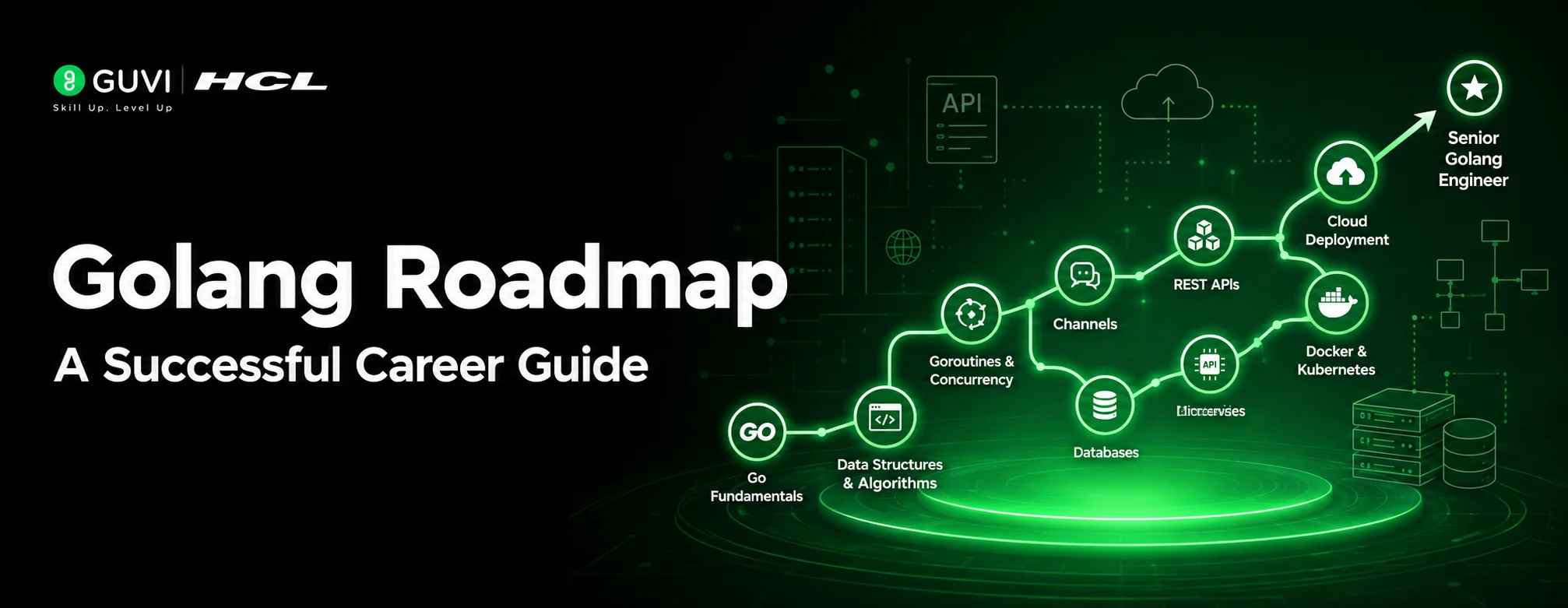
Golang Roadmap – A Successful Career Guide for 2026
Jul 07, 2026 4 Min Read 1647 Views
(Last Updated)
Want to enter the software development world but feeling confused about where to start?
Golang is one of the best programming languages for beginners in 2026 because of its:
- Simple syntax
- Fast performance
- Beginner-friendly learning curve
Approximately 2 million developers use Go as their primary language, with nearly 5 million total users in the last year.
Source: 6sense
Go is widely used in modern cloud-native development and powers technologies like Kubernetes, Docker, and Terraform.
These numbers show how rapidly the Go ecosystem is growing across modern software development. If you are planning to start your journey, this Golang Roadmap will help you understand the right skills, tools, and career path to follow in 2026.
Table of contents
- TL;DR Summary
- GOLANG Roadmap
- Phase 1: Understanding Golang Development
- Phase 2: Building Core Golang Fundamentals
- Phase 3: Choosing Your Golang Specialization
- Phase 4: Core Skills & Tools Every Golang Developer Must Know
- Phase 5: Latest Golang Trends in 2026
- Phase 6: Build Projects Based on Your Career Path
- Phase 7: Becoming Industry Ready
- Golang Developer Salary in 2026
- Prepare for Go Interviews:
- Conclusion
- FAQS
- Is Golang a good career choice in 2026?
- Is Golang easy for beginners to learn?
- What does a Go developer do?
- How long does it take to learn Golang?
- Is Golang mainly used for frontend or backend development?
- Why is Golang popular in cloud and DevOps development?
- Which companies use Golang?
- Is Golang good for microservices?
- Which framework is best for Golang backend development?
- What projects should beginners build in Golang?
TL;DR Summary
- This Golang Roadmap helps you start your Go development journey in 2026.
- It covers core Go fundamentals, backend development, and real-world development tools.
- It explains important areas like cloud-native development, DevOps tools, and infrastructure technologies.
- It includes project ideas, industry trends, and career opportunities for Go learners.
- Whether you want to become a backend developer, cloud engineer, or infrastructure developer, this Golang Roadmap helps you focus on the right skills step by step.
GOLANG Roadmap
Phase 1: Understanding Golang Development
Who is a Go Developer?
- A Go developer is a software engineer who uses the Go programming language, also known as Golang, to build fast, scalable, and reliable software applications.
- Go developers commonly work on backend systems, APIs, cloud-native applications, microservices, and modern infrastructure tools.
- Because Go was designed for handling large-scale systems efficiently, it is widely used in cloud computing, DevOps, and distributed systems development.
Why Choose Go Development in 2026?
- Simple and beginner-friendly syntax
- Fast performance and scalable backend development
- Strong support for cloud-native applications and microservices
- Powers technologies like Docker and Kubernetes
- High demand for backend, cloud, and DevOps roles
Go (Golang) was originally created at Google in 2007 because engineers were frustrated with the growing complexity and slow compilation times of languages like C++. Go was designed to make software development faster, simpler, and more scalable.
Source: Wikipedia
Phase 2: Building Core Golang Fundamentals
Before You Move Ahead in Golang Roadmap
These Go fundamentals are the foundation of everything you’ll build later: APIs, cloud-native applications, microservices, DevOps tools, and scalable backend systems.
Without understanding these core concepts properly, advanced technologies will eventually start feeling confusing and difficult to manage.
So don’t rush this phase.
Strong fundamentals are what separate developers who only follow tutorials from developers who can actually build real-world systems confidently.
Your First Go Program
Let’s look at how simple and beginner-friendly Go syntax actually is.
package main
import “fmt”
func main() {
fmt.Println(“Hello, Go Developer!”)
}
One of the biggest reasons developers enjoy learning Go is its clean and beginner-friendly syntax. Even simple programs are easy to read, understand, and build upon as your skills grow.
Why Learning GO Fundamentals Matters the Most?
Strong fundamentals make everything easier later , from APIs and backend systems to cloud and DevOps tools. The better your basics are, the faster and more confidently you’ll grow as a Go developer.
Phase 3: Choosing Your Golang Specialization
Once your Go fundamentals become clear, the next step in Golang roadmap is choosing the area you want to specialize in. Instead of trying to learn everything at once, focus on the technologies and skills that match your career goals and interests.
Backend Go Developer:
Build APIs and scalable backend applications.
Cloud & DevOps Engineer:
Work on deployment, automation, and cloud infrastructure.
Microservices Developer:
Build distributed and event-driven applications.
Infrastructure & Systems Developer:
Develop high-performance systems and infrastructure tools.
Learning Resources for Your Chosen Path In Golang roadmap
Read Logs and Work With Linux: A Simple Guide for New DevOps Learners
Code to Cloud Using Terraform and AWS: The Epic Guide to Automated Deployment
Backend Development Roadmap: A Complete Guide
Modern Backend Architecture Trends: What Full-Stack Developers Need to Know
Phase 4: Core Skills & Tools Every Golang Developer Must Know
Learning Go is just the beginning. Real-world Go development also involves working with APIs, databases, containers, cloud tools, and backend systems that companies use every day.
| Tool / Technology | Where it is used ? |
| Go (Golang) | Building backend systems and scalable applications |
| Gin / Fiber | Creating REST APIs and backend web applications |
| PostgreSQL | Managing and storing application data |
| Redis | Caching and improving backend performance |
| Docker | Containerizing Go applications for deployment |
| Kubernetes | Managing cloud-native and scalable deployments |
| Git & GitHub | Version control and team collaboration |
| Postman | API testing and debugging |
| gRPC | Communication between microservices |
| Kafka | Event-driven systems and real-time applications |
| GitHub Actions | CI/CD and deployment automation |
| Prometheus | Monitoring application and server performance |
| VS Code / GoLand | Writing, managing, and debugging Go code |
At first, these tools might look overwhelming, but don’t worry, you won’t be using everything at once.
Start small, build projects consistently, and you’ll naturally become comfortable with these technologies as you grow in your Golang roadmap journey.
Phase 5: Latest Golang Trends in 2026
Go is evolving much faster than many developers realize. From cloud-native platforms and DevOps tools to scalable APIs and AI infrastructure, Go is now being used in some of the most modern areas of software development in 2026.

Pro Tip:
Don’t stress yourself trying to learn every new Go trend at once.
Technologies keep changing, but if you stay curious, build projects regularly, and keep exploring modern tools little by little, you’ll naturally grow with the industry over time.
Phase 6: Build Projects Based on Your Career Path
As you move forward in this Golang Developer Roadmap, two things become very clear:
- You learn Go much faster by building projects than by only watching tutorials.
- Real projects help you connect APIs, databases, cloud tools, and backend concepts in a much more practical and understandable way.
To make your learning journey easier, we’ve already listed practical project ideas based on different Go career paths. Start with these projects instead of getting overwhelmed searching randomly online.
| Developer Tip: Don’t build projects just to “complete” them, build them to understand how real systems work. Even a small Go project can teach you APIs, databases, debugging, deployment, and backend architecture if you take the time to improve it step by step. If you master Go + DevOps tools: You don’t just prepare for jobs. You learn how real systems are built. |
Want to Explore More Go Projects?
You can also check out this beginner-friendly project guide to get more practical project ideas and improve your Go development skills step by step.
Top 15 Golang Project Ideas [With Source Code]
Phase 7: Becoming Industry Ready
As you reach the final stage of this Golang Developer Roadmap, your focus should slowly shift from just learning Go to becoming ready for real-world development roles.
Focus On:
- Building a strong project portfolio
- Improving your GitHub profile
- Practicing Go interview questions
- Exploring open-source projects
- Understanding real backend systems
- Staying consistent with coding and project building
Golang Developer Salary in 2026
If you stay consistent with this Golang Developer Roadmap, keep building projects, and improve your practical skills step by step, Go development can become a very strong and high-paying career path in the coming years.
| Role | Average Salary Range in India |
| Junior Go Developer | ₹5 – ₹10 LPA |
| Backend Go Developer | ₹8 – ₹18 LPA |
| Cloud / DevOps Engineer | ₹10 – ₹20 LPA |
| Senior Golang Developer | ₹20+ LPA |
| Infrastructure / Platform Engineer | ₹15 – ₹30 LPA |
Source: Glassdoor AmbitionBox.
Prepare for Go Interviews:
Top 40 Golang Interview Questions and Answers
Common Beginner Mistakes
- Learning tools without fundamentals
- Watching tutorials without building projects
- Ignoring GitHub and portfolio building
- Trying to learn everything at once
Ready to Become a Go Developer?
Build strong Go fundamentals, work on real-world backend projects, and gain practical development experience with beginner-friendly programs designed for aspiring developers.
EXPLORE FULL-STACK DEVELOPMENT COURSE BY HCL GUVI
Conclusion
This Golang Developer Roadmap is not about learning every technology at once or rushing through tutorials. Start with strong fundamentals, build real projects, explore modern tools gradually, and stay consistent with practice.
The Go ecosystem is growing rapidly across backend, cloud, DevOps, and infrastructure development. With patience, practical learning, and continuous improvement, Go development can become a very strong and rewarding long-term career path in 2026.
FAQS
Is Golang a good career choice in 2026?
Yes, Golang is one of the fastest-growing programming languages for backend, cloud-native, DevOps, and scalable infrastructure development in 2026.
Is Golang easy for beginners to learn?
Yes, Go is considered beginner friendly because of its simple syntax, clean structure, and easy-to-understand programming concepts.
What does a Go developer do?
A Go developer builds backend systems, APIs, cloud-native applications, microservices, and scalable infrastructure using the Go programming language.
How long does it take to learn Golang?
With consistent practice and project building, beginners can learn Golang fundamentals within a few months.
Is Golang mainly used for frontend or backend development?
Golang is mainly used for backend development, APIs, cloud infrastructure, DevOps tools, and distributed systems.
Why is Golang popular in cloud and DevOps development?
Go offers fast performance, concurrency support, lightweight deployment, and scalability, making it ideal for cloud-native and DevOps environments.
Which companies use Golang?
Companies like Google, Uber, Netflix, and Dropbox use Go for backend and infrastructure systems.
Is Golang good for microservices?
Yes, Go is widely used for microservices because of its speed, concurrency features, and lightweight architecture.
Which framework is best for Golang backend development?
Popular Go backend frameworks include Gin, Fiber, and Gorilla Mux for building APIs and scalable web applications.
What projects should beginners build in Golang?
Beginners can start with REST APIs, task management systems, authentication services, log monitoring tools, and Dockerized backend applications.
Success Stories

About the Author
Reemsha Khan
Always been a storyteller at heart. Now, I turn complex topics into simple, easy-to-understand stories through content. Hope you find it helpful.
View all posts by Reemsha Khan
Connect with me @







Did you enjoy this article?