


Roadmap Articles
Angular Roadmap: Best Guide for Beginners in 2026
Embedded Systems Roadmap: Best Guide for Beginners in 2026
C++ Developer Roadmap 2026: Complete Beginner to Advanced Guide

Get In Touch For Details! Request More Information
TypeScript Roadmap 2026: Complete Beginner to Advanced Guide
Jun 02, 2026 5 Min Read 1621 Views
(Last Updated)
JavaScript works fine until projects start becoming larger and more complex.
Instead of finding bugs after applications break, TypeScript helps developers catch errors much earlier while writing code itself.
In 2026, TypeScript is no longer just an optional skill for frontend developers. It continues to remain one of the most widely used technologies in modern web development.
It has become a core part of:
React applications
Next.js development
Full-stack development
Enterprise-level web applications.
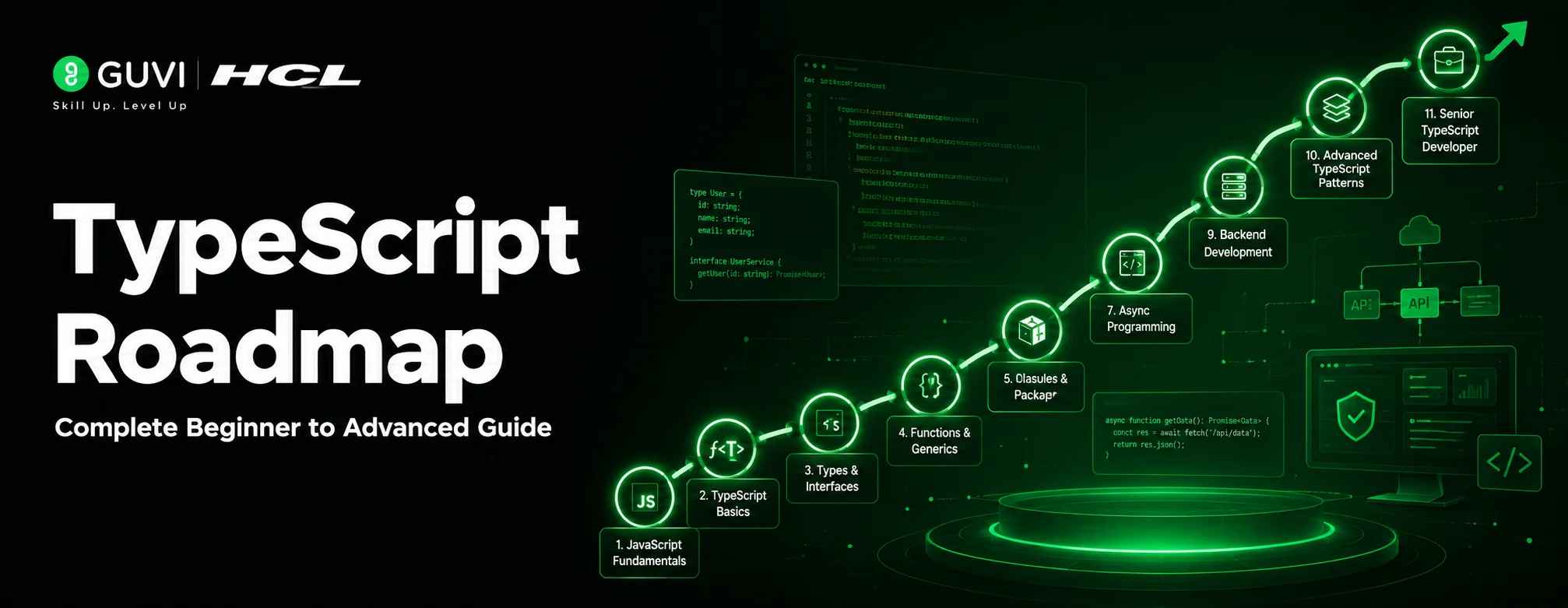
This TypeScript Roadmap will guide you step by step through the skills, tools, projects, and modern development concepts you need to learn to become a TypeScript developer in 2026
Table of contents
- TL;DR Summary
- Complete TypeScript Roadmap 2026
- Phase 1: Understanding TypeScript Development
- Phase 2: Learn JavaScript Fundamentals First
- Pro Tip:
- Phase 3: Building Core TypeScript Fundamentals
- Phase 6: Core Tools Every TypeScript Developer Must Know
- Pro Tip
- Phase 7: Build Projects & Become Industry Ready
- What is TypeScript Developer Salary in 2026?
- Conclusion
- FAQs
- Is TypeScript worth learning in 2026?
- Should I learn JavaScript before TypeScript?
- Is TypeScript better than JavaScript?
- What is the best TypeScript roadmap for beginners?
- Which frameworks commonly use TypeScript?
- Is TypeScript difficult for beginners?
- Can I become a Frontend developer with TypeScript?
- Is TypeScript good for backend development?
- What projects should I build while learning TypeScript?
- Which companies use TypeScript?
- How long does it take to learn TypeScript?
- Is TypeScript useful for React developers?
TL;DR Summary
- This TypeScript Roadmap helps you understand what to learn in 2026.
- It covers JavaScript fundamentals, core TypeScript concepts, and real-world development skills.
- It explains important tools, frameworks, projects, and modern development practices.
- It also highlights career paths like frontend, full-stack, and backend development.
- Overall, this roadmap helps you focus on the right TypeScript skills and technologies step by step.
Complete TypeScript Roadmap 2026
Phase 1: Understanding TypeScript Development
What is TypeScript?
TypeScript is a programming language built on top of JavaScript that helps developers write cleaner and more scalable code with better error checking.
Why is TypeScript Popular in 2026?
- Better Scalability
- Early Error Detection
- Modern Web Development
- High Industry Demand
What Does a TypeScript Developer Do?
A TypeScript developer builds modern web applications using scalable and maintainable code practices. They commonly work on frontend applications, APIs, full-stack platforms, and enterprise-level systems.
Common Areas They Work In:
- Frontend applications
- Full-stack development
- Backend APIs
- Enterprise web apps
TypeScript was originally considered “too strict” by many JavaScript developers. But today, some of the world’s largest frontend and full-stack applications rely heavily on TypeScript because it helps teams manage massive codebases much more efficiently.
Phase 2: Learn JavaScript Fundamentals First
Many beginners think JavaScript and TypeScript are completely different technologies. But in reality, TypeScript is built on top of JavaScript itself.
That is why learning core JavaScript fundamentals first makes TypeScript much easier to understand later, especially while working on modern frontend and full-stack applications.
The stronger your JavaScript fundamentals become, the easier TypeScript, React, Next.js, and modern full-stack development will feel later in your journey.
Learning resources
- Learn core JavaScript fundamentals
- Understanding how objects, methods, and classes work in JavaScript makes learning TypeScript concepts much easier later.
- Exploring the New Array and Object Methods in JavaScript
- Variables and Data Types in JavaScript: A Complete Guide
How TypeScript is Built on JavaScript?
TypeScript does not replace JavaScript. It adds extra safety on top of JavaScript so developers can catch mistakes earlier and write cleaner code.
JavaScript Example
let username = “Alex”;
Typescript Example
let username: string = “Alex”;
JavaScript builds the foundation, while TypeScript adds better structure, scalability, and safer development practices on top of it.
If you are still confused between the two, understanding TypeScript vs JavaScript differences can make the learning path clearer.
Pro Tip:
If you master JavaScript fundamentals properly, you are already halfway through your TypeScript roadmap journey.
Strong JavaScript Fundamentals + TypeScript Concepts = Modern TypeScript Developer
Phase 3: Building Core TypeScript Fundamentals
Now that your JavaScript fundamentals are getting stronger, the next step in this TypeScript Roadmap is learning the core TypeScript concepts used in modern frontend and full-stack development.
These fundamentals are what make TypeScript feel more structured than JavaScript. They help developers write cleaner code, improve readability, catch errors earlier, and manage larger applications more efficiently.
How TypeScript Improves Normal JavaScript?
<span style=”color:#f7df1e;”><strong>JavaScript:</strong></span>
<span style=”color:#ffffff;”>let age = 22;</span>
<br>
<span style=”color:#3178c6;”><strong>TypeScript:</strong></span>
<span style=”color:#ffffff;”>let age: number = 22;</span>
<br>
Here, TypeScript clearly defines that <code>age</code> should always store a number. This improves readability and helps developers avoid common coding mistakes as applications become larger.
Once these fundamentals become comfortable, the rest of your TypeScript Roadmap becomes much easier to learn and apply in real-world projects.
Phase 4: Learn Modern TypeScript Concepts
Now that your TypeScript fundamentals are becoming stronger, the next step in this TypeScript Roadmap is learning modern concepts that developers use in real-world applications.
This is the phase where TypeScript starts feeling smarter and more powerful for building cleaner code, handling larger projects, and making development easier to manage as applications grow.
A Simple Modern TypeScript Example
<span style=”color:#3178c6;”><strong>TypeScript:</strong></span>
<span style=”color:#ffffff;”>type User = string | number;</span>
<br>
Here, TypeScript allows the <code>User</code> type to accept either a string or a number using union types. This makes applications more flexible while still keeping development safer and easier to manage.
Phase 5: Choosing Your TypeScript Specialization
Now, almost every field in development expects you to build deeper skills in one direction instead of learning everything at once.
As you continue learning TypeScript fundamentals, start exploring different paths and figure out where your interests and strengths fit best.
What Career Paths Can You Choose After Learning TypeScript?
Build modern user interfaces and web applications using frameworks like React, Next.js, and Angular.
Work on both frontend and backend applications, handling everything from UI to APIs and databases.
Build APIs, server-side logic, authentication systems, and scalable backend services using Node.js and TypeScript.
Mobile App Developer
Create cross-platform mobile applications using technologies like React Native and TypeScript.

Enterprise Application Developer
Build large-scale business applications, dashboards, internal platforms, and maintain complex systems.
UI Engineer
Focus on building scalable, interactive, and highly optimized user experiences using TypeScript and frontend technologies.
Developer Tools Engineer
Build internal tools, libraries, SDKs, and developer platforms that improve development workflows.
TypeScript started as a frontend-friendly language, but today it is widely used across frontend and full-stack development.
Frameworks like React, Next.js, and many modern development teams use TypeScript to improve scalability, maintainability, and developer productivity across large applications.
Try not to stress too much about choosing your specialization immediately.
Keep exploring while learning, build small projects, and over time you’ll naturally start understanding which path feels right for you.
Phase 6: Core Tools Every TypeScript Developer Must Know
Learning TypeScript alone is not enough in modern development. As you start building real projects, you’ll also work with tools that developers use daily for coding, debugging, project management, and collaboration.
| Tool | Where is it used? |
| VS Code | Writing and managing TypeScript code |
| Git & GitHub | Version control and collaboration |
| npm / pnpm | Managing packages and dependencies |
| ESLint | Maintaining cleaner code |
| Prettier | Consistent code formatting |
| Vite | Faster frontend development |
| Node.js | Running JavaScript and TypeScript applications |
| Postman | Testing APIs |
| Next.js | Modern frontend and full-stack development |
Pro Tip
Start with VS Code, Git, Node.js, and package management first. As you progress through this TypeScript Roadmap and start building projects, you can gradually explore the remaining tools naturally.
Phase 7: Build Projects & Become Industry Ready
Building projects is one of the fastest ways to improve your TypeScript skills. Along with learning concepts, start creating projects and showcasing them publicly to build a stronger developer profile.
Frontend Development
- Portfolio Website
- Task Management App
Full Stack Development
- Authentication System
- Blog Platform
Backend Development
- REST API Server
- Real-Time Chat Application
Mobile Development
- Expense Tracker App
- Weather App
Enterprise Development
- CRM Dashboard
- Admin Analytics Panel
Top 15+ TypeScript Projects with Source Code
Build Your Portfolio
Start uploading projects to GitHub and create a portfolio that shows your learning journey. A few completed projects often create a stronger impression than dozens of unfinished ones.
How to Use GitHub to Strengthen Your Resume: The 2026 Complete Guide
What is TypeScript Developer Salary in 2026?
- Freshers: ₹4 LPA – ₹8 LPA
- Mid-Level Developers: ₹10 LPA – ₹18 LPA
- Full Stack Developers: ₹15 LPA – ₹25 LPA+
- Senior TypeScript Developers: ₹30 LPA+
Start small, keep building, and focus on consistency. Projects and practical experience often matter more than learning every concept perfectly.
Ready to Turn Your Learning Into Real Projects?
The best way to gain real development experience is by learning step by step, building projects, and working with modern development tools used in the industry.
EXPLORE FULL-STACK DEVELOPMENT COURSE BY HCL GUVI
You do not need to learn every technology shown in this roadmap immediately. Focus on building consistently and improving one phase at a time.
Conclusion
This TypeScript Roadmap is not about memorizing syntax or rushing through frameworks. It is about building strong development fundamentals, understanding modern web technologies, and growing through practical projects and real-world learning.
TypeScript has become one of the most important technologies in modern frontend and full-stack development, and its demand continues to grow rapidly in 2026. Stay consistent, keep building projects, and your development skills will naturally improve over time.
FAQs
Is TypeScript worth learning in 2026?
Yes, TypeScript is one of the most in-demand technologies for modern frontend, full-stack, and enterprise application development in 2026.
Should I learn JavaScript before TypeScript?
Yes, learning JavaScript fundamentals first makes TypeScript much easier to understand because TypeScript is built on top of JavaScript.
Is TypeScript better than JavaScript?
TypeScript adds static typing, better error checking, and improved scalability, making it more suitable for large and modern applications.
What is the best TypeScript roadmap for beginners?
The best TypeScript roadmap includes JavaScript basics, TypeScript fundamentals, frameworks, tools, projects, and real-world development skills.
Which frameworks commonly use TypeScript?
Frameworks like React, Next.js, Angular, NestJS, and React Native heavily use TypeScript in modern development workflows.
Is TypeScript difficult for beginners?
TypeScript may feel slightly challenging initially, but developers with JavaScript knowledge usually adapt to it quickly.
Can I become a Frontend developer with TypeScript?
Yes, TypeScript is widely used in frontend development, especially with React and Next.js applications.
Is TypeScript good for backend development?
Yes, TypeScript is commonly used with Node.js and NestJS for building scalable backend APIs and full-stack applications.
What projects should I build while learning TypeScript?
Beginners can build portfolio websites, task management apps, REST APIs, authentication systems, dashboards, and full-stack applications.
Which companies use TypeScript?
Many modern tech companies use TypeScript for scalable web applications, frontend systems, enterprise software, and full-stack platforms.
How long does it take to learn TypeScript?
With regular practice and project building, most beginners can learn core TypeScript concepts within a few months.
Is TypeScript useful for React developers?
Yes, TypeScript is now widely used in modern React development because it improves code quality, scalability, and developer experience.
Success Stories

About the Author
Reemsha Khan
Always been a storyteller at heart. Now, I turn complex topics into simple, easy-to-understand stories through content. Hope you find it helpful.
View all posts by Reemsha Khan
Connect with me @









Did you enjoy this article?