


Programming Languages Articles
Product Manager Portfolio: How to Build The Best One That Gets You Hired in 2026
Code Review Best Practices: How to Give and Receive Feedback Effectively


Get In Touch For Details! Request More Information
Top 10 Hardest and Easiest Programming Languages in 2026
Sep 15, 2026 9 Min Read 324777 Views
(Last Updated)
Starting a coding journey can feel confusing when nearly 500 programming languages exist. Most beginners naturally want to know which language is easiest to learn and which ones may take more time.
Programming language difficulty is not the same for everyone. It depends on a learner’s technical background, career goals, and previous coding experience.
This article ranks popular programming languages from easiest to hardest. It also explains their applications, advantages, and limitations to help you choose the right starting point.
TL;DR
Python is the easiest programming language for most beginners in 2026 because it offers readable syntax and broad career applications. JavaScript is better suited for web development, while Java remains valuable for enterprise software roles. C++ is harder to master because it requires deeper knowledge of memory management and complex programming concepts.
- Easiest first language: Python
- Best for web development: JavaScript
- Best for AI and automation: Python
- Best for enterprise roles: Java
- Hardest options: C++, Assembly, Haskell, and Malbolge

Table of contents
- What Are the Easiest and Hardest Programming Languages? (2026 Ranked List)
- What Makes a Programming Language 'Easy' or 'Hard'?
- Programming Languages: Easiest to Hardest
- HTML
- JavaScript
- Python
- Ruby
- JAVA
- C++
- Assembly Language
- Prolog
- Malbolge
- Which Programming Language Should You Learn First in 2026?
- Easiest Language for Data Science vs Web Development vs Automation
- Easiest Language for Data Science
- Easiest Language for Web Development
- Easiest Language for Automation
- How Long Does It Take to Learn Python, Java, or C++?
- Python: Around 3 Months to Become Job-Ready
- Java: Around 6 Months to Become Job-Ready
- C++: Around 9 Months to Become Job-Ready
- Which Language Has the Highest Salary for Beginners?
- Final Words
- FAQs
- Which is the easiest programming language to learn?
- Which programming language should a beginner learn first?
- Is HTML a programming language?
- Is Python easier than Java?
- Is JavaScript easier than Python?
- What is the hardest programming language to learn?
- Which programming language is best for data science?
What Are the Easiest and Hardest Programming Languages? (2026 Ranked List)
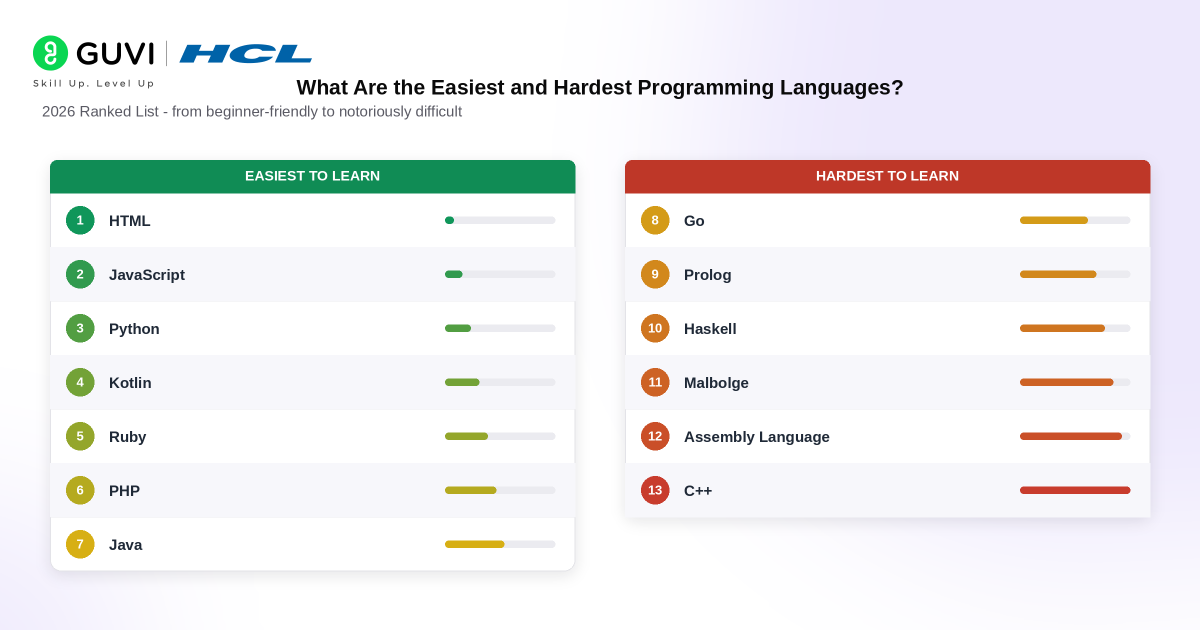
Programming language difficulty depends on the learner’s background and career goal. The time required also varies according to daily practice and project experience.
The following comparison can help beginners shortlist a suitable language.
| Language | Difficulty (1-10) | Job Market | Time to Learn | Best For |
|---|---|---|---|---|
| HTML | 1/10 | High as a supporting web skill | 2-4 weeks | Website structure and web development basics |
| JavaScript | 2/10 | Very high | 4-6 months | Front-end and full-stack web development |
| Python | 2/10 | Very high | 3 months | Data science, AI, and automation |
| Ruby | 3/10 | Moderate | 3-4 months | Back-end development with Ruby on Rails |
| PHP | 3/10 | High | 3-4 months | WordPress and server-side web development |
| Kotlin | 4/10 | High | 4-6 months | Modern Android application development |
| Java | 5/10 | Very high | 6 months | Enterprise software and Android back-end systems |
| Go | 5/10 | Growing | 5-6 months | Cloud applications and scalable back-end systems |
| C++ | 7/10 | High | 9 months | Game development and high-performance software |
| Assembly Language | 8/10 | Niche | 12 months or more | Embedded systems and hardware programming |
| Prolog | 8/10 | Low and specialized | 6-9 months | Logic programming and academic AI applications |
| Haskell | 9/10 | Niche | 9-12 months | Functional programming and research |
| Malbolge | 10/10 | No practical market | Not practical for career learning | Programming language experiments |
To help you get started, we’ve put together a free JavaScript ebook that covers the basics, key concepts, and real-world applications. Whether you’re a complete beginner or brushing up your skills, this ebook will be your perfect guide! [Download Your Free JavaScript Ebook]
What Makes a Programming Language ‘Easy’ or ‘Hard’?
Before we dive into each language, it helps to understand what actually determines difficulty. Programmers and researchers typically measure it across four dimensions:
- Does the language use English-like words or cryptic symbols? Python reads almost like plain English. Assembly Language does not. Syntax Readability:
- How much prior knowledge do you need? HTML can be picked up in a day by anyone. Haskell requires understanding lambda calculus and category theory. Learning Curve:
- How helpful are the error messages? Python gives friendly, readable errors. C++ can produce 100-line template errors for a tiny mistake. Error Tolerance:
- How many tutorials, communities, and courses exist? JavaScript has millions of free resources. Malbolge has almost none. Available Resources:
Programming Languages: Easiest to Hardest
1. HTML
HTML or Hypertext Markup Language, is a markup language, rather than a programming language. Still, it is one of the first steps taken in the journey of learning coding. It gives a good idea of the basics of programming, hence it can be referred to as the easiest programming language to learn. It is used to define the text, color, and appearance of other dynamic elements/buttons on the webpage.
Applications of HTML
- Create web pages
- Define web element structures
- Defines the appearance of web elements
- Modified versions of HTML are used to define pages and entire web applications. Eg: FBML in the case of Facebook.
Why HTML is Easy
- Easy to understand, learn, and remember the syntax
- Simple open and close tags to implement core actions
- Easy debugging
Here is the basic Hello, World! in HTML:
<!doctype html>
<html lang="en">
  <head>
    <meta charset="utf-8" />
    <title>Hello World</title>
  </head>
  <body>
    <h1>Hello, world!</h1>
  </body>
</html>
Also Read: Best Websites to Learn HTML & CSS
2. JavaScript
JavaScript is a web programming language that allows you to develop interactive client-side web elements or web pages. It’s one of the easiest programming languages for beginners.
Combined with HTML and CSS, along with frameworks like Node, Angular, and React, one can build both client-side and server-side web applications and websites. Hence, it’s considered among the best programming languages for web development.
Also Read: YouTube Channels to Learn JavaScript
Applications of JavaScript
- Build the client-side of the website
- Build a server-side through in combination with Node.js
- Build browser-based games
- Develop interactive, engaging mobile and web applications
❓ Python or JavaScript: which should a beginner learn first?
If your goal is web development (building websites and apps), start with JavaScript. If your goal is AI, data science, or automation, start with Python. Both are excellent first languages the right choice depends entirely on the career you want.
Why JavaScript is Easy
- It can be compiled with most browsers to get real-time results
- Highly popular. Thus, many resources for effective learning
- Greater results in fewer efforts
- Great building block to learning other languages
Here is the basic Hello, World! in JavaScript:
<!doctype html>
<html lang="en">
  <head>
    <meta charset="utf-8" />
    <title>Hello World with JavaScript</title>
  </head>
  <body>
    <h1 id="message"></h1>

    <script>
      // Insert text into the page
      document.getElementById("message").textContent = "Hello, world!";
    </script>
  </body>
</html>
3. Python
Python is a fairly easy, all-purpose programming language to learn because of its easy-to-understand syntax and variety of libraries, and ready-made functions. This makes Python a good language for beginners to learn as well. Python has a wide variety of applications. It is a programming language that doesn’t have a steep learning curve yet allows learners to enter high-paying careers.
Applications of Python
- Extensively used for machine learning
- Used for data science and data analytics
- Create programs for IoT and electronics
- Web development through Django or Flask
Why Python is Easy
- It uses English words in its syntax, making Python programs highly readable and understandable
- The syntax uses a lot of white spac,e which makes it appear less overwhelming
- It’s easy to debug
- A great number of readymade libraries and functions
Here is the basic Hello, World! in Python:
# Basic Hello World program in Python
print("Hello, World!")
Also Read: Websites to learn Python
Confused about which programming language to start with? Practice beginner-friendly coding lessons, quizzes, and hands-on exercises for Python, JavaScript, Java, and more on HCL GUVI Learn Hub
Build strong Python programming skills to understand why Python is often considered one of the easiest and most beginner-friendly languages in 2026 with HCL GUVI’s Python Course. Learn Python fundamentals, coding logic, automation, problem-solving, and real-world programming concepts through self-paced training designed for beginners and aspiring developers.
4. Ruby

Ruby was born after combining several programming languages. It’s an open-source natural programming language that focuses on simplicity and productive use for back-end programming.
Also Read: Resources to Learn Ruby
Applications of Ruby
- Building servers
- Helps in web scraping and crawling
- Used in software development. E.g. HULU, Shopify, etc.
- Web development through Ruby on Rails
Why Ruby is Easy
- The syntax language uses a lot of English words.
- Minimum and crisp code commands required to implement the heaviest of tasks
- A free and open-source language that provides great flexibility and enables easy modification
- Great community to support new learners
Here is the basic Hello, World! in Ruby:
# Basic Hello World program in Ruby
puts "Hello, World!"
Important Note:
Ruby is easy and elegant, but job demand in India has declined relative to Python and JavaScript. If job placement is your primary goal, prioritise Python or JavaScript first. Learn Ruby afterward if you work with Rails-based projects.
Put your new language to the test with HCL GUVI’s CodeKata — 1,500+ hands-on coding problems ranked from beginner to interview-level, the same kind of questions asked by companies like Amazon, Walmart, and JusPay. Whether you chose Python for its easy syntax or Java for its job demand, CodeKata helps you build real fluency, one problem at a time.
5. JAVA
JAVA is one of the most popular programming languages for software and application development. It extensively uses object-oriented programming and is among the easiest programming languages to learn. It works on the Write Once, Run Everywhere concept.
Applications of JAVA
- Build desktop software
- Build mobile applications with elaborate backend support
- Game development
- Big Data applications
Why JAVA is Easy
- Easy for people with prior experience in object-oriented programming
- The syntax uses words from the English language
- Concise nature of codes
Here is the basic Hello, World! in Java:
// Basic Hello World program in Java
public class HelloWorld {
    public static void main(String[] args) {
        System.out.println("Hello, World!");
    }
}
Also Read: Best website to Learn Java
Build strong Java programming skills to understand why Java remains one of the most important languages for developers in 2026 with HCL GUVI’s Java Programming Course. Learn Java fundamentals, object-oriented programming, coding logic, problem-solving, and real-world programming concepts through structured training designed for beginners and aspiring developers.
6. C++
C++ is an extensive programming language that helps build programs where the hardware and software are intricately involved. Interacting with memory is a little difficult in C++ and the advanced syntax could put off beginners.
Applications of C++
- Build operating systems. Eg: Linux Kernel, Google Chrome OS, etc.
- Build elaborate software like Photoshop.
- Build GUI-based applications like Microsoft Office.
- Build database management software
Why C++ is Tough
- It has a very typical, specific, and complex syntax
- It’s difficult to learn without learning C
- It’s tricky to manage memory
- Although highly efficient, C++ is a very dynamic language, and it’s a little difficult to keep track.
Here is the basic Hello, World! in C++:
// Basic Hello World program in C++
#include <iostream>
using namespace std;

int main() {
    cout << "Hello, World!" << endl;
    return 0;
}
Explore: Discover the Power of Programming with English: A Must-Know for All Coders
7. Assembly Language
Assembly language is among the hardest programming languages to learn as they’re run and used differently than the above high-level languages. It’s a low-level language used to directly communicate with hardware, only the code is readable by humans.
Reading and understanding Assembly Languages isn’t easy because the codes are assembled. You must also be familiar with the internal functioning of a computer/hardware/CPU to really work with assembly languages, thus making it one of the toughest programming languages to learn.
Applications of Assembly Languages
- Develop hardware
- Develop electronic microprocessors
- High-performance device development
- Build high-frequency trading platforms
Why Assembly Languages Are Tough
- Need a great understanding and interaction of computers with hardware
- It can’t be understood or interpreted without understanding the entire context of the code
- Hard to debug
- As a low-level language, one needs to fulfill a large knowledge gap before learning
- Very complex syntax
Here is the basic Hello, World! in Assembly Language:
; Basic Hello World program in x86 Assembly (NASM)
section .data
    msg db "Hello, World!", 0xA ; message with newline
    len equ $ - msg             ; length of the message

section .text
    global _start

_start:

8. Prolog

Prolog, meaning Logical Programming, lays utmost emphasis on building accurate logic from the start. It is one of the best programming languages language for AI and Natural Language Processing (NLP) programs.
Applications of Prolog
- AI CRM, systems, and applications
- Build chatbots
- Build cost-effective and low-maintenance programs
Why Prolog is Tough
- Can’t get away with logical inconsistencies
- Inputs and outputs can be inconsistent
- Difficult to build logic as functions defined through goals, rules, and facts can restrict beginners with less logical proficiency
- Uncommon data structures from common programming languages
- Online resources can’t be applied directly for guidance
Here is the basic Hello, World! in Prolog:
% Basic Hello World program in Prolog
:- initialization(main).

main :-
    write('Hello, World!'), nl,
    halt.
9. Haskell
Haskell is a programming language built on the Lambda Calculus. It works in a functional paradigm, unlike most modern programming languages, which take a more intuitive outlook. This makes it a hard programming language to learn for modern developers.
Applications of Haskell
- Extensively used to write powerful C code for application development
- Academic and research purposes
- Industrial development
- Data processing and software testing
- JavaScript is used by 62% of developers, making it the most popular programming language in the 2024 Stack Overflow survey.
- HTML and CSS are used by 53% of developers, underscoring their continued importance in web development.
- Python is used by 51% of developers, showing its dominance across data science, AI, and general-purpose programming.
- Rust was admired by 72% of developers in the 2026 Stack Overflow survey, making it the most respected programming language.
- Among developers using Rust, 34% reported it as their main language for daily work.
Why Haskell is Tough
- The syntax uses abrupt words
- Very difficult to identify errors and correct them
- More about focused, clear, and mapped thinking than actual coding
- Huge jargon makes it difficult to figure out
Here is the basic Hello, World! in Haskell:
-- Basic Hello World program in Haskell
main :: IO ()
main = putStrLn "Hello, World!"
10. Malbolge
Malbolge is one of the esoteric programming languages. Hence, it’s intended to be impossibly challenging to learn. The first Malbolge program wasn’t completed until two years after its creation. It was done by a compiler based on Lisp.
Malbolge is a self-evolving language whose syntax is almost impossible to comprehend because of the lack of white spaces or coherent words at all.
Applications of Malbolge
- Although a few programs were written with Malbolge, it’s simply impractical to use if you can’t understand the syntax or the logic. This makes it the hardest programming language for anyone to work with.
Why Malbolge is Tough
- The syntax almost can’t be understood
- Language self-alteration leads to undefined or unexpected behavior
- Scanty learning resources available
Here is the basic Hello, World! in Malbolge:
(=<`#9]~6ZY32Vx/4Rs+0Po-&Jk)"Fh}|Bcy?`=|{z@w>t!o<mk
Which Programming Language Should You Learn First in 2026?
Python is the best first programming language for most beginners in 2026.
Its syntax resembles natural English and requires less code for common tasks. Beginners can focus on programming logic without immediately dealing with complex syntax or manual memory management.
Python also supports several career paths. It is widely used for data analysis and artificial intelligence. Developers also use it for automation and back-end applications.
Choose Python first when:
- You have never written code before.
- You want to explore data science or AI.
- You want to automate repetitive tasks.
- You need a language with extensive beginner resources.
JavaScript may be a better first language when your goal is web development. It runs directly in web browsers and adds interactivity to websites.
Java is suitable for learners targeting enterprise software roles. However, its syntax and object-oriented structure usually take longer to understand than Python.
Therefore, the clearest recommendation is:
- Choose Python for the easiest general-purpose starting point.
- Choose JavaScript when you want to build websites.
- Choose Java when you want to enter enterprise software development.
Easiest Language for Data Science vs Web Development vs Automation
The easiest programming language changes according to the field. A language that works well for data analysis may not be the best choice for interactive websites.
| Career Area | Easiest Language | Why It Is Suitable | Beginner Project |
|---|---|---|---|
| Data Science | Python | It provides beginner-friendly libraries for data analysis and visualization. | Analyze a sales dataset and create a basic report. |
| Web Development | JavaScript | It works inside browsers and supports interactive web pages. | Create an interactive portfolio website. |
| Automation | Python | It can automate files, emails, spreadsheets, and repetitive computer tasks. | Build a script that organizes files into folders. |
Easiest Language for Data Science
Python is the easiest language for beginners entering data science. Libraries such as Pandas and NumPy simplify data processing. Matplotlib helps learners create visualizations.
Beginners should first learn Python fundamentals. They can then move to data cleaning and statistical analysis.
Easiest Language for Web Development
JavaScript is the most practical starting language for web development. HTML creates the page structure, but JavaScript controls interactive features.
A beginner can use JavaScript to build forms and navigation menus. It also supports back-end development through Node.js.
Easiest Language for Automation
Python is the easiest choice for automation because its syntax is concise. It also provides libraries for handling files and web-based tasks.
Beginners can create useful automation scripts after understanding variables and loops. This provides visible results without requiring advanced application development.
How Long Does It Take to Learn Python, Java, or C++?
The time required depends on the learner’s consistency and previous technical knowledge. Studying for one or two hours daily can provide steady progress.
Python: Around 3 Months to Become Job-Ready
The first month can cover syntax and basic problem-solving. The second month can focus on libraries and small projects.
The third month should include one career-focused project. Data science learners can analyze a dataset. Automation learners can build a practical script.
Suggested timeline:
- Month 1: Python syntax and basic programming logic
- Month 2: Libraries and problem-solving practice
- Month 3: Projects and interview preparation
Java: Around 6 Months to Become Job-Ready
Java requires additional time because beginners must understand object-oriented programming. They may also need to learn collections and exception handling.
The final months should focus on projects and coding interview questions.
Suggested timeline:
- Months 1-2: Core syntax and programming fundamentals
- Months 3-4: Object-oriented programming and collections
- Months 5-6: Projects, DSA, and interview preparation
C++: Around 9 Months to Become Job-Ready
C++ takes longer because learners must understand pointers and memory management. Its advanced syntax can also make debugging more challenging.
The first few months should build strong programming fundamentals. Learners can then study object-oriented programming and the Standard Template Library.
Suggested timeline:
- Months 1-3: Syntax and programming logic
- Months 4-6: Pointers, memory, and object-oriented programming
- Months 7-9: DSA, projects, and interview preparation
These timelines are estimates rather than guaranteed placement periods. A strong portfolio and regular coding practice can influence job readiness.
Which Language Has the Highest Salary for Beginners?
No programming language automatically guarantees the highest salary. Employers pay for the role and the candidate’s ability to solve practical problems.
Java often provides one of the strongest combinations of fresher demand and salary potential in India. It is widely used in enterprise applications and large back-end systems.
Python can lead to well-paying opportunities in data science and AI. However, knowing Python syntax alone is not enough. Candidates may also need statistics or machine learning knowledge.
C++ can attract high salaries in specialized areas such as systems engineering and quantitative development. These roles usually require advanced problem-solving skills, so they are more difficult for beginners to enter.
The practical comparison is:
| Language | Beginner Salary Potential | Entry-Level Opportunity | Additional Skills Usually Needed |
|---|---|---|---|
| Python | High in data and AI roles | High | SQL, statistics, or automation tools |
| Java | High and relatively stable | Very high | DSA, Spring Boot, and databases |
| JavaScript | Moderate to high | Very high | HTML, CSS, and a front-end framework |
| C++ | Very high in specialized roles | Moderate | Advanced DSA and systems knowledge |
| Go | High in cloud-focused roles | Limited for freshers | APIs, Linux, and cloud fundamentals |
Want to master Python or JavaScript with live mentor support? Join HCL GUVI Zen Class and learn full stack development, data science, or software engineering through industry-focused projects. Also, unlock JavaScript programming language mastery with our free JS eBook: learn faster, code smarter, and build projects with confidence.
Final Words
Learning new programming languages has many benefits. You gain more skills, become a better programmer, and widen your horizons in the tech world. Although you must understand that it’s a continuous process.
One must give higher priority to learning a relevant and useful programming language rather than the simplest or toughest programming language. This would help you give meaning to your coding journey. We hope you find the easiest and hardest programming languages to learn with this article.
FAQs
Which is the easiest programming language to learn?
Python is the easiest general-purpose programming language for most beginners. Its readable syntax allows learners to understand coding logic without dealing with complex rules.
Which programming language should a beginner learn first?
Most beginners should start with Python. Learners interested specifically in web development should begin with HTML and CSS before learning JavaScript.
Is HTML a programming language?
No. HTML is a markup language used to structure web pages. It does not contain programming features such as loops or conditional logic.
Is Python easier than Java?
Python is generally easier for beginners because it requires less code and has simpler syntax. Java takes longer because learners must understand object-oriented programming concepts earlier.
Is JavaScript easier than Python?
Both languages are beginner-friendly. Python is usually easier for general programming, data science, and automation. JavaScript is more suitable for building interactive websites.
What is the hardest programming language to learn?
Malbolge is considered one of the hardest programming languages because it was intentionally designed to be difficult. Assembly and Haskell are also challenging for beginners.
Which programming language is best for data science?
Python is the best starting language for data science. It provides beginner-friendly libraries such as Pandas, NumPy, and Matplotlib.
Success Stories

About the Author
Vaishali
I'm a seasoned writer with four years of experience across technical, non-technical, and just about every genre or niche you can imagine. Adaptable and curious, I enjoy exploring new topics and making information engaging and easy to understand. Fueled by a steady stream of tea, I approach each project with creativity, reliability, and genuine enthusiasm for storytelling.
View all posts by Vaishali
Connect with me @

Did you enjoy this article?
Comments









Awesome
Very helpful insights. I wish to maintain connection with you as I start a new career in coding. Thanks a great deal.
Dear madam, your article is helpful to me i want to learn javascript. ,
Give about java script
JavaScript
Liked it succinct
It was very helpful for me. I will strive without regret~
like this information
I’m a new coder and looking for direction
Thankyou sir or mam