


Interview Articles
InfyTQ Interview Experience 2026: Process, Questions, Preparation & Tips
Deloitte NLA Interview Experience 2026: Rounds, Questions and Preparation - Best Guide
Capgemini Exceller Interview Questions 2026: Coding, Technical, HR, and AI Prep - Best Guide
Wipro Elite NTH Interview Experience 2026: What Candidates Say


Get In Touch For Details! Request More Information
Top 50 Data Science Interview Questions for Freshers [2026]
Oct 23, 2026 8 Min Read 5694 Views
(Last Updated)
Are you a recent graduate aiming to become a Data Scientist? Preparing for data science interview questions for freshers requires a strong understanding of statistics, Python, SQL, machine learning, and data analysis. Freshers are usually tested on their fundamentals first, followed by questions that check how well they can apply those concepts to practical problems.
If you’re preparing for your first data science role, concepts such as supervised and unsupervised learning, EDA, feature engineering, overfitting, and model evaluation are important to understand. You should also be prepared to explain your academic or personal projects clearly.
This article covers the top 50 data science interview questions for freshers, ranging from basic concepts to advanced and scenario-based questions.
Table of contents
- TL;DR
- Most Commonly Asked Data Science Interview Questions for Freshers
- What is Data Science?
- What are the key steps in a data science workflow?
- What is the difference between Data Science, AI, ML, and DL?
- What is the difference between Data Science and Data Analytics?
- What is the difference between supervised and unsupervised learning?
- What is the difference between structured and unstructured data?
- What is overfitting and underfitting?
- What is the Curse of Dimensionality?
- What is the role of a p-value in hypothesis testing?
- What is the difference between classification and regression?
- What is the Central Limit Theorem?
- What is feature engineering?
- Basic Data Science Interview Questions for Freshers
- What are KPI, Lift, and DOE?
- What are sampling techniques, and why are they used?
- What is the difference between long and wide format data?
- What is a bias-variance tradeoff?
- What is a confusion matrix, and how is it used?
- What is the difference between mean, median, and mode?
- What is a null hypothesis?
- What is cross-validation?
- What is Exploratory Data Analysis?
- What is the difference between correlation and causation?
- Intermediate Data Science Interview Questions for Freshers
- What is logistic regression ?
- What is linear regression and what are its limitations?
- What is the difference between correlation and covariance?
- What is feature selection and why is it important?
- What is the difference between bagging and boosting?
- What is the use of regularization in machine learning?
- What is the difference between precision and recall?
- What is an ROC curve?
- What is the purpose of a train-test split?
- Advanced Data Science Interview Questions for Freshers
- What are eigenvalues and eigenvectors?
- What is PCA and how does it help in dimensionality reduction?
- What are autoencoders?
- What is a generative adversarial network (GAN)?
- What are exploding and vanishing gradients?
- What is the difference between RNN and CNN?
- What is the use of LSTM in time series?
- What is the difference between batch and stochastic gradient descent?
- Scenario-Based and Practical Data Science Interview Questions for Freshers
- How would you handle missing values in a dataset?
- How would you deal with imbalanced data?
- How would you train a model on a large dataset with limited RAM?
- How would you train a model on a large dataset with limited RAM?
- How would you evaluate a machine learning model?
- How would you choose the right algorithm for a problem?
- How would you explain a model to a non-technical stakeholder?
- How would you improve an underperforming model?
- How would you handle outliers?
- Your model performs well on training data but poorly on test data. What would you do?
- You receive a dataset with many missing values. How would you decide what to do?
- One feature has a very strong impact on your model. You suspect the feature may be unreliable. What would you do?
- Data Science Resume and Portfolio
- 💡 Did You Know?
- Mock Interview Preparation
- Concluding Thoughts…
- Frequently Asked Questions
- What are the most important topics for a fresher preparing for a data science interview?
- How many data science questions should a fresher practice?
- Is Python necessary for a data science interview?
- Should freshers prepare SQL for data science interviews?
- Should I include data science projects on my resume?
- How can I improve my confidence before a data science interview?
TL;DR
- Data science interviews for freshers commonly cover Python, SQL, statistics, machine learning, EDA, and data preprocessing.
- Understanding fundamental concepts is more important than memorizing lengthy definitions.
- Freshers should be able to explain supervised learning, overfitting, feature engineering, model evaluation, and common ML algorithms.
- Scenario-based questions test how you apply data science concepts to practical problems.
- Reviewing your projects, resume, and portfolio and practicing mock interviews can improve your interview preparation.
Most Commonly Asked Data Science Interview Questions for Freshers
1. What is Data Science?
Data science is an interdisciplinary field that combines statistics, mathematics, programming, and domain knowledge to extract useful insights from data.
2. What are the key steps in a data science workflow?
A typical workflow includes:
- Understanding the problem
- Collecting data
- Cleaning and preparing data
- Performing EDA
- Feature engineering
- Building a model
- Evaluating the model
- Deploying and monitoring the solution
3. What is the difference between Data Science, AI, ML, and DL?
Data Science focuses on extracting insights and building data-driven solutions. AI is the broader field of creating systems that perform tasks associated with intelligence. Machine Learning is a subset of AI that learns patterns from data, while Deep Learning uses neural networks to learn complex patterns.
4. What is the difference between Data Science and Data Analytics?
Data analytics mainly focuses on analyzing existing data to answer specific questions and support decisions. Data science covers analytics along with predictive modeling, machine learning, experimentation, and other data-driven techniques.
5. What is the difference between supervised and unsupervised learning?
Supervised learning uses labeled data to train models for tasks such as classification and regression.
Unsupervised learning works with unlabeled data to discover patterns or groups, such as clusters.
6. What is the difference between structured and unstructured data?
Structured data is organized into a predefined format, such as rows and columns in a database.
Unstructured data includes text, images, audio, and videos that do not follow a fixed tabular structure.
7. What is overfitting and underfitting?
Overfitting happens when a model learns the training data too closely and performs poorly on new data.
Underfitting occurs when a model is too simple to capture important patterns in the data.
8. What is the Curse of Dimensionality?
The Curse of Dimensionality refers to problems that occur when the number of features becomes very large. Data points become sparse, computation becomes more expensive, and models may become harder to train effectively.
9. What is the role of a p-value in hypothesis testing?
A p-value helps determine how compatible the observed data is with the null hypothesis. A smaller p-value provides stronger evidence against the null hypothesis when interpreted using a predefined significance level.
10. What is the difference between classification and regression?
Classification predicts categories or labels, such as spam or not spam.
Regression predicts continuous numerical values, such as house prices or sales.
11. What is the Central Limit Theorem?
The Central Limit Theorem states that, under common conditions, the sampling distribution of the mean approaches a normal distribution as the sample size increases, even if the original population is not normally distributed.
12. What is feature engineering?
Feature engineering involves selecting, transforming, or creating useful variables from existing data. Good features can help machine learning models identify patterns more effectively.
If you’re looking to strengthen your fundamentals and build practical projects, HCL GUVI’s Data Science Course can help you develop the technical skills needed for entry-level data science roles.
Basic Data Science Interview Questions for Freshers
13. What are KPI, Lift, and DOE?
KPI stands for Key Performance Indicator and is used to measure progress toward a business objective.
Lift measures how much better a predictive model performs compared with a baseline or random selection.
DOE, or Design of Experiments, is a structured method for studying how different factors affect an outcome.
14. What are sampling techniques, and why are they used?
Sampling techniques are methods used to select a smaller group from a larger population.
Common probability sampling techniques include:
- Simple random sampling
- Stratified sampling
- Systematic sampling
- Cluster sampling
15. What is the difference between long and wide format data?
In wide-format data, each entity generally occupies one row and different variables appear in separate columns.
In long-format data, multiple rows can represent different observations or measurements for the same entity.
16. What is a bias-variance tradeoff?
Bias represents error caused by overly simple assumptions, while variance represents sensitivity to changes in the training data.
A good model balances both so it can generalize well to unseen data.
17. What is a confusion matrix, and how is it used?
A confusion matrix summarizes the performance of a classification model using:
- True Positives
- True Negatives
- False Positives
- False Negatives
These values help calculate accuracy, precision, recall, and F1-score.
18. What is the difference between mean, median, and mode?
Mean is the average of the values.
Median is the middle value after sorting the data.
Mode is the most frequently occurring value.
Median is often preferred when a dataset contains significant outliers.
19. What is a null hypothesis?
A null hypothesis is the default assumption that there is no significant relationship, difference, or effect.
20. What is cross-validation?
Cross-validation evaluates a model by dividing the dataset into multiple subsets and training and testing the model across different combinations of those subsets.
It helps provide a more reliable estimate of model performance.
21. What is Exploratory Data Analysis?
EDA is the process of examining a dataset using statistics and visualizations to identify patterns, relationships, missing values, and outliers before building a model.
22. What is the difference between correlation and causation?
Correlation means two variables are associated or move together.
Causation means a change in one variable directly contributes to a change in another. Correlation alone does not prove causation.
Intermediate Data Science Interview Questions for Freshers
Moving beyond basics, intermediate data science concepts often appear in technical rounds of interviews. These questions test your analytical skills and understanding of machine learning fundamentals.

23. What is logistic regression ?
Logistic regression is a supervised machine learning algorithm commonly used for classification problems. It estimates the probability of an outcome and is often used for problems such as customer churn or fraud detection.
24. What is linear regression and what are its limitations?
Linear regression models the relationship between a dependent variable and one or more independent variables using a linear equation.
Its limitations include sensitivity to outliers and difficulty modeling complex nonlinear relationships.
25. What is the difference between correlation and covariance?
Covariance shows how two variables change together and depends on their scale.
Correlation standardizes the relationship and generally ranges from -1 to +1.
26. What is feature selection and why is it important?
Feature selection identifies the most relevant variables for a model.
It can reduce noise, improve interpretability, reduce overfitting, and make model training more efficient.
27. What is the difference between bagging and boosting?
Bagging trains multiple models independently and combines their predictions.
Boosting trains models sequentially, with later models focusing more on errors made by previous models.
28. What is the use of regularization in machine learning?
Regularization adds a penalty to the model’s objective function to reduce unnecessary complexity and help prevent overfitting.
L1 and L2 are common regularization techniques.
29. What is the difference between precision and recall?
Precision measures how many predicted positive cases are actually positive.
Recall measures how many actual positive cases the model successfully identifies.
30. What is an ROC curve?
An ROC curve shows the relationship between the true positive rate and false positive rate at different classification thresholds.
The AUC summarizes how well a model separates the classes.
31. What is the purpose of a train-test split?
A train-test split separates data into training and testing sets.
The training data is used to build the model, while the testing data evaluates how the model performs on unseen data.
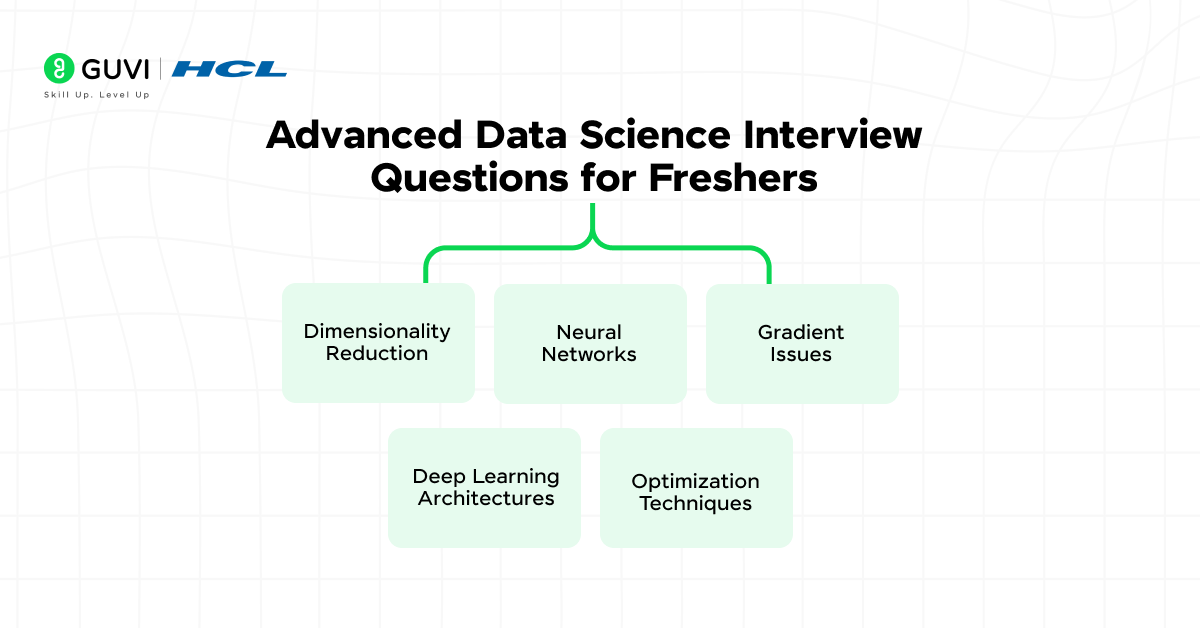
Advanced Data Science Interview Questions for Freshers
Advanced concepts often distinguish exceptional candidates in data science interviews. Mastering these topics demonstrates a deeper understanding of the field and its cutting-edge techniques.
32. What are eigenvalues and eigenvectors?
Eigenvalues and eigenvectors are fundamental concepts in linear algebra that help analyze matrices. An eigenvector is a non-zero vector that, when multiplied by a matrix, changes only in scale (not direction). The eigenvalue is the scaling factor applied to the eigenvector. In data science, they’re crucial for dimensionality reduction techniques and understanding data variance. They help extract key features from datasets and understand the structure inherent in data.
33. What is PCA and how does it help in dimensionality reduction?
Principal Component Analysis (PCA) transforms correlated variables into a smaller set of uncorrelated variables called principal components. It works by finding directions (eigenvectors) with maximum variance in the data. PCA helps by:
- Reducing computational complexity
- Minimizing multicollinearity and overfitting
- Improving visualization by projecting high-dimensional data into lower dimensions
- Preserving as much information as possible while reducing dimensions
34. What are autoencoders?
Autoencoders are neural networks that learn efficient data encodings in an unsupervised manner. They consist of two main parts: an encoder that compresses input data into a latent-space representation, and a decoder that reconstructs the original input from this compressed form. Autoencoders excel at dimensionality reduction, feature learning, anomaly detection, and image denoising. Unlike PCA, autoencoders can capture complex nonlinear correlations in data.
35. What is a generative adversarial network (GAN)?
A GAN consists of two competing neural networks: a generator that creates new data instances and a discriminator that evaluates their authenticity. The generator tries to produce realistic data while the discriminator attempts to distinguish fake from real data. Throughout training, both networks improve until the generator creates data so realistic that the discriminator cannot differentiate it from authentic samples. GANs are used for generating realistic images, data augmentation, and completing missing information.

36. What are exploding and vanishing gradients?
These are problems encountered when training deep neural networks:
- Vanishing gradients occur when gradients become extremely small during backpropagation, making earlier layers learn very slowly or not at all
- Exploding gradients happen when gradients grow exponentially, causing unstable updates that lead to NaN values
Both issues make training difficult, especially in deep networks and RNNs. Solutions include gradient clipping, proper weight initialization, and using architectures like LSTM.
37. What is the difference between RNN and CNN?
RNNs (Recurrent Neural Networks) and CNNs (Convolutional Neural Networks) serve different purposes:
- RNNs handle sequential data by maintaining memory of previous inputs, making them ideal for text, time series, and speech
- CNNs excel at spatial data like images by using filters to detect patterns regardless of their position
Their architectures differ fundamentally: RNNs have feedback loops, while CNNs use convolutional layers with filters and pooling operations.
38. What is the use of LSTM in time series?
Long Short-Term Memory (LSTM) networks are specialized RNNs designed to overcome the vanishing gradient problem. In time series analysis, LSTMs are valuable because they:
- Remember information over long sequences through their unique memory cell structure
- Capture both short and long-term dependencies in temporal data
- Control information flow through input, forget, and output gates
- Perform well on tasks like time series prediction, anomaly detection, and sequence classification
39. What is the difference between batch and stochastic gradient descent?
These gradient descent variants differ in how they process data:
- Batch gradient descent uses the entire dataset to compute gradients, providing accurate estimates but requiring significant computation
- Stochastic gradient descent (SGD) uses a single training example per iteration, converging faster but with noisier updates
Batch GD works well for smooth error surfaces but struggles with large datasets. SGD is faster and can escape local minima, though it’s less stable. A compromise between the two is mini-batch gradient descent, which uses small random subsets of data.
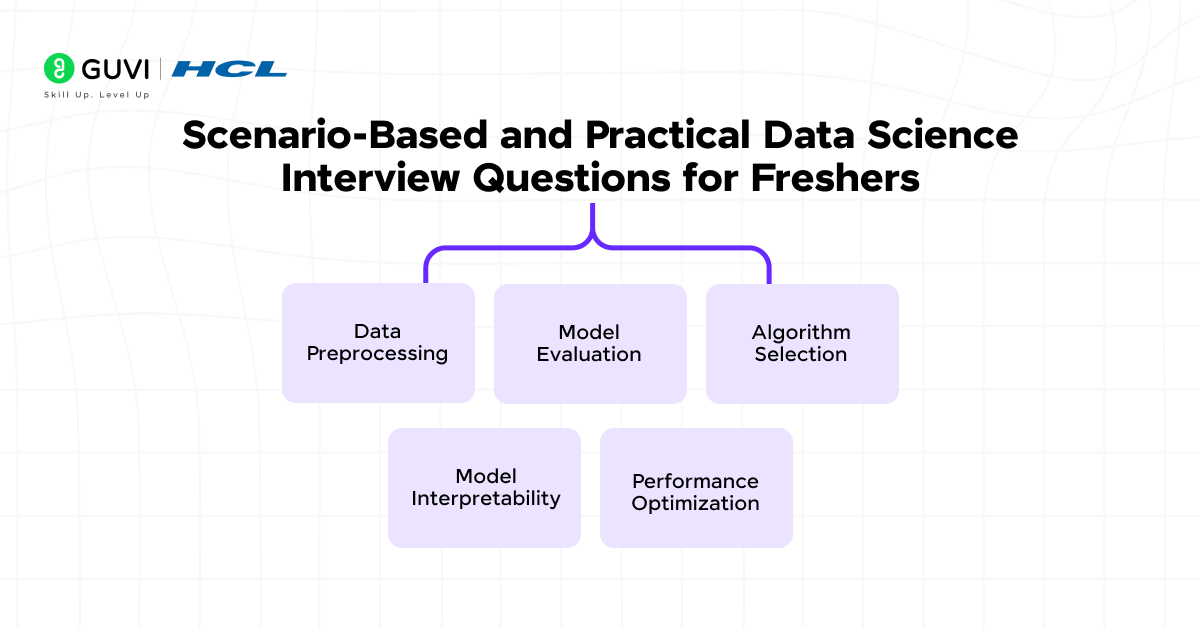
Scenario-Based and Practical Data Science Interview Questions for Freshers
Real-world data science problems rarely present themselves as neatly as theoretical concepts. Scenario-based questions test your ability to apply knowledge to practical situations, a crucial skill for freshers entering the field.
40. How would you handle missing values in a dataset?
First, understand how much data is missing and why it is missing.
Depending on the situation, you could remove affected records, use mean or median imputation for numerical data, use mode for categorical data, or use more advanced imputation methods.
41. How would you deal with imbalanced data?
You can use techniques such as:
- Oversampling the minority class
- Undersampling the majority class
- SMOTE
- Class weights
You should also use appropriate evaluation metrics instead of relying only on accuracy.
42. How would you train a model on a large dataset with limited RAM?
Tackle RAM limitations through batch processing, where you train on smaller chunks of data sequentially. Alternatively, use incremental learning algorithms that update gradually with new data. Indeed, tools like Dask provide pandas-like functionality with out-of-memory computation. Consider dimensionality reduction or feature selection to decrease the dataset size.
42. How would you train a model on a large dataset with limited RAM?
You can process the data in smaller batches, use incremental learning, reduce unnecessary features, or use tools designed for larger-than-memory datasets.
43. How would you evaluate a machine learning model?
The evaluation metric depends on the problem.
For classification, you might use precision, recall, F1-score, or AUC. For regression, metrics such as MAE, MSE, or RMSE can be useful.
44. How would you choose the right algorithm for a problem?
First identify whether the problem is classification, regression, clustering, or another type.
Then consider dataset size, feature types, interpretability requirements, computational resources, and the expected outcome. Starting with a simple baseline is often useful.
45. How would you explain a model to a non-technical stakeholder?
Use simple language and focus on the business problem and outcome rather than technical terminology.
Visualizations, examples, and comparisons can help explain the model’s predictions and limitations.
46. How would you improve an underperforming model?
Start by checking data quality and analyzing the model’s errors.
Then consider feature engineering, better preprocessing, hyperparameter tuning, additional data, or trying another algorithm.
47. How would you handle outliers?
First determine whether the outlier is a data-entry error, a genuine observation, or something unusual that is important to the problem.
Depending on the situation, you can remove it, transform the data, cap the value, or use an algorithm that is less sensitive to outliers.
48. Your model performs well on training data but poorly on test data. What would you do?
This is a common sign of overfitting.
You could try regularization, reduce unnecessary features, simplify the model, collect more data, or use cross-validation.
49. You receive a dataset with many missing values. How would you decide what to do?
First determine the percentage and pattern of missing values.
Then consider why the values are missing and whether the affected feature is important. Depending on the situation, you might use imputation, remove a feature with excessive missingness, or use a model that handles missing values.
50. One feature has a very strong impact on your model. You suspect the feature may be unreliable. What would you do?
First verify the source and quality of the feature.
I would check for data errors, leakage, unusual distributions, and relationships with other variables. I would also compare model performance with and without the feature before deciding whether to keep or replace it.
Data Science Resume and Portfolio
Your resume and portfolio can support your interview preparation by showing recruiters what you have actually worked on.
Include projects that demonstrate skills such as:
- Python
- SQL
- Data cleaning
- EDA
- Machine learning
- Data visualization
- Model evaluation
Your portfolio can also include GitHub repositories, dashboards, notebooks, and project explanations.
For guidance on presenting your skills and projects, check HCL GUVI’s Data Scientist Resume and Portfolio Guide.
💡 Did You Know?
- Many data science interview questions are designed to evaluate how candidates think and structure their approach, not just whether they reach the correct answer.
- Interviewers often value clear explanation of assumptions and trade offs more than the complexity of the model chosen.
- Real world scenario based questions are increasingly preferred over purely theoretical ones, especially for mid to senior level data science roles.
Mock Interview Preparation
After revising these 50 questions, practice answering them without looking at the answers.
Try explaining each concept in your own words and practice scenario-based questions using examples from your projects.
You can also use mock interviews to identify gaps in your technical knowledge and improve your communication before attending an actual data science interview.
If you’re looking to strengthen your fundamentals and build practical projects, HCL GUVI’s Data Science Course can help you develop the technical skills needed for entry-level data science roles.
Also Read: Data Scientist Roles and Responsibilities
Concluding Thoughts…
Preparing for a data science interview as a fresher is mainly about building strong fundamentals and learning how to apply them to practical problems.
Start with statistics, Python, SQL, EDA, and basic machine learning concepts. Once you’re comfortable with these areas, practice intermediate questions, scenario-based problems, and questions related to your projects.
Most importantly, don’t focus only on memorizing answers. Understand the concepts well enough to explain them clearly and apply them to real-world situations.
Frequently Asked Questions
1. What are the most important topics for a fresher preparing for a data science interview?
Focus on Python, SQL, statistics, EDA, machine learning fundamentals, feature engineering, and model evaluation.
2. How many data science questions should a fresher practice?
There is no fixed number, but practicing a broad set of conceptual, coding, and scenario-based questions can help you prepare for different interview formats.
3. Is Python necessary for a data science interview?
Python is widely used in data science, so understanding Python fundamentals and libraries used for data analysis and machine learning is useful.
4. Should freshers prepare SQL for data science interviews?
Yes. SQL is commonly used to retrieve, filter, join, and analyze data stored in databases.
5. Should I include data science projects on my resume?
Yes. Projects can demonstrate your ability to apply concepts such as data cleaning, analysis, visualization, and machine learning to practical problems.
6. How can I improve my confidence before a data science interview?
Practice answering questions aloud, review your projects, take mock interviews, and focus on understanding concepts instead of memorizing answers.
Success Stories

About the Author
Jebasta
I translate the language of data into stories that anyone can understand. As a writer with a data science background, I simplify analytics, AI, and decision-making so beginners and enthusiasts can confidently explore the world of data.
View all posts by Jebasta
Connect with me @














Did you enjoy this article?