


Interview Articles
Deloitte NLA Interview Experience 2026: Rounds, Questions and Preparation - Best Guide
Capgemini Exceller Interview Questions 2026: Coding, Technical, HR, and AI Prep - Best Guide
Wipro Elite NTH Interview Experience 2026: What Candidates Say
Wipro HR Interview Questions for Elite NTH 2026: How to Answer Them - Best Guide


Get In Touch For Details! Request More Information
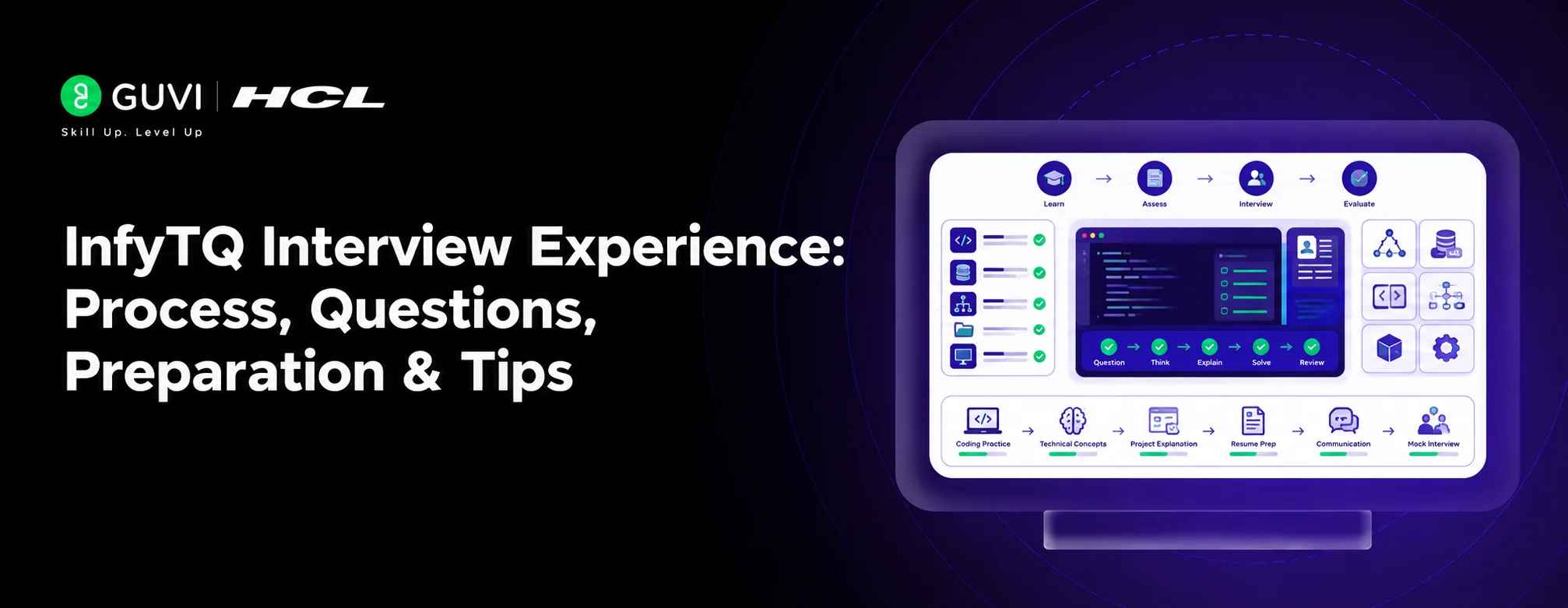
InfyTQ Interview Experience 2026: Process, Questions, Preparation & Tips
Sep 29, 2026 6 Min Read 122 Views
(Last Updated)
Getting shortlisted through InfyTQ is exciting, but the real pressure begins when you start thinking about the interview. You may know Python or Java, but can you explain your logic clearly? You may have solved SQL queries, but can you write one under interview pressure?
That is where this InfyTQ Interview Experience Guide helps. It explains the InfyTQ interview process, commonly asked InfyTQ interview questions, technical topics, preparation steps, and mistakes you should avoid before your Infosys InfyTQ interview.
The demand for strong freshers is still real, but companies are becoming more skill-focused. Infosys reported that in fiscal 2026, it received 5,884,480 employment applications, interviewed 450,901 applicants, and extended 87,286 employment offers. That means preparation quality matters more than ever.
Table of contents
- TL;DR Summary
- What is the InfyTQ Interview All About?
- Why does InfyTQ matter for freshers?
- What do interviewers usually evaluate?
- InfyTQ Interview Process 2026
- Certification Round structure
- Advantage Round structure
- Final interview structure
- InfyTQ Interview Questions Asked in 2026
- Common InfyTQ technical interview questions
- Sample answer approach for coding questions
- Sample SQL questions for Infosys InfyTQ interview
- InfyTQ Interview Preparation Roadmap
- 7-day preparation plan before the interview
- How to prepare your project explanation
- Certification Round vs Advantage Round
- Career Benefits and Salary Insights
- Why this interview can improve your placement confidence
- Salary and role expectations
- Common Mistakes to Avoid in Infosys InfyTQ Interview
- Memorizing code without understanding logic
- Ignoring SQL and DBMS basics
- Giving vague project answers
- Not practising communication aloud
- Build Your Foundation Before the Test
- Wrapping Up
- FAQs
- What is the InfyTQ Interview Experience like?
- What are the most common InfyTQ Interview Questions?
- Is the Infosys InfyTQ interview difficult?
- What should I prepare for the InfyTQ technical interview?
- What is the InfyTQ interview process in 2026?
- How do I start InfyTQ interview preparation?
- Can I use Python in InfyTQ?
- Does InfyTQ include negative marking?
TL;DR Summary
- InfyTQ tests fundamentals: coding, SQL, DBMS, projects, and communication.
- The process varies by score: Certification Round, Advantage Round, and techno-behavioral interview.
- Questions are practical: expect Java/Python, SQL, OOP, DBMS, and project discussions.
- Depth beats breadth: master one programming language well.
- Preparation needs consistency: practise coding, SQL, mock interviews, and project explanation.
- Interview answers need structure: explain logic, handle edge cases, code cleanly, and dry-run.
What is the InfyTQ Interview All About?
Before you prepare random questions, understand what the interview is actually testing. The interview is not designed to scare you; it is designed to check whether your exam score reflects real understanding.
Why does InfyTQ matter for freshers?
InfyTQ is important because it gives students a structured way to demonstrate programming and problem-solving skills before entering Infosys’ recruitment pipeline. The official certification structure includes hands-on coding, programming MCQs, and DBMS, making it more skill-based than a purely aptitude-driven test.
For freshers, this matters because interviewers often look for proof of fundamentals. Your degree tells them what you studied. Your InfyTQ performance tells them how well you can apply it.
What do interviewers usually evaluate?
In an Infosys InfyTQ Interview, interviewers usually evaluate five areas:
- Programming clarity: Can you write and explain logic in Java or Python?
- SQL confidence: Can you retrieve, filter, join, and group data correctly?
- OOP understanding: Can you explain concepts with examples?
- Project explanation: Can you describe what you built and why?
- Communication: Can you stay calm and explain your thought process?
In coding interviews, saying “I don’t know, but here is how I would approach it” is often better than guessing confidently. Interviewers usually value structured thinking over memorized answers.
InfyTQ Interview Process 2026
The InfyTQ interview process depends on your performance in the earlier rounds. Infosys’ certification guideline states that candidates scoring 65% or above in the Certification Round, after required checks, may either appear for the Advantage Round or a techno-behavioral interview for the Systems Engineer role.
Certification Round structure
The Certification Round is a three-hour test. It includes:
- 2 Java/Python hands-on questions
- 10 Java/Python multiple-choice questions
- 10 DBMS questions
There is no negative marking in the Certification Round, according to Infosys’ official examination guidelines.
This round checks whether you can solve problems, understand code behavior, and apply database fundamentals.
Advantage Round structure
The Advantage Round is more advanced. Infosys’ official guideline says it includes three programming-based questions of varying difficulty levels, to be answered within three hours.
Candidates who clear the Advantage Round may get a pre-placement interview opportunity for Specialist Programmer or Digital Specialist Engineer roles, based on performance.
Final interview structure
The final interview is usually techno-behavioral. That means you can expect both technical and HR-style questions.
The InfyTQ technical interview may include coding logic, SQL, DBMS, OOP, project discussion, and scenario-based problem solving. The behavioral part may test your teamwork, learning attitude, communication, and interest in Infosys.
InfyTQ Interview Questions Asked in 2026
This section gives you practical question patterns instead of random lists. Use these as preparation checkpoints.
Common InfyTQ technical interview questions
Here are commonly expected InfyTQ Interview Questions:
| Area | Sample Questions | What the interviewer checks |
| Python/Java | Write a program to reverse a string without using built-in reverse functions. | Checks logic, syntax, loops, and edge-case thinking. |
| Arrays/Lists | Find the second largest element in an array. | Tests iteration, comparison, and handling duplicate values. |
| SQL | Write a query to find the second highest salary from an employee table. | Checks subqueries, ordering, limits, and database thinking. |
| OOP | Explain inheritance with a real-world example. | Tests conceptual clarity and example-based explanation. |
| DBMS | What is normalization and why is it used? | Checks whether you understand database design beyond queries. |
| Project | What problem did your project solve? | Tests ownership, clarity, and practical exposure. |
Sample answer approach for coding questions
Do not jump directly into code. A good answer follows this flow:
- Restate the problem: Briefly repeat the question in your own words to show you understood it clearly.
- Explain the logic: Share the approach you will use before coding so the interviewer can follow your thinking.
- Mention edge cases: Point out special inputs like empty values, duplicates, or very small lists that may affect the output.
- Write clean code: Code in a readable way with clear variable names and simple logic.
- Dry-run with one example: Walk through a sample input step by step to prove your solution works.
- Discuss time complexity: Explain how efficient your solution is, especially in terms of execution time and memory usage.
For example, if asked to find the second largest number, say: “I will maintain two variables, largest and second_largest, and update them while traversing the array once. This avoids sorting and gives better efficiency.”
Sample SQL questions for Infosys InfyTQ interview
You should practise SQL daily because DBMS is part of the official Certification Round structure.
Expected SQL questions include:
- Find employees earning more than the department average.
- Retrieve duplicate records from a table.
- Explain primary key vs foreign key.
- Difference between DELETE, TRUNCATE, and DROP.
- Use GROUP BY and HAVING in one query.
- Explain joins with examples.
InfyTQ Interview Preparation Roadmap
A good InfyTQ interview preparation is not about studying everything. It is about building confidence in the areas that repeatedly appear in assessments and interviews.
7-day preparation plan before the interview
| Day | Focus Area | What to Practise |
| Day 1 | Programming basics | Loops, functions, strings, arrays/lists. |
| Day 2 | Coding problems | Pattern questions, number problems, sorting logic. |
| Day 3 | SQL | SELECT, JOIN, GROUP BY, HAVING, subqueries. |
| Day 4 | OOP + DBMS | Classes, inheritance, normalization, keys, indexing. |
| Day 5 | Project revision | Architecture, modules, challenges, your contribution. |
| Day 6 | Mock interview | Explain code aloud and practise HR questions. |
| Day 7 | Revision | Review mistakes, prepare short self-introduction. |
How to prepare your project explanation
Your project answer should be simple and structured. Use this format:
- Problem: What issue did the project solve?
- Tech stack: Which tools, language, database, or framework did you use?
- Your role: What did you personally build or debug?
- Challenge: What problem did you face?
- Learning: What did you improve after completing it?
This makes your answer sound practical, not memorized.
Certification Round vs Advantage Round
The Certification Round and Advantage Round serve different purposes. One checks core readiness; the other identifies stronger programming ability for specialized roles.
| Parameter | Certification Round | Advantage Round |
| Difficulty | Moderate; focuses on fundamentals. | Higher; focuses on advanced programming. |
| Duration | 3 hours. | 3 hours. |
| Question Type | Hands-on coding, MCQs, DBMS. | Three programming-based questions. |
| Language | Java/Python selected during slot booking. | Java/Python plus options for other languages. |
| Outcome | Certification and possible Systems Engineer interview path. | Possible SP or DSE interview opportunity. |

Career Benefits and Salary Insights
Going through an InfyTQ interview experience can benefit you even beyond one interview because it forces you to prepare the same fundamentals used in most fresher hiring rounds.
Why this interview can improve your placement confidence
Infosys’ Foundation Program for entry-level engineering and science graduates includes 19–23 weeks of in-house training at Mysore and covers more than 45 technology streams, including newer additions such as generative AI and prompt engineering. This shows why Infosys looks for learners who can absorb new technologies quickly.
India Skills Report 2026 also notes that Computer Science and IT engineers remain highly employable, with CS at 80% employability and IT at 78%. For students, this means fundamentals plus interview readiness can create a real advantage.
Salary and role expectations
Infosys’ official InfyTQ guideline connects performance paths to roles such as Systems Engineer, Digital Specialist Engineer, and Specialist Programmer, but salary can vary by hiring cycle, role, campus/off-campus route, and official offer terms.
For 2026 specialized fresher hiring, multiple public hiring notices and media reports have referenced Digital Specialist Engineer packages around ₹6.25 LPA plus joining bonus, while Specialist Programmer levels may go higher depending on level and performance. Treat these as indicative figures and always verify the latest Infosys offer communication before making decisions.
Common Mistakes to Avoid in Infosys InfyTQ Interview
Mistakes in the Infosys InfyTQ interview are often not about lack of intelligence. They usually happen because candidates prepare passively, memorize answers, or fail to communicate their logic.
Memorizing code without understanding logic
Many candidates practise 100 coding problems but cannot explain one properly. This becomes risky when the interviewer changes one condition in the problem.
Instead of memorizing solutions, understand the pattern behind them. Learn why a loop starts from a certain index, why a condition is used, and how edge cases are handled.
When you explain your approach clearly, even a partially correct solution can create a better impression than silent coding.
Ignoring SQL and DBMS basics
Some students focus only on Python or Java and treat DBMS as secondary. That is a bad strategy because DBMS is part of the official Certification Round pattern.
You should know joins, keys, normalization, constraints, indexes, and basic query writing. Interviewers may ask simple SQL questions, but they expect clear answers.
Practise writing queries by hand, not just reading them. Writing helps you remember syntax under pressure.
Giving vague project answers
Saying “we built a web app” is not enough. Interviewers want to know your actual contribution.
Prepare your project in terms of modules, database design, features, bugs solved, and improvements. Be honest about what you did and what your teammates handled.
A clear project explanation can make even a simple academic project sound strong.
Not practising communication aloud
You may know the answer in your head, but interviews require spoken clarity. Many freshers lose confidence because they are explaining technical concepts aloud for the first time.
Practise explaining code to a friend, mentor, or even to yourself. Record your answer once and check whether it sounds structured.
Good communication does not mean fancy English. It means clear, calm, and logical explanation.
Build Your Foundation Before the Test
A strong InfyTQ score comes from consistent fundamentals: one programming language, SQL confidence, and daily problem-solving. To practise coding regularly, use HCL GUVI’s CodeKata to solve problems and sharpen your logic before the exam.
For more structured guidance across coding, data, and career-focused tech skills, explore HCL GUVI’s premium tech courses and build practical confidence before placement season. HCL GUVI’s learning ecosystem focuses on practical digital upskilling and workforce readiness across academia and industry.
Wrapping Up
In the end, your InfyTQ Interview Experience depends on how clearly you understand and explain your fundamentals. Focus on programming, SQL, DBMS, OOP, project explanation, and calm communication. The interview process rewards candidates who can walk interviewers through their thinking, not just repeat memorized answers. Before the interview, revise one language deeply, practise common questions, and explain every solution aloud. Solve daily, revise smartly, and step in ready to think like a developer.
FAQs
1. What is the InfyTQ Interview Experience like?
The InfyTQ interview experience is usually a techno-behavioral discussion where interviewers check programming, SQL, DBMS, project knowledge, and communication skills. The difficulty depends on your performance path and the role being considered.
2. What are the most common InfyTQ Interview Questions?
Common InfyTQ Interview Questions include coding problems on strings, arrays, loops, SQL queries, OOP concepts, DBMS basics, and project-related questions. You may also be asked HR questions about teamwork and learning attitude.
3. Is the Infosys InfyTQ interview difficult?
The Infosys InfyTQ interview is manageable if your fundamentals are clear. It becomes difficult only when candidates memorize code without understanding logic or ignore SQL and DBMS.
4. What should I prepare for the InfyTQ technical interview?
For the InfyTQ technical interview, prepare one programming language, OOP, DBMS, SQL, basic data structures, coding dry runs, and project explanation. Also practise explaining your logic step by step.
5. What is the InfyTQ interview process in 2026?
The InfyTQ interview process generally follows the Certification Round, possible Advantage Round, and a techno-behavioral interview depending on performance. Infosys’ official guideline states that eligible candidates may move toward Systems Engineer, DSE, or Specialist Programmer interview paths.
6. How do I start InfyTQ interview preparation?
Start your InfyTQ interview preparation with one language, SQL, DBMS, and 2–3 coding problems daily. Then revise your project and practise mock interviews aloud.
7. Can I use Python in InfyTQ?
Yes. Infosys’ Certification Round includes Java/Python hands-on and MCQ sections, based on the language selected during test-slot booking.
8. Does InfyTQ include negative marking?
Infosys’ official examination guideline states that there is no negative marking in the Certification Round.
Success Stories











Did you enjoy this article?