


Career Articles
Is the HCL GUVI AI/ML Program Right for You? A Quick Self-Assessment
Inside the HCL GUVI AI/ML Curriculum: What You’ll Actually Build
Cognizant GenC Hiring Process 2026: Eligibility, Registration Link, Prep & More - Best Guide
Cognizant GenC Next Recruitment Process 2026: Eligibility, Rounds & Preparation - Best Guide


Get In Touch For Details! Request More Information
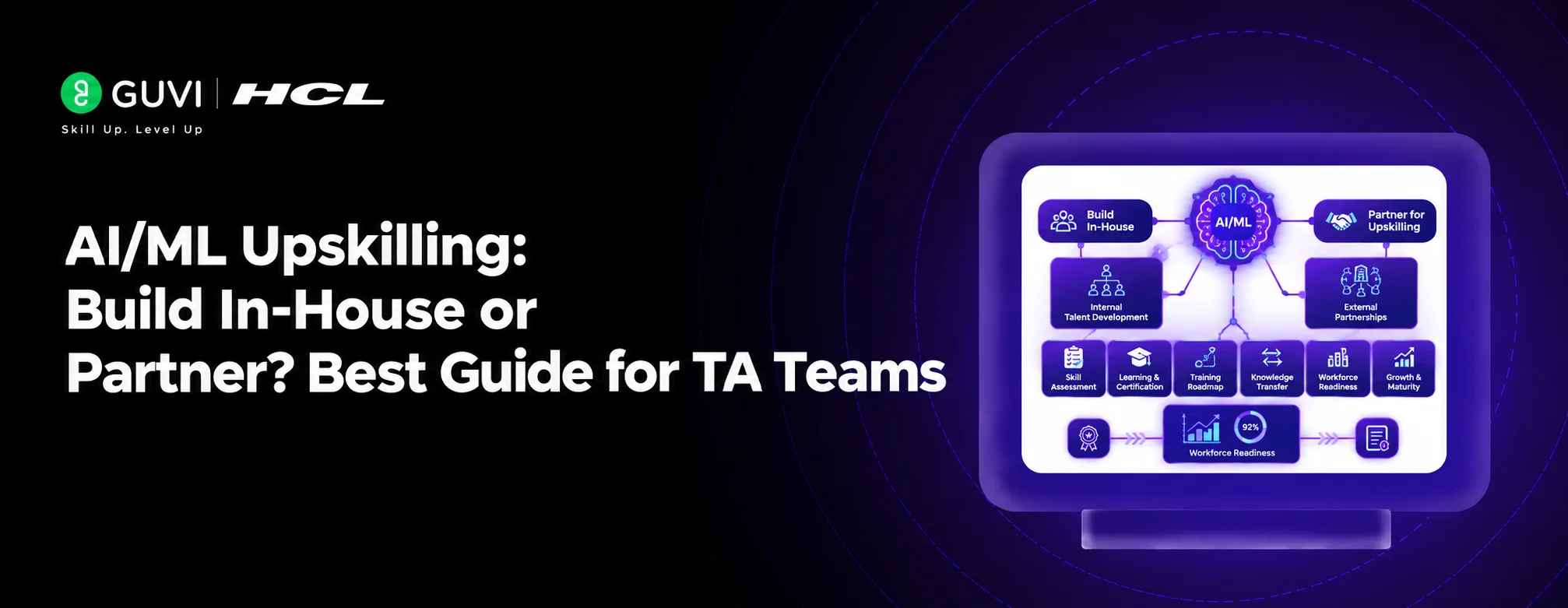
AI/ML Upskilling: Build In-House or Partner? Best Guide for TA Teams 2026
Sep 10, 2026 8 Min Read 14 Views
(Last Updated)
Table of contents
- TL;DR
- What Does AI/ML Upskilling Mean for a TA Team?
- What AI Skills Should You Build Across the Workforce?
- AI Fluency
- AI Practitioner Skills
- AI Engineering Skills
- Why Does the Training Model Matter in 2026?
- What Should Always Stay In-House?
- When Should You Build AI/ML Upskilling In-House?
- Your Skills Are Highly Company-Specific
- You Have Credible Internal SMEs
- Your Cohort Is Manageable
- You Can Keep the Content Current
- Internal Application Matters More Than External Credentials
- When Should You Partner With an AI/ML Certification Provider?
- In-House vs Certification Partner vs Hybrid: Quick Comparison
- What Is the Real Cost of Building Training In-House?
- When Is a Hybrid Model Better?
- How Should TA Teams Decide Between In-House and Partner-Led Training?
- Which Roles Are You Building For?
- What Skills Are Missing Today?
- How Quickly Is the Capability Needed?
- How Many Employees Need Training?
- Do Employees Need an External Credential?
- How Much Proprietary Context Is Required?
- How Will You Measure Success?
- How Do You Evaluate an AI/ML Certification Provider?
- Curriculum
- Trainers and Mentors
- Practical Learning
- Assessment
- Certification
- Enterprise Readiness
- How Do You Design AI/ML Workforce Training That Transfers to Work?
- Stage 1: Diagnose
- Stage 2: Learn
- Stage 3: Apply
- Stage 4: Validate
- Real-World Example: A BFSI GCC Building an Internal AI Talent Pipeline
- How Should You Measure AI Training Outcomes?
- Learning Outcomes
- Application Outcomes
- Talent Outcomes
- Business Outcomes
- Common Mistakes TA Teams Should Avoid
- Starting With a Course Catalogue
- Treating Certification as Job Readiness
- Asking Internal SMEs to Do Everything
- Outsourcing the Learning Strategy
- Measuring Only Completion
- Build a Practical AI/ML Learning Path with HCL GUVI
- Conclusion
- FAQs
- Should a company build AI training in-house or use an external provider?
- What should TA teams look for in an AI certification partner?
- What should AI/ML workforce training include?
- Is an AI certification enough to prove job readiness?
- When should a company choose a hybrid AI training model?
- How should TA measure the ROI of employee AI training?
- How often should corporate AI training content be updated?
- What is TA's role in AI workforce development?
TL;DR
For TA and L&D teams, AI/ML upskilling is not simply a build-or-buy decision. Build internally when you have capable AI SMEs, proprietary workflows, a manageable learner cohort, and the bandwidth to update content continuously. Choose an AI/ML certification provider when speed, specialist trainers, structured assessments, scalable delivery, and external credentials matter more.
For many organizations, a hybrid model works best. Let an external partner teach common AI foundations while internal experts teach company systems, data, governance, and real business use cases.
AI/ML upskilling has become a workforce planning problem, not only a learning problem. TA teams now have to decide which AI capabilities to hire externally, which adjacent employees can learn, and which roles can be filled through internal movement.
That makes AI/ML talent development a shared responsibility across TA, L&D, engineering leaders, managers, and employees.
LinkedIn expects 70% of the skills used in most jobs to change by 2030, with AI acting as a major catalyst. This makes the design of your AI learning model increasingly important.
The real question is not, “Which AI course should we buy?” It is, “Which capabilities should we own internally, and which learning components are better delivered by specialists?”
What Does AI/ML Upskilling Mean for a TA Team?
AI/ML upskilling is the structured process of helping existing employees build the artificial intelligence and machine learning capabilities required for current or future roles.
For TA, the objective should extend beyond course completion.
A strong program can help you:
- Close role-specific skill gaps
- Build internal AI talent pipelines
- Identify employees with adjacent skills
- Support internal mobility
- Redeploy employees into emerging roles
- Reduce dependence on repeated external hiring
- Improve readiness for AI-enabled work
Before choosing a course or provider, define the level of AI capability each employee group actually needs.
What AI Skills Should You Build Across the Workforce?
Not everyone needs the same technical depth.
A practical workforce plan can divide AI capability into three levels.
1. AI Fluency
This level is for employees who will use AI but are not expected to build AI systems.
Topics can include:
- AI fundamentals
- Generative AI basics
- Prompting
- Output evaluation
- Data privacy
- Responsible AI
- Workflow automation
- Human oversight
2. AI Practitioner Skills
This level suits analysts, developers, product teams, and domain professionals applying AI to business problems.
Skills can include:
- Python
- SQL
- Data preparation
- Machine learning fundamentals
- LLM APIs
- RAG fundamentals
- Experimentation
- Model evaluation
When defining technical role requirements, HCL GUVI’s AI Engineer Skills Roadmap can help TA teams translate a broad request for “AI skills” into specific capability areas.
3. AI Engineering Skills
These are required when employees will build, deploy, or maintain AI systems.
Skills may include:
- Machine learning
- Deep learning
- LLM application development
- RAG pipelines
- Vector databases
- AI agents
- APIs
- Cloud deployment
- Model evaluation
- MLOps
- AI system design
- Responsible AI
This role-based approach prevents a common mistake in corporate AI training: putting every employee through the same technical curriculum.
Why Does the Training Model Matter in 2026?
AI and machine learning skills are changing quickly, and companies need a training model that can keep pace with new tools, workflows, and role requirements.
For TA and L&D teams, the choice of training model affects more than learning delivery. It can influence how quickly employees build new skills, how easily training can scale across teams, how much internal expertise is required, and how well learning connects with actual business needs.
An in-house model offers more control and company-specific relevance, while an external partner can provide specialist trainers, structured learning, assessments, and faster deployment. A hybrid model can combine both by using external expertise for technical foundations and internal teams for proprietary tools, workflows, governance, and business context.
This makes the training model an important part of workforce planning, especially when organizations want to build internal AI capability instead of relying only on external hiring.
This makes AI/ML workforce training part of your talent supply strategy.
If every new AI requirement is treated as an external hiring requirement, TA can miss employees who already have domain knowledge, coding experience, analytics skills, or related technical capabilities.
According to the World Economic Forum’s Future of Jobs Report 2025, 77% of surveyed employers plan to reskill and upskill their existing workforce to work more effectively alongside AI by 2030.
What Should Always Stay In-House?
Even when you work with an AI/ML certification provider, several responsibilities should remain inside your organization.
Keep internal ownership of:
- Workforce planning
- Role architecture
- Skill-gap definitions
- Proprietary workflows
- Company data access
- Security requirements
- AI governance
- Internal tools
- Business use cases
- Internal mobility decisions
- Performance expectations
- Final business outcome measurement
The partner may support teaching, labs, projects, assessments, learner support, and certification.
It should not decide what your future workforce should look like.
That distinction is central to sustainable AI/ML talent development. Learning delivery can be external. Workforce strategy cannot.
When Should You Build AI/ML Upskilling In-House?
Build internal training when you already have the expertise, capacity, and business reason to own the learning system yourself.
1. Your Skills Are Highly Company-Specific
Internal learning works well when employees need knowledge of proprietary data pipelines, internal AI platforms, model standards, company tools, or specialized domain processes.
2. You Have Credible Internal SMEs
A senior AI engineer is not automatically an effective trainer.
Your SMEs must have enough time to:
- Structure concepts
- Create exercises
- Teach learners
- Review projects
- Answer questions
- Maintain materials
3. Your Cohort Is Manageable
A focused advanced cohort may be easier to train internally than hundreds of employees across different locations, roles, and experience levels.
4. You Can Keep the Content Current
AI training needs regular review.
Someone must own updates to:
- Models and APIs
- Frameworks
- GenAI workflows
- Agentic AI concepts
- Labs
- Assessments
- Internal governance requirements
5. Internal Application Matters More Than External Credentials
An external certificate is not essential for every role.
For highly specialized internal work, demonstrated ability to solve an actual company problem may be a stronger outcome.
The main advantage of internal training is control. The main risk is the operational effort hidden behind that control.
When Should You Partner With an AI/ML Certification Provider?
An AI/ML certification provider becomes useful when the organization needs learning capability faster than it can build that capability internally.
A partner-led model is particularly useful when:
- The program needs to launch quickly
- Learners are spread across teams or locations
- Internal SMEs have limited teaching bandwidth
- The curriculum spans several AI areas
- Standard assessments are required
- Learners need mentor support
- External certification has value
- Management needs progress reporting
- Content needs regular updates
A strong provider should offer more than recorded videos and a certificate.
TA should be able to understand:
- What employees will learn
- Who teaches them
- What they will build
- How they are assessed
- How much mentor support exists
- What completion actually proves
HCL GUVI’s Best AI and ML Certifications guide is useful when comparing the difference between a credential, structured technical learning, and practical project experience.
In-House vs Certification Partner vs Hybrid: Quick Comparison
| Decision Factor | Build In-House | External Partner | Hybrid |
| Speed to launch | Slower if content starts from zero | Usually faster | Fast foundation plus internal customization |
| Company relevance | Very high | Depends on customization | Very high |
| Specialist depth | Depends on available SMEs | Wider trainer access | Shared |
| Scalability | Can strain internal trainers | Better for larger cohorts | Strong |
| Assessments | Must be designed internally | Standardized assessment possible | External plus internal |
| Certification | Internal recognition | External credential possible | Both |
| Content updates | Employer manages them | Usually partner managed | Shared |
| Proprietary knowledge | Strong | Limited unless customized | Strong |
| Learner support | Depends on team capacity | Mentors/support may be available | Shared |
| Best fit | Niche internal capability | Common technical skills at scale | Enterprise capability building |
AI/ML workforce training should not be selected purely on course price.
Compare total effort, launch speed, technical depth, learner support, assessment quality, customization, and the cost of keeping training current.
What Is the Real Cost of Building Training In-House?
A direct course-fee comparison can make internal learning look cheaper than it really is.
Internal programs may require:
- SME design time
- Instructional design
- Content production
- Lab environments
- Cloud resources
- Technical assessments
- Trainer preparation
- Live delivery
- Doubt support
- Program administration
- Reporting
- Curriculum maintenance
There is also opportunity cost.
Every hour an experienced ML engineer spends building training materials is an hour that person is not spending on engineering or delivery work.
For an external training model, calculate:
- Program fee
- Customization
- Platform integration
- Internal coordination
- Learner time
- Cloud or lab costs not included
- Governance reviews
- Procurement overhead
The better question is not “Which model is cheapest?”
Ask:
Which model can create the required capability at acceptable cost, speed, quality, and risk?
When Is a Hybrid Model Better?
For many organizations, hybrid AI/ML upskilling provides the most practical balance.
Use a partner for:
- AI foundations
- Structured technical modules
- Hands-on labs
- Mentoring
- Assessments
- Certification
Keep your internal teams responsible for:
- Business use cases
- Proprietary datasets
- Architecture standards
- Company tools
- Responsible AI policies
- Security
- Domain knowledge
- Final project validation
This approach strengthens AI/ML talent development without asking internal experts to create a complete learning product from the beginning.
It also solves a major limitation of generic training: employees may understand AI concepts but still not know how to apply them inside your environment.
How Should TA Teams Decide Between In-House and Partner-Led Training?
Use these seven questions before approving AI/ML upskilling.
1. Which Roles Are You Building For?
Start with roles, not course titles.
Examples include:
- AI-enabled recruiter
- Data Analyst
- Machine Learning Engineer
- AI Engineer
- Software Engineer using GenAI
- MLOps Engineer
- AI Product Manager
2. What Skills Are Missing Today?
Compare target roles with current employee capability.
Use:
- Technical assessments
- Current projects
- Manager reviews
- Role expectations
- Internal mobility data
- Job descriptions
Avoid relying only on employee self-ratings.
3. How Quickly Is the Capability Needed?
An internal academy that takes several months to design can make sense for a long-term skill strategy.
It is less useful when a business unit needs capable employees for a project in the next quarter.

4. How Many Employees Need Training?
Cohort size changes the decision.
A small specialist group can often work closely with internal SMEs.
A large multi-location cohort may require stronger delivery, scheduling, reporting, and mentor infrastructure.
5. Do Employees Need an External Credential?
Certification can provide a common learning benchmark.
However, TA should not use a certificate alone as evidence of job readiness.
6. How Much Proprietary Context Is Required?
The more a role depends on company data, regulated workflows, internal platforms, or specialist domain knowledge, the more learning should remain internal.
7. How Will You Measure Success?
Define the measures before the program begins.
Otherwise, completion percentage becomes the default metric even when it tells you little about workforce capability.
How Do You Evaluate an AI/ML Certification Provider?
Treat an AI/ML certification provider as a capability partner, not simply a content vendor.
Curriculum
Ask:
- Is the curriculum mapped to target roles?
- Does it cover the depth those roles actually need?
- Does it include current ML and GenAI workflows?
- Are RAG, agents, deployment, MLOps, and responsible AI covered where relevant?
- How often is content reviewed?
Trainers and Mentors
Check:
- Trainer profiles
- Current industry experience
- Teaching experience
- Mentor availability
- Doubt resolution model
- Learner-to-mentor support structure
Practical Learning
Ask whether learners:
- Work with real or realistic datasets
- Write code
- Build complete projects
- Debug failures
- Deploy models
- Evaluate AI outputs
Guided demos should not be the only practical component.
Assessment
Look for:
- Pre-assessment
- Module checks
- Coding or technical assessments
- Project evaluation
- Final assessment
- Clear pass criteria
Certification
Ask what the credential actually validates.
Is it based on:
- Attendance?
- Course completion?
- Technical assessment?
- Capstone performance?
- A combination?
The best AI certification providers should be transparent about the evidence behind the certificate.
Enterprise Readiness
Check whether the partner can support:
- Custom learning paths
- Internal use cases
- Cohort reporting
- LMS integration
- Data privacy requirements
- Role-based analytics
- Manager dashboards
- Accessibility requirements
- Different experience levels
How Do You Design AI/ML Workforce Training That Transfers to Work?
AI/ML workforce training should move through four clear stages.
Stage 1: Diagnose
Start with the workforce requirement.
Use:
- Job architecture
- Future role demand
- Skill assessments
- Manager input
- Existing project evidence
Do not start by assigning courses.
Stage 2: Learn
Match training depth with role requirements.
Not every employee needs deep learning or MLOps.
An HR professional may need AI fluency and responsible usage.
A software engineer may need APIs, LLM application development, RAG, evaluation, and deployment.
An ML engineer may need deeper model development and production ML.
Stage 3: Apply
Require practical application.
Examples include:
- Building a classification model
- Developing a RAG assistant
- Evaluating an LLM workflow
- Deploying a model API
- Creating an AI agent with human review
- Building an ML pipeline
For production-oriented employees, HCL GUVI’s MLOps Roadmap can help map the skills required from experimentation through deployment and monitoring.
Stage 4: Validate
Use multiple forms of evidence:
- Assessments
- Labs
- Technical projects
- Internal demos
- Manager evaluation
- Capstone review
- Certification
A completion certificate without application evidence is a weak internal mobility signal.
Real-World Example: A BFSI GCC Building an Internal AI Talent Pipeline
Consider an illustrative BFSI Global Capability Centre in India with 1,200 employees.
TA forecasts increasing demand for GenAI-enabled software development, analytics, and risk automation skills.
Instead of filling every requirement through external recruitment, the company identifies 80 employees from software, data, and analytics functions who already have adjacent skills.
An external training partner teaches:
- Python refreshers
- Machine learning
- LLM development
- RAG
- Model evaluation
- MLOps
Internal security and risk leaders teach:
- Data handling requirements
- Company architecture
- Model approval
- Internal AI governance
- Regulatory context
Learners complete a capstone using sanitized or synthetic business data. External mentors assess technical execution, while internal SMEs evaluate whether the approach fits company requirements.
This hybrid AI/ML talent development model gives TA a stronger internal talent pool without transferring regulated business knowledge outside the organization.
How Should You Measure AI Training Outcomes?
Do not measure AI/ML workforce training only through enrolment and completion.
Use four levels.
1. Learning Outcomes
Measure:
- Pre- and post-assessment improvement
- Lab completion
- Technical assessment results
- Project scores
- Certification results
2. Application Outcomes
Measure:
- Project quality
- Manager validation
- Application of new skills
- Technical independence
- Time required to complete relevant tasks
3. Talent Outcomes
For TA, measure:
- Internal fill rate for AI roles
- Internal mobility
- Redeployment
- External hiring dependence
- Time to productivity after role movement
- Retention in newly skilled roles
4. Business Outcomes
Where possible, connect learning with:
- Faster delivery
- Better model quality
- Reduced manual effort
- Lower rework
- Successful AI use cases
- More pilots reaching production
Common Mistakes TA Teams Should Avoid
1. Starting With a Course Catalogue
Do not choose a program before defining the roles and capability gaps you are trying to address.
2. Treating Certification as Job Readiness
A credential can show that structured learning was completed.
TA should still review technical assessments, projects, internal application, and manager feedback.
3. Asking Internal SMEs to Do Everything
Subject experts already have delivery responsibilities.
A program that depends entirely on their spare time can quickly face scheduling, support, and curriculum maintenance problems.
4. Outsourcing the Learning Strategy
A training partner can deliver curriculum and assessment.
The employer should still own role priorities, internal mobility, governance, and workforce outcomes.
5. Measuring Only Completion
A high completion rate with little workplace application is not a strong result.
Connect AI/ML talent development with skill gain, internal movement, role readiness, and business application.
Build a Practical AI/ML Learning Path with HCL GUVI
If your TA or L&D team is benchmarking technical AI curricula, HCL GUVI’s Artificial Intelligence and Machine Learning Programme provides a useful reference for the capabilities modern AI learners need.
The current curriculum covers machine learning, deep learning, LLMs, RAG systems, AI agents, APIs, AI system design, MLOps, deployment workflows, responsible AI, and practical projects.
For employee-sponsored learning, use an external curriculum alongside your own role architecture, internal use cases, data rules, security expectations, and manager evaluation.
A training partner should strengthen your workforce strategy, not replace it.
Conclusion
AI/ML upskilling works best when TA separates learning delivery from workforce capability ownership. Build internally when knowledge is proprietary, capable SMEs are available, and the cohort is manageable. Partner when you need specialist depth, quicker delivery, structured assessments, learner support, and scale. For many enterprises, a hybrid model gives the strongest balance by combining external technical learning with internal business context and governance. Whatever model you choose, measure practical skill gain, internal mobility, role readiness, and workplace application rather than treating course completion as the final outcome.
FAQs
1. Should a company build AI training in-house or use an external provider?
Build internally when content is highly proprietary and you have capable SMEs with enough time to teach and maintain it. Use an external partner when speed, specialist expertise, scale, structured assessment, or certification matters more.
2. What should TA teams look for in an AI certification partner?
Look for role-aligned curriculum, experienced trainers, practical labs, real projects, meaningful assessments, current content, mentor support, learner analytics, customization options, and clear data privacy rules.
3. What should AI/ML workforce training include?
Training depth should match the target role. AI fluency may cover responsible AI and effective tool use, while technical paths can include Python, ML, deep learning, LLMs, RAG, evaluation, deployment, and MLOps.
4. Is an AI certification enough to prove job readiness?
No. Certification is one signal. Combine it with assessments, practical projects, internal use cases, technical interviews, and manager validation before making internal movement decisions.
5. When should a company choose a hybrid AI training model?
Choose a hybrid model when you need external technical expertise and standardized learning but want proprietary workflows, data, governance, security, and final capability validation to remain internal.
6. How should TA measure the ROI of employee AI training?
Track skill improvement, project quality, internal fill rate, redeployment, time to productivity, manager validation, workplace application, and relevant business outcomes. Completion rate alone is not enough.
7. How often should corporate AI training content be updated?
Review high-change areas such as LLMs, APIs, AI agents, model evaluation, deployment, and MLOps regularly. Update learning whenever target roles, company tools, policies, or major technical practices change.
8. What is TA’s role in AI workforce development?
TA should translate future hiring demand into skill requirements, identify employees with adjacent capabilities, support cohort selection, define internal mobility outcomes, and connect learning results with workforce planning.
Success Stories

About the Author
Reemsha Khan
Always been a storyteller at heart. Now, I turn complex topics into simple, easy-to-understand stories through content. Hope you find it helpful.
View all posts by Reemsha Khan
Connect with me @








Did you enjoy this article?