


Artificial Intelligence and Machine Learning Articles
Finance Manager to Data Analytics: Career Growth, Salary and Seniority
How to Evaluate LLM Outputs in Production Deployments
AI/ML Skills Gap 2026: Why Companies Can't Find Job-Ready Talent
20 AI/ML Interview Questions Recruiters Can Use Without a Tech Background - Best Guide


Get In Touch For Details! Request More Information

How AI Is Built: The Complete Beginner Guide
Jun 05, 2026 6 Min Read 880 Views
(Last Updated)
Nobody programs an AI to recognize a cat.
No engineer writes rules like “four legs, pointy ears, whiskers.” There are too many exceptions. Too many cats that break every rule you write.
Instead, you show the system ten thousand images labeled “cat” and ten thousand labeled “not cat.” You let it find the patterns. You correct it when it is wrong. You repeat until it gets it right on images it has never seen before.
That is how AI is made. Not programmed with rules but trained with examples.
This guide walks through the complete AI development process from raw data to deployed system, covering every stage of the machine learning pipeline, what goes wrong at each step, and what separates AI that works in production from models that only work in notebooks.
Table of contents
- Quick TL;DR Summary
- What Building AI Actually Involves
- Stage 1: Problem Definition and Feasibility
- Stage 2: Data Collection and Management
- Stage 3: Data Preprocessing and Feature Engineering
- Stage 4: Model Selection and Training
- Stage 5: Evaluation and Testing
- Stage 6: Deployment and Production Monitoring
- Final Thoughts
- FAQs
- How long does it take to build an AI system from scratch?
- How much data does training an AI model require?
- What is the difference between machine learning and deep learning?
- Why do AI models fail in production despite strong test performance?
- Can AI be built without massive amounts of data?
Quick TL;DR Summary
- AI is built through a structured lifecycle starting with problem definition, moving through data collection, model training, and evaluation, ending with deployment and production monitoring.
- Training data quality determines the ceiling of model performance more than any other single factor in the entire development process.
- Neural networks train by repeatedly adjusting millions of parameters using loss function feedback until predictions generalize beyond the training set.
- A model performing well in development but poorly in production has a data distribution problem, a deployment problem, or both.
- Building AI well is less about mastering the latest architecture and more about executing the full pipeline without skipping the steps that look optional until they are not.
How AI Is Made?
AI is created through a structured development process that includes collecting and preparing data, designing algorithms, training machine learning models, and continuously evaluating their performance. During training, the model learns patterns from data by adjusting its internal parameters to improve accuracy. Once trained and tested, the AI system is deployed into real-world applications where it can make predictions, automate tasks, or support decision-making.
What Building AI Actually Involves
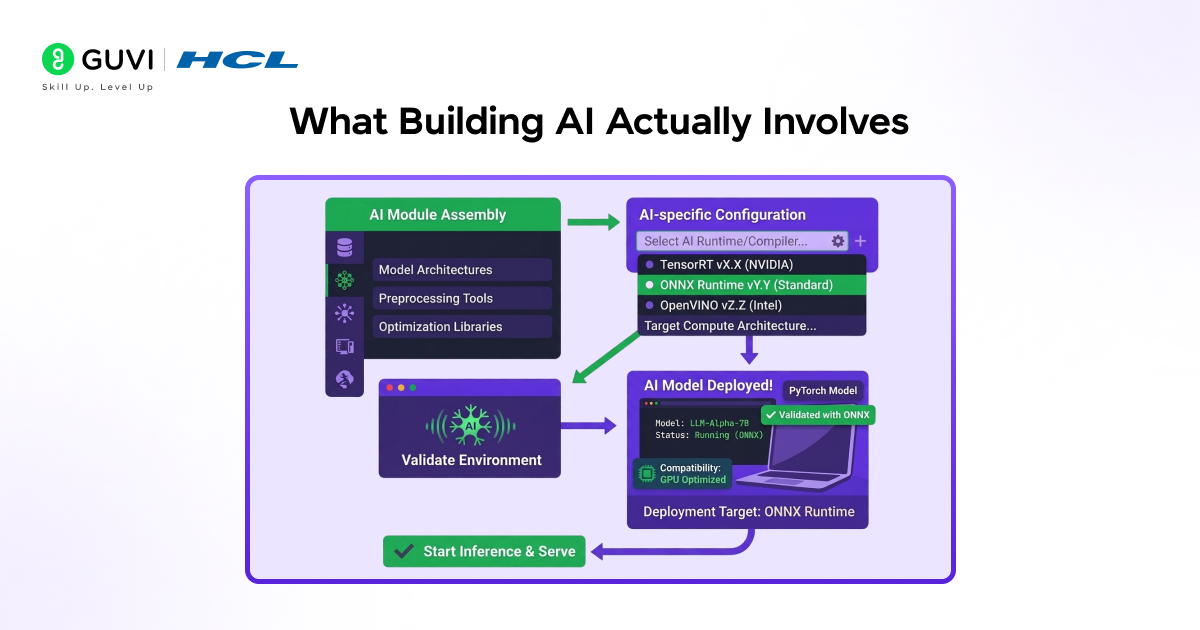
- It Starts With a Problem, Not a Technology
The most common mistake in AI development is starting with the algorithm and working backward to the problem. Teams reach for deep learning because it is powerful, then spend months discovering their problem did not need it.
Every successful AI system begins with a precisely defined problem: what decision needs to be made, what data is available, what a correct answer looks like, and what the cost of being wrong is. These questions determine every subsequent technical choice.
- It Is an Empirical Discipline, Not a Mathematical One
AI development is not derivation from first principles. You cannot reason your way to a model that works. You build, measure, find failure modes, fix them, and build again.
This empirical loop runs at every stage. Data quality is measured and improved. Architectures are compared experimentally. Hyperparameters are tuned by testing. Production behavior feeds back into retraining. The loop never fully stops.
- It Produces Systems That Degrade Without Maintenance
AI models are trained on historical data. The world changes. User behavior shifts. Data distributions drift. A model deployed without monitoring and retraining will quietly become less accurate over time while still producing outputs that look normal.
Read More: The Impact of AI: How Artificial Intelligence Is Changing Everything
Stage 1: Problem Definition and Feasibility

- Framing the Problem Correctly
Before any data is collected, the problem must be framed in terms a machine learning system can address. Classification asks which category an input belongs to. Regression asks for a numerical value. Ranking asks for an ordered list. Generation asks for novel output content.
Getting the framing wrong at this stage creates systems that solve the wrong problem very accurately.
- Defining What Success Looks Like
Success metrics must be defined before training begins. For a medical diagnosis model, success might mean maximizing recall to catch every positive case. For fraud detection, it might mean precision above a threshold at a given recall level.
The business metric and the model metric must be clearly connected. Optimizing a model metric that does not correspond to business value is how AI projects produce technically impressive results that deliver nothing real.
- Assessing Feasibility
Feasibility assessment asks whether sufficient data exists, whether the signal in it is strong enough to learn from, and whether the required performance level is achievable within operational constraints. Skipping this step leads to projects that consume months before discovering a fundamental obstacle that a week of scoping would have caught.
Stage 2: Data Collection and Management

- Why Data Quality Determines the Performance Ceiling
A model trained on poor data learns to replicate errors, biases, and gaps with high confidence. No algorithm extracts signals that do not exist in the training set.
Removing systematic noise, correcting label errors, and improving coverage of underrepresented cases frequently produces larger improvements than switching to a more complex model architecture.
- Sources of Training Data
Organic data comes from existing business operations: transaction logs, user behavior, sensor readings. It reflects real-world conditions but typically requires significant cleaning.
Curated datasets are purpose-built collections like ImageNet and Common Crawl that enabled major advances in vision and language modeling.
Synthetic data is generated programmatically or by generative AI when real data is scarce, expensive, or raises privacy concerns, but requires validation that synthetic distributions match real-world ones.
Human-labeled data involves annotators applying correct labels to raw data. It is expensive and slow but necessary when ground truth cannot be derived automatically.
- Data Labeling and Annotation
Label quality directly determines what the model learns. Annotation guidelines must be precise enough that different annotators label the same example the same way. Inter-annotator agreement is the standard quality measure. Label errors in training data are more damaging than errors in test data because they corrupt what the model internalizes as valid patterns.
Andrew Ng became one of the strongest advocates of data-centric AI after observing that many machine learning teams achieved larger performance gains by improving data quality rather than endlessly experimenting with new model architectures. In many practical AI systems, cleaner labels, better feature consistency, reduced bias, and more representative datasets often improve results more reliably than switching to increasingly complex models. This insight helped shift industry attention toward the importance of data engineering, dataset curation, and systematic error analysis in modern AI development.
Stage 3: Data Preprocessing and Feature Engineering
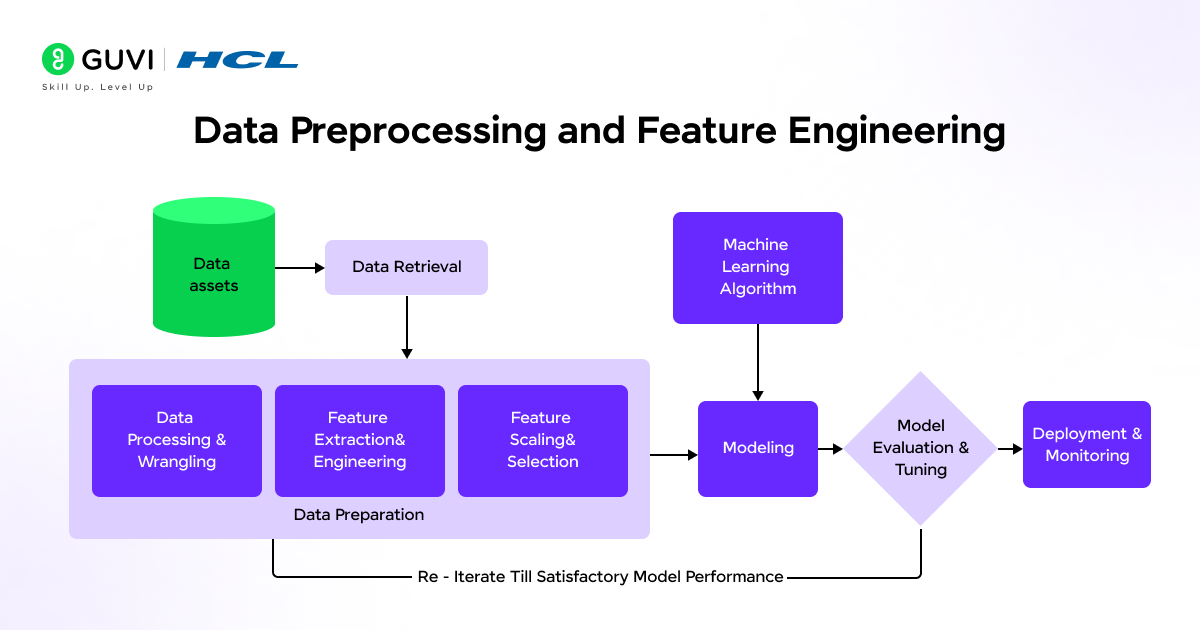
- Why Raw Data Is Never Ready for Training
Real data contains missing values, outliers, inconsistent formatting, duplicate records, and scale mismatches between features. Preprocessing transforms raw data into a form the model can learn from effectively rather than spending capacity on data artifacts.
- Core Preprocessing Operations
Missing value handling uses deletion when data is abundant, mean or median imputation for numerical features, or model-based imputation that predicts missing values from other features.
Normalization and scaling transforms numerical features to comparable ranges so large-valued features do not dominate gradient updates regardless of actual predictive importance.
Encoding categorical variables converts categories into numerical representations through one-hot encoding for nominal categories or ordinal encoding for ordered ones.
Train, validation, and test splitting divides data into three non-overlapping sets. Data leakage between splits, where test information influences training, is one of the most common sources of inflated performance estimates in AI development.
- Feature Engineering
Feature engineering transforms raw variables into representations that make patterns easier for algorithms to learn. For tabular data this means extracting day of week from timestamps or computing ratios between related features. For text it means generating sentence embeddings. Deep learning has reduced but not eliminated the importance of this work, as input representation choices still significantly affect what the model learns.

Stage 4: Model Selection and Training

- Matching Model Complexity to Problem Complexity
Simpler problems with clear feature relationships are best served by logistic regression, linear regression, or decision trees. Complex problems with high-dimensional inputs benefit from neural networks: convolutional networks for spatial data, transformers for sequential data, gradient boosted trees for structured tabular data.
Defaulting to the most complex architecture regardless of problem requirements wastes data, compute, and debugging time.
- How Neural Network Training Works
Training finds parameter values that minimize the loss function, a mathematical measure of prediction error. Gradient descent computes the loss on a batch of examples, calculates how each parameter contributed to that loss through backpropagation, and updates every parameter in the direction that reduces it. This repeats across many batches until loss stops improving.
- Key Hyperparameters
Learning rate controls update step size. Too high causes divergence. Too low causes unnecessarily slow training or stalling.
Batch size determines how many examples compute each gradient update. Larger batches are more accurate but require more memory and can hurt generalization.
Regularization through dropout, weight decay, and early stopping prevents the model from memorizing training examples instead of learning generalizable patterns.
- Recognizing Overfitting and Underfitting
Overfitting shows as high training accuracy and significantly lower validation accuracy, meaning the model memorized noise rather than learning patterns. Underfitting shows poor performance on both sets, meaning the model is too simple for the problem. The goal is strong validation performance on data the model was not trained on.
Stage 5: Evaluation and Testing
- Why Validation Performance Is Not Enough
A model performing well on validation data may still fail in production when real-world distributions differ from training distributions. Comprehensive evaluation tests on data representing actual deployment conditions: different time periods, different user populations, and adversarial inputs designed to find failure modes.
- Evaluation Metrics by Task Type
Classification: Accuracy, precision, recall, F1 score, and AUC-ROC each capture different aspects of performance. Which matters most depends on whether false positives or false negatives carry higher cost in the specific application.
Regression: Mean absolute error and root mean squared error measure prediction accuracy in original units. R-squared measures explained variance.
Generation: Perplexity measures language model prediction quality on held-out text. Human evaluation remains the gold standard for output quality in generation tasks.
- Bias and Fairness Evaluation
A model performing well on average may perform significantly worse for specific demographic groups or edge case populations. Disaggregated evaluation breaks overall metrics down by relevant subgroups to identify where the model underperforms. This is not optional for systems in high-stakes domains including hiring, lending, healthcare, and criminal justice.
A major challenge in machine learning is not training models, but successfully deploying and maintaining them in real-world environments. Many organizations discover that a model performing well in development can fail in production because of issues like data drift, scalability, latency, monitoring, and integration complexity. This is why modern AI success depends not only on model training, but also on strong MLOps, deployment engineering, and continuous monitoring systems that keep models reliable after launch.
Stage 6: Deployment and Production Monitoring
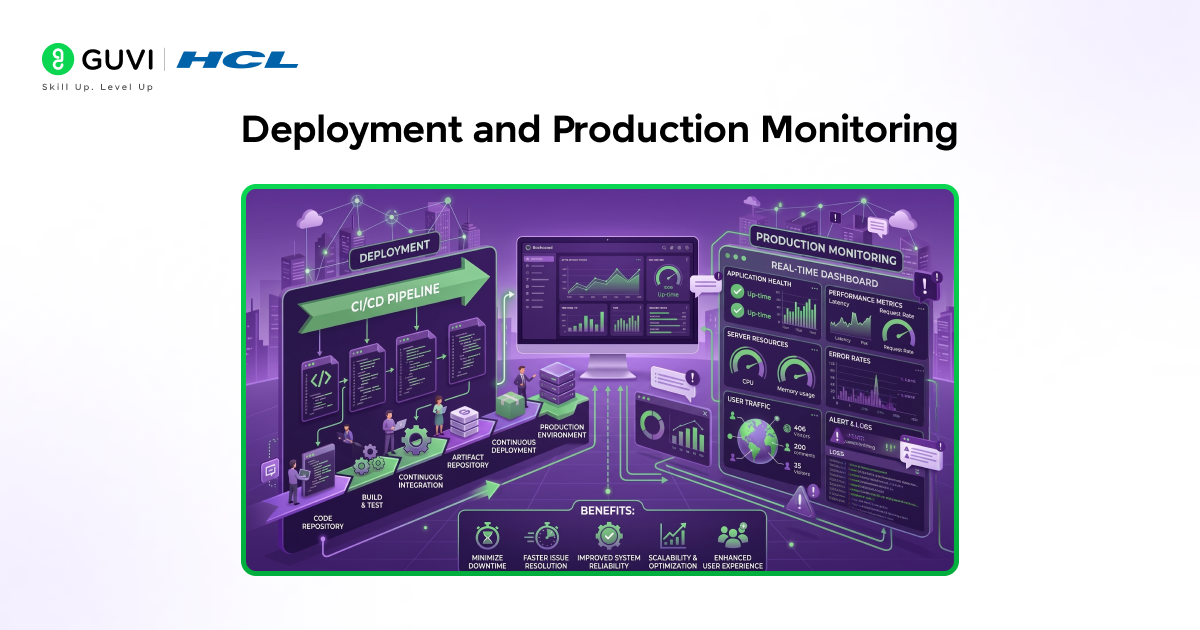
- The Gap Between Development and Production
Development environments have clean data and forgiving failure modes. Production environments have noisy data and failures that affect real people. Bridging this gap requires serving infrastructure, latency management, versioning for rollback, and monitoring that detects degradation before users notice.
- Deployment Strategies That Reduce Risk
Shadow deployment runs the new model in parallel with the existing system, comparing outputs without exposing users to new predictions. This validates real-world behavior before any user impact.
Canary deployment routes a small percentage of traffic to the new model. Problems affect a small fraction of users and can be caught before full rollout.
A/B testing routes different user groups to different model versions and measures impact on business metrics, providing causal evidence that the new model actually improves outcomes.
- Monitoring and the Retraining Loop
Data drift monitoring detects when incoming data distribution changes from what the model trained on, signaling retraining needs.
Performance monitoring tracks accuracy on production data using ground truth labels when they become available through delayed feedback.
System monitoring tracks latency, throughput, and error rates to catch infrastructure problems before they affect users at scale.
To learn more about how AI is built and how intelligent systems are trained, enroll in this AI and Machine Learning course covering AI fundamentals, Python, deep learning, NLP, and computer vision through hands-on projects and expert guidance with certification.
Final Thoughts
AI is not made by writing clever rules or finding the right algorithm in a textbook. It is made through a disciplined engineering process that begins with clear problem definition, runs through careful data work, principled model design and training, rigorous evaluation, and responsible deployment with ongoing monitoring.
The models that work in production are built by teams that invested in data quality, understood their evaluation metrics, planned for distribution shift, and built the infrastructure to detect when things go wrong.
Building AI well is less about mastering the latest architecture and more about executing the full pipeline without cutting the corners that look optional until they are not.
FAQs
1. How long does it take to build an AI system from scratch?
Simple prototypes on clean existing data can be ready in days, but production-grade systems with custom data pipelines and robust deployment infrastructure typically take months, most of which is spent on data work rather than model training.
2. How much data does training an AI model require?
Simple models can work with thousands of examples while deep learning from scratch typically needs hundreds of thousands. Fine-tuning pre-trained models dramatically reduces this requirement by starting from representations already learned on large datasets.
3. What is the difference between machine learning and deep learning?
Machine learning is the broader field of algorithms that learn from data. Deep learning is a subset using multi-layer neural networks that automatically learn feature representations, dominating image, audio, and language tasks while traditional methods remain competitive on structured tabular data.
4. Why do AI models fail in production despite strong test performance?
The most common cause is distribution shift, where production data differs from training data. Other reasons include data pipeline differences between environments and evaluation metrics that did not align with real-world requirements.
5. Can AI be built without massive amounts of data?
Yes, through transfer learning, few-shot learning, synthetic data generation, and data augmentation. These approaches have made AI practical in domains where large labeled datasets are impossible to collect at scale.
Success Stories

About the Author
Vishalini Devarajan
An Aerospace Engineer turned content writer, I focus on making complex concepts easy to understand through well-structured, reader-friendly blogs. Whether it’s a technical topic or a non-technical one, I love creating content that is clear, engaging, and impactful.
View all posts by Vishalini Devarajan
Connect with me @














Did you enjoy this article?